
LIUX Big: This Spanish electric car makes its debut in France with a material never seen before in the automotive industry
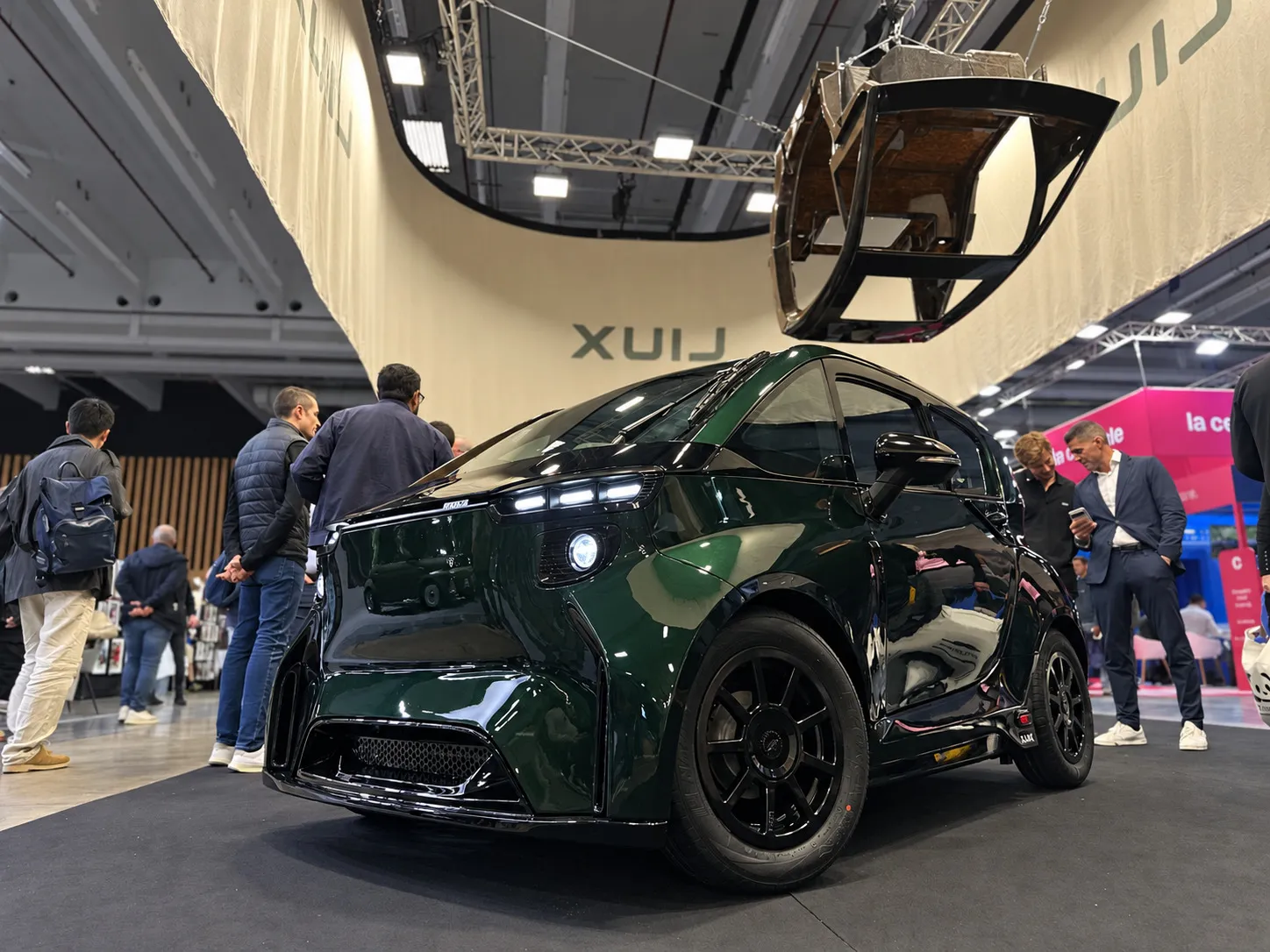

An electric car made from linen? That’s the surprising gamble by LIUX, a young Spanish brand that brought its first model, the BIG, to the Motor Show. Expected in France by 2027, this small two-seater promises a range of up to 270 km. We met its founder to learn more about its ambitions.
For its first participation in an international auto show, the young Spanish brand LIUX traveled with its first commercial model: the LIUX BIG. Displayed at booth A14 in hall 7.1, this small electric vehicle relies on a unique feature: a monocoque made from linen fiber biocomposite.
"We were obsessed with the question: how to create a more sustainable car, not just through electrification, but also through its materials, the way it’s built, recycled, and used," Antonio Espinosa de los Monteros tells us at the small manufacturer’s booth at the auto show. In 2020, he met David Sancho, an engineer who had developed a hypercar shown at Le Mans. "He was the first person to tell me he liked the idea, instead of saying it was crazy," the CEO smiles.
For funding, this young startup relies mainly on private investors, supplemented by European funds. A new round of financing has just been completed, which should cover its needs for the next two years and enable it to achieve profitability.

A linen fiber monocoque
At 2.76 meters long, the LIUX BIG is a two-seater vehicle approved in the L7e category, which applies to heavy quadricycles. Far more luxurious than a Citroën AMI, it can be driven starting at age 16 with a B1 license. According to the manufacturer, its linen fiber monocoque structure could reduce the weight of the frame by 40% compared to an equivalent steel version, and cut its carbon footprint by about 60%. This weight reduction allowed the manufacturer to strengthen the chassis structure while still meeting the category limits, which require a curb weight of 450 kilograms without the battery.

Up to 270 km of range
Two battery options are available: a 15 kWh version offering 215 km of range according to the WMTC cycle, or a 20 kWh version claiming 270 km of range. The claimed fuel consumption is 6.7 kWh per 100 km. Charging can be done via a household outlet at 3.3 kW with the smaller battery and 4.8 kW with the larger one. It takes less than three hours to charge from 20% to 80% with the 15 kWh battery. Questions arise regarding the placement of the charging port. As a Type 2 port, it is located at the rear bumper—not exactly the most ergonomic position...

In terms of performance, the engine delivers 15 kW at nominal power and 35 kW (47 hp) at peak power, achieving 0 to 50 km/h in 4.5 seconds with a top speed limited to 90 km/h. Inside, there is an instrument panel screen behind the steering wheel. However, there is no central display; instead, there is a holder for a smartphone or tablet.
LIUX BIG 15 kWh
LIUX BIG 20 kWh
Catégorie
L7e
L7e
Dimensions (L x l x h)
2.76 x 1.50 x 1.48 m
2.76 x 1.50 x 1.48 m
Poids
648 kg
n.c.
Coffre
240 litres
240 litres
Puissance (nominal / maximale)
15 / 35 kW
15 / 35 kW
Autonomie
215 km (WMTC)
270 km (estimation)
Consommation
6.7 kWh/100 km
n.c.
Recharge (prise domestique)
3.3 kW
4.8 kW
Max speed
90 km/h
90 km/h
Note: The model shown in Paris is a pre-series version. However, it is already almost final — the exterior design will remain identical in the production model. The main focus currently lies on improving the materials used inside the cabin, as some components were created using 3D printing for the exhibition purposes.
Manufactured in Spain… with Chinese electronics
LIUX currently has two facilities in Spain. The first, located in Alicante, produces the composites developed in-house. The second facility, situated in Azuqueca de Henares about 40 minutes from Madrid, handles assembly. The initial phase of the plant will enable production of 5,000 vehicles per year, with plans to expand capacity to 15,000 to 20,000 units at the same site.
The rest of the components come from around the world, especially China for electronics. It’s a forced choice, according to the executive: “There simply is no supply in Europe. No batteries, no electric motors of this size, no controllers, no screens. It’s crazy,” he lamented.
Also read
Electric cars: new purchase subsidy of up to 2,000 € — who will benefit?

L7e: a category still searching for its place
Why wasn’t the BIG approved as a classic car? “It’s a matter of cost,” answers Antonio Espinosa de los Monteros bluntly. Approving a car in category M1 requires a completely different level of investment, whereas the L7e meets most urban and suburban needs according to him. The brand is still considering the possibility of creating an intermediate category, an M0 that would sit between L7e and M1, and is preparing its platform to accommodate it.
The industry leader does not hide his frustration over the lack of support for this sector. He highlights the paradox of the European Commission, which calls for a small, sustainable, and lightweight European car while dismissing quadricycles that already meet these criteria. This exclusion is also reflected in the policies implemented by member states. “In Spain, purchase subsidies amount to 4,000 euros for a conventional electric car, compared to 1,200 euros for an L7e. This destroys our competitiveness, as it brings the price of an M1 down to that of an L7,” explains our interviewee.
France: A Market Yet to Be Developed
Along with Spain and Italy, France will be one of the top three markets where BIG will be launched in Europe. “There is a very mature L6e market in France, but the L7e market still needs to be developed, unlike in Italy,” admits the CEO of LIUX, who believes France has not yet had a good product in this category. The competition remains limited, with models such as the Silence S04 from Spain or the Ligier Myli in L7e version. The microcar segment is also attracting new entrants, like the Chinese company Linktour, which was also present at the Mondial with its Alumi model that we got to test this summer.
But who is this small electric car really aimed at? While the LIUX BIG can be purchased by those 16 and older with a B1 license, the brand does not focus particularly on young drivers. It is primarily targeted at motorists looking for a second car for their daily commutes, both in the city and on the outskirts. According to its CEO, people aged 40–60 are actually the most interested in this model.
Pricing to be determined
The final price is not yet known, but it will be below 18,000 euros, excluding any subsidies. This pricing strategy positions it alongside some Chinese urban electric cars that are highly competitive in the market.
1,000 cars in the first year
For distribution, LIUX relies on a network of dealers. Beyond engaging the general public, its presence at the motor show is also driven by the desire to find new business partners. There is no fixed profile: these can be automobile dealers or specialists in quadricycles or two-wheelers. For Antonio Espinosa de los Monteros, the two decisive criteria are the ability to provide after-sales support and genuine commitment to the brand. “We are not interested in multi-brand distributors without a segmentation strategy,” warns LIUX’s CEO.

In terms of production volume, the brand aims to produce 1,000 cars by 2027, its first year of market launch. This is a drop in the ocean compared to the volumes sold in the automotive industry, but it represents a real challenge for a young brand starting from scratch. For LIUX’s CEO, 2027 should be used to validate sales, after-sales service, and customer relationships, before pursuing more aggressive growth starting in 2028.
To highlight the interest in its compact car, LIUX cites nearly 7,500 people on its waiting list. However, these are merely expressions of interest, far from actual pre-orders or confirmed purchases. Thus, the gamble is far from guaranteed to succeed. Entering the automotive market is a risky endeavor for a young brand, especially in a segment that still struggles to establish itself. Caught between microcars and traditional city cars, the L7e category suffers from a serious lack of recognition, while government support in Brussels and across member states seems geared primarily toward traditional car manufacturers, who are already under pressure from Chinese brands. With a price close to that of some electric city cars, LIUX will need to convince consumers that linen fabric and efficiency are worth considering...
And for you, could a small electric vehicle made of linen fiber like the LIUX BIG become the second car in your family? Let us know in the comments!