
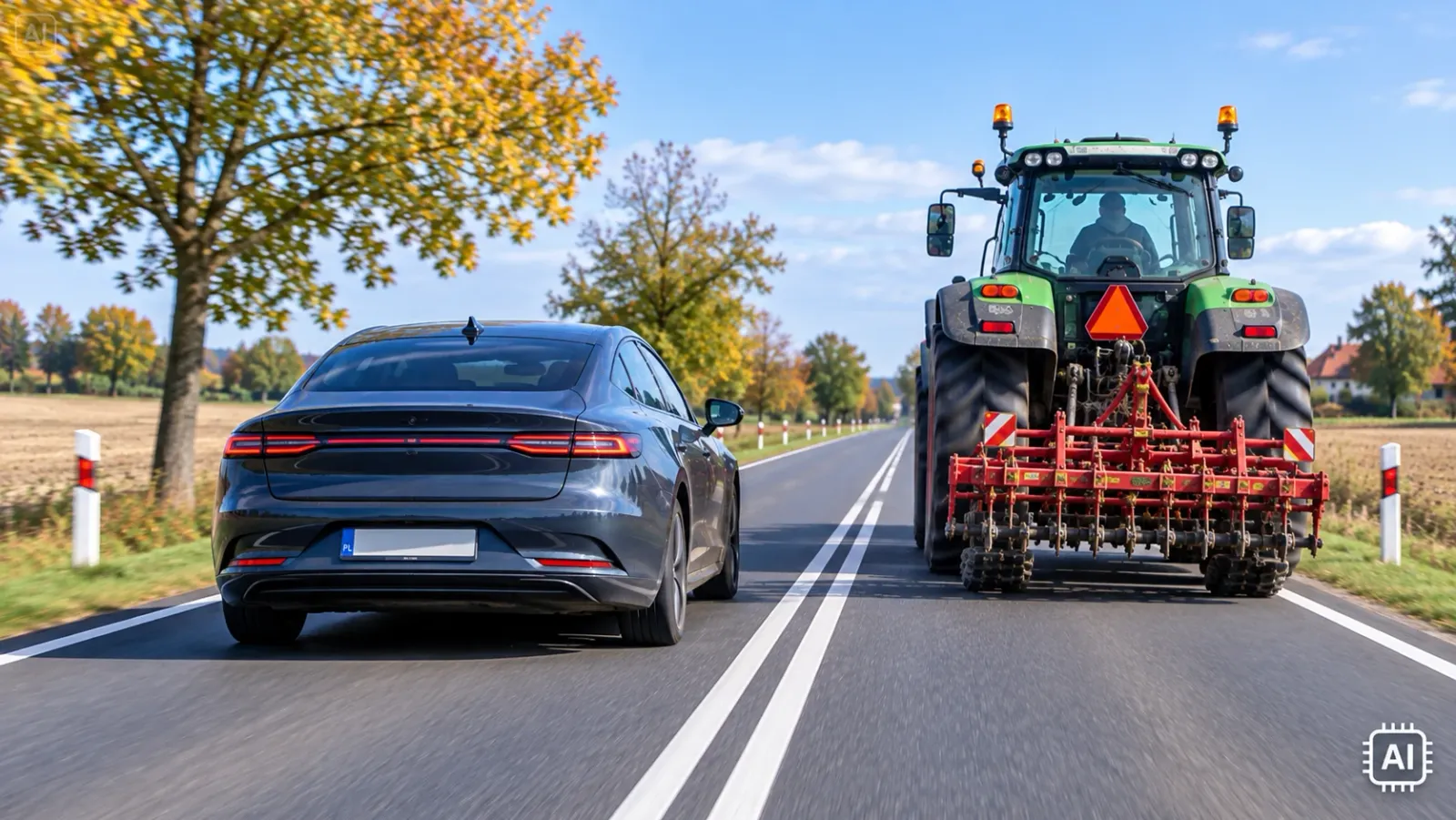
Overtaking a tractor on a two-lane road. When is it legal, and when does it cost 1000 zł and 15 demerit points?
In the article
What P-4 line actually prohibits
Why the B-25 sign also applies to tractors
How much does a mistake cost: fines, demerit points, and repeat offenses
Where overtaking is not allowed even without a sign
The new speed limit for tractors and changes to points-reduction courses
P-4 line – prohibition on crossing, not overtaking
The regulation on road signs and signals defines P-4 “double continuous line” as a marking that separates traffic lanes moving in opposite directions. It means a prohibition on crossing or entering the line. The rule says nothing about overtaking at all. In theory, therefore, it is possible to overtake a slower vehicle as long as the entire maneuver stays within one’s own lane.
In practice, this is almost impossible when driving a farm tractor. Agricultural machinery is wide and usually occupies most of the lane, and the driver overtaking must also maintain a safe side distance, as required by Article 24, Paragraph 2 of the Road Traffic Act. It is also forbidden to use the shoulder to avoid obstacles—overtaking on the shoulder is prohibited. Overtaking on a double solid line results in a fine of 200 zł and 5 penalty points, while overtaking on a single solid line results in a fine of 100 zł and 1 penalty point.
Sign B-25 – the prohibition that applies to tractors
The vertical sign B-25, “No Overtaking,” functions quite differently. It prohibits overtaking motor vehicles with multiple axles from the location of the sign to the nearest intersection or the B-27 sign, “End of No Overtaking Zone.” The key detail lies in the legal definitions: a farm tractor is not a motor vehicle but is considered a motor vehicle with multiple axles. The same applies to tracked vehicles, which are machines whose design limits their speed to 25 km/h, such as harvesters, bulldozers, and excavators.
Therefore, it is not allowed to overtake a tractor behind the B-25 sign, even if the road width theoretically permits it and the lane markings are not crossed. However, this prohibition does not apply to bicycles, mopeds, single-wheel motorcycles, and draft animals. An exception occurs when a plate under the sign limits the prohibition only to the specified vehicles.
Fines – 1000 zł, 15 points, and double penalty for recidivism
Failure to obey sign B-25 is one of the most severely penalized violations related to overtaking. The penalty schedule specifies a fine of 1000 zł and 15 demerit points – the maximum amount that can be imposed for a single offense. If a driver commits the same offense again within two years, the fine increases to 2000 zł.
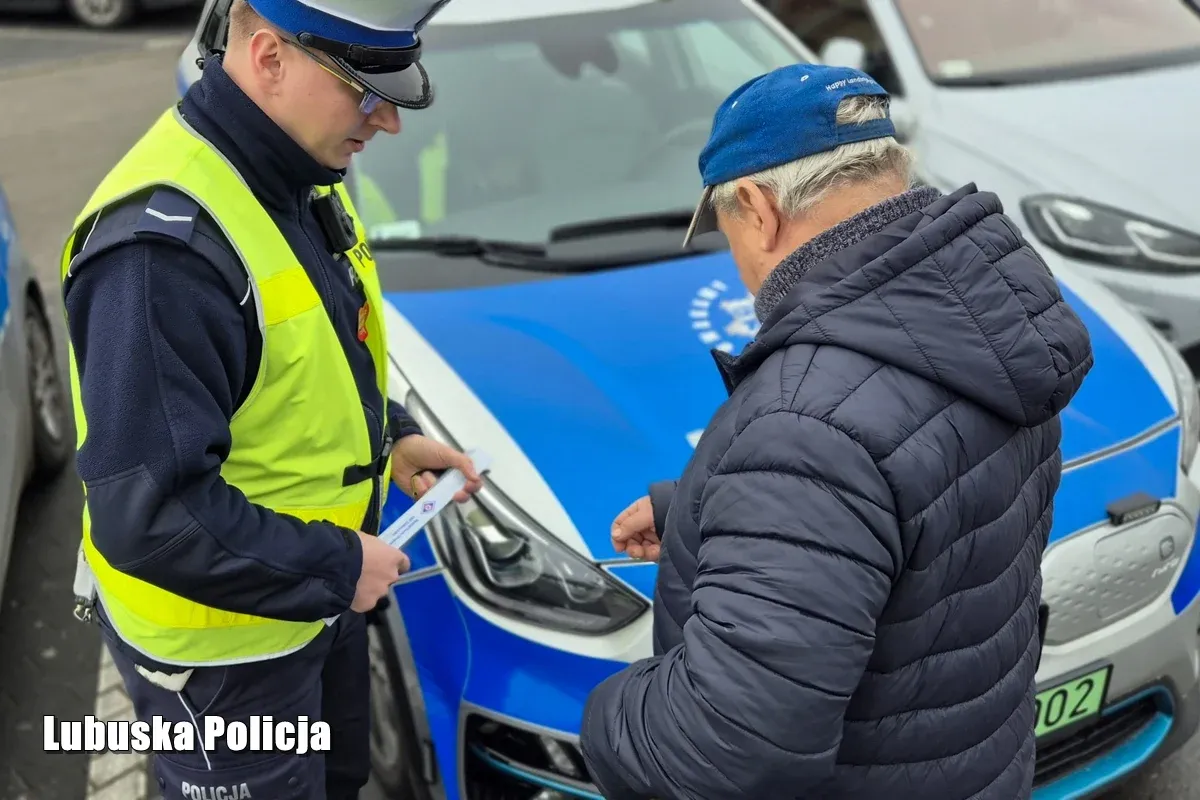
The point limit for an experienced driver is 24, while for someone with a driver’s license less than a year old it is 20. Exceeding this limit means losing the license and having to retake the exam. Starting June 3, 2026, the course offered by the ROAD authority, which allows 6 points to be deducted once every six months, will only be available for a closed list of minor violations. Most of the most serious violations related to overtaking have been excluded from this list, and as reported by Dziennik.pl, this also applies to violations of rule B-25. Therefore, the points will remain on the account for a year.
Areas without signs – prohibitions directly from the law
The absence of the B-25 sign does not mean freedom. Article 24, paragraph 7 of the Road Traffic Act prohibits overtaking a motor vehicle when approaching the top of a hill, on a curve marked with warning signs, and at an intersection, except at a roundabout or an intersection where traffic is directed. Each of these violations results in a fine of 1000 zł (2000 zł in case of recidivism) and 10 demerit points.
The ban also applies at railway crossings and bicycle crossings as well as directly in front of them, as well as at pedestrian crossings and right in front of them, unless traffic is directed there. Overtaking at a pedestrian crossing or directly in front of it carries a fine of 1500 zł and 15 demerit points.
Tractor – 40 km/h starting from March 2026.
As of March 3, 2026, the permitted speed for a farm tractor, including with a trailer, is 40 km/h instead of the previous 30 km/h. This change was introduced by an amendment to the Road Traffic Act in response to requests from farmers who pointed out that modern tractors are faster and safer than before. Tractors with low-speed drives still cannot exceed 25 km/h.
For drivers, this means one thing: the speed difference between a car and a tractor is smaller, so overtaking takes longer and requires a longer stretch of road with good visibility. A tractor with a long trailer can form a combination several meters long, and the maneuvering process may extend for hundreds of meters. The agility of an electric vehicle, which delivers full torque from zero, reduces the time needed for maneuvering, but it does not change the regulations.
Tractor driver responsibilities – turning right and maintaining a constant speed
The responsibility does not lie solely with the vehicle overtaking. According to Article 24, Paragraph 6 of the Road Traffic Act, the driver of a slow-moving vehicle, agricultural tractor, or engineless vehicle is obligated to move as far to the right as possible to facilitate overtaking. Failing to fulfill this obligation results in a fine of 100 zł. Additionally, no driver of the vehicle being overtaken may increase their speed during or immediately after overtaking — this violation carries a fine of 350 zł.
Before starting the maneuver, the driver must ensure they have adequate visibility and sufficient space, that no one behind them is attempting to overtake, and that the vehicle ahead is not signaling a left turn. The latter situation is particularly common with tractors moving onto fields. If any of these conditions are not met, it is best to wait for a broken line or a straight stretch of road.
Maciej Gis