
Germany has the world’s tallest wind turbine: a 365-meter tower that is different from others and generates 3.8 MW of power.
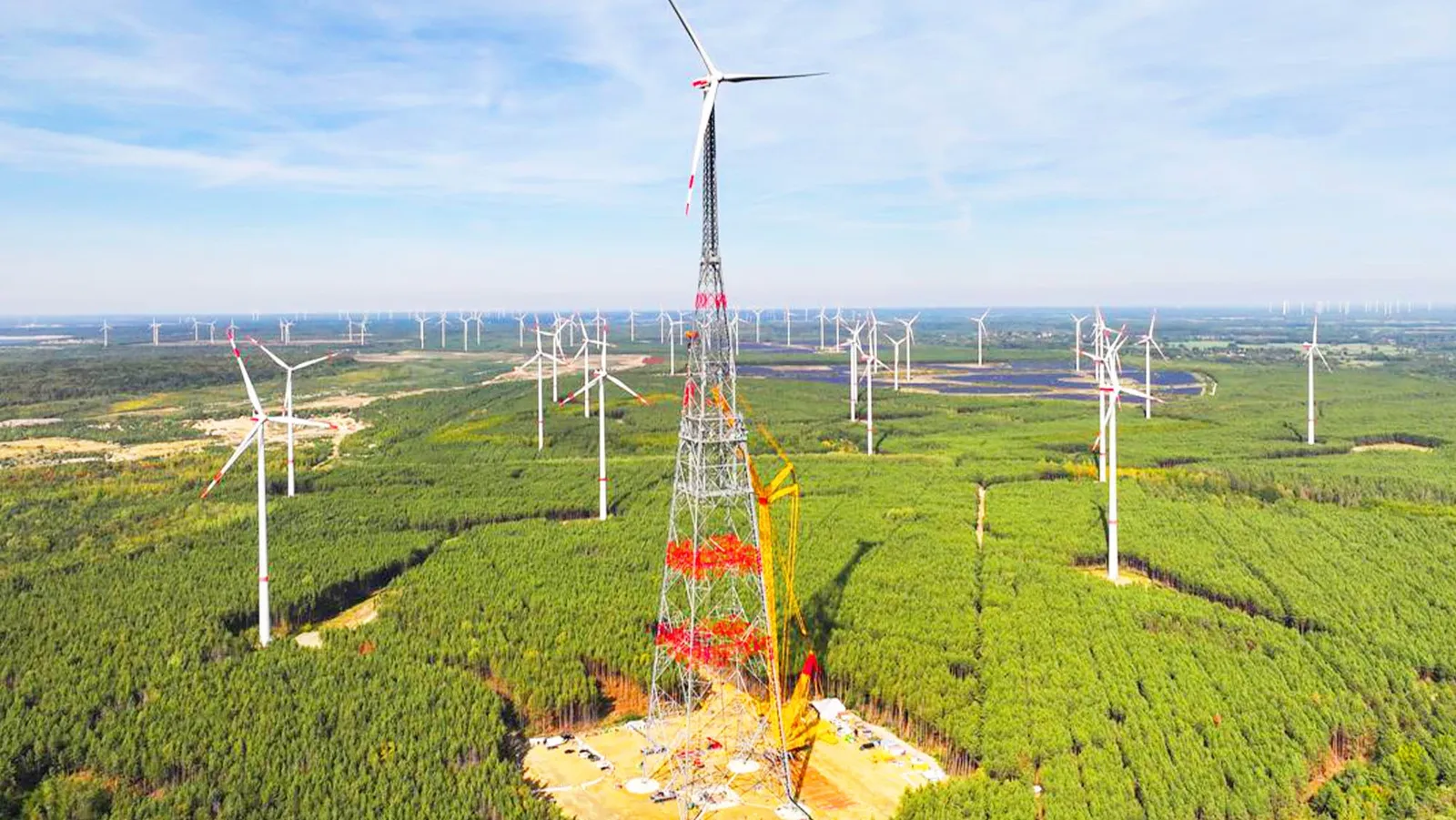
Germany has managed to install the world’s tallest wind turbine on its territory. It is located in Schipkau, in the Lusatia region of Brandenburg state, and reaches a total height of 365 meters. This height far exceeds the 330 meters of Paris’s Eiffel Tower, including its antenna.
The installation, however, is just a few meters away from another German record. Berlin’s television tower reaches 368 meters, making the new wind turbine the second tallest structure in the country at present.
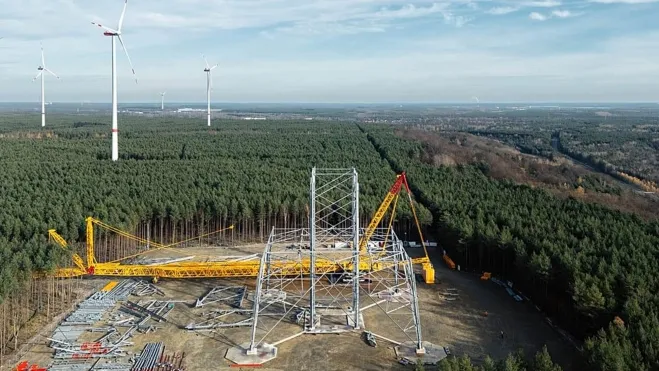
300-meter tower with a 3.8 MW turbine
The project, developed by the German company GICON for the Federal Agency for Disruptive Innovation (SPRIND), aims to demonstrate that installing wind turbines at heights far exceeding those typically used can significantly increase the production of renewable electricity.
The experience at Schipkau will allow researchers to determine whether the advantages of capturing stronger and more consistent winds outweigh the technical challenges of building and maintaining structures of such scale.
The construction reached its final height on September 28, 2026, after completing one of the project’s most delicate engineering operations.
The main feature of this installation is its structure. It does not use the typical steel or concrete tubular tower found in conventional wind farms, but rather a giant steel lattice structure that allows for a much greater height.
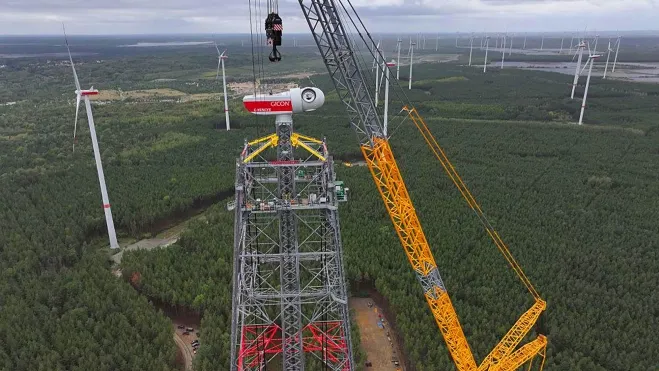
The assembly features a telescopic system consisting of a fixed outer structure and a movable inner structure. This design enables the nacelle and blades to be installed at a lower height, after which the entire structure is raised to a hub height of 300 meters.
To carry out this operation, a special cable-based lifting system was used, which allowed the inner structure to be extended and secured in its final position.
At the top is a Vensys 126 turbine, with a nominal power of 3.8 MW and a rotor diameter of 126.2 meters. The blades raise the maximum height of the installation to 365 meters.
It is important to note that the nominal power is not exceptionally high by current industry standards. The innovation lies in the height at which the generator operates, rather than in increasing its installed power.
The goal: producing more electricity by harnessing high-altitude winds
The reason for building a structure of these dimensions is related to wind behavior. At greater heights above the ground, air currents typically encounter fewer obstacles and have higher and more consistent speeds.
This feature has direct consequences for electricity generation. The power available in the wind increases approximately with the cube of its speed, so a relatively small increase can result in a significant difference in the energy that a wind turbine can capture.
According to estimates by the team responsible for the project, installing a turbine at 300 meters in height could yield approximately twice as much energy as a conventional installation with the same rotor diameter.
It is also expected to extend the number of hours per year during which electricity can be generated, reducing reliance on weather conditions that affect wind turbines at lower heights.
However, these figures still need to be verified through the operation of the prototype. The goal of the German installation is precisely to measure the actual wind behavior, assess energy efficiency, and determine whether the benefits justify the additional costs of construction and maintenance.
A new approach to expanding wind farms
GICON believes this technology could provide an alternative for increasing renewable energy production without the need to occupy large additional areas of land.
The idea is to utilize existing wind farms to install tall wind turbines, creating facilities with different wind capture levels. In this way, the same site can accommodate conventional turbines as well as those capable of harnessing air currents at higher altitudes.
The company plans to use the results from the prototype to develop a wind farm with three to five turbines of this type. Future installations are also intended to achieve a nominal power output of over 7 MW per turbine.
This initiative is particularly relevant for Germany, which needs to increase its renewable energy generation capacity while working toward phasing out coal-based electricity production by 2038.
In the first half of 2026, renewable sources provided 59.1% of the electricity generated and fed into Germany’s grid. Wind energy was the largest individual source, accounting for 29.4% of the total.
Although the structure has already reached 365 meters, the project has not yet completed all the necessary operations to begin operating. Among the pending tasks was the installation of internal wiring, with an official opening scheduled for November 19, 2026.