
Test: Jeep Compass Full Electric vs e-Hybrid Plug-in. Why refuel at all?

Still unsure between driving entirely electric and going with a plug-in hybrid? Then the new Jeep Compass makes the choice interesting. Both versions cost exactly the same. But which one is more comfortable to drive, which is more cost-effective, and when is a plug-in hybrid still useful? We tested both powertrains and outlined the differences.
Is this the moment to switch completely to electric driving, or is a plug-in hybrid still the safer choice for now? While fully electric driving is becoming a logical option for more and more car owners, the plug-in hybrid remains an attractive alternative for some. But is that still justified? Especially now that electric cars can cover longer distances and fast charging is becoming increasingly convenient. What if you consider not only the purchase price but also performance, energy consumption, operating costs, and changing tax regulations?
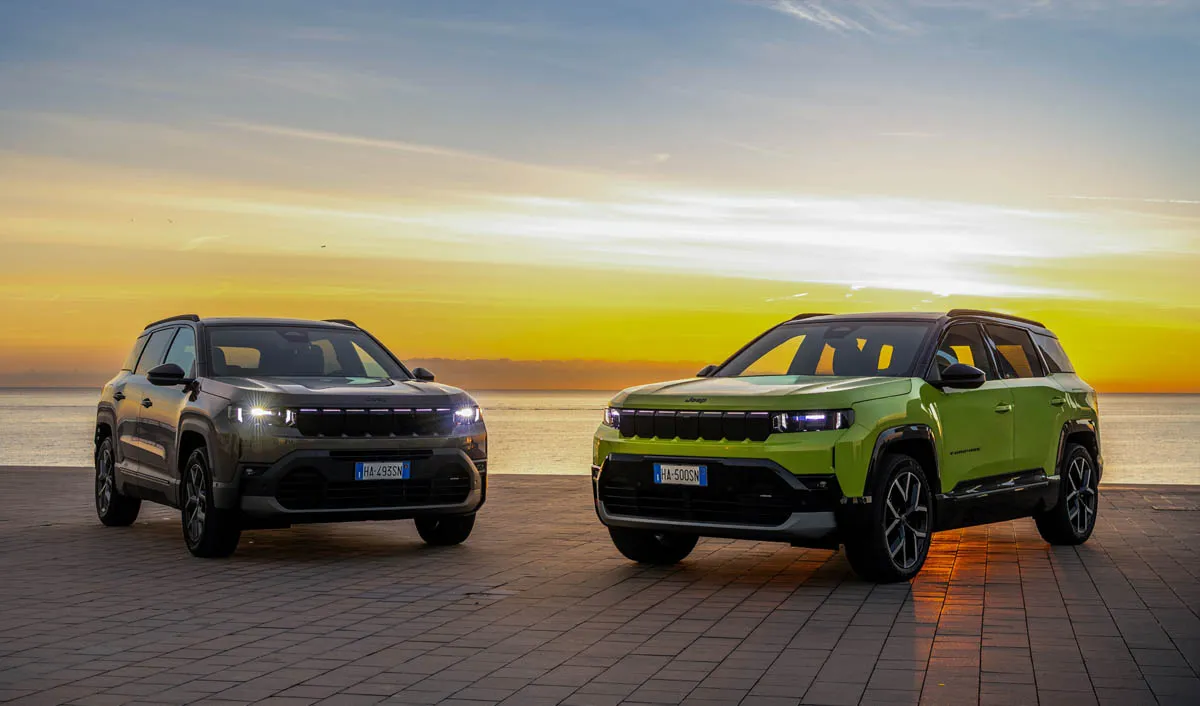
The Jeep Compass as an ideal comparison
We now know the new Jeep Compass quite well. During our previous test drive in Barcelona, we got to experience the Jeep Compass Full Electric. Recently, we drove the Jeep Compass e-Hybrid Plug-in for a week, followed by a week in the much more powerful Jeep Compass Full Electric 4xe.
To keep the comparison as fair as possible, we first compare the Jeep Compass e-Hybrid Plug-in with the regular Jeep Compass Full Electric. Both have front-wheel drive, deliver roughly the same power, and cost exactly the same in the Altitude version: €42,995. Next, we look at the Jeep Compass Full Electric 4xe, which, with its 375 horsepower and all-wheel drive, presents a completely different story.
The Jeep Compass Full Electric has less horsepower but feels more powerful
On paper, the Jeep Compass e-Hybrid Plug-in even has a slight advantage. Its 1.6-liter four-cylinder gasoline engine produces 150 horsepower, supplemented by an electric motor that delivers 125 horsepower. Together they offer 225 horsepower, enabling the SUV to accelerate from 0 to 100 km/h in eight seconds.
The Jeep Compass Full Electric relies on 213 horsepower and needs 8.5 seconds for the same acceleration. Yet the electric version feels much more convincing while driving.
The difference lies mainly in how each vehicle delivers its power. In the Jeep Compass Full Electric, the drive system responds instantly to every movement of the accelerator pedal. The car feels alert, confident, and determined. You request power and get it right away, without noticing any strain on the drivetrain.
The Jeep Compass e-Hybrid Plug-in makes a very different impression. As long as you drive smoothly and in electric mode, there are few issues. But when you accelerate aggressively and the gasoline engine needs to step in, it seems like the powertrain first has to find the right response. The transmission shifts gears, the four-cylinder engine reaches quite high RPMs, and only then is the required power available.
Moreover, the gasoline engine produces noticeably loud noise. It’s not exactly a pleasant sound either. As a result, despite its higher power output, the Jeep Compass e-Hybrid Plug-in feels less smooth and less powerful than the Jeep Compass Full Electric. That is perhaps the biggest difference between the two versions. The electric powertrain gives the impression of handling its tasks effortlessly, while with the plug-in hybrid, you can clearly sense how much effort is required.
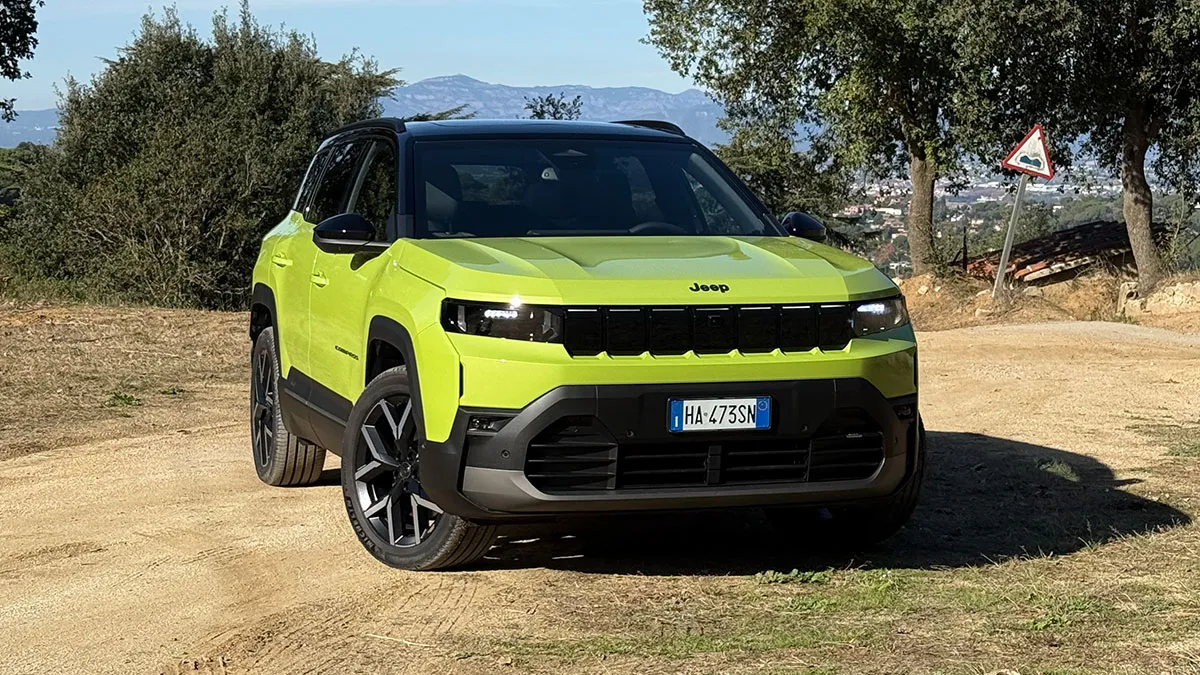
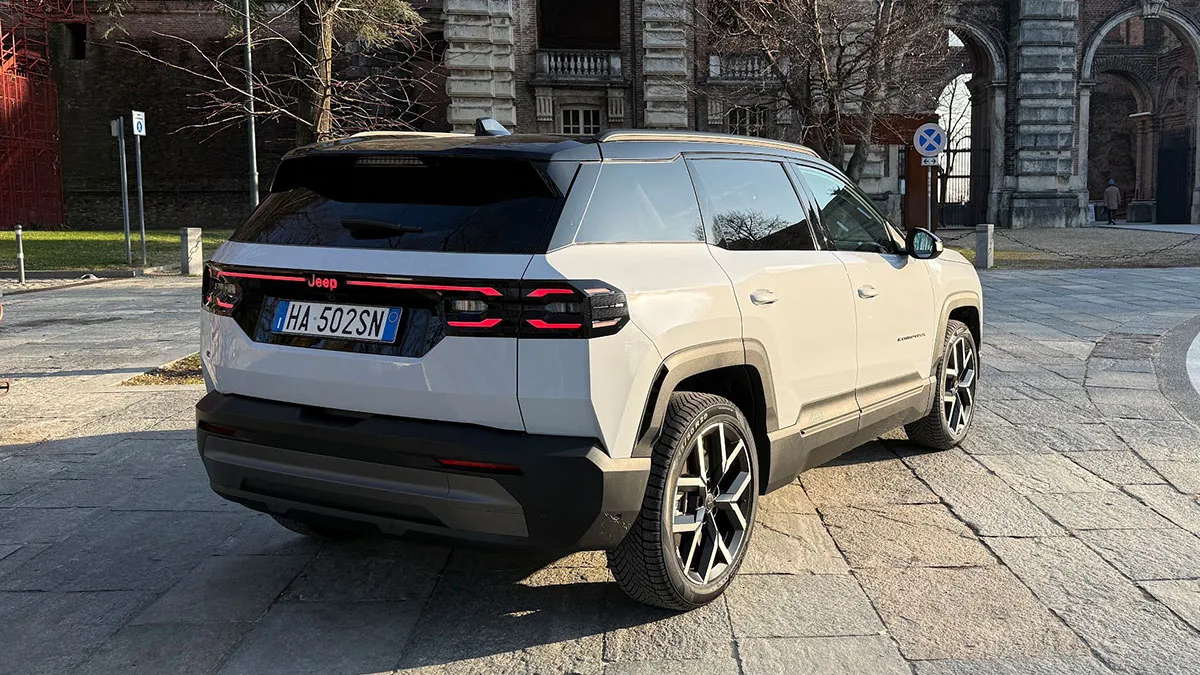
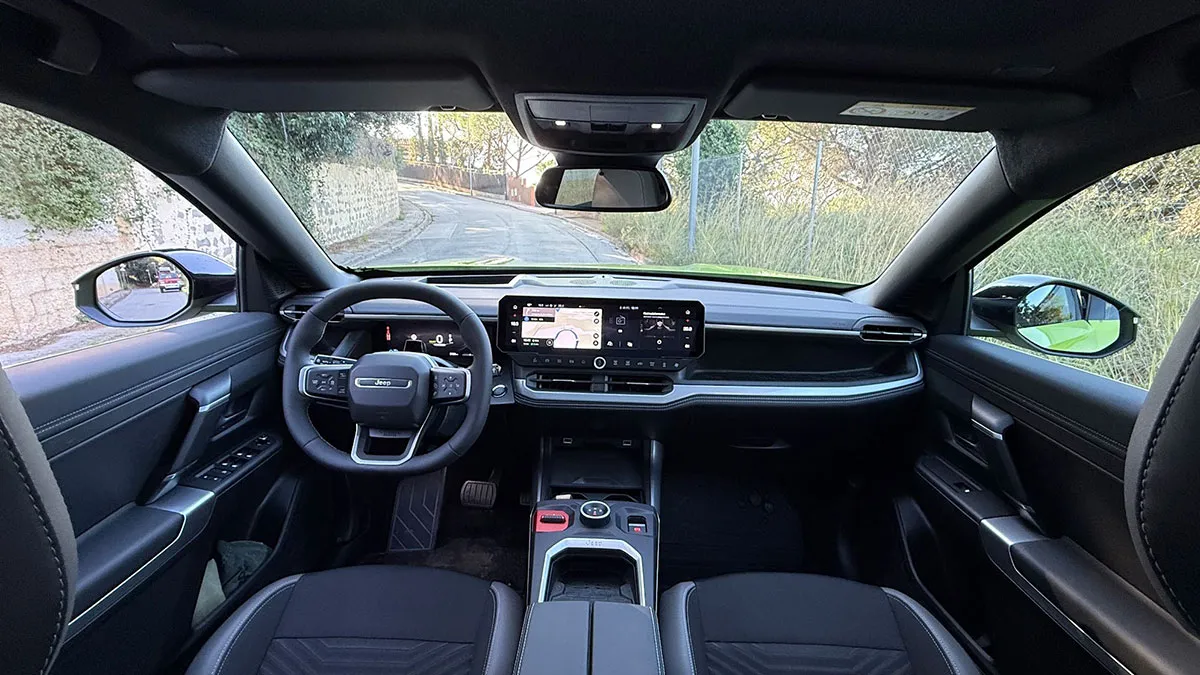
Jeep Compass e-Hybrid Plug-in: a significant step forward
That doesn’t mean Jeep has been idle. On the contrary, the new Jeep Compass e-Hybrid Plug-in has made considerable technical advancements compared to the previous generation.
The battery capacity has increased from 11.4 to 17.9 kWh. This has also led to a significant improvement in electric range. While the previous Jeep Compass 4xe Plug-in Hybrid could travel about 50 kilometers purely on electricity according to WLTP figures, the new Jeep Compass e-Hybrid Plug-in can cover up to 94 kilometers, depending on the trim level. For the Dutch Altitude version, the specification list shows 90 kilometers. That represents roughly 80 percent more electric range than before.
Jeep claims that fuel consumption with an empty battery pack has also improved. The company states a 10 percent reduction compared to the previous Compass model. Thanks to the 55-liter fuel tank and the larger battery pack, Jeep reports a theoretical maximum range of up to 978 kilometers. This makes the Jeep Compass e-Hybrid Plug-in attractive to drivers who frequently travel long distances and want to stop as little as possible while on the road.
During our test, we saw how fuel-efficient the Jeep Compass e-Hybrid Plug-in can be as long as the electric drive does most of the work. The onboard computer showed a gasoline consumption range of 1 to 76.9, or even 1 to 83.3, along with an electric range of 5.2 to 5.8 kilometers per kWh. But once the electric range is exhausted, the situation changes significantly. Our practical measurements show that gasoline consumption then quickly rises to around 1 to 15 to 1 to 16. This is a substantial difference from the official WLTP figure of about 1 to 33 to 1 to 34.5, which always assumes a combination of electric driving and gasoline use.
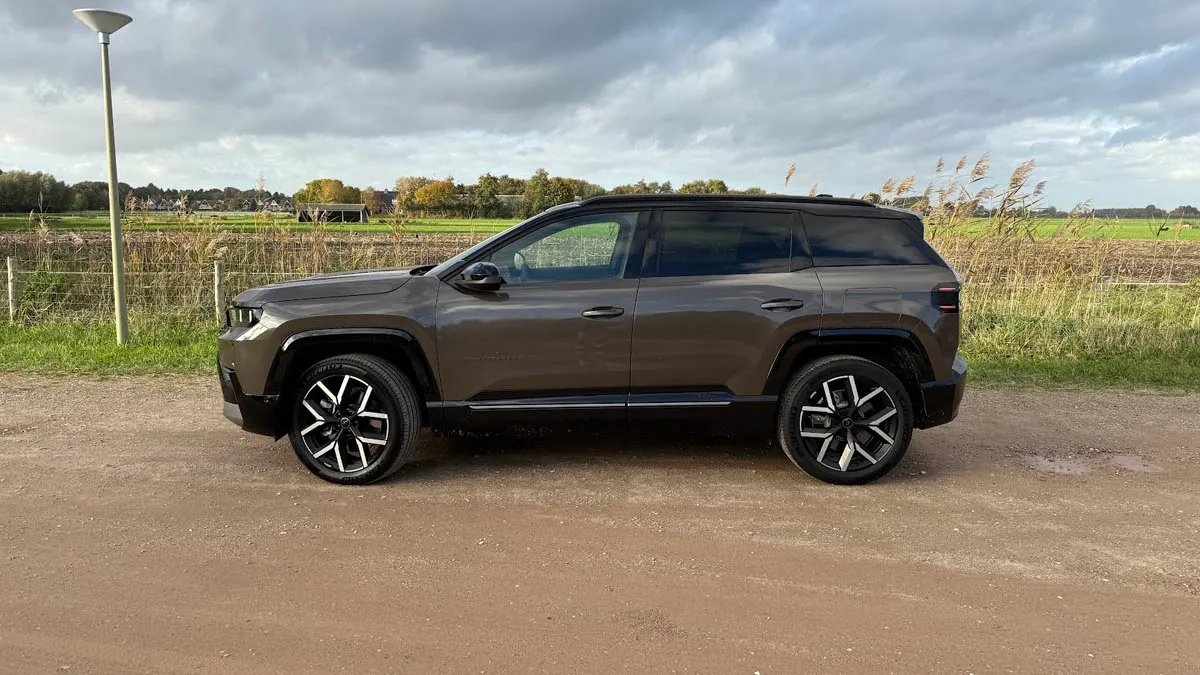
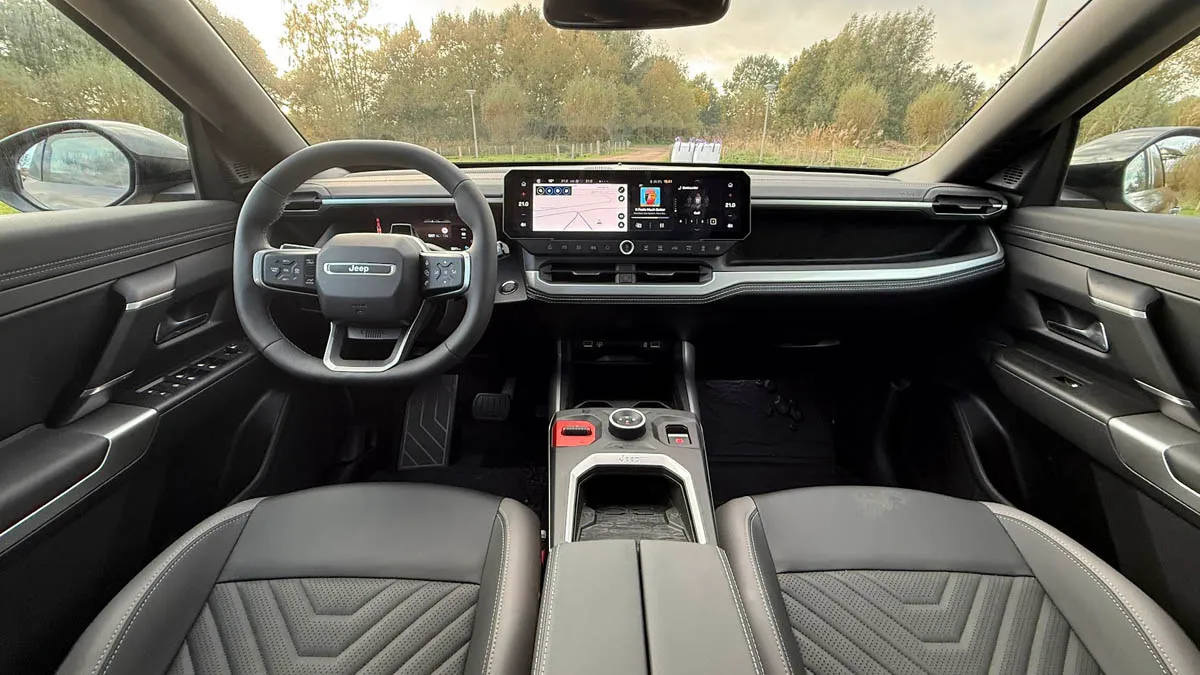
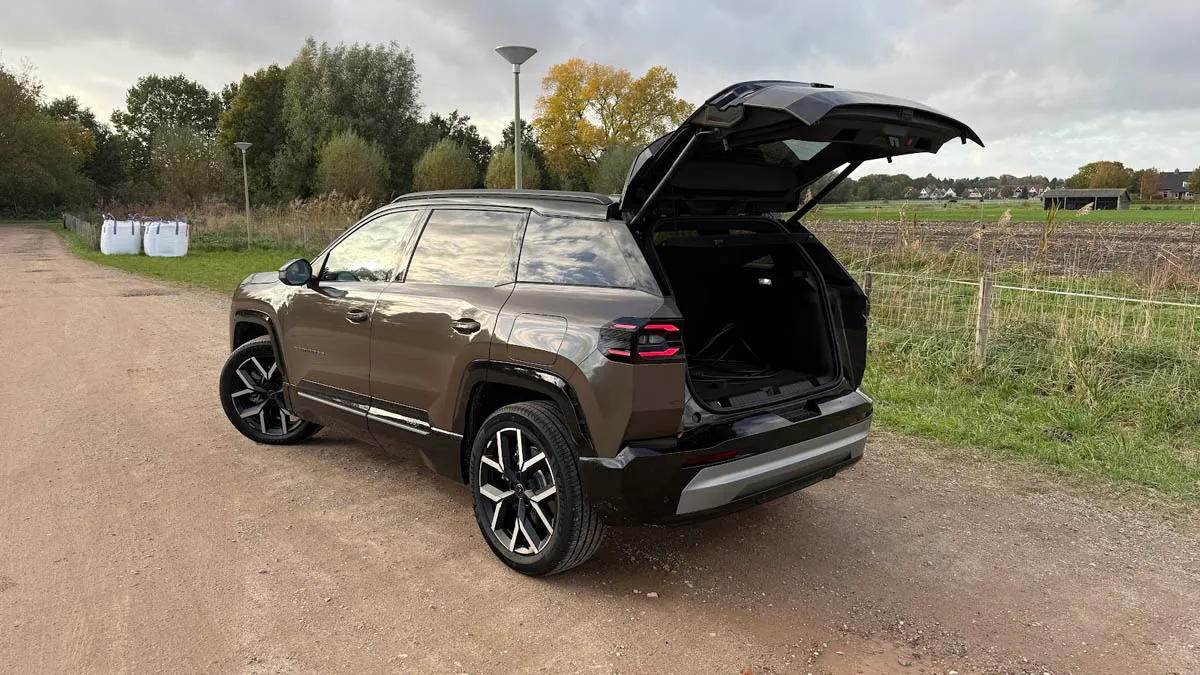
Jeep Compass e-Hybrid Plug-in vs Full Electric: Key Differences
Specifications
Jeep Compass e-Hybrid Plug-in
Jeep Compass Full Electric
Starting Price
€ 42,995
€ 42,995
Power
225 hp
213 hp
Drive Type
Front-wheel drive
Front-wheel drive
0-100 km/h
8.0 seconds
8.5 seconds
Battery Capacity
17.9 kWh
74 kWh
Electric Range WLTP
90 km
500 km
Total Range WLTP
Up to 978 km
Up to 500 km
Electric consumption WLTP
20.5-21 kWh/100 km
17.5-18.6 kWh/100 km
Gasoline consumption WLTP
1 in 34.5 to 1 in 33.3
Excluding taxes
AC charging capacity
7 kW
11 kW
AC charging time (0-100%)
2 hours 53 minutes
Approximately 8 hours
DC fast charging
Not possible
Max. 160 kW
DC charging time (20-80%)
Not possible
31 minutes
Trunk space
550 liters
550 liters
Towed weight with brakes on
1,500 kg
1,230 kg
Net additional tax per month (2026)*
€ 275
€ 239
*Tax calculated based on Jeep’s example, assuming the lowest tax bracket and registration in 2026. Technical specifications and consumer prices based on the Dutch Jeep price list.
What do both Compass models actually cost?
The purchase price is identical, but costs vary significantly thereafter. To illustrate this, we ran both models through our updated e-Drivers Check. This TCO calculator not only accounts for expenses on electricity, gasoline, and road taxes but also includes insurance, roadside assistance, maintenance, and depreciation.
We assume 20,000 kilometers per year over a four-year period. The electricity price is €0.40 per kWh, so we consider not only cheap home charging but also more expensive charging locations. Gasoline costs €2.15 per liter in this calculation. For the Jeep Compass e-Hybrid Plug-in, we assume that half of the kilometers are covered by electric driving. Both cars have a purchase price of €42,995.
For the other criteria, we use the values from the calculator, including 19.9 kWh per 100 kilometers for the Full Electric version, 17.5 kWh for the electric part of the plug-in hybrid, and 6.5 liters of gasoline per 100 kilometers when it runs on gasoline.
Cost Comparison
Jeep Compass e-Hybrid Plug-in
Jeep Compass Full Electric
Purchase Price
€ 42,995
€ 42,995
Annual Energy Cost
€ 2,098
€ 1,592
Annual Insurance Cost
€ 276
€ 348
Annual Roadside Assistance Cost
€ 180
€ 180
Annual Road Tax
€ 1,492
€ 1,136
Annual Maintenance Cost
€ 400
€ 200
Annual Operating Cost
€ 4,446
€ 3,456
Estimated Residual Value after 4 Years
€ 15,914
€ 17,611
Total Cost after 4 Years (TCO)
€ 44,863
€ 39,208
The calculation is based on the e-Drivers Check for 20,000 kilometers per year and four years of use. The calculator uses an annual depreciation rate of 22% for plug-in hybrids and 20% for fully electric vehicles. The figures are indicative and are based on adjustable assumptions, including maintenance costs and residual value.
After four years, the Jeep Compass Full Electric comes out €5,655 cheaper according to this calculation. That amounts to nearly €118 per month on average. Lower energy costs, road tax, and maintenance expenses contribute to the advantage of the electric version, while the assumed residual value also proves more favorable.
Of course, these are not guaranteed figures. The actual costs depend on factors such as the number of kilometers driven, where you charge the vehicle, and its residual value after a few years. Curious to see how the comparison works for you? With our free e-Drivers Check, you can adjust the electricity price, fuel consumption, maintenance costs, depreciation, and all other variables yourself. It’s also easy to calculate different loan terms or higher annual mileage.
Driving 150 kilometers per day: is a plug-in hybrid then smarter?
But what if you drive many more kilometers? Suppose you drive 150 kilometers per day, for example, for commuting. That’s almost five times the average of about 31 kilometers driven by a private car in the Netherlands per calendar day, according to the CBS. With 200 working days, that amounts to 30,000 kilometers per year. With such distances, you might be more inclined to choose the Jeep Compass e-Hybrid Plug-in. After all, you don’t need to charge on the road and can simply refuel when the electric range is exhausted.
But even at those higher mileage levels, our e-Drivers Check shows a different story. Using the same assumptions as the previous calculation, but with 30,000 kilometers per year, the Jeep Compass Full Electric results in total costs of €42,392 over four years. The Jeep Compass e-Hybrid Plug-in costs €49,058 according to the same calculation. This represents a difference of €6,666 in favor of the fully electric version—nearly €139 per month on average.
Of course, driving 150 kilometers per day requires more attention to charging. With a practical range of around 400 to 430 kilometers, you’ll need to plug in the Full Electric model at a charging station roughly every two workdays. On the other hand, with the plug-in hybrid, which officially has a maximum electric range of 90 kilometers, you can cover part of your daily distance on gasoline if you can’t charge in between. For drivers who travel long distances, fully electric driving turns out to be financially attractive. As long as you can charge regularly at home, at work, or on the road, the higher annual mileage isn’t a good reason to choose a plug-in hybrid on its own.
Jeep Compass Full Electric 4xe: for those who want everything
Then there’s the Jeep Compass Full Electric 4xe. After spending a week in the Jeep Compass e-Hybrid Plug-in, we drove this most powerful electric version for a week. This makes the differences in driving experience even more pronounced.
The Jeep Compass Full Electric 4xe features two electric motors, all-wheel drive, and a whopping 375 horsepower. According to Jeep, it accelerates from 0 to 100 km/h in 5.4 seconds. The power is available instantly, and the drivetrain responds effortlessly at any speed. While the regular Jeep Compass Full Electric already offers a convincing driving experience, the Jeep Compass Full Electric 4xe adds significantly more performance. Additionally, it remains pleasantly quiet inside, even when accelerating hard.
The all-wheel drive also makes it more suitable for off-road terrain. Jeep has equipped this version with additional ground clearance and adjusted off-road settings. As a result, the Jeep Compass Full Electric 4xe is not only the fastest but also the most off-road capable model in the current lineup.
The price starts at €50,495, which is exactly €7,500 more than the regular Jeep Compass Full Electric. In addition to the enhanced performance and all-wheel drive, it comes with a larger 96 kWh battery pack and a WLTP range of up to 606 kilometers.
The regular Jeep Compass Full Electric is the smarter choice due to its lower price. But once you experience what the 375 hp 4xe model has to offer, you’ll find that passion sometimes leads to different considerations.
Why we would choose the Jeep Compass Full Electric
The Jeep Compass e-Hybrid Plug-in certainly has its place. Those who travel frequently with a caravan can benefit from its higher towing capacity of 1,500 kilograms, compared to 1,230 kilograms for the Full Electric version. Those who prefer to refuel rather than charge on long trips also have good reasons to choose the plug-in hybrid. However, for those who don’t need these advantages, it comes with a more complex drivetrain that is less convincing while driving.
And that’s not even mentioning maintenance. A plug-in hybrid combines a full gasoline engine with an electric drive, including all the components that require maintenance. Think oil, filters, spark plugs, and the exhaust system. With a fully electric vehicle, those costs are eliminated, meaning the financial advantage is likely to increase further in the long term. Therefore, in our TCO calculation, we account for €400 in maintenance per year for plug-in hybrids, compared to €200 for electric models. These are assumptions that you can adjust in the calculator itself.
Okay, we’re not called e-Drivers.com for no reason, so you might suspect we have some bias. But if the all-electric Compass drives better, costs less to operate, and likely requires less maintenance in the long run, Jeep makes it very difficult for us to choose the plug-in hybrid.
What about you? Which one of the two (or three) would you pick? Let us know in the comments below!