
Tesla Roadster: Catches onto surfaces firmly, launches using compressed air
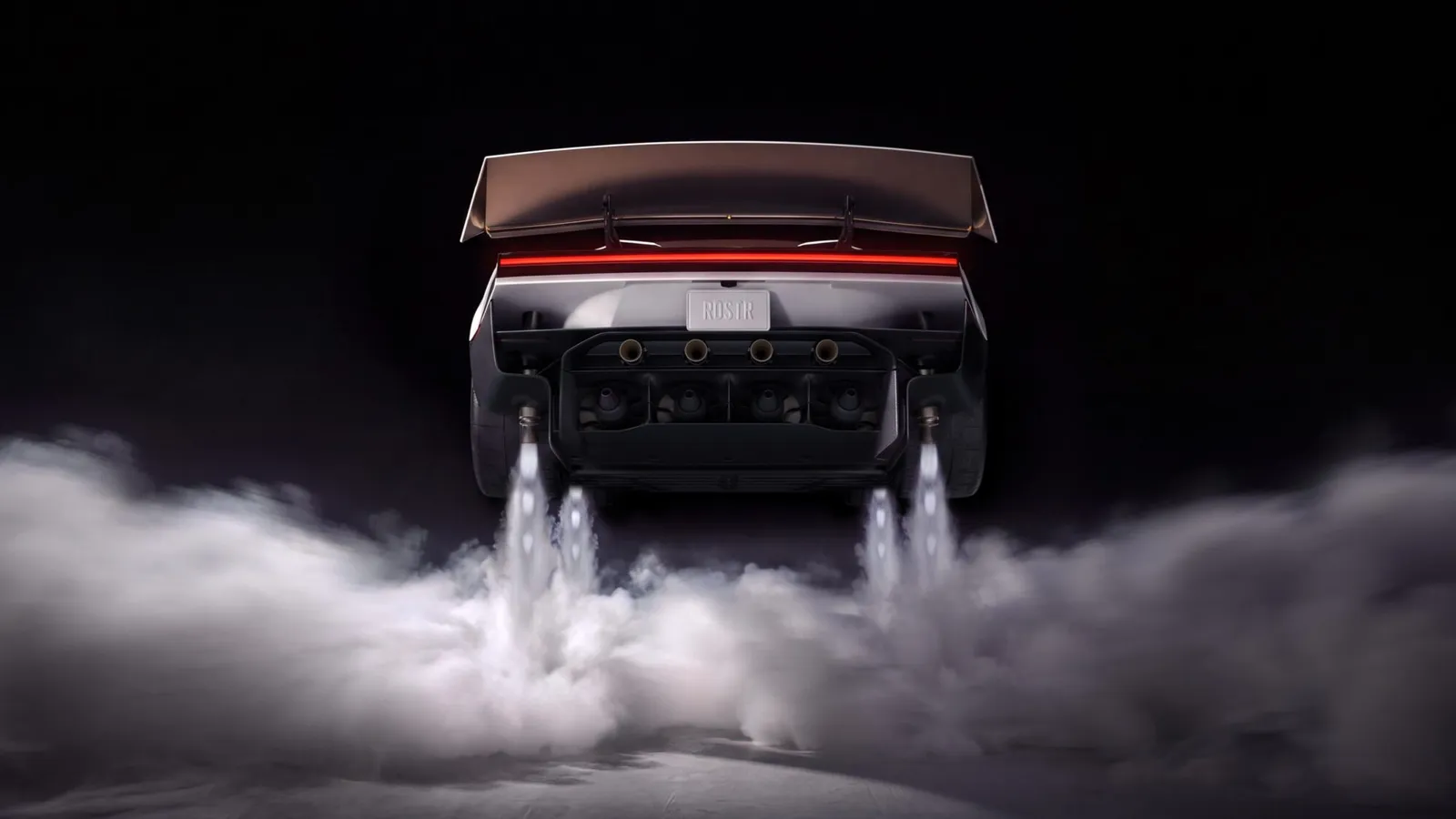
Tesla has unveiled the new Roadster in Performance, Thrust, and Rocket versions, equipped with turbocharging systems and some featuring cold gas engines. Production is set to begin in 2028, with reservations in Germany requiring at least 50,000 euros.
Advertisement
Tesla first unveiled the second generation of the Roadster in 2017. At that time, production was scheduled to begin in 2020, with a battery of 200 kWh and a range of up to 1,000 kilometers. However, series production has not yet taken place. At SpaceX’s rocket testing and development site in McGregor, Texas, Tesla has now introduced a significantly revised version. According to Elon Musk, it was created through close collaboration between engineers from both companies. Musk now estimates that production will begin in 2028.
The 2017 study shows little visual similarity to the new model. Its body adopts the angular design language Tesla last used on the Cybertruck. During the presentation, officials cited the reconnaissance aircraft SR-71 as one of its inspirations. Technically, the manufacturer summarizes the Roadster under three key concepts: active aerodynamics, a multi-mode suction system, and cold-gas engines. Which of these components are included depends on the chosen version. According to Musk, the Roadster is intended to remain Tesla’s only model that requires manual driving in the long term.

Performance, Thrust and Rocket
Tesla plans three versions. The Performance version is labeled by the manufacturer as road-ready. It features two seats, active aerodynamic elements, and a turbocharger system, but no engines. Tesla claims the 0 to 60 mph (around 97 km/h) acceleration takes less than 1.6 seconds.
The Thrust version will be available as a limited edition and is described by Tesla as track-ready. It also has two seats and the turbocharger system, with cold gas engines installed at the rear. This setup is intended to achieve around 97 km/h acceleration in less than 0.9 seconds. During the presentation, an acceleration time of 0.81 seconds was cited for a run with rear engine assistance. Musk expects the production vehicle to beat this figure even further.
The third version of the Rocket is a single-seater that is only available upon personal invitation. Its cold gas engines are distributed around the chassis to provide forward and upward acceleration as well as rotation around the longitudinal axis. Tesla states that the vehicle can fly. According to the manufacturer, this version does not have approval for use on public roads. Tesla claims the Rocket can accelerate to about 97 km/h in less than 0.59 seconds and reach a top speed of over 230 mph (around 370 km/h). Musk said during the unveiling that the vehicle is not optimized for safety and may not be legal in all countries.

Advertisement
Suction system and aerodynamics
The suction system consists of a multi-stage fan and a seal for the floor. It is located in the diffuser area, drawing air under the vehicle to create a vacuum that presses the car against the road surface. Unlike wings and underbodies, whose downforce increases only with speed, this system works even when the vehicle is stationary. According to Tesla, it generates up to 2 g of force. This is sufficient to keep the Roadster suspended upside down from a ceiling while stationary.
The system operates in two modes. At low speeds, it presses the vehicle against the ground, while at high speeds, the front and rear sections open to allow more air to flow beneath the car. According to Tesla, this enables cornering at forces exceeding 2 g, whereas tire grip typically reaches only about 1.26 g on its own. The system is complemented by active aerodynamics, with modes for high downforce and low drag. The angle of the rear wing is automatically adjusted to the driving conditions.

Compressed air cold gas engines
Jet engines generate thrust by expelling gas stored at high pressure through nozzles, without any combustion occurring. In space exploration, they are used among other things for attitude control. The Roadster uses air for propulsion. It is stored in two carbon fiber composite pressure tanks with a combined volume of 600 liters, which can hold approximately 250 kilograms of air according to Tesla. The system does not require any special fuel, and the vehicle can refill its tanks on its own, according to Musk.
The Rocket has a total of ten nozzles. The four rear nozzles expel air at supersonic speeds, generating together more than 80 kN of thrust per Tesla. The nozzles are controlled by purely electric actuators that, according to Tesla, can make adjustments in a fraction of a second to stabilize the vehicle in flight.
During the demonstration, a Roadster used suction to drive itself upside down over a curved ramp, detach from it, and then land back on its wheels using thrusters. In another display, the vehicle flew over several parked Tesla Model cars while spinning around its own axis. According to Musk, the Roadster operated autonomously for these demonstrations for safety reasons.

Advertisement
Range, Battery, and Charging Speed
Tesla claims the range is over 300 miles, which is approximately 483 kilometers. This is less than half of the figure Tesla cited in 2017. The manufacturer does not specify a testing method for determining the range figure.
Tesla has not yet released any information regarding battery capacity, the number of electric motors, system power, or charging capacity. The vehicle’s weight is also unknown.

Design and Interior
Exteriorly, the Roadster features concealed headlights, a continuous light strip at the rear, and aerodynamic elements seamlessly integrated into its design. The wheels are very lightweight with thin spokes. The white paint, named Ano White, is said by Tesla to be inspired by coatings used in space technology, which protect against UV radiation and cold while dissipating static charges. The gold-tinted windows are designed to resemble the coatings on space suit visors and are complemented by titanium accents.
The interior is painted white, with the seat sides and details covered in gray microfiber material. The seats are firmly molded into the chassis. The steering wheel, brakes, and accelerator pedal are operated via wire, meaning without mechanical connections, with steering controlled through a yoke. Additionally, there is a central touchscreen and two smaller displays within the driver’s field of view. To reduce weight, Tesla also uses manual control elements along with magnesium, titanium, and carbon fiber as materials.

Reservation without purchase price
Reservations can be made through Tesla’s German website. For the Performance version, an initial payment of 5,000 euros is required, with another 45,000 euros due within ten days. For the Thrust version, in addition to the first 5,000 euros, an additional 245,000 euros are needed, totaling 250,000 euros. Tesla explicitly states that only the first payment is fully refundable. If the second payment is not made on time, the reservation may be canceled. No reservation fee has been announced for the Rocket version.
Tesla has not specified a fixed purchase price for any of the three versions. A delivery date for Germany has also not been determined yet. Tesla has not communicated whether or how the engine-equipped variants will be approved for use in Germany.