
Tesla finally unveils its new Roadster: a crazy electric car that defies the laws of physics
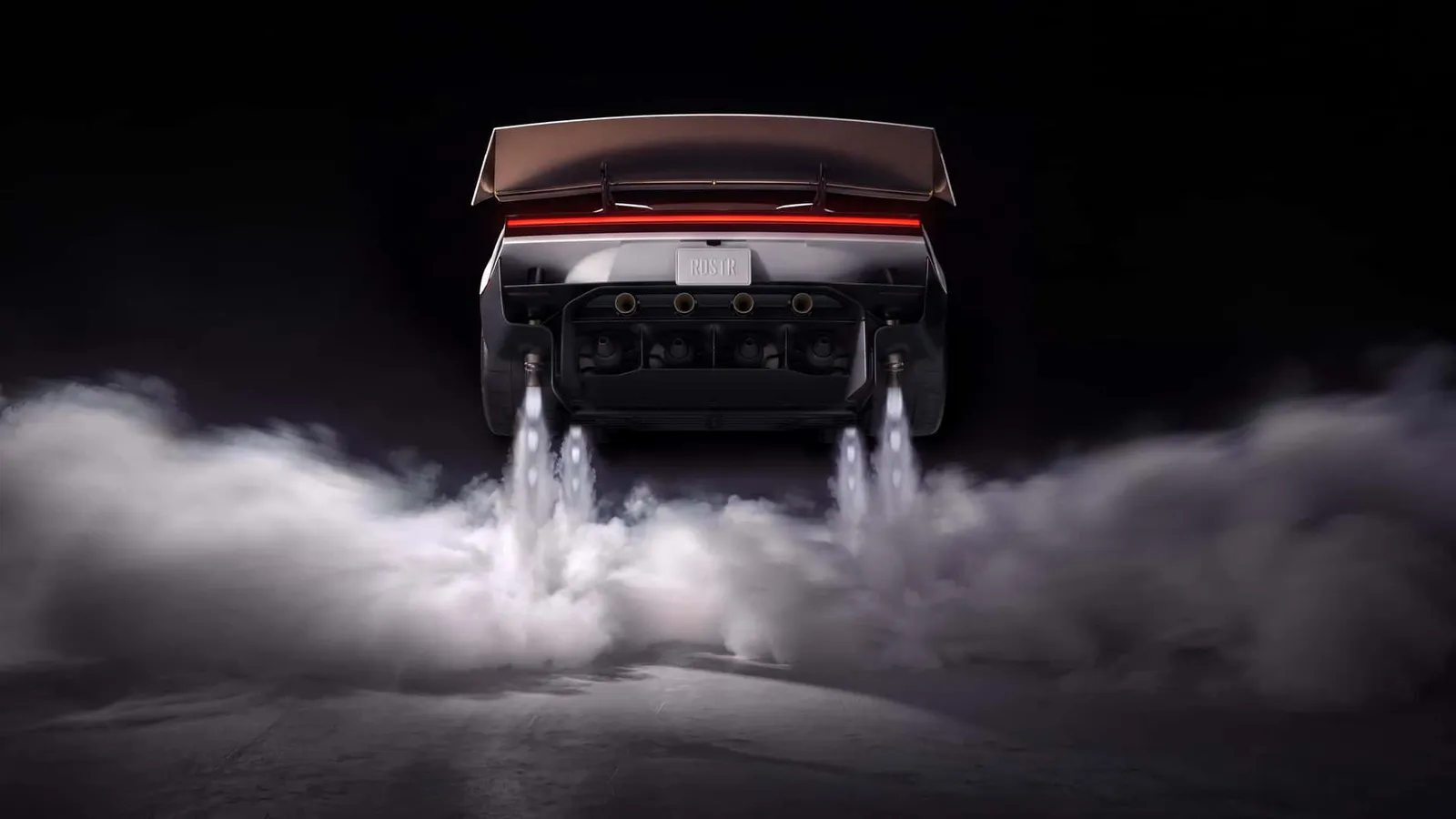
Nine years after its first unveiling, the new Tesla Roadster has finally made its grand return. Elon Musk unveiled an electric car with utterly astonishing capabilities in Texas. Thanks to technologies developed in collaboration with SpaceX, it can lift off from the ground, perform aerial maneuvers, and achieve accelerations that seem to defy the laws of physics. But behind this spectacle, some questions remain unanswered.
It took nearly a decade, but this time, Tesla finally unveiled its new Roadster. On the night of October 15 to 16, 2026, the American automaker held an event at a SpaceX test site in Texas. And quite frankly, Elon Musk aimed to make a lasting impression. Rather than settling for a traditional presentation with some acceleration tests on a track and a speech about performance, Tesla chose to demonstrate capabilities that are particularly unusual for a car. The show included a vehicle driving backward, jumping over other cars, and even spinning in midair. Just that!
Nine Years of Waiting for the Tesla Roadster
First unveiled in November 2017, the new Tesla Roadster was originally scheduled to hit the roads in 2020. At that time, Elon Musk promised extraordinary performance: 0 to 100 km/h in 1.9 seconds, a top speed over 400 km/h, and a range of nearly 1,000 kilometers.
But years passed and delays piled up. Meanwhile, Tesla focused its efforts on other projects, including the Cybertruck, autonomous driving, and robotics. The Roadster seemed to fall almost into oblivion. In 2026, Elon Musk announced a new unveiling scheduled for October 1st, which was then postponed to October 15th due to unfavorable weather conditions. This delay makes sense when considering the vehicle’s astonishing capabilities...
An electric car that can drive backward!
The vehicle was revealed climbing an enormous curved ramp, until it ended up completely upside down. The car then remained pressed against the surface before leaving the structure, rotating, and returning to the ground. How is this possible? The manufacturer developed a suction system installed under the vehicle. Fans create a vacuum that keeps the car pressed against the road surface, even when it is above it. According to Tesla, this device is powerful enough to generate a suction force equivalent to about twice the weight of the vehicle.
The Roadster could thus remain attached to an inverted surface, even when stationary. This system is also useful for driving on racetracks. By artificially increasing aerodynamic downforce, it could improve traction and allow the vehicle to take corners at particularly high speeds. Tesla even mentions downforce levels similar to those seen in Formula 1. Independent tests will be needed to verify these claims.
SpaceX thrusters for takeoff from the ground
The other major breakthrough relates to the famous thrusters developed with SpaceX. Elon Musk has been talking about this technology for several years, but no one really knew how far Tesla had progressed in developing it. The demonstration now provides some initial answers. The Roadster was able to lift off from the ground and pass over several vehicles (a Cybertruck, a Cybercab, and other Tesla models).
The principle relies on the use of highly compressed gas under extreme pressure, expelled by thrusters. Unlike a traditional rocket, it does not involve burning fuel to generate thrust. Tesla claims to have worked with SpaceX engineers to adapt this technology for use in the atmosphere. Pressurized tanks reinforced with carbon fiber are integrated into the available space within the vehicle. It’s impressive, but likely unnecessary.
The goal is to generate enough thrust to lift the car into the air, as well as to improve its performance on land. However, one should not imagine the Roadster as a flying car capable of replacing an airplane. The demonstrations involve short-duration maneuvers in a controlled environment. Tesla has not shown any capability for extended aerial travel.
Three versions: Performance, Thrust, and Rocket
The performance figures announced are also astonishing. Tesla has detailed three variants of the Roadster, each with very different features depending on the technologies used. The Performance version serves as the entry point in the lineup. It has two seats, active aerodynamic elements, and the previously mentioned induction system. Tesla claims a 0 to 96 km/h acceleration time of less than 1.6 seconds.
0 to 100 km/h in 0.59 seconds?
The Thrust variant adds compressed gas thrusters to the rear. These are intended to help reduce the acceleration time to under 0.9 seconds to reach 96 km/h.
This version is presented as a setup more geared toward racing circuits. The Rocket takes the concept even further by eliminating the second rear thruster and installing multiple thrusters around the vehicle to control its movement in the air. Tesla claims an acceleration from 0 to 96 km/h in less than 0.59 seconds, along with a top speed exceeding 370 km/h. Note that these are figures provided by Tesla. The demonstration showed an acceleration time of around 0.81 seconds, but not all of the claimed performance metrics have been independently verified.
Refined Design and a Minimalist Interior
The Roadster unveiled in 2026 bears little resemblance to the 2017 prototype. Tesla has significantly redesigned its silhouette, adopting a more angular styling language similar to that of the Cybertruck and Cybercab. The body retains the proportions of a very low sports car, with a long hood and a sloping roofline. However, the surfaces are now tighter, and the lighting elements are more refined. The overall design appears far more futuristic than the original model.
Inside, Tesla sticks to its minimalist approach. It features a yoke-style steering wheel paired with electronic steering without traditional mechanical links, along with a large central screen. Two smaller displays are also located in front of the driver. The manufacturer states it opted for lightweight materials such as carbon, magnesium, and titanium. The seat positions are fixed, with some adjustments replaced by manual controls to reduce weight.
Another unique feature is that the active aerodynamic wings reportedly use actuators derived from research on Optimus, Tesla’s humanoid robot. This is a way to share certain technologies across the company’s various projects.
Is the range ultimately halved?
This is one of the least pleasing surprises in this presentation. In 2017, Tesla promised a range of around 1,000 km thanks to a 200 kWh battery. Nine years later, those ambitions seem to have been reduced. The company now mentions a range of over 300 miles, which is just over 480 km.
This figure represents less than half of the initial goal. It should be noted, however, that Tesla has not yet provided final data on battery capacity, energy consumption, or the conditions under which this range was measured. This change may be explained by the technical choices made to improve performance and reduce weight. The numerous components required for the propulsion system also take up significant space inside the vehicle.
The interior layout has also changed. While the 2017 prototype was intended to offer four seats in a 2+2 arrangement, the new Roadster is now limited to two occupants. The Rocket version can even accommodate just one person.
Not all versions will be road-legal
This is an important point. Although Tesla presents its Roadster as an electric sports car designed to push the limits of automobiles, not all of its variants will necessarily be road-legal. The Performance version is said to be suitable for road use. The Thrust version should also be able to be used on roads, though its approval status remains pending depending on the market.
On the other hand, the Rocket is explicitly presented as an unapproved version for use on public roads. Its aerial capabilities obviously raise questions about safety and regulations. It’s difficult to imagine a vehicle capable of jumping over other cars in traffic. The demonstration held in Texas took place under very specific conditions, on a closed site with a vehicle controlled remotely.
It remains to be determined which technologies will actually be available to customers and under what conditions they can be used. This is especially true in Europe, where approval requirements are strict.
What will the new Tesla Roadster cost?
First, let’s clarify that the new Tesla Roadster will indeed be available in France. It’s already visible in the configurator!
But despite this impressive presentation, Tesla has not announced the final price of its new vehicle. During its first unveiling in 2017, the company mentioned a starting price of $200,000 and a Founders Series edition at $250,000. These figures can no longer be considered reliable references for the model revealed today. Nevertheless, Tesla has reopened reservations.
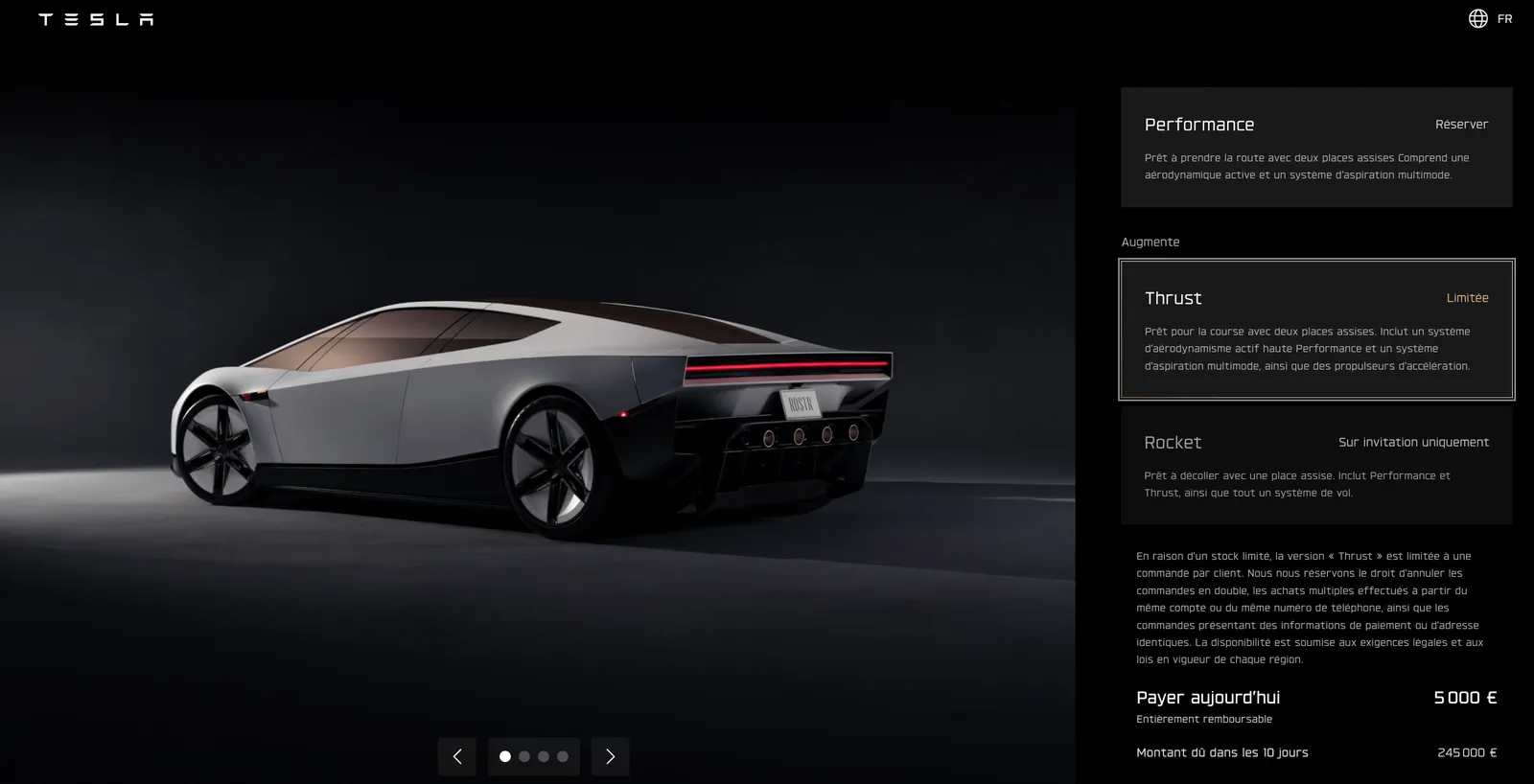
For the Performance version, an initial deposit of 5,000 euros is required, followed by another 45,000 euros within ten days. In total, 50,000 euros is needed to reserve a vehicle whose final price remains unknown. For the Thrust version, 5,000 euros are required first, then 245,000 euros — that adds up to a significant amount. As for the Rocket version, it will be available only by invitation.
Market release now scheduled for 2028
This is perhaps the most frustrating piece of news of the evening. After nine years of waiting, the new Roadster is still not ready for market release. Elon Musk now aims for production to begin in 2028. That deadline would mean the first units are produced more than a decade after the model was initially introduced. And given the numerous delays since 2017, it’s hard to consider this timeline as certain.
The manufacturer has not provided a specific date for the first deliveries, nor has it detailed the planned production volumes. It remains unclear where the Roadster will be assembled and what the final specifications of the models sold will be. This presentation thus marks an important milestone in the vehicle’s development, but it does not mean that first customers will be able to drive one soon.
A remarkable vehicle, but what for?
Beyond its impressive aerodynamic features and acceleration, this presentation raises a more fundamental question: what role can the Roadster still play in Tesla’s strategy? When it was unveiled in 2017, the company aimed to prove that an electric car could surpass the best traditional sports cars. At that time, the message made sense. Tesla was still trying to convince the general public of the capabilities of its technology.
But the market has changed significantly. Today, several manufacturers offer electric sports cars with exceptional performance. Tesla itself has played a major role in making impressive acceleration capabilities more accessible through the Model S Plaid. More importantly, the company’s priorities have shifted. Elon Musk now focuses on autonomous driving, robotaxis, artificial intelligence, and robotics. The Roadster almost seems like a counterintuitive project, as it celebrates the driving experience and human performance.
The executive acknowledges that this model should not have a significant financial impact on Tesla’s results. Its role is more to serve as a technological showcase, demonstrating what the company’s engineers can achieve when overcoming typical constraints. From this perspective, the presentation fulfilled its purpose. Tesla managed to deliver a spectacle rarely seen in the automotive industry. The next step is to turn this demonstration into an actual production vehicle.
In short, does Tesla really need a flying supercar when it aspires to create an automotive future where drivers no longer even need to hold a steering wheel? It’s up to you to decide. Watch the full event here: