
No more limits, more power, more intelligence… what the Electra CEO promises us
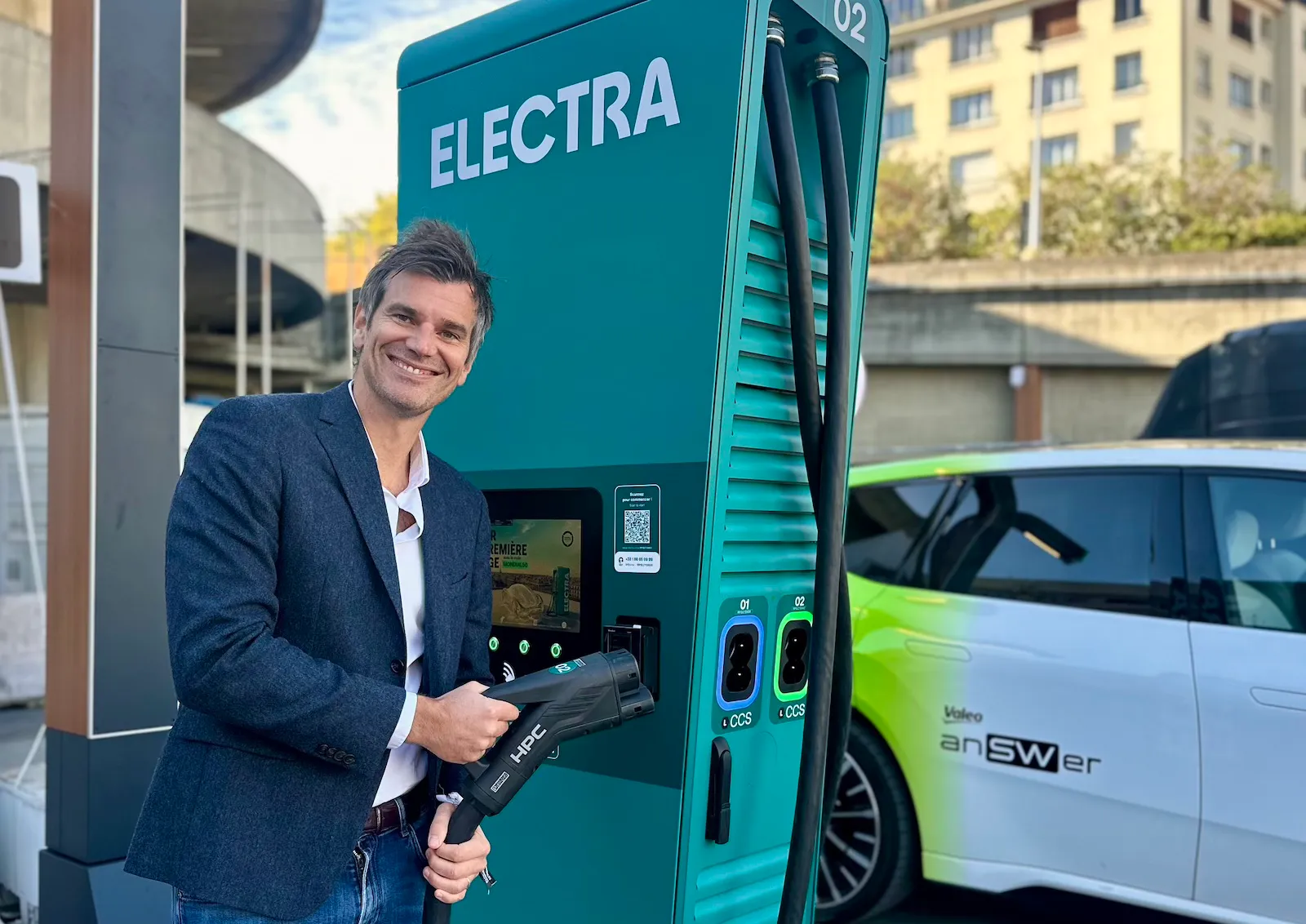
Having become profitable since the beginning of the year, Electra aims to accelerate its growth. With 600 kW charging stations, expanded facilities, an app available to all networks, and AI enhancements, Aurélien de Meaux, co-founder and president of the company, discussed at the Mondial de l’Auto what awaits electric vehicle users in the coming months.
"No more limits, no more stations, no more Germany, no more partnerships, no more AI, no more charging points, and no more power constraints." When asked what electric vehicle drivers can expect from Electra by early 2027, Aurélien de Meaux outlined its roadmap for readers of Automobile Propre. Six years after its establishment, the company operates over 800 stations in ten countries, including around 415 in France. And it shows no signs of slowing down...
The origins of Electra
Before Electra, Aurélien de Meaux co-founded Cheerz, a photo printing app launched in 2012. In 2020, amid the health crisis, he left that venture and decided to enter the mobility sector, which he is passionate about. He then consulted around a dozen acquaintances and experts about their transition to electric vehicles. “Within a minute, they were all talking about charging: I live in a condo, I don’t have a parking space, it seems there aren’t enough charging stations, the stations are broken...,” he recalls.
Together with Julien Belliato, who comes from the infrastructure sector, and Augustin Derville, he founded Electra with a simple idea: to recreate the experience of a gas station. “They’re everywhere, they work 100% of the time, and it only takes three minutes. We needed to recreate those same conditions so that switching to electric vehicles wouldn’t be a hassle.” The timing proved ideal: two years later, Europe set a deadline for ending sales of new internal combustion engine vehicles by 2035, and investment funds flocked to the sector.
More power, more charging stations
Specifically, what changes are coming for Electra customers in the months to come? The first major change is power output. After offering 300 and 400 kW chargers, Electra is now standardizing 600 kW chargers at its new stations to support the latest models capable of handling increasingly high charging powers. The older stations aren’t being neglected either: some of the units installed in 2021 and 2022, which have “aged a bit,” will be upgraded with entirely new, more powerful, and additional chargers.
The other goal is to expand the charging stations, which currently have an average of six to seven charging points. “Wherever space permits, we will ensure that there are almost no more stations with only four charging points, and that all of them have at least six or eight,” says Aurélien de Meaux. “We want larger and more powerful stations so that people don’t have to worry.”
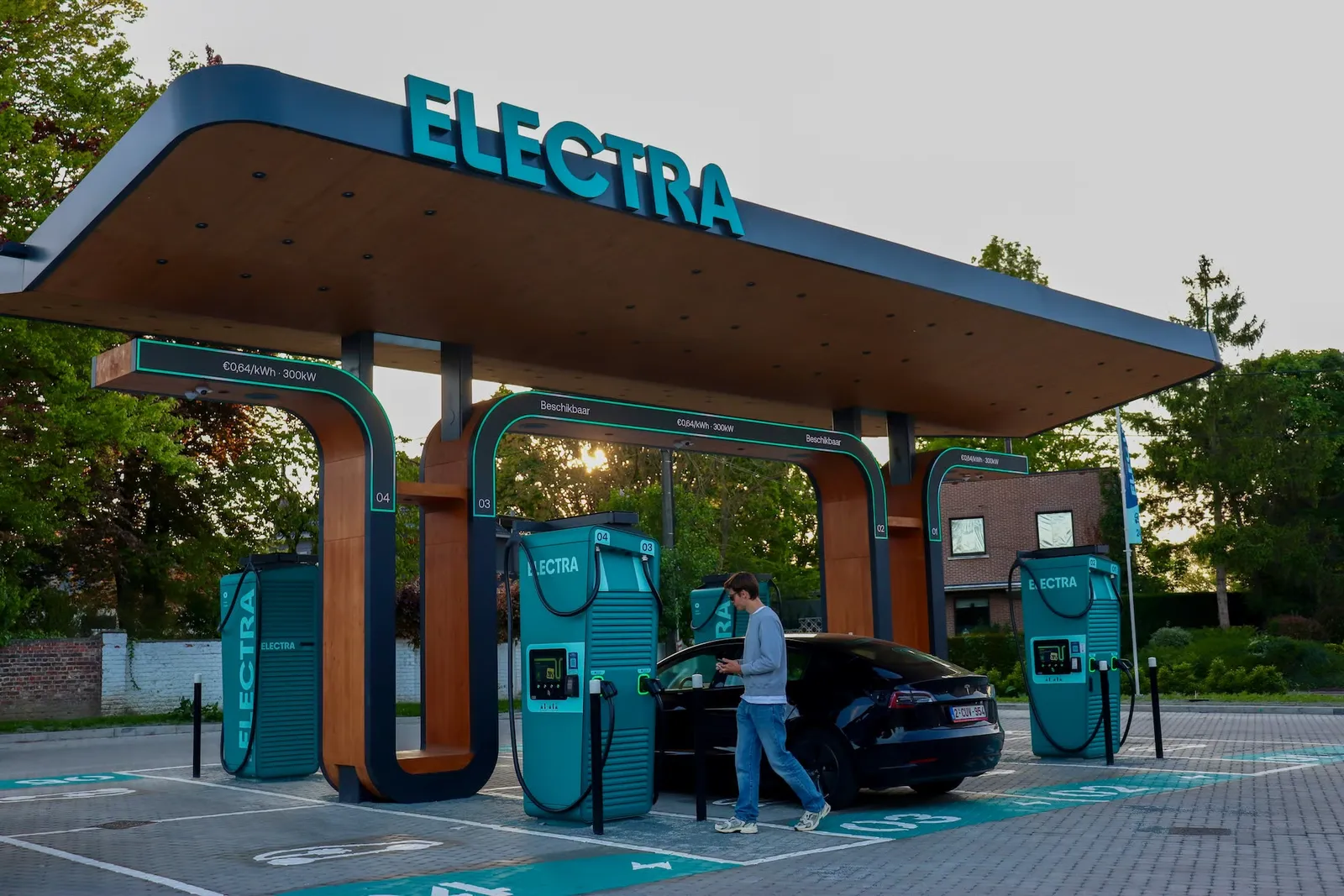
In terms of equipment, Electra relies on the Italian manufacturer Alpitronic. “I think they hold between 50 and 60% of the market share in Europe. What they’ve accomplished is enormous,” notes Aurélien de Meaux, praising the quality of their equipment and the manufacturer’s specialization.
For the executive, this success illustrates a fundamental trend in the electric vehicle sector. “In electric cars, who wins? Tesla, BYD, XPeng, and new players. When there’s a breakthrough in innovation, those who are 100% focused, thinking day and night about creating the best product, generally outperform established companies. It turns the tables.” This philosophy is also applied to Electra: “We don’t have any other agenda, no other business goals.”
Software: Electra’s secret weapon
If Electra purchases its terminals from Alpitronic, everything that makes them function is developed in-house. “We buy the hardware according to the configuration we require, and then connect it with our software. All the software, all the intelligence—those are things we’ve developed ourselves,” insists Aurélien de Meaux. This is a unique approach in an industry where many operators outsource this component. “Honestly, that’s Electra’s greatest strength. In terms of technology, I think we’re two or three steps ahead of the market.”
For the manager, the operator operates on two fronts: on one side, industry-related tasks (connection, permits, work with Enedis, maintenance, operation), and on the other side, technology. “People say a car is a computer on four wheels. A charging station is a computer that stands upright. It continuously sends us thousands of pieces of information from the car, the electrical grid, and the charging station.”
These data first enhance the user experience: automatic charging (Autocharge), Plug & Charge, subscriptions, reservations. But they are also valuable for maintenance. “We can restart a charging station remotely, perform predictive analysis, and distribute power intelligently. There’s a great deal of precision involved; we could discuss this with the technical teams for hours,” says Aurélien de Meaux.
To keep this software running, Electra employs 70 developers who release two to three updates per day. Handling compatibility with new models, error reporting, and managing the roughly 250 supported recharge cards: “There are many more use cases than in the oil industry, with all these issues related to power and communication with the car. Outsourcing this is too difficult for me.”
More intelligence: one app for all networks
This is the biggest news of the year. Since late June, the Electra app has given access to all public charging stations, regardless of their operator: over a million charging points in the ten countries where the company operates. For Electra’s CEO, this was primarily about addressing a recurring request from users. “We’ve been asked for this many times. People would say, ‘I love the Electra app; I use it all the time, but whenever I need to use another network, since Electra isn’t available everywhere, I have to switch apps.’ Now, they can stay on the same app!”
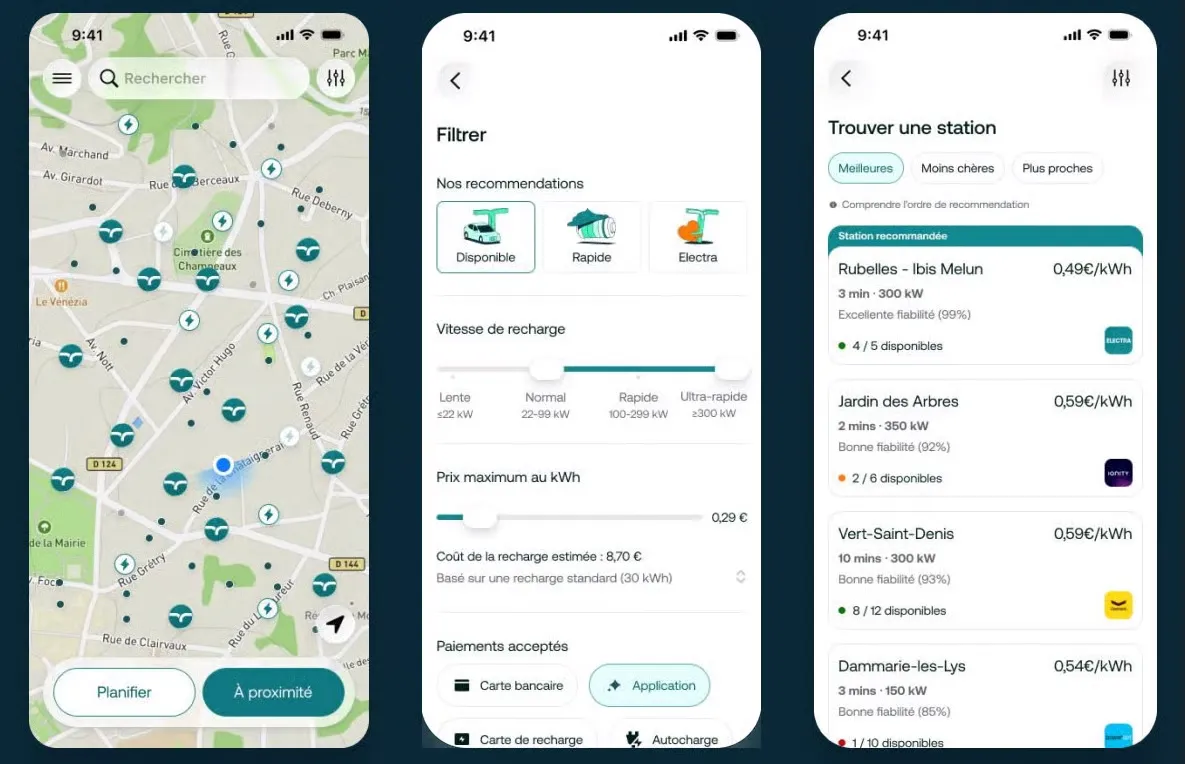
To stand out, Electra claims it does not charge any commission or surcharge for top-ups at its competitors’ stations: the price displayed is that of the operator. The app also offers favorable rates on its own network as well as those of its partners in ChargeLeague, the alliance formed with Fastned, Ionity, and Atlante.
Competing with Chargemap (which belongs to the same group as Automobile Propre), the app also includes a CarPlay-compatible route planner. This planner takes into account weather, temperature, car model, and charging profile to optimize stops. This approach seems attractive: Electra claims to have 100,000 users of its card in three months, about half of them in France.
The next step: voice commands enhanced by artificial intelligence. “The idea is that you can say: take me to Nice, stop at 6 p.m. because I want to take a break, find the cheapest route for me, or the fastest,” explains Aurélien de Meaux. Early versions are currently in testing. The operator also wants to increase partnerships with manufacturers and navigation tools to further simplify the process, from battery preparation to payment.
Also read
Test of the connected high-capacity Sparklin Spark 1 charger: the ideal solution for cottages, hotels, campsites, and Airbnb?
Network availability, a priority
Electra has made the availability of its charging stations a top priority. At the heart of this system is a supervision center located in Lyon, known as the NOC (Network Operating Center). The building, whose official opening is expected in the coming days, houses about twenty people who monitor the entire network around the clock. Artificial intelligence is also utilized here: it analyzes customer calls and emails to automatically flag the most common issues—such as overheating cables or rejected cards—to the technical teams.
In the field, the operator combines its own technicians, known as “Flying Doctors,” with major partner maintenance firms, three per country, such as Eiffage or Omexom in France.
Electra is also not spared by the scourge of cable thefts. “We don’t have more of them than others, but we’re also victims of this phenomenon,” admits Julien Belliato, co-founder of Electra and operations director. For the company, the cost is high. “A cable costs between 1,000 and 1,500 euros. Thieves, on the other hand, burn everything to recover the copper and only get 40 to 70 euros per cable. It’s a plague.” To combat this, Electra uses several defenses. “We first try to prevent it by protecting the cables with Kevlar sheaths. It often works, but not always—it depends on the thieves’ equipment,” explains our interlocutor. The stations are also equipped with alarms connected to police stations, which trigger as soon as a camera detects an intrusion or when a cable is cut. “It works pretty well: some thieves have been caught.”
“Catch it like that.” The operator finally cooperates with law enforcement and other operators, especially within the Charge France association. “There have been quite a few arrests in recent weeks. It seems things are starting to work.”Staying Focused on Core Business
Electric trucks, home charging: Electra doesn’t plan to diversify. “My brief experience as an entrepreneur taught me to focus on one thing and do it well. For Electra, that’s fast charging available to the public,” summarizes Aurélien de Meaux, who notes that the ten target markets represent 230 to 250 million vehicles to be electrified in the long term.
In the field of heavy trucks, the executive is convinced that the future lies in electric vehicles. However, Electra does not make this a priority. “We can’t do everything.” While one or two charging spots may be reserved for trucks at certain stations when space permits, the decision to install them will be made on an opportunistic basis. In other words, electric charging for heavy trucks is not part of Electra’s strategic priorities.
The same logic applies to home charging, a completely different business model that requires negotiation with property owners and management companies. Rather than entering this market, Electra has formed a partnership with Zeplug.
A business that has become profitable
Although it still needs to turn a profit on the approximately 1.2 billion euros raised since its establishment, including both equity and debt, the company maintains strong financial health. It has been profitable (positive EBITDA) since the beginning of the year and does not plan to raise additional funds before 2028 or 2029.
Electra claims a market share of over 20% in fast charging in France, where it positions itself as the leading provider in terms of utilization rates. According to Aurélien de Meaux, “If the market average is 100, Electra’s rate is around 230 to 250.” He attributes this success to strategic location choices, advanced technology, network effects, and a highly urban coverage that is favored by fleet operators.
Fleets continue to pour in, driven by rising diesel prices. Transport and delivery companies such as UPS, DHL, Amazon, and Chronopost, as well as ride-hailing and taxi services like G7, Uber, and Bolt, are accelerating their transition to electric vehicles. The company currently has 750 to 800 partner fleets in Europe and is expected to reach around a thousand by the end of the year, slightly below the initially targeted 1,200.
"Two or three years ago, fleet managers switched to electric vehicles for sustainability reasons. Now, it’s about cost," notes Aurélien de Meaux.
Germany, the new priority market
Globally, Germany is at the center of Electra’s ambitions. The company already has around fifty charging stations there and aims to reach a hundred by the end of the year, with a goal of 800 stations by 2030.
To accelerate growth, Electra plans to combine the development of new charging stations with acquisitions. For Aurélien de Meaux, consolidation in this sector is inevitable. “In charging, small isn’t beautiful,” he says with a smile. The executive confirms that an initial network acquisition should be announced in the coming weeks in a neighboring country.
In France, Electra remains on the lookout but has yet to find the right partner. In the long term, international expansion is set to take precedence: 60% of the operator’s charging stations will be located outside France by the end of 2027, and 70% by 2030.
Also read
Zeplug and ChargeGuru disappear: here’s Tohmo, their new brand for electric charging
“Sell Electra? That’s not interesting to me”
If Aurélien de Meaux made a good deal by selling Cheerz to the German company CEWE, which acquired 80% of it in 2018 for around 36 million euros, he does not see himself taking the same path with Electra.
“Selling isn’t something that interests me. I’ve already sold a company once and was lucky enough to make some money back then. Today, I see the potential and the prospects: we’ve built out this network a lot over the 2020s. For the 2030s, there are a billion things to do.”
With a goal of 2,500 stations by 2030, Electra still has a long way to go. But Aurélien de Meaux sees the accelerating sales of electric cars as reason enough to remain optimistic. “Two or three years ago, we looked at countries like the Netherlands or Denmark with 40% penetration and thought it would be extraordinary. It’s quite exhilarating to think that this is actually happening.”