
Great Han: BYD launches 5.26-meter-long electric sedan
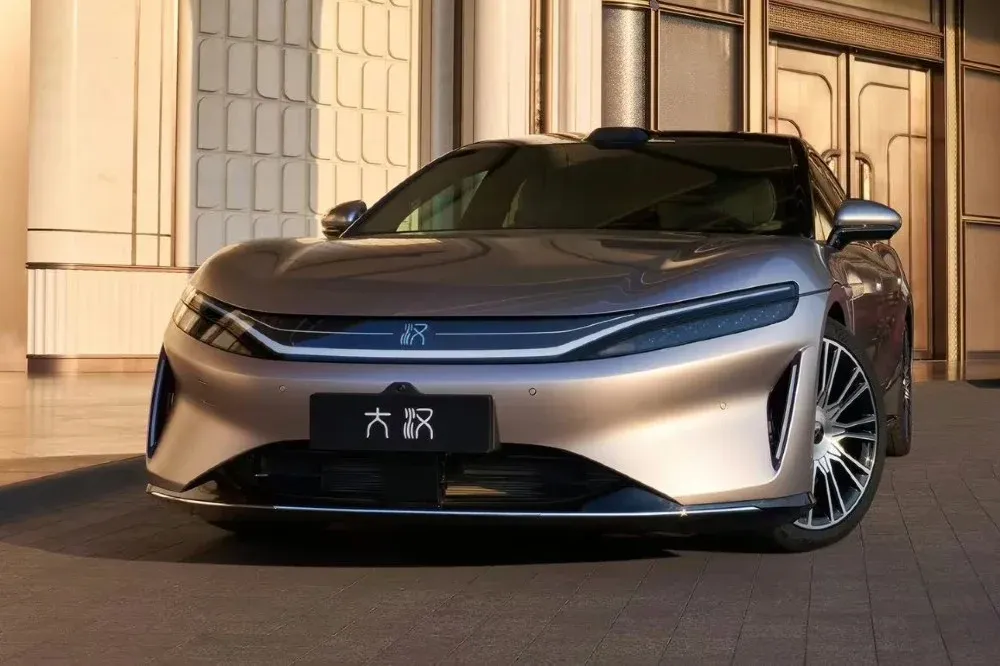
BYD is introducing its new electric flagship sedan, the Da Han EV — also known as Great Han — in China. This sedan has been positioned by BYD as a luxury model for years alongside the E-SUV BYD Tang, which was also renamed “Great Tang” this summer.
Image: BYD
BYD already launched its seven-seater electric SUV, the Great Tang, in China back in June. This full-size SUV is expected to achieve a range of up to 950 kilometers according to Chinese standards and will cost around 30,800 euros. The new Great Han, as its conventional flagship sedan, was supposed to follow at a later date. Four months later, it’s here: officially named the Da Han EV, this electric vehicle is built on a 1,000-volt architecture, aims for a range of 1,008 kilometers per Chinese testing cycle, and will cost 235,900 yuan, which is approximately 31,300 euros.
Both successors to the Tang and Han models now rank as new luxury models in the company’s “Dynasty” series. They share the same length of 5.26 meters, with the Da Han EV being significantly lower at 1.51 meters, true to its sedan design. The model is available in three variants with list prices ranging from 235,900 to 275,900 yuan, which translates to a price range of 31,300 to just under 36,600 euros.
The entry-level model “LiDAR Premium” features rear-wheel drive and achieves a range of 1,008 kilometers according to CLTC standards. Above it is the also rear-wheel-drive “LiDAR Flagship” model with an identical range, which is further surpassed by the all-wheel-drive “LiDAR Flagship” version. BYD claims 880 kilometers of range for this last model. In all cases, the five-seater sedan is 2 meters wide and 3.13 meters long between the axles. BYD reports a drag coefficient of 0.197.
Regarding the powertrain, we already know the key specifications—thanks to the mandatory registration process in China with the Ministry of Industry and Information Technology. Thus, the 370 kW output of the single-motor variants and the 570 kW output of the all-wheel-drive version come as no surprise. The acceleration from 0 to 100 km/h is said to take 4.9 seconds for the single-motor version and 3.3 seconds for the all-wheel-drive version. All variants share a 102.3-kWh battery from BYD’s portfolio. It is a Blade battery using LFP chemistry from BYD’s second generation, which, according to the manufacturer, supports flash charging and can be charged from 10% to 97% in just nine minutes.
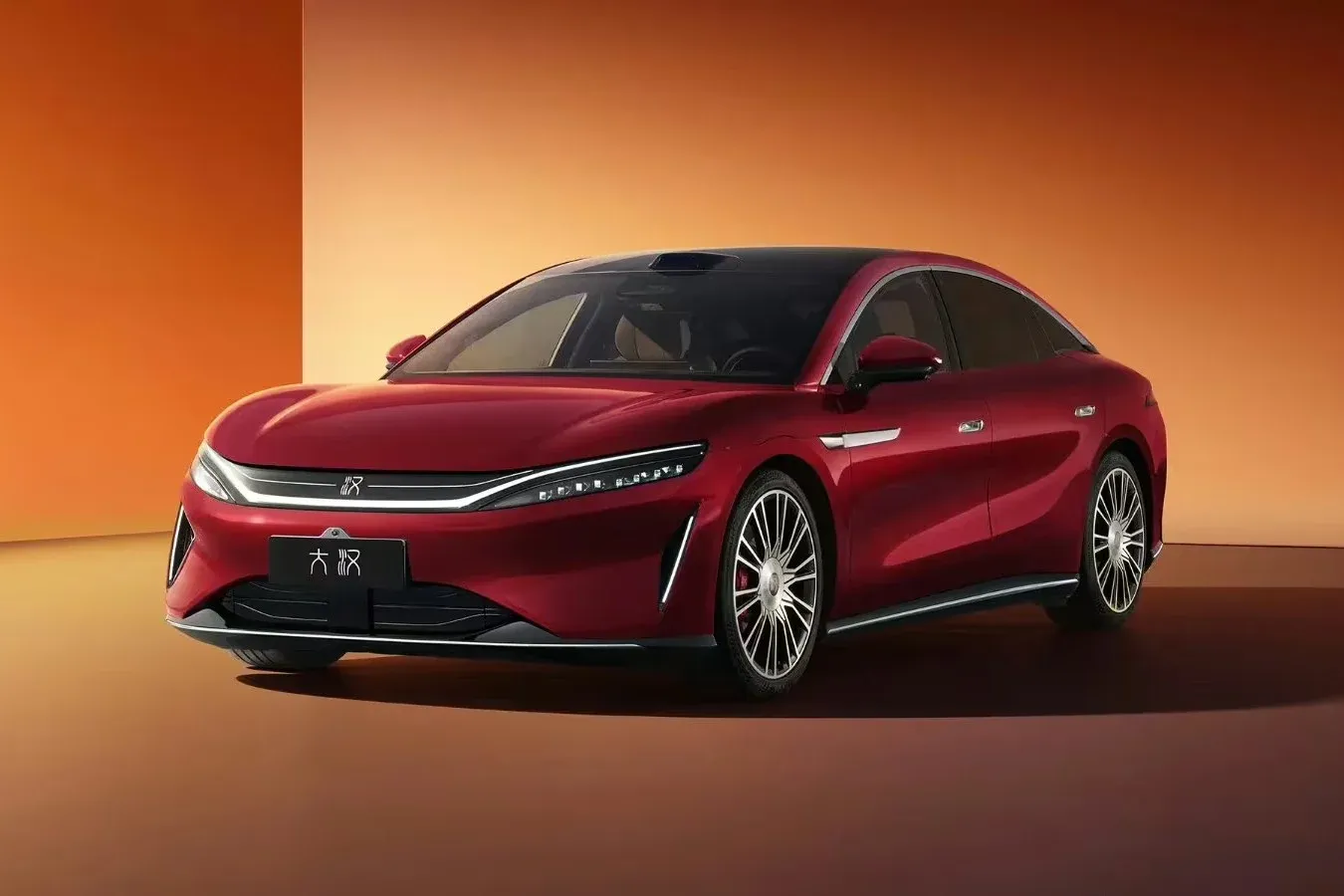
BYD lists a special dual-chamber air suspension and a predictive chassis control system called “Road Preview” as additional features of the new luxury sedan. The model series also features a rear-wheel steering system with a maximum steering angle of 7 degrees, reducing the turning radius to 5.2 meters and enabling what is known as “Crab Walk,” a type of diagonal movement of the vehicle. All variants are equipped with a LiDAR-based driver assistance system (“God’s Eye B”) as well as a driver assistant package (“God’s Eye 5.0”). Additional features include special comfort seats, Nappa leather upholstery, or a high-quality audio system with 31 speakers.
The exterior design of the Han successor follows BYD’s signature “Loong Face” design, featuring narrow headlights, a chrome grille, and vertical air intakes. The roof has a distinct color accent and houses the aforementioned LiDAR sensor in the center at the front. The new flagship is also equipped with 20- or 21-inch wheels (in various designs). The vehicle’s curb weight ranges from 2.2 to 2.5 tons.
The pre-sale of the Da Han EV began on August 21 at the Chengdu Auto Show. According to Chinese industry websites, initial purchase incentives include one year of free fast charging as well as trade-in bonuses. Importantly, the launch will initially feature only battery-electric versions. Although BYD has already applied for regulatory approval for a plug-in hybrid version of the Da Han EV, it did not announce prices for the partially electric model at the current presentation.
Regarding positioning, colleagues at CN EV Post recently noted that BYD is filling a gap in its product portfolio within the 300,000 yuan price segment by introducing the Great Tang and Great Han, thereby “creating a clearly tiered product matrix alongside the Denza and Yangwang model lines.” Both of these are luxury sub-brands of BYD.
For context, the Han, just like the Tang, is a historically significant model for BYD. With these two models, BYD gained early access to the domestic premium electric vehicle market. Since their launch, both models have undergone multiple updates. Most recently, in 2025, BYD expanded these two series with the new flagship models Tang L and Han L, which are based on the company’s new 1,000-volt platform. With the Great series, BYD is further expanding its product range.