
GBT begins series production of solid-state battery cells
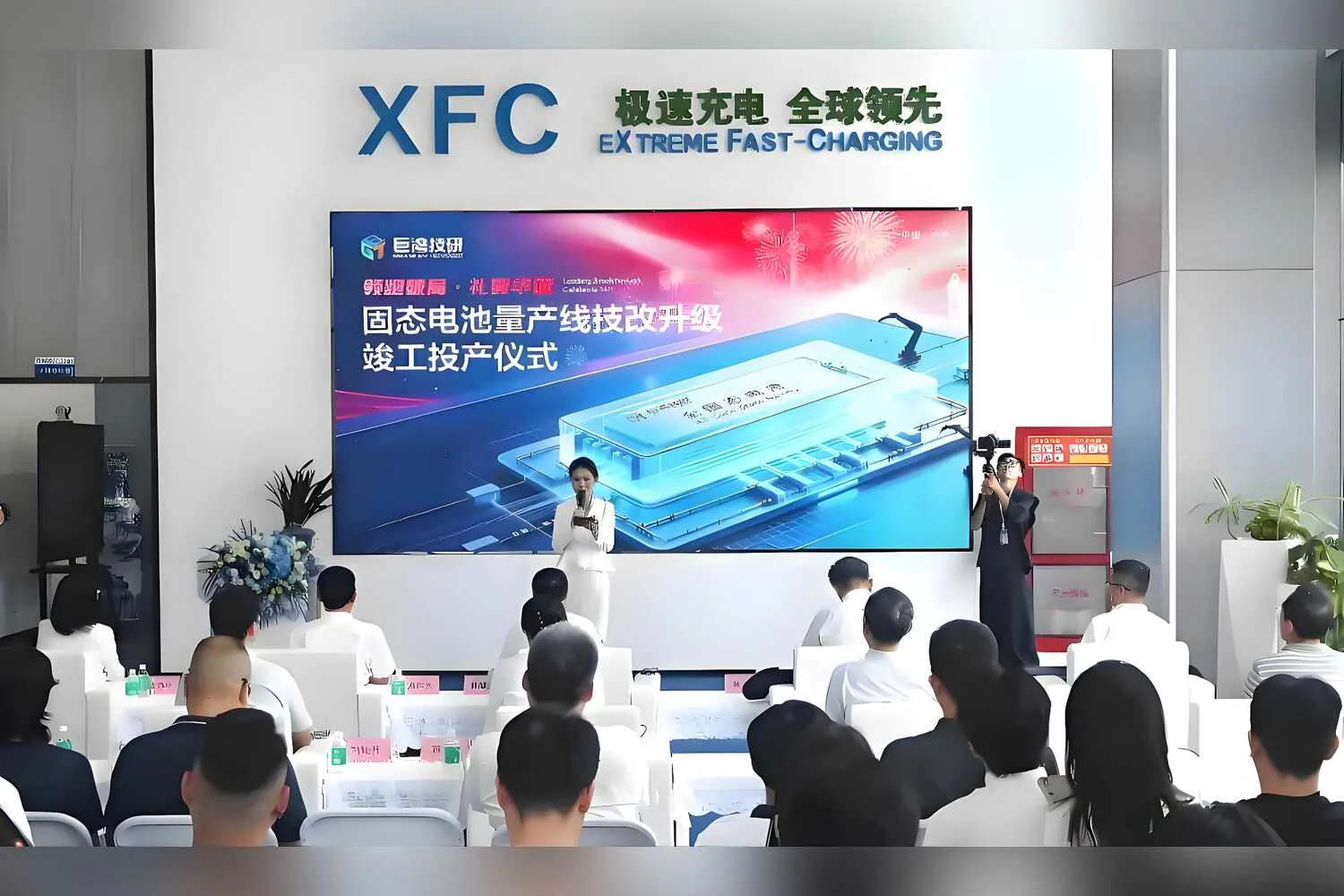
Greater Bay Technology, a Chinese battery developer supported by the GAC Group, has started series production of solid-state battery cells in Guangzhou. Production is taking place on a converted lithium-ion line with an initial capacity of 1 GWh, which can be expanded to up to 4 GWh.
GBT starts series production of solid-state cells in Guangzhou.
Image: Greater Bay Technologies
On 13 October, GBT began series production of all-solid-state battery cells at its plant in Nansha, near Guangzhou. Instead of building a new dedicated facility, the company repurposed an existing lithium-ion production line. The plant currently has a capacity of 1 GWh for solid-state cells. According to the company, if demand increases, the remaining capacity of the 4 GWh plant can also be converted to solid-state cell production.
According to GBT, two of its production cells have met the requirements in tests conducted by the National Power Battery Innovation Center. The company claims to be the first manufacturer whose cells have been verified under the new regulatory framework. The standard is, among other things, meant to provide a clearer distinction between true solid-state batteries and semi-solid or hybrid cells.
The core technological innovation lies in the manufacturing process. Many solid-state battery programmes rely on sulphide electrolytes, which require oxygen-free and extremely dry environments for processing, often necessitating specially designed production facilities.
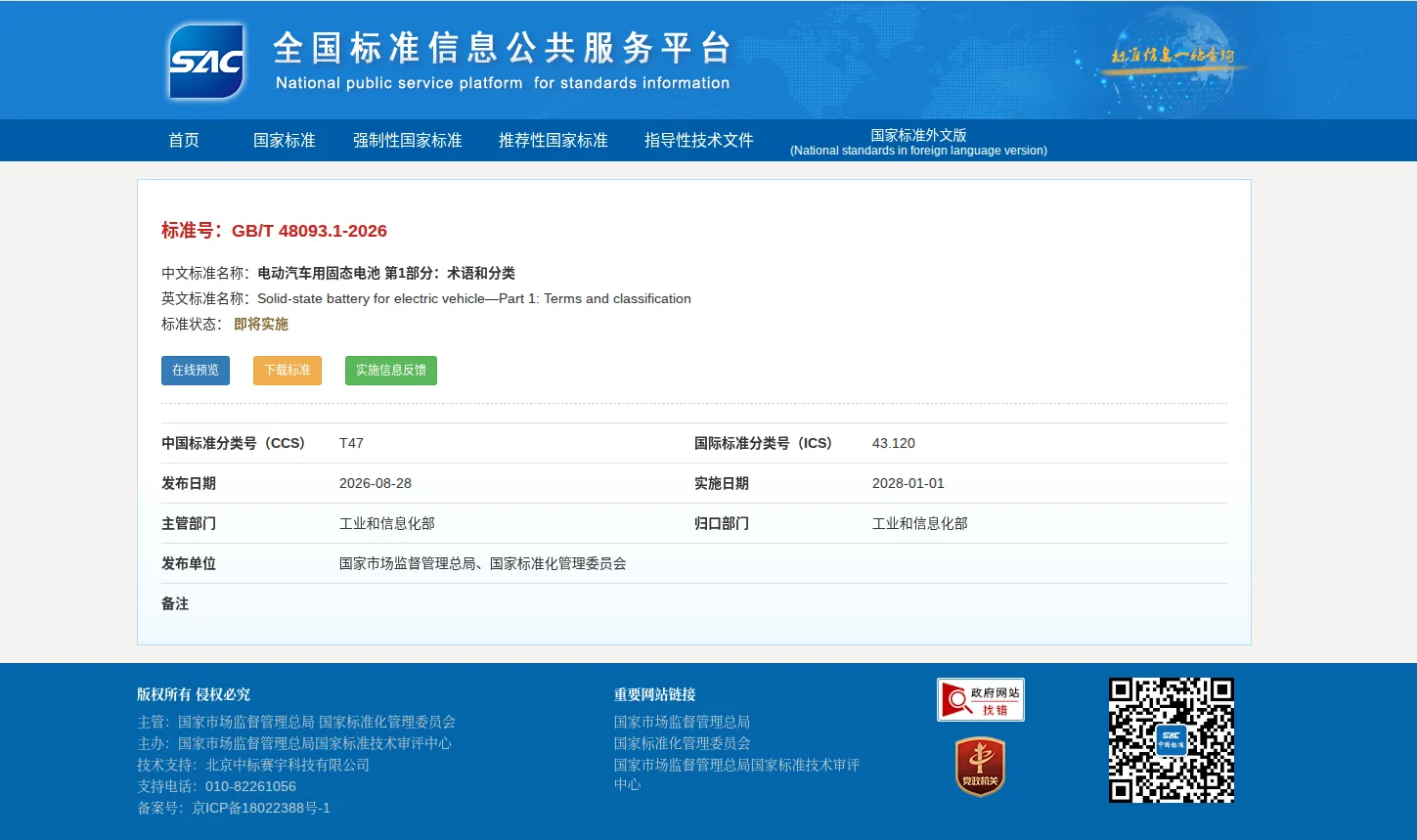
GBT states that its cells are the first to be tested and certified according to the requirements of the Chinese Standard GB/T 48093.1-2026. The standard, “Solid-state battery for electric vehicle – Part 1: Terms and classification,” was published on 28 August 2026 but will not formally enter into force until 1 January 2028.
GBT is taking a different approach. The company’s proprietary organic-inorganic composite electrolyte is first introduced into the cell as a liquid precursor and then solidified inside. This is said to create an adaptable, elastic interface with the electrodes.
Since the electrolyte is formed inside the cell, key production steps such as electrode manufacturing, stacking, formation, and testing can continue on conventional lithium-ion equipment, according to GBT. The main modification was to the electrolyte filling process, where the precursor is injected and cured in a dry, oxygen-free environment.
GBT relies on repurposed lithium-ion production
The Chinese cell manufacturer says the production line can manufacture both conventional lithium-ion cells and solid-state cells, switching between the two technologies as demand requires. GBT aims to reduce capital investment and economic risk during the ramp-up of the new cell technology. The company also produces the solid electrolyte and key raw materials itself and claims to hold more than 50 patents for the technology.
“This is not a new line built from scratch; it is an existing line with a new core,” says GBT founder and CTO Huang Xiangdong, who says the project progressed from A-samples in April to series production in October.
For its technology platform, GBT cites energy densities between 260 and 480 Wh/kg, depending on the cell generation and material configuration. The first generation now in production is based on pouch cells for automotive applications and established electrode materials. Later generations are expected to use lithium-metal anodes, among other innovations. GBT states that samples are already being tested by customers from various industries, with some cells also undergoing testing and validation with automakers.
In terms of safety, GBT refers to tests conducted in accordance with the Chinese Battery Standard GB 38031-2025. In an externally conducted nail penetration test on a fully charged cell, neither fire nor explosion occurred. Regarding lifespan, the manufacturer has so far only stated that the cycle stability is comparable to conventional lithium-ion cells.
Alongside the start of production, GBT has announced its first cooperation partners. Hubei Liming Lithium Technology is to integrate the cells into battery systems for vehicles and stationary storage. Additionally, there is a collaboration with an eVTOL aircraft development centre in Shenzhen. Furthermore, GBT states that it is in advanced discussions with several major automakers regarding series applications.
The battery developer, supported by GAC, is entering an environment where battery quality has recently become a major focus for the automotive group itself. There have been increasing reports of issues with LFP cells from supplier CALB in the widely used Aion S in China, particularly in high-mileage vehicles. GAC Aion and CALB have responded with extended warranty and service measures. There is no connection to GBT or its solid-state technology.
GBT sees electric vehicles as the primary target market for its solid-state cells. The company also mentions other applications, including eVTOLs, humanoid robots, stationary storage, and special vehicles. In Europe, the battery developer is working with the commercial vehicle startup Flynt and offers its technology through cell supplies, technology transfer, and joint ventures.
Whether this approach truly enables a faster and more capital-efficient path to the industrialisation of solid-state batteries will now be demonstrated in series production. The decisive factor will be whether the technology can be manufactured in larger quantities with stable quality, competitive costs, and the announced performance specifications.
_Source: Information via email_