
Researchers are developing an early warning system for electric vehicle batteries
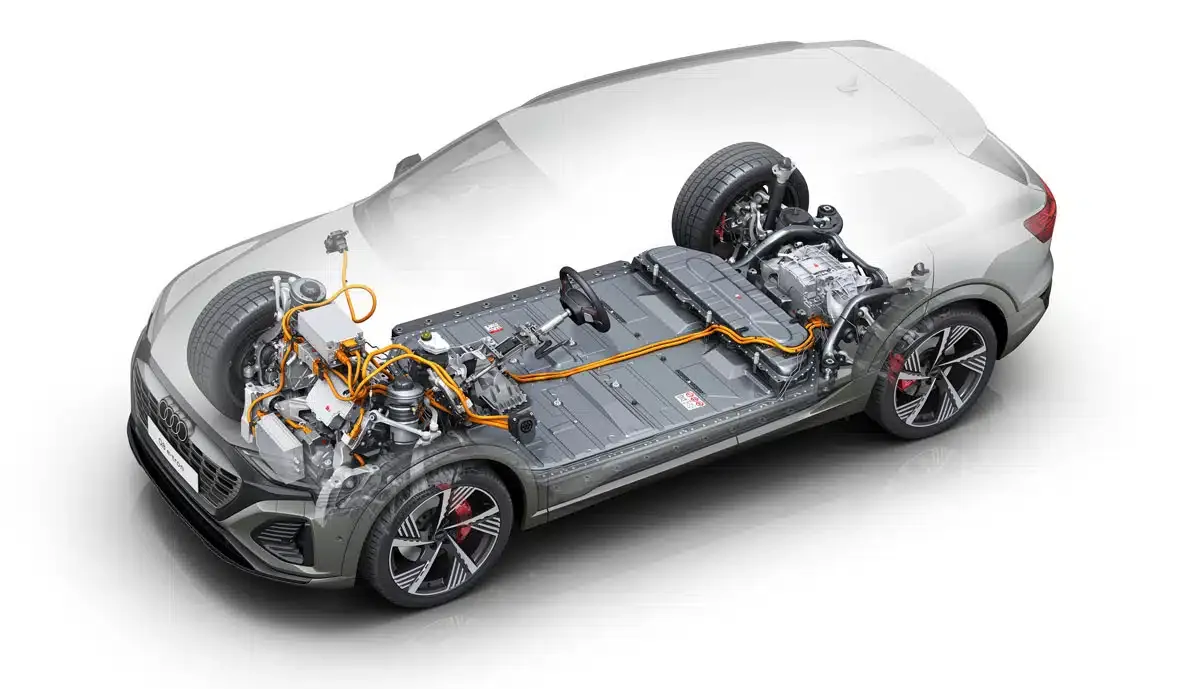
Image: Audi (illustrative)
An international research team involving China’s Tongji University and the Fraunhofer Heinrich-Hertz Institute has developed a new early warning system for lithium-ion batteries. The study combines fiber-optic temperature sensors with a multi-stage diagnostic process. Its goal is to detect critical temperature changes in electric vehicle battery systems earlier than with conventional battery management systems.
According to the scientists, the advantage lies in the significantly higher spatial resolution of temperature monitoring. While the conventional measurement system examined in the study used 32 temperature measurement points, the integrated fiber optic sensors enabled measurements at 540 locations. This allows for more accurate detection of local temperature differences within the battery pack. The optical fibers do not require a separate electrical sensor cable for each measurement point.
The early warning system analyzes not only the absolute temperature but also its rate of change and the so-called Shannon entropy of the temperature distribution. This mathematical measure describes the statistical distribution of temperature readings and is used to detect unusual thermal patterns. Together with dynamic warning thresholds, these various metrics aim to identify thermal anomalies before conventional limits are reached.
In laboratory tests, the system achieved a maximum time advantage of 706 seconds, equivalent to 11 minutes and 46 seconds, compared to the reference criteria of conventional battery management systems used in the study. Under real vehicle operating conditions, the maximum advantage was 554 seconds, or 9 minutes and 14 seconds.
The development is intended to detect abnormalities early, which may indicate an increased risk of a so-called thermal runaway. In such cases, battery cells can heat up significantly due to uncontrolled chemical reactions. Earlier detection could give battery management more time to implement appropriate protective measures. However, the study did not prove whether this can actually prevent battery fires.
Scientists from Tongji University in Shanghai and the Fraunhofer Heinrich-Hertz-Institut in Goslar were involved in this research. The technology is still in the research phase. For widespread use, factors such as the long-term durability of the sensors, their integration into various battery designs, and additional costs would need to be examined. No specific plans for deployment in production vehicles were mentioned.
Also interesting
About the author
Thomas Langenbucher is an expert in electromobility with experience in the automotive and financial industries. Since 2011, he has been covering electric vehicles, sustainable technologies, and mobility solutions for ecomento.de. Learn more.
Reader interactions