
Daimler Buses: Electric tour bus with over 500 km range tested
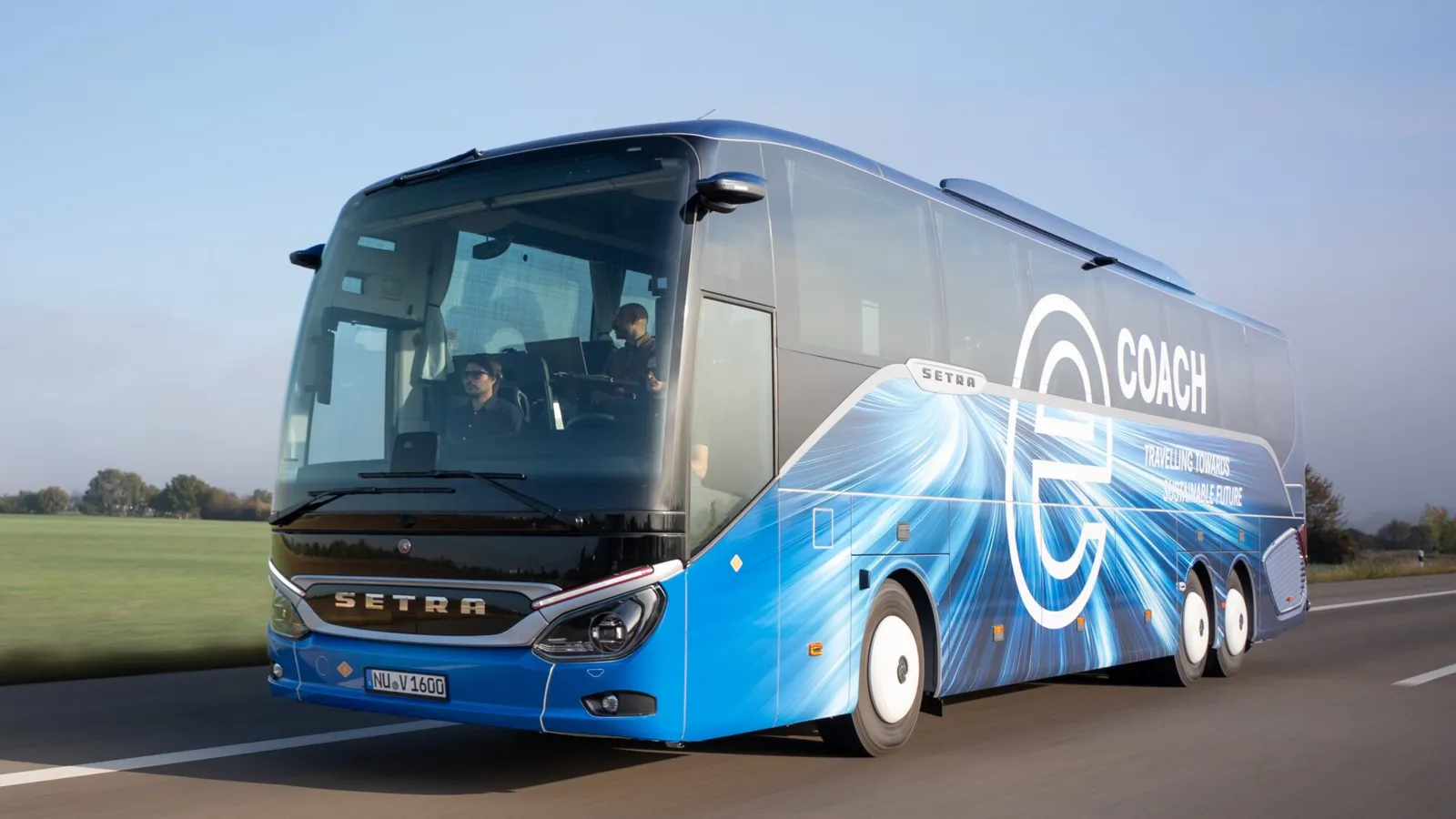
Daimler Buses has tested a technology platform for an electric coach with a range of over 500 km as part of the ELCH funding project, in collaboration with KIT, RPTU, Uni Mannheim, and Flix. Funded at 6.26 million euros, the project will run until the end of 2026.
Advertisement
In urban buses, electric propulsion is already standard in many German municipalities, but the situation is different in the coach sector. Long distances on intercity routes, high average speeds on highways, and the need for space for passengers and luggage place significantly higher demands on batteries and energy efficiency. This is precisely where the “Electrified Coach” initiative, or ELCH for short, focuses—initiated by Daimler Buses in collaboration with research institutions and intercity coach operator Flix. At a meeting in Neu-Ulm at the beginning of October, the technology platform developed as part of the project was tested in a joint drive.
Test Drive of the Technology Platform in Neu-Ulm
The consortium meeting in Neu-Ulm was the last face-to-face gathering of the project partners before the completion of the initiative. The focus was on a joint test drive using the experimental vehicle, designed for a range of over 500 kilometers. The drive was intended to test and validate the technical concepts developed so far under practical conditions.
Daimler Buses does not provide details in the announcement regarding battery capacity, propulsion performance, or charging speed. It is also unclear from the information whether the stated range has already been achieved in tests or remains only a design goal. In addition to the test drive, the partners used the meeting to discuss the project progress and coordinate the remaining tasks until completion. ELCH is ongoing until the end of 2026.
Advertisement
Goal: a market-ready battery-electric tour bus
The stated goal of the project is to develop and validate a battery-electric tour bus concept that can be used economically in regular service. It’s not just about the drive system and batteries. The partners are also examining energy consumption, aerodynamics, ways to reduce weight through lightweight design, cost-effectiveness, and practical applicability in tour bus operations.
Weight and air resistance play a more significant role in tour buses than in urban traffic: A large portion of the journey is covered at a consistently high speed, and regenerative braking offers fewer benefits here compared to stop-and-go driving. Therefore, any improvement in efficiency directly affects the achievable range or the size of batteries required.
The partners and their tasks
The project is coordinated by Daimler Buses. The consortium includes the Karlsruhe Institute of Technology (KIT) with its Institute for Technology of Information Processing (ITIV), the University of Mannheim with its Mannheim Institute for Sustainable Energy Studies (MISES), the Rheinland-Pfälzische Technische Universität Kaiserslautern-Landau (RPTU) with its iMAD and SAM institutes, as well as Flix SE.
Research Institutions
KIT focuses on analyzing and processing vehicle data and working on an optimized operating strategy for electric tour buses. At RPTU, emphasis is placed on lightweight design and aerodynamics to improve fuel consumption and range. MISES in Mannheim evaluates the economic viability of battery-electric tour buses in various usage scenarios and their competitiveness compared to other options.
Partner Flix
Flix, as the operator of the long-distance bus network, contributes real operational and usage data to the project. Based on this data, practical driving cycles and application scenarios are intended to be developed, allowing for more realistic evaluation of the concepts compared to standardized test cycles.
Funding and Integration into Daimler Buses’ Strategy
The German Federal Ministry for Economic Affairs and Energy is funding ELCH under the “Competition for Electrified Heavy Transport and Passenger Transport” call within the Elektro-Mobil program, with a total amount of 6.26 million euros. The funding is administered through the DLR project management agency.
For Daimler Buses, this project is part of its own electrification strategy. The manufacturer aims to offer battery-electric tour buses by the end of the decade. The findings from ELCH are intended to inform the development of corresponding vehicle concepts and technologies. The company does not specify any particular model or timeline for market launch in this regard.
Advertisement