
Both are good, but one is raw.
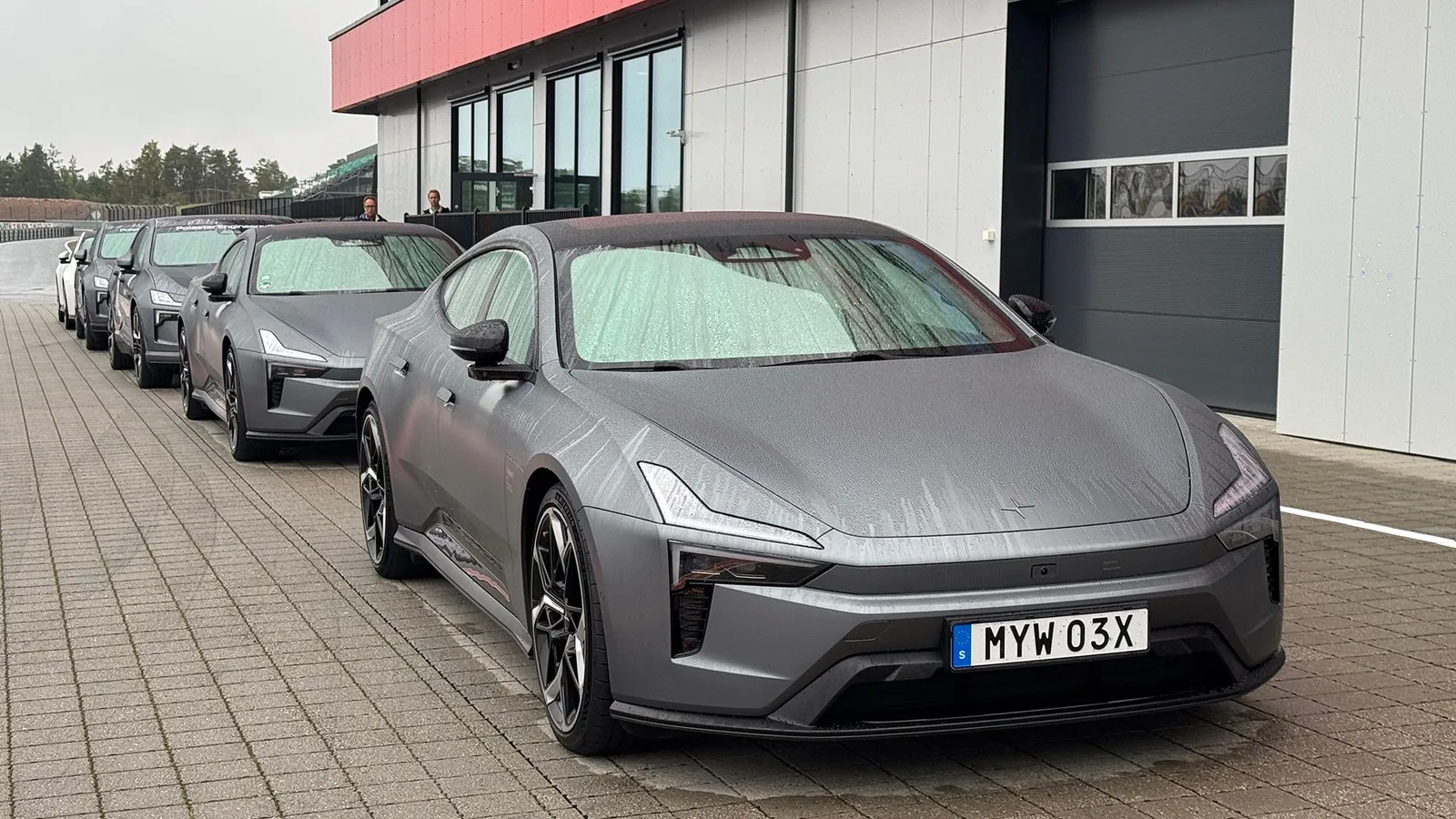
Polestar invited us for a quick test drive of the Polestar 5 in both trim versions. The Performance version is the one we’ll remember.
10/16/2026 07:00 | Updated 11:18
We met early at the Polestar facility in Fornebu. There were two Polestar 5s parked there — a silver Long Range and a white Performance.
I grabbed the keys to the white one and pointed the dashboard toward Rudskogen. But I took the slower route. Instead, I chose the most scenic roads in inner Østfold.
We’ll take a closer look at:
What kind of car is this?
Pros and cons
Sitting position — wonderfully low
Interior — minimalist and familiar
Rear seating — best for two
Trunk space — quite limited
Driving experience — pretty fun
Range — 678 kilometers
Charging — 350 kW
Price and competitors — it’s not cheap
Conclusion
We’re excited to meet Polestar’s chief test engineer and chassis engineer, and get to test their first proper GT car on the track. More on that later.
What kind of car is this?
The Polestar 5 is a large, low, and expensive electric GT developed from the Precept concept car.
It features its own aluminum platform, along with huge power and ambitious goals. There’s no doubt Polestar has Porsche Taycan and Geely Group’s own Lotus Emeya in mind here.
Polestar 5 – Summary
Pluses
Great driving experience
Solid handling
Adequate space for four passengers
Minus points
Expensive
Limited space
Camera mirrors
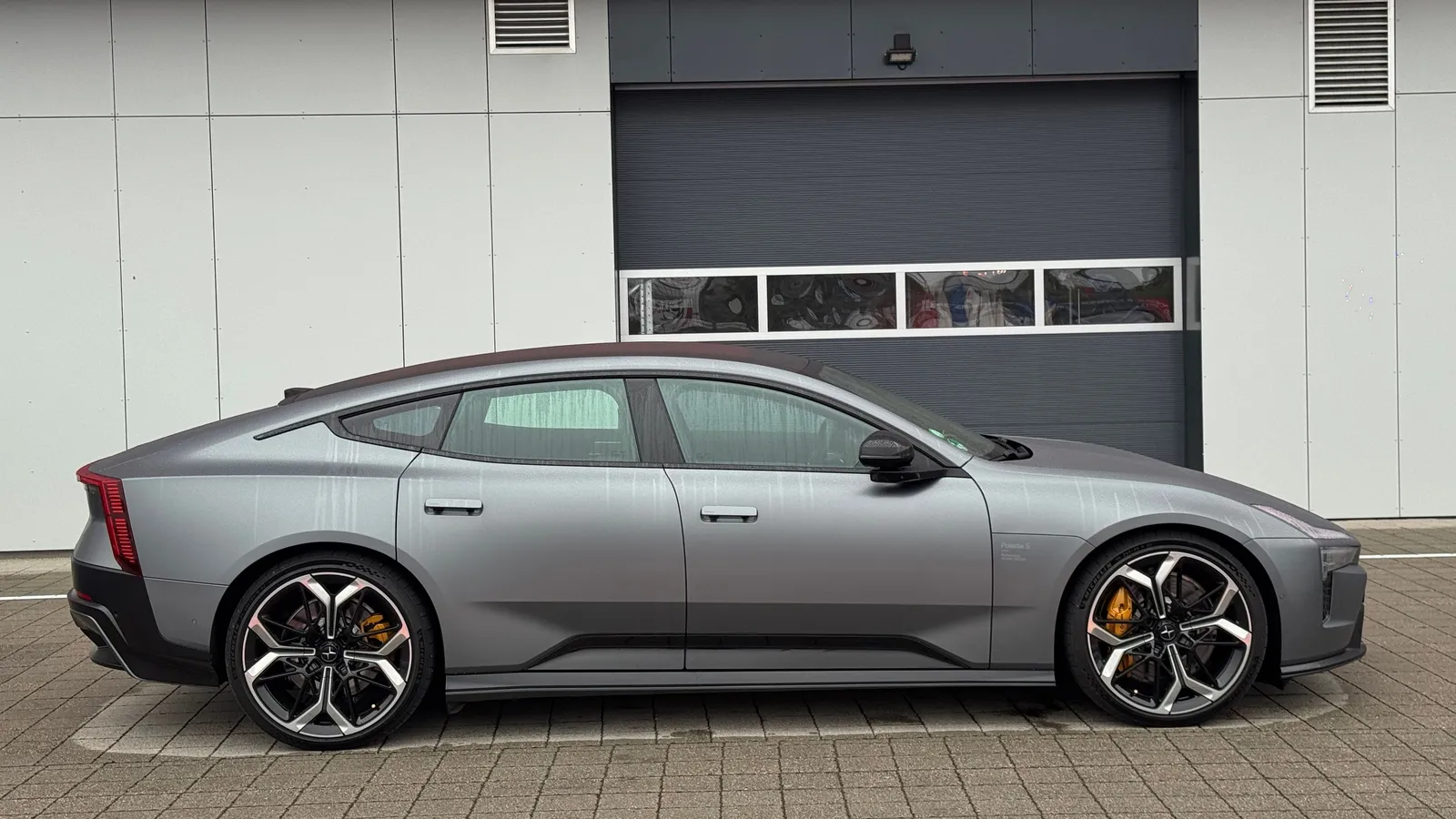
The design is heavily inspired by the Precept concept, resulting in a car over five meters long but no more than 1.4 meters high. And it looks awesome on the road.
This is not the car you buy because you need the most car for your money. With a starting price well over 1.3 million kroner, Polestar has placed the Polestar 5 in a completely different world from the brand’s more affordable models.
Similar to the Precept concept
The body is built on a custom aluminum platform where aluminum components are welded together, unlike what Lotus did with its Elise sports car back in the day.
The goal is extremely high torsional stiffness, which they have also achieved. The torsional strength is said to be 45,000 Nm per millimeter for those familiar with such figures.
Design-wise, the resemblance to the Precept concept is clear. The long, low profile and distinctive rear end are preserved, with the trunk remaining far back.
The rear view is handled by a camera and digital rearview mirror, just like in the Polestar 2. It comes in an SUV version with a rear wheel drive setup. The Polestar 4 SUV is expected to become their bestseller until the next car is launched.
Sill-less windows, sill-less side mirrors, and door handles that extend from the body further enhance its concept car aesthetic. Along with the distinctive lighting signature at the front, there’s no doubt it’s the Swedish star arriving.
20-inch wheels are standard on the Dual Motor version, while the Performance model starts at 21 inches. Both can be ordered with one inch larger wheels. The tires are specially developed by Michelin for this car.
Sitting position – wonderfully low
Here, Polestar has nailed it. You sit incredibly comfortably and very low, if that’s what you prefer. This is something many people love about this type of car.
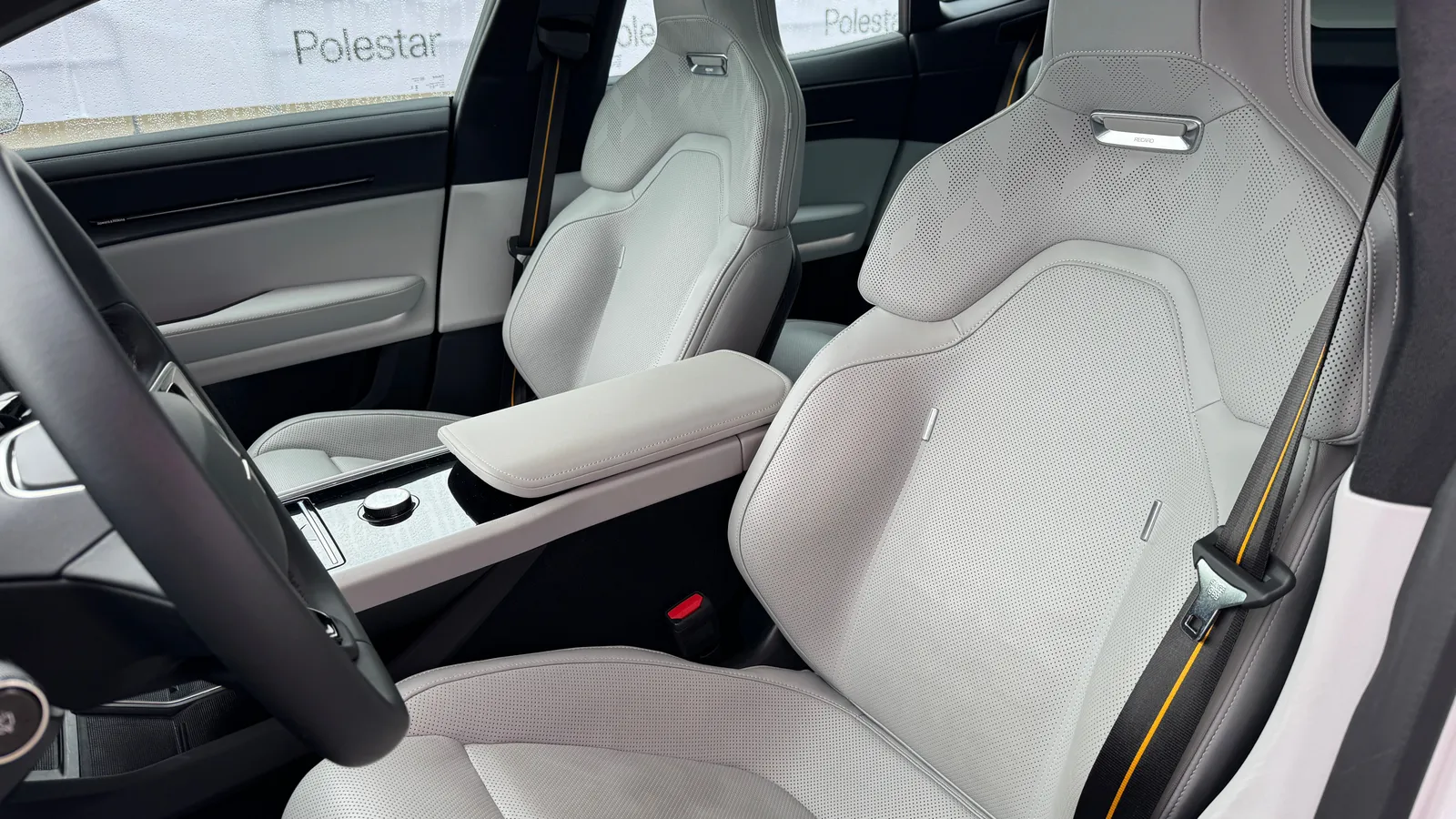
It is obvious that a Porsche-like driving position has been high on the wishlist during development, even though the seats have far fewer adjustment options.
The seats were developed in collaboration with Recaro and feature 8-way electric adjustment. They can be equipped with both ventilation and massage functions. The seat back has a manual recline function.
The steering wheel adjustment has a large range, making it easy to extend it far enough to achieve a comfortable driving position. Both steering wheel and mirror adjustments require input via the screen.
The steering wheel is fast enough, but if one wants to lean into a corner without grinding the tires, it takes a long time to adjust the mirrors using the screen.
Interior – Minimalist and familiar
The interior is unmistakably Polestar, and thus also shares a certain kinship with Volvo.
It is minimalist and quite subdued. You have separate screens for instruments and multimedia.
The design is strictly business-oriented, with large gray and orange accents that are easy to reach even with sweaty fingers.
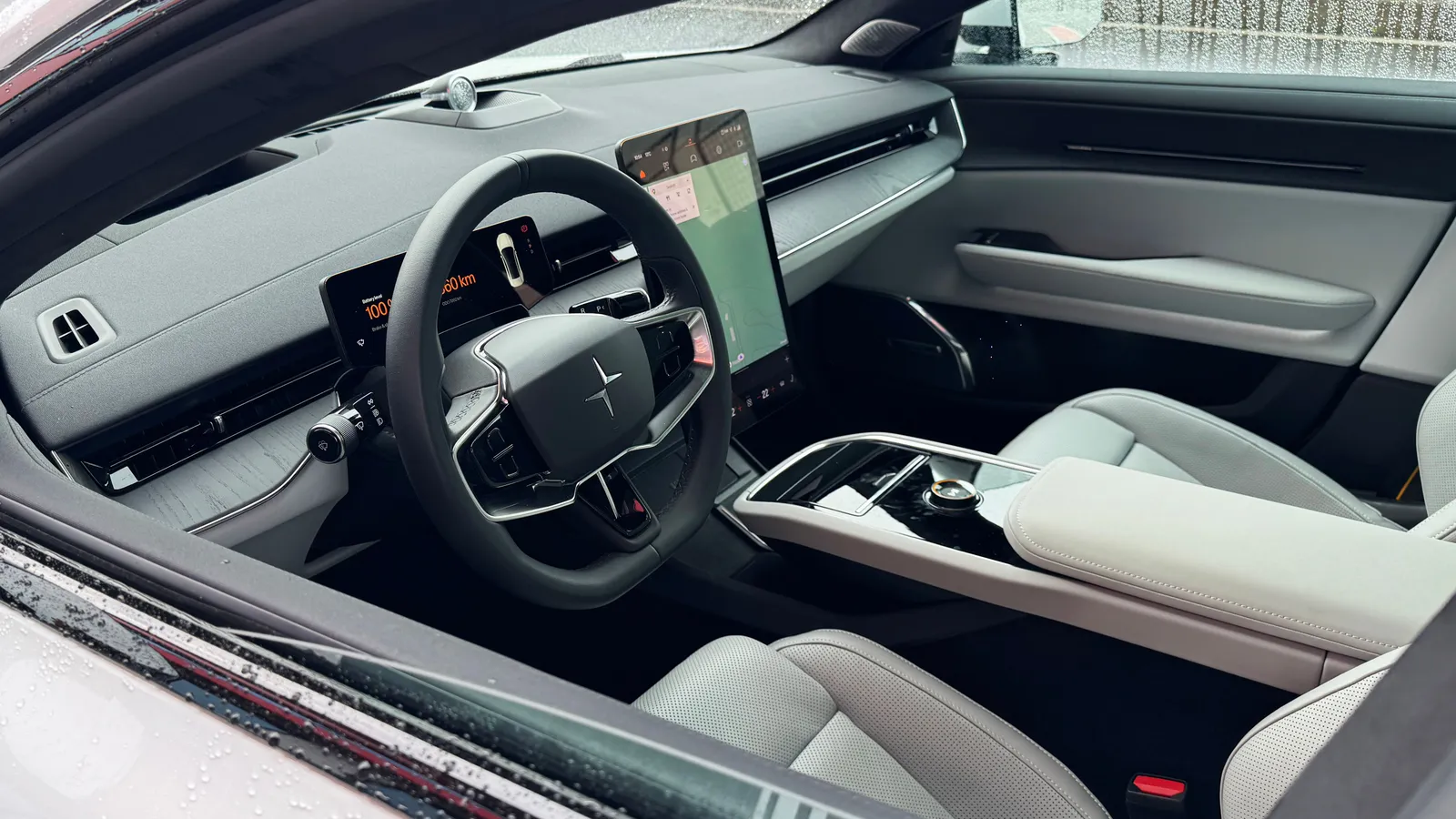
The buttons are physical switches behind a common plastic surface, but lack permanent symbols. Only when you touch them does the function appear on the instrument screen.
It works fine once you get familiar with the car, but for us who still switch between test vehicles, it requires unnecessary adjustment and takes your attention off the road.
The digital rearview mirror isn’t entirely optimal either, as the view needs to shift focus, and the camera is additionally affected by weather conditions. But without a rearview camera, it’s naturally the only option to see traffic behind.
Polestar is perhaps the car manufacturer in the world most concerned about climate emissions throughout a vehicle’s lifecycle, which is why you’ll find a range of recyclable materials, all of which are of sufficient quality to be easily recycled into your next Polestar.
You’ll also find wood and genuine leather. The sacrificed animals naturally come with a guaranteed smiley face for good animal welfare. It’s even printed on the seat backs. Check it out.
The wireless phone charger delivers a weak 15 watts with cooling, while the USB-C ports provide 18 watts. This is surprisingly modest for such an expensive car, as we often hear numbers around 50 and 60 watts.
The storage space in the center console is also not impressive. This isn’t the car for someone who wants plenty of room for all kinds of small items.
Rear seat – best for two
I’m 1.89 meters tall, and behind my own driver’s seat I have a few fingers of space in front of my knees and about an inch up to the panoramic roof. The floor is flat.
The car features a typical 4+1 layout, meaning two power-adjustable sports seats with lumbar support and a large center console that can be raised so a fifth person can sit in the middle in an emergency.
The panoramic roof extends back to cover the rear passengers’ heads. Polestar’s reason for removing the rear window is precisely to create more headroom at the back.
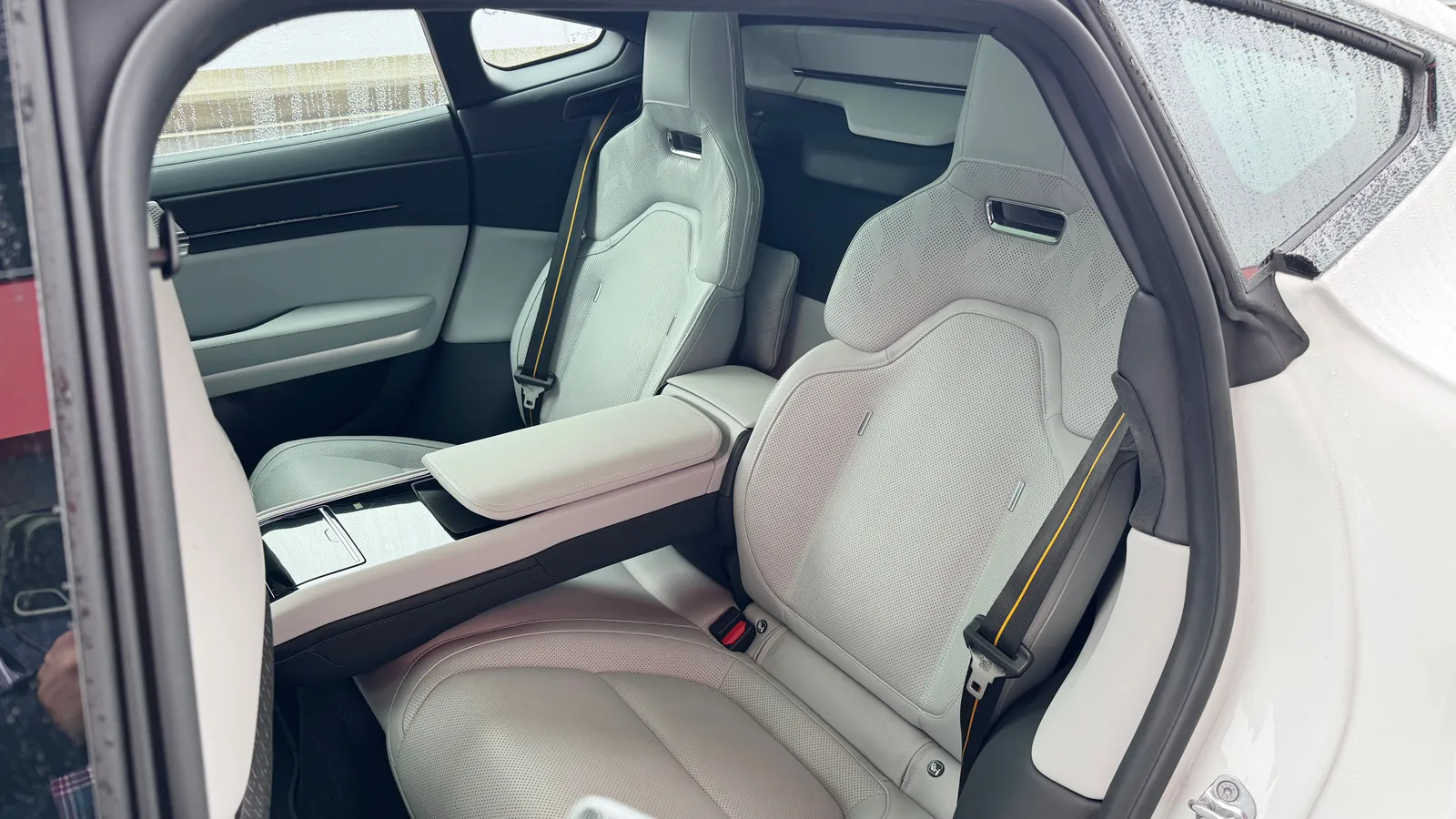
With a rear seat, there would need to be a headrest right above the heads of the rear passengers, which isn’t possible in this design.
They could possibly look at the Tesla Model 3 and how it addresses this issue. It has glass roofs both above the heads and over the rear seats.
The center console features controls for seat adjustment in addition to physical buttons on the side of the seat for heating, cooling, and climate control. Two USB-C ports are available at the back of the center console.
Two Isofix anchors are also standard, but none in the front seat.
Trunk – Spacious
The absence of rear seats provides a fairly large opening to the trunk, somewhere between that of a sedan and an estate car. This offers good visibility inside the spacious trunk area.
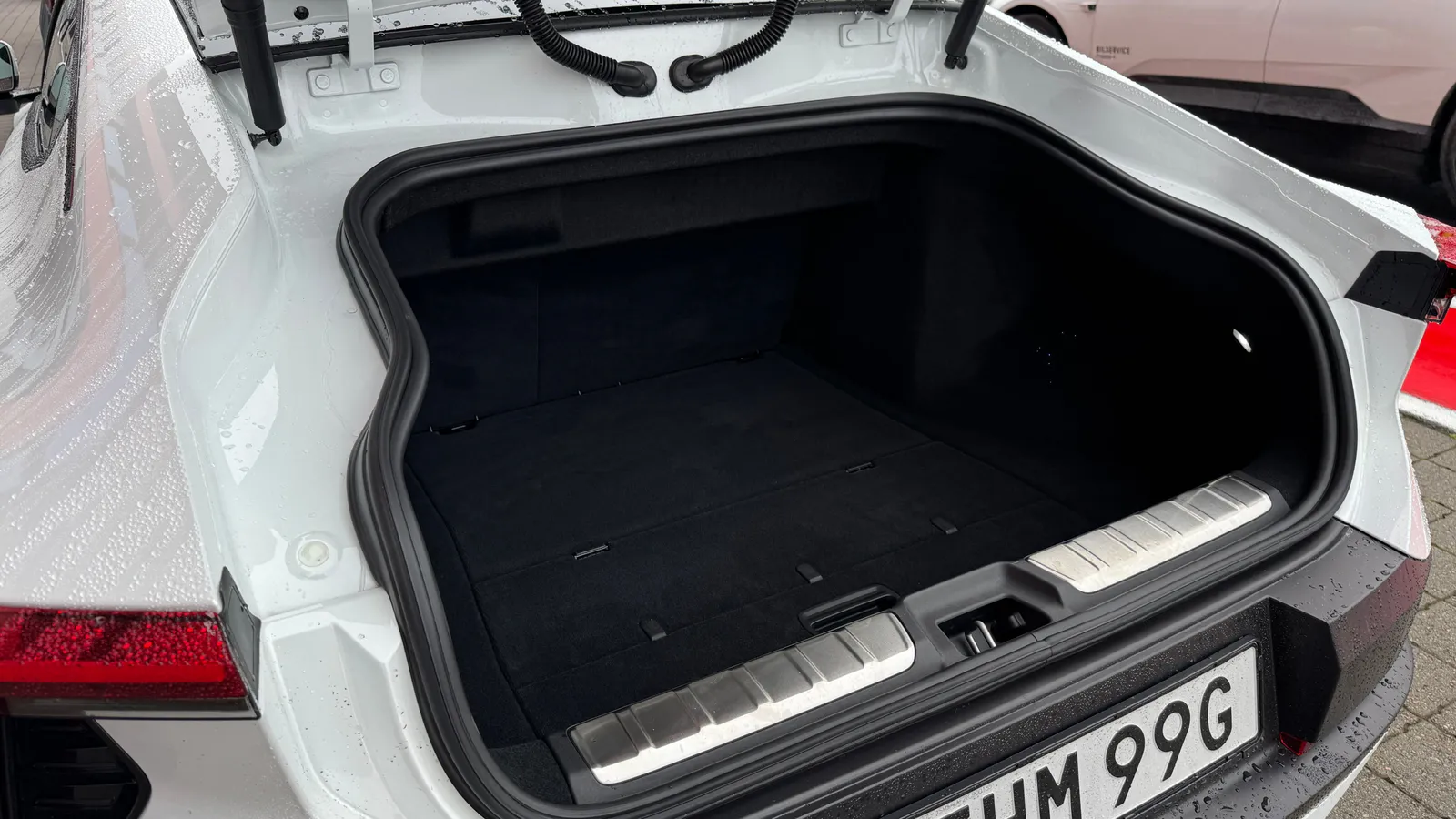
The volume is 365 liters. With the seats folded down, the capacity increases to 1128 liters.
Both volumes are considered very small, and the hollow space inside the trunk when the seats are lowered electrically is also limited.
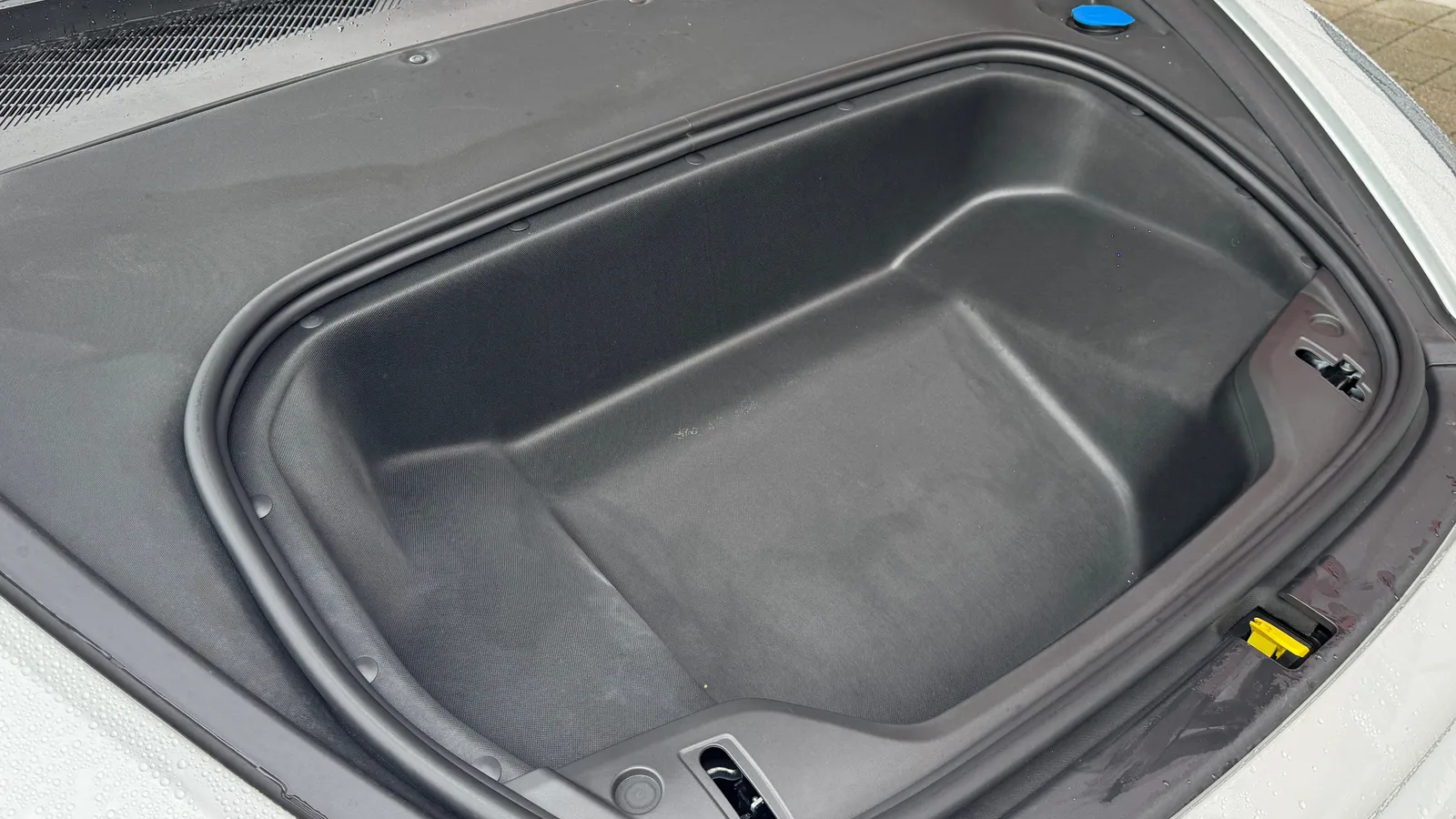
There is additional storage under the floor, and Polestar features a practical partition that can be raised using seat holders—a solution familiar to many from Volvo.
Fortunately, they managed to fit a 62-liter trunk under the low floorpan.
Both versions of the Polestar 5 can pull 1800 kilograms. This is an advantage Porsche does not have.
Driving experience – quite fun
The Dual Motor version has 748 horsepower and 812 Nm of torque. All-wheel drive enables the car to go from 0 to 100 km/h in 3.9 seconds.
The Performance version boosts to 884 horsepower and 1015 Nm of torque, reducing the 0–100 km/h time to just 3.2 seconds. Top speed is 250 km/h for both.
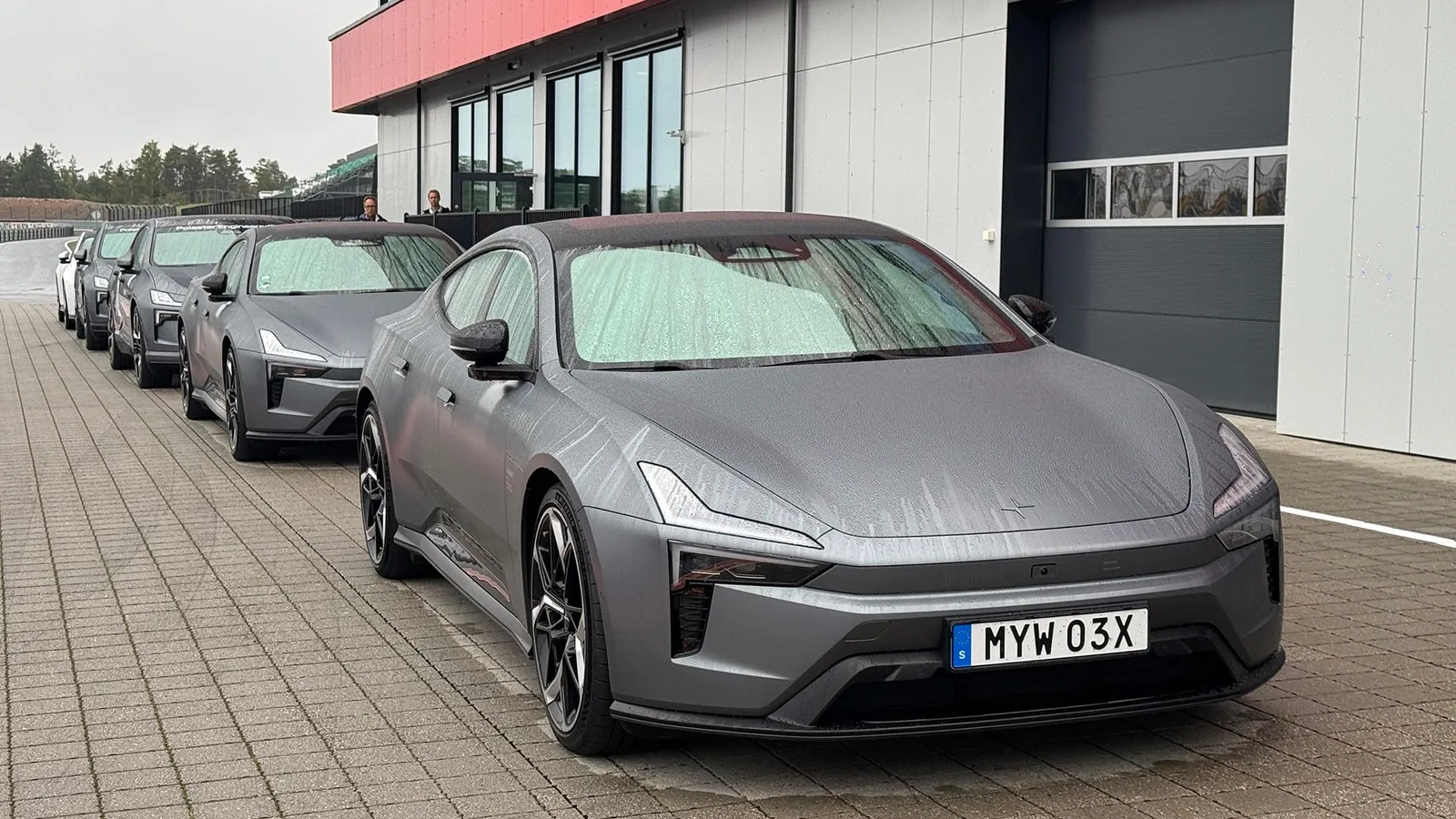
We drive the aforementioned Performance model on roads leading to Rudskogen. The vehicle weighs 2.5 tons, but the weight is largely offset thanks to what they call MagneRide suspension.
You can set it in three basic modes, but the system updates 500 times per second based on your speed, steering angle, throttle input, braking force, and the direction the car is moving relative to the road’s alignment.
All of this allows us to handle roads with 80 km/h speed limits quite comfortably, which is common in Østfold.
Here we see the benefits of Swedes’ thorough testing over the years, in contrast to Chinese competitors who struggle more to launch new models.
We have never been fully satisfied with either the Smart or Zeekr models offered to us, not to mention the car most comparable to them – the Lotus Emeya.
It’s almost a failure that Polestar performs better than Lotus, given Lotus’ solid racing history. But it does reveal something about where the focus lies in these different cultures.
Why mention these specifically? Well, because all of these brands are owned by the same conglomerate, Geely. And all of them, except Polestar, share platforms. Polestar has developed its own completely unique platform for this car.
On the track with the master himself
We need to do a bit of calculating before heading onto the track. In the passenger seat is Joakim Rydholm, the engineer responsible for the driving dynamics in all Polestar models.
He is an experienced rally driver who remains active driving a Mitsubishi Evo 10. The guy turns up the Performance setting to Sport and disables the ESP system, so we really have to feel the car’s balance on that extremely smooth asphalt.
For those who haven’t driven on a track before—when the asphalt gets wet on a track, it becomes much smoother than a regular road due to all the rubber left behind in the turns.
We just need to navigate through the first turn. It’s quick, fun, and easy to control, even though we’re aware of the weight under these conditions.
The response to acceleration, braking, and steering is exactly as we want it. And it’s clear evidence that they programmed this themselves.
“The standard steering resistance is perfect, but some people want it harder, while others prefer it softer. That’s why we have a setting that is seven percent softer and eight percent stiffer,” says Rydholm, who’s in the passenger seat.
And a full 612 horsepower can be sent to the rear wheels. It’s not surprising that this happens, but everything is done with a sense of control. This is a fantastic car.
One thing to note is that the advanced drivetrain that was highly notable in the Polestar 3 is missing. The Polestar 3 had a differential lock to send power to the wheel that needed it most, rather than braking the wheel that needed it least.
The reason it’s not included here is that better technology has been developed for the ESP system, and it turns out they also streamlined this feature in the Polestar 3 as part of the facelift.
Back on the road
Most people don’t drive 2.5-ton cars on public roads. It’s ideal to have them weigh a ton less, or even more, not just to avoid having to wait for grip to navigate curves, but also to reduce tire and brake wear. This is where these cars are actually used.
And now we get the key to the Long Range version. We take the same route back, this time with locally renowned Andreas Scheel from Finansavisen at the wheel for the first leg back to Oslo.
More like this?
Sign up for our newsletter
– get car news straight to your inbox!
You learn a lot from sitting in the passenger seat as well. And you can clearly tell the difference between the models.
The response when accelerating is noticeably slower. Still, the Dual Motor isn’t sluggish in any way. With 748 horsepower, it’s also very fast by normal standards.
You can also see a big difference in the suspension. Neither has air suspension, but while the Performance model features the aforementioned MagneRide system, the Long Range has conventional suspension.
On the challenging roads with a locally renowned driver at the wheel, we can clearly see that the suspension is somewhat softer under pressure.
In normal conditions, the car feels more powerful, but it naturally isn’t quite the same weapon.
Range – 678 kilometers
This is perhaps the best argument for choosing the Performance version. Dual Motor claims a WLTP range of 678 kilometers with fuel consumption of 1.78–1.83 kWt/mile.
The Performance version is much more power-hungry, so its range is 558 kilometers. The reported fuel consumption rises to 2.12 kWt/mile.
Paying 270,000 kroner to lose 12 miles of range might be hard for some to accept. That would also mean missing out on the yellow seat belts.
Charging – 350 kW
Both versions use the same large battery with a net capacity of 106 kWt and a gross capacity of 112 kWt.
The maximum DC charging power is listed at 350 kW, while AC charging stops at 11 kW.
That’s perhaps a bit disappointing compared to several of its Chinese counterparts, where the charging speeds are so high that you can’t find chargers that offer comparable performance in Norway.
Price and Competitors – It’s Not Cheap
The Polestar 5 Dual Motor starts at 1,309,000 kroner, while the Performance version costs from 1,578,000 kroner. That’s a jump of 269,000 kroner.
For that amount, you not only get an additional 136 horsepower but also the more advanced MagneRide suspension and a sportier set of wheels.
And now we’re in a price range where expectations are quite high. The Porsche Taycan is an obvious benchmark, the aforementioned Emeya is within reach, as is the Tesla Model S Plaid when it was on sale — plus the upcoming Mercedes-AMG GT four-door Coupé.
Otherwise, the choice of electric four-door GTs isn’t very large.
Conclusion
The Polestar 5 will be a car for the few, but it is an important flagship model to show how Polestar sees itself in the market.
It is meant to be a sporty premium alternative, ideally for former Volvo owners.
Although a five-meter-long four-seater with limited trunk space will never be a sensible choice, the Long Range version is the rational pick between the two.
The real question is whether you want to go far comfortably or have more fun over shorter distances.
Also read
The post Both are good, but one is raw appeared first on Norsk elbilforening.