
Electric cars saved 20 billion dollars worth of oil in six months
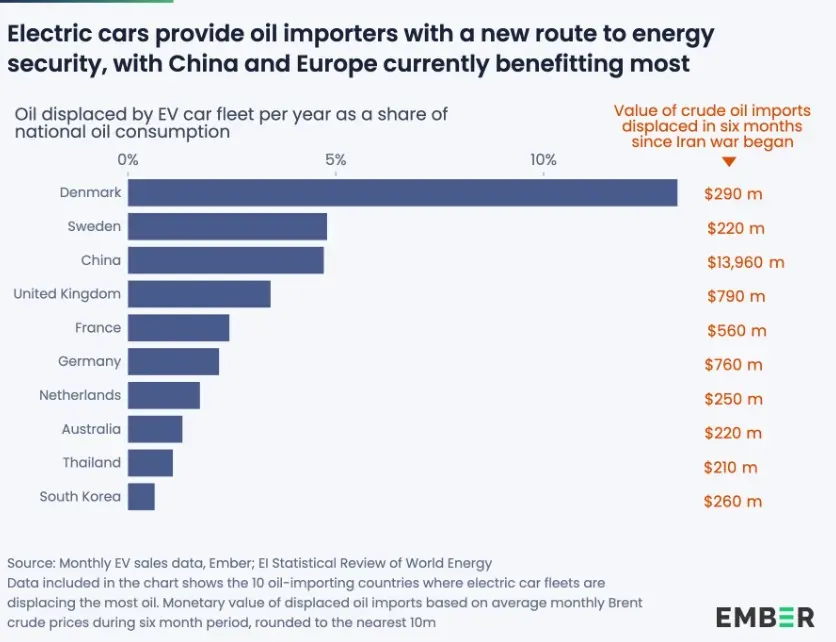
Electric vehicles have allowed oil-importing countries to avoid purchasing crude oil worth an estimated $20 billion between March and August 2026. This is according to an analysis by the energy think tank Ember, which quantifies the contribution of battery-powered fleets to energy security during a period of severe global supply tensions. Meanwhile, Italy is among the 15 countries that in 2026 surpassed the United States for the first time in terms of market share for fully electric vehicles.
The data comes as disruptions in oil supplies caused by the war between the United States, Israel, and Iran raise concerns about fuel prices. In this context, electric vehicles are not only a solution to reduce emissions but also a tool to decrease reliance on imported crude oil and limit the economy’s exposure to international crises.
200 million barrels of oil less imported
According to Ember, between March and August 2026, electric vehicles in importing countries replaced an amount of oil equivalent to 200 million barrels of crude, worth approximately $20 billion in total.
The estimate refers to the oil that did not need to be purchased thanks to the use of electric vehicles instead of those with internal combustion engines. It is not therefore a similar savings for every driver, but an aggregate benefit for economies that import fossil fuels.
China accounts for the largest share of this savings, with $14 billion worth of oil not imported thanks to its electric vehicle fleet. European Union member states contributed another $3.1 billion, largely due to the efforts of Germany and France.
The Danish case illustrates the impact that a well-established electric vehicle fleet can have on energy security: on an annual basis, electric cars in use in Denmark replace an amount of oil equivalent to 13% of the country’s total consumption.
Italy’s EV Share Exceeds That of the United States
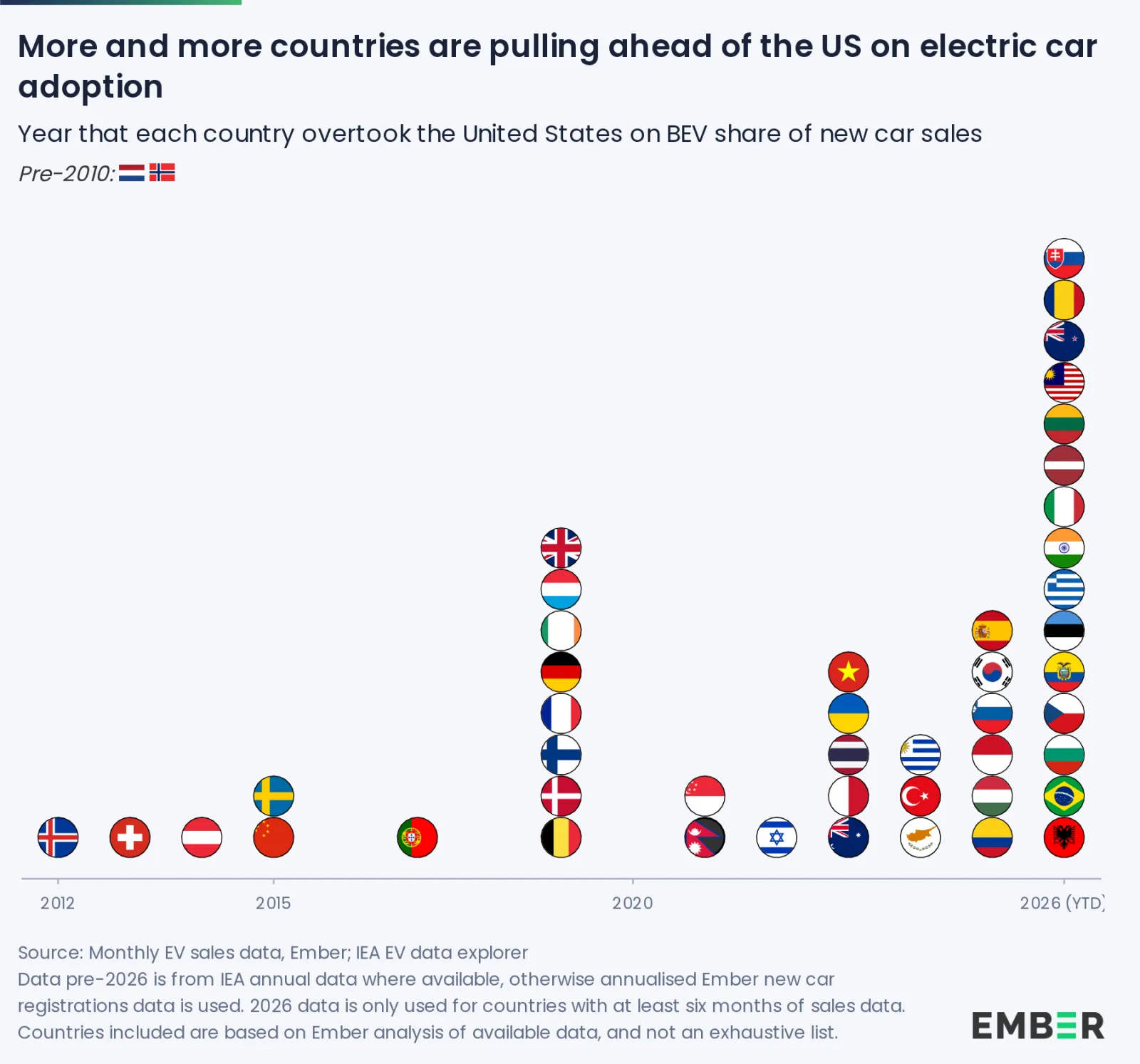
The comparison refers to BEVs,即 battery-powered electric vehicles, and excludes plug-in hybrids. According to Ember, 49 of the 56 countries under observation now have a BEV market share higher than that of the United States.
In the United States, electric vehicles accounted for 6% of sales in the first eight months of 2026, following a reduction in federal support for electric mobility in 2025.
In India, however, the share of BEVs surpassed that of the United States every month starting in April. Brazil is gaining ground thanks to growth in its domestic market and expansion of national production capacity.
For Italy, the figures indicate relative progress compared to the United States, but they alone are not sufficient to describe the maturity of the domestic market. To assess the adoption of electric vehicles, absolute sales volumes, registration trends, and the growth rate of the existing fleet must also be considered.
Growing global sales, even without China and the U.S.
The transition is progressing despite changes in support policies in some of the world’s major economies. In the first eight months of 2026, global sales of battery electric vehicles increased by 11% compared to the same period in 2025. By contrast, plug-in hybrids saw a 12% decline, while internal combustion engine vehicles experienced a 6% drop.
Excluding China and the United States, global BEV sales grew by about 45% on an annual basis according to Ember. The share of battery electric vehicles in total global new vehicle registrations reached 18%, up from 16% in the same period of the previous year.
National policies also continue to influence demand. In France, the social leasing program has helped push the share of BEVs above 30% of sales. In Germany, registrations have benefited from new consumer incentives introduced at the beginning of 2026.
Less imported oil means greater energy security
The core message goes beyond reducing emissions. Every electric vehicle that replaces a gasoline or diesel car reduces the demand for petroleum-based fuels, having positive effects on the trade balance and resilience to price shocks.
For an importing country like Italy, the advantages also depend on how the electricity used to charge cars is produced. In fact, integrating electric mobility with renewable energy sources can further reduce dependence on foreign energy.
The oil crisis thus reveals an often less visible aspect of the transition: electrifying transportation doesn’t just mean changing automotive technology, but also reducing the economy’s exposure to fluctuations in an unstable global market.
READ ALSO: “Energy Crisis and Transition: Enough with Emergency Solutions” and watch the VIDEO