
Aral Pulse Expands Trucking Network Further for Amazon Partners
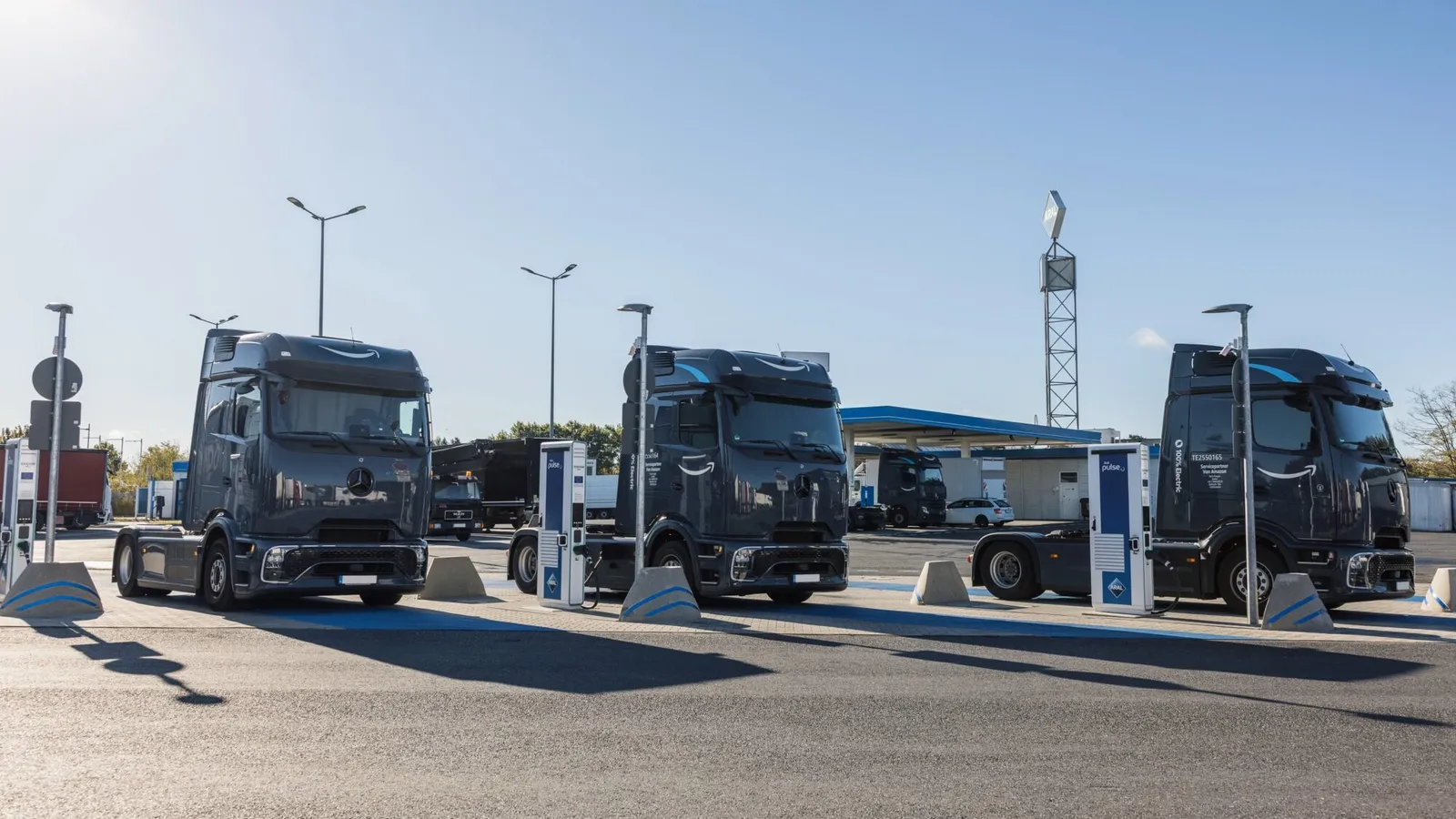
Aral pulse is expanding its partnership with Amazon: The online retailer’s logistics partners now have enhanced access to around 35 truck charging locations, including the Megawatt charging park in Königs Wusterhausen near the A10 highway. Since 2022, over one million kWh has been charged at Aral pulse locations.
Ad
The partnership between Aral pulse, the electric mobility brand of fuel station operator Aral, and Amazon in the field of electric trucks has been in place for four years. With a new agreement announced on October 15 in Bochum and Königs Wusterhausen, it is now being extended to additional locations in Germany’s truck charging network.
Specifically, Amazon’s logistics partners—such as freight companies and carriers that transport goods on behalf of the online retailer—will gain expanded access to Aral pulse’s truck charging network in Germany. Part of the agreement explicitly includes the Megawatt charging park in Königs Wusterhausen, located on the A10 highway southeast of Berlin. It is part of a series of high-power charging hubs that Aral pulse has built specifically for heavy commercial vehicles.
Approximately 35 locations for electric trucks
According to the National Charging Infrastructure Coordination Center, Aral pulse operates the largest public fast-charging network for electric trucks in Germany with around 35 locations. The company states that these sites are situated along strategically important freight routes. The announcement does not specify the total number of charging points or how they are distributed across the various locations.
All locations share the feature of having access lanes. Trucks with trailers do not need to park there or reverse into the charging station; instead, they can drive in, charge, and then drive out again.
In addition, there are service facilities designed to be accessible around the clock: toilets, showers, rest areas, as well as shops or dining options. The idea is to allow drivers to use their legally required rest times to recharge their batteries. According to Aral, the locations are well-lit, safe, and strategically located for easy access.
Ad
Charging capacity: combined MCS and CCS
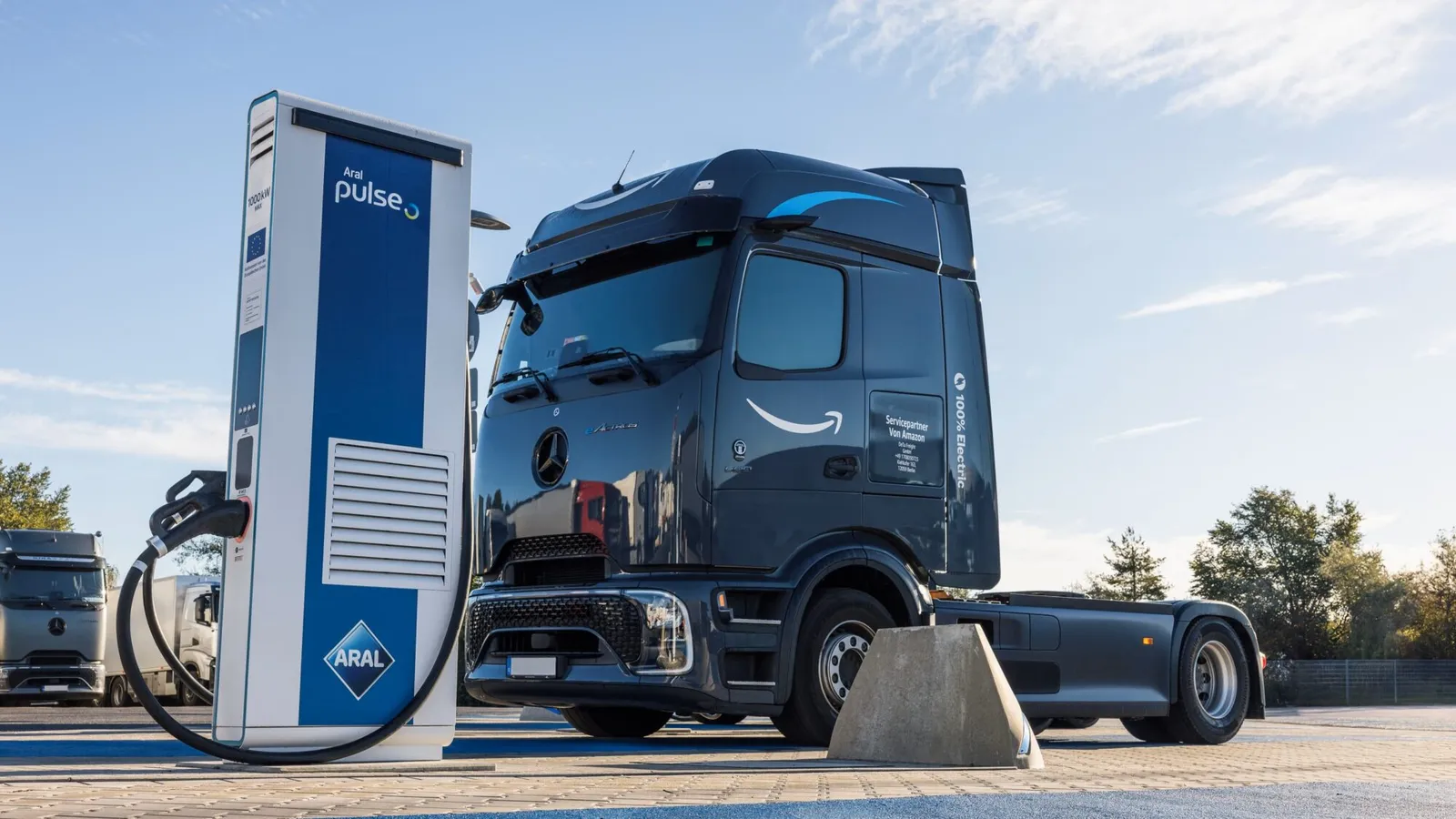
Aral Pulse’s megawatt charging parks rely on a combination of the Megawatt Charging System (MCS) and the well-known CCS standard. MCS was developed specifically for heavy commercial vehicles and allows significantly higher charging speeds than CCS, though it is not yet supported by all electric trucks. Thanks to the simultaneous CCS setup, vehicles without an MCS connector can also charge, albeit more slowly.
According to Aral, an electric truck can be charged from 20% to 80% at these locations in about 30 minutes. This figure is confirmed by truck manufacturer Scania per a footnote. At the same time, Aral notes that the actual charging speed depends on factors such as the battery capacity and the maximum voltage of the respective vehicle.
Alpitronic HYC1000 in Königs Wusterhausen
The current announcement provides no details about the on-site infrastructure. However, previous announcements from Aral pulse indicate that the location, situated in an industrial area near the A10/A13 highway interchange, offers six charging bays. Each bay is equipped with one MCS and one CCS charging point, resulting in a total of six MCS and six CCS connections. The HYC1000 system from South Tyrolean manufacturer Alpitronic is used, the same system installed at Aral pulse’s other megawatt charging parks, such as those in Hannover (A2), Buchholz/Aller (A7), Schnaittach (A9), and Rastow (A24).
In the HYC1000, the power modules are not located in the charging stations but in a central power cabinet containing eight modules, each with 125 kW of capacity. This cabinet dynamically distributes up to 1,000 kW among the connected charging stations. The MCS connector can handle up to 1,000 kW at a maximum of 1,500 amperes, while a standard CCS connector can handle up to 600 kW. When multiple trucks charge simultaneously at the same power cabinet, they share the available power.
Display
Over one million kWh charged since 2022
The partnership is not entirely new. It traces back to a pilot project in 2022 that began at an Amazon logistics facility in Dortmund. Since then, according to the company, Amazon partners have charged over one million kilowatt-hours at Aral pulse. By the end of 2026, more than 50 battery-electric trucks are expected to be in use across Amazon’s logistics network in Germany.
For context: With a typical consumption for heavy electric trucks of roughly 1 to 1.3 kWh per kilometer, one million kWh—depending on the vehicle, load, and route—corresponds to a driving distance of around 770,000 to one million kilometers.
Alexander Junge, who oversees electromobility at Aral’s board, sees this expansion as proof that the charging network is designed for large commercial fleets used in long-distance transport. The truck charging network has been expanded over the past years to meet rising demand. Andreas Marschner, responsible for sustainable logistics worldwide at Amazon, points to the company’s investments in electrifying Europe’s transportation network, where reliable charging options are a key component.
Part of a larger partnership between bp and Amazon
The agreement is part of a broader global partnership between Aral’s parent company, bp, and Amazon. It covers not only energy supply but also digital solutions including generative AI; Amazon Web Services is bp’s preferred cloud provider. Aral itself operates around 2,400 gas stations in Germany and, according to its own claims, is one of the largest providers of publicly accessible fast charging stations through Aral pulse.
Advertisement