
MG4 XPower 64 kWh: test of the Chinese-British electric vehicle. How does it perform in everyday use?
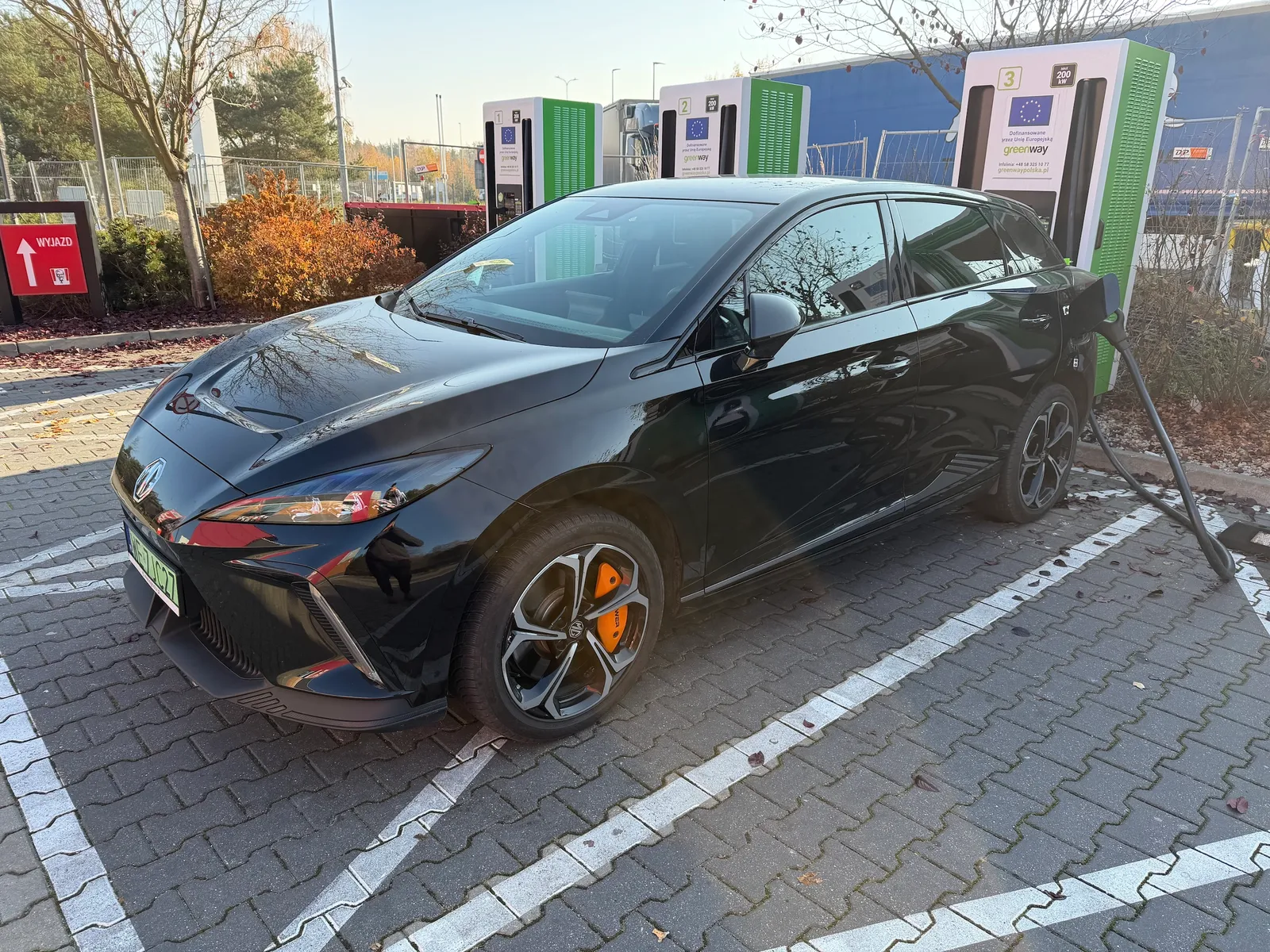
Another Chinese car that ended up in my hands. This time it’s the MG4, a compact C-segment hatchback that can be described as an electric family car with a slightly sportier vibe. The MG brand originated in the UK, but it now belongs to the Chinese SAIC conglomerate. So, it can be said we’re dealing with a British-Chinese manufacturer, though it’s currently much more Chinese than British.
Table of Contents
Show
Hide
I tested the XPower version with all-wheel drive and a 64 kWh battery. This car surprised me mainly with its driving comfort, practicality, and fairly good energy efficiency. However, not everything impressed me. My biggest concerns are about the infotainment system, which falls short of what I would expect from a modern electric vehicle.
MG4 XPower 64 kWh: Key Specifications
Segment: C, hatchback
Length: 4287 mm
Width: 1836 mm
Height: 1504 mm
Battery capacity: 64 kWh
Drive type: four-wheel drive (4×4)
Maximum DC charging power: 140 kW
Top speed: 160 km/h
Urban energy consumption: approximately 19-20 kWh/100 km
Highway energy consumption: approximately 24-26 kWh/100 km
External design. The MG4 has its own style
From the outside, the MG4 looks really good. The front bumper features a slightly sporty design, and the headlights resemble squinting eyes. Vertical turn signals add to this, providing a nice contrast with the other front elements. The overall design appears modern and has its own distinct character.
In the XPower version I tested, the large orange-colored brake calipers also draw attention. Combined with the wheels, they create an interesting stylistic accent. The daytime running lights, passing lights, and high beams activate automatically, but there are no matrix headlights here.
The rear end is equally interesting as well. The lights form a continuous strip that is interrupted by the brand logo. Additional patterns are located on the upper part of the lights, which remind me somewhat of the stylistic elements of the Tesla Cybertruck. Two spoilers, with a stop light placed between them, are also characteristic features.
Here’s a small problem. I’m not sure if I got a defective unit, but at speeds around 60 to 100 km/h, the spoilers would whistle. At first it was quite annoying, then I stopped paying much attention to it, but it might bother some drivers.
The interior of the MG4. Comfortable, but no wow factor
The interior is designed in a rather unusual way. In front of the driver there’s a small display showing the most important information. We can adjust its layout and decide what to display on it. On the left side, information about the distance to the car ahead can be shown, in the middle the speed, and on the right the energy consumption or navigation. We can also divide the various information into smaller sections.
On the right side is the main screen for the infotainment system. And here my concerns start.
The infotainment system seems outdated
Visually, I wasn’t particularly impressed by the system. It reminds me a bit of older technology and cars from a few years ago. We have Apple CarPlay and Android Auto, but in the vehicle tested, they only worked via wired connections. Unfortunately, I couldn’t find the appropriate cable at home, so I relied solely on the manufacturer’s software during testing.
It doesn’t offer many customization options or advanced settings. We can find the most essential functions and information, but there are no standout features. The system doesn’t operate with exceptional smoothness, though I didn’t experience any lag. It simply performs as one would expect from a car in the mid-range price segment.
Below the screen, there are several physical buttons. We can use them to turn the air conditioning on or off, activate the heating for the front or rear windshield, turn on the hazard lights, or return to the main screen. There is also a volume control. It’s good that the manufacturer didn’t move everything to the touchscreen.
Below that are the air vents, and even further down is a space for the phone with an inductive charger. This solution didn’t fully convince me. When the accelerator pedal was pressed harder, the phone would move around on the base. I’m not sure if the rubber was already slippery or if it was just designed that way, but it could definitely have been done better.
Steering wheel, buttons, and equipment
The steering wheel features numerous control elements. On the left side, we find the cruise control, while on the right side are the multimedia functions and the information displayed on the screen. The driver’s door includes basic controls for the windows.
I appreciate the classic door handles. In recent years, many electric cars have adopted hidden, sliding, or electronically controlled solutions. Here, you simply grab the handle and open the door.
An interesting feature is the sunglasses compartment located in the upper part of the cabin, next to the lighting and mirror. Such solutions were quite popular in the past, but they are becoming increasingly rare these days.
We also have classic buttons for controlling the lighting and setting up automatic lighting. The rear mirror is photochromic, but the side mirrors are not. It’s a shame because, especially in lower cars, the lack of photochromic side mirrors can be annoying.
Seats and finish quality
The driver’s seat has electric adjustment, while the passenger seat is adjusted manually. The seats themselves are comfortable and quite soft. The material in the central part feels pleasant to the touch, and the sides are finished with a material similar to leather. I’m not an expert on materials, so I won’t determine whether it’s real leather or a synthetic alternative.
The armrest hides a small storage compartment, and on the center console we find cupholders and additional space under a sliding shade.
Trunk and practicality
The MG4’s trunk isn’t the smallest, but it’s not among the largest in its class either. I think for a 2+2 family, its capacity will be sufficient for a short trip.
There’s additional space under the floor for items that don’t need to take up space in the main trunk area. We can store charging cables, a tire repair kit, or other small items there. In the vehicle tested, someone even left tire bags there.
On the passenger side, there’s a small storage compartment. We can’t fit too much in it, but it should be enough for the most important documents and small items.
There’s no frunk under the hood. The electric motor and basic car components are located there. However, access to fluid fill ports and the low-voltage battery is convenient.
Two ISOFIX seats and rear space
We can easily install two child seats with ISOFIX at the back. I really liked the way the mounting points can be concealed. They are secured with Velcro, so when we don’t use ISOFIX, we just close the mounting and the sofa looks tidy. We don’t have to push the seats through narrow gaps or search for hooks deep between the seats.
However, after installing two seats, there’s practically no room for anyone else to sit in the middle. Five people could ride in this car for a short distance, but it wouldn’t be particularly comfortable.
During testing, I traveled with my wife and two children. The passengers didn’t complain about lack of space, so in that regard, the MG4 performed quite well for our family.
Energy Consumption of MG4 XPower
While driving in the city, the energy consumption was around 19-20 kWh/100 km. On the highway, it was slightly higher, staying at 24-26 kWh/100 km.
The test took place during autumn when temperatures had already started to drop. As a result, the figures are likely to be worse than those from cars I tested in the summer. This should be kept in mind when comparing energy consumption from different tests. You can also find a separate article on our blog discussing how temperature affects energy consumption in electric cars.
DC charging up to 140 kW. Actual result around 130 kW
The maximum DC charging capacity of the MG4 XPower is 140 kW. During the test, I managed to achieve around 130 kW, even though the battery wasn’t preheated, which I consider a pretty good result.
The car also offers the ability to adjust the maximum AC charging level from the infotainment system. This feature is particularly useful when charging the vehicle at home and we don’t want to overload the electrical wiring. We can limit the charging power so that the session lasts longer and ends, for example, in the morning.
How does the MG4 perform in everyday use?
The MG4 is a car that is really enjoyable to drive. The driving position is comfortable, the seats perform well during long drives, and passengers didn’t complain about a lack of space. It isn’t the largest family car, but it should be sufficient for a 2+2 family.
The version with a 64 kWh battery allows, according to my estimates, approximately 300 km of driving in urban areas during winter conditions. In summer, one can expect around 350 km. During autumn and winter, depending on temperature and driving style, the range may drop to about 250-300 km.
These aren’t ideal results, but there’s no need to expect miracles either. We can’t cheat physics or battery capacity. One simply has to accept that electric cars will have a shorter range in colder months. Fortunately, the number of public charging stations in Poland is increasing, making electric travel increasingly easier.
MG4 XPower: What can be improved?
The biggest flaw of the MG4 for me is its infotainment system. I expected something more modern, especially since electric cars are often portrayed as the more futuristic part of the automotive industry. Instead, we have a system that doesn’t impress much visually or in terms of its capabilities.
Added to this are the induction charger, which doesn’t hold the phone as well as it should, and the whistling sound from the rear spoiler at certain speeds. The latter issue might be specific to the particular unit I drove.
Is it worth buying the MG4?
The MG4 XPower has many advantages. It’s comfortable, performs well in daily driving, offers all-wheel drive, and its charging speed of around 130 kW is quite decent. It will also be sufficient for a 2+2 family setup.
It’s worth remembering, however, that the MG4 is no longer a model that the manufacturer heavily promotes in its lineup. From what I’ve observed recently, it’s disappearing from MG’s website, with its place being taken by a successor featuring newer battery technology known as semi-solid. Next year, I’ll also be testing other MG electric models, including the MG6S and MG5S, so I’ll be able to see if the manufacturer has improved the aspects of the MG4 that didn’t quite meet my expectations.
If you’re looking for a convenient electric car for daily driving that can also handle longer trips, the MG4 is worth considering. Especially if you can find a unit at a good price after discounts. At the time of writing, prices range from 136,000 to 151,000 zł, as sales on 2024 and 2025 models are ongoing. The biggest disappointment for me remains the infotainment system, but other than that, it’s truly a pleasant car.