
ZF introduces a revolutionary engine for electric cars that operates at 30,000 rpm, delivers 3,500 Nm of torque, and reduces its size and weight by 25%.
The evolution of electric car engines is taking a rather interesting path. For years, manufacturers have focused on increasing power, improving efficiency, and reducing material consumption. But now they are beginning to explore another possibility that could have significant implications for both car design and manufacturing costs: getting the engines to operate at much higher speeds.
The German specialist ZF has been working on this area for some time and has just unveiled new details about its High Revolution Drive technology. This approach aims to overcome certain limitations of current electric propulsion systems by using a smaller and lighter motor that, thanks to a specially developed transmission, can deliver performance typically associated with much larger units.
What’s interesting is that this technology is not intended solely for high-performance sports cars or luxury models. ZF wants to apply it to mass-produced electric vehicles, where reducing a few kilograms, saving materials, and freeing up space can be a significant advantage. Early results show that there is still considerable room for improvement in motors that already stand out for their high efficiency.
An electric motor with 30,000 rpm that reduces weight by 25% and uses half as many magnets
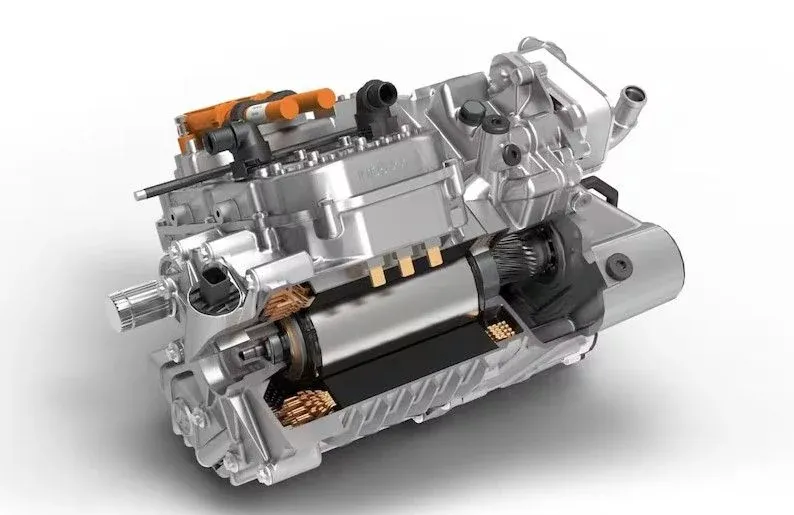
The main feature of the new ZF High Revolution Drive is its ability to reach 30,000 revolutions per minute, a speed far exceeding the 18,000 rpm of the motor used by the company as a reference. To achieve this, engineers have developed a system that combines an electric motor, power electronics, and transmission into a single compact unit.
The version presented achieves a maximum power of 200 kW (272 HP), but what’s truly remarkable is that it manages to reduce both size and weight by approximately 25% compared to a conventional system with equivalent performance. This is a significant difference for a component that must be installed in a space where every centimeter counts and that also directly affects the car’s total weight.
The key lies in a basic characteristic of electric motors. For the same power, the higher the rotational speed, the less torque the motor needs to generate. This allows for a smaller rotor, thereby using fewer materials to achieve the same result. The problem is that the wheels cannot rotate at such speeds, so it’s essential to adapt the motion through a transmission.
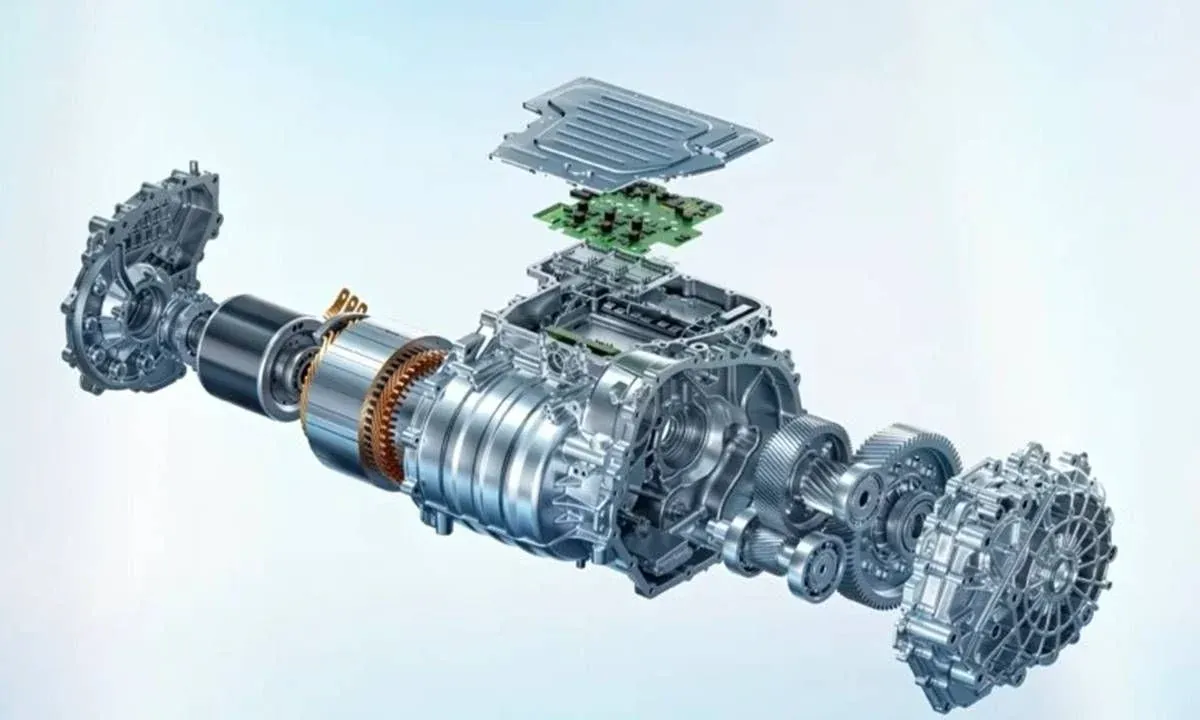
ZF has addressed this issue by using a two-stage reducer with helical gears and an approximate gear ratio of 18:1. This allows the engine to rotate at very high speeds while the transmission reduces those revolutions and increases the torque available at the output. Thanks to this configuration, the system achieves a maximum torque of 3,500 Nm at the transmission output to the wheels.
Another advantage lies in material consumption. ZF claims that the High Revolution Drive requires 50% less magnetic mass than its 18,000 rpm reference unit. This can have significant implications for manufacturing costs and reliance on critical raw materials, especially at a time when European manufacturers are seeking to reduce their exposure to certain supply chains.
Of course, running a motor at such high speeds also presents challenges. As revolutions increase, it becomes more difficult to control vibrations, noise, and the stresses on bearings. Therefore, ZF has developed the motor, gears, and mechanical supports together, paying special attention to the geometry of the transmission teeth.
According to Thomas Meiser, head of ZF’s electric mobility division, 30,000 rpm currently represents the best balance between technical performance and costs for this solution. This speed allows for the benefits of a more compact motor without the manufacturing and operational challenges undermining those advantages.
There is another particularly interesting fact: despite the increased RPMs and the use of a two-stage reducer, the entire system maintains an efficiency of nearly 93%, practically identical to that of the conventional unit used for comparison. This means ZF has managed to reduce size and weight without sacrificing the system’s overall energy efficiency.
Reducing weight can also help improve range, although ZF has not yet provided specific figures on how many extra kilometers a vehicle equipped with this technology might achieve. Its main advantage will likely be the combination of lower weight, reduced material usage, and easier integration into electric platforms.
The High Revolution Drive is part of ZF’s modular SELECT architecture, which allows different components to be adapted to each manufacturer’s needs. The company is initially focusing its development on systems ranging from 150 kW (204 HP) to 200 kW (272 HP), a power range particularly suitable for large electric sedans and SUVs.
In addition, the technology is compatible with both 400-volt and 800-volt architectures, which would facilitate its use across different platforms without the need to develop a completely new system for each application. This flexibility can be particularly attractive to manufacturers looking to share components across multiple models and reduce development costs.
ZF is already in talks with various automakers, with the goal of bringing this technology into production around 2030. There is still work to be done, especially to ensure durability, control costs, and adapt the system to the demands of mass production.
But this approach is particularly interesting for the European industry. While much attention focuses on batteries, charging times, and new electrical architectures, companies like ZF are showing that engines themselves also have significant room for improvement. Achieving the same power with a 25% smaller and lighter unit, using half as many magnets, can be just as important for the future of electric cars as increasing their range by a few kilometers.
Source | ZF