
A German university turns its parking lot into a solar power plant with 200 kWh sodium batteries
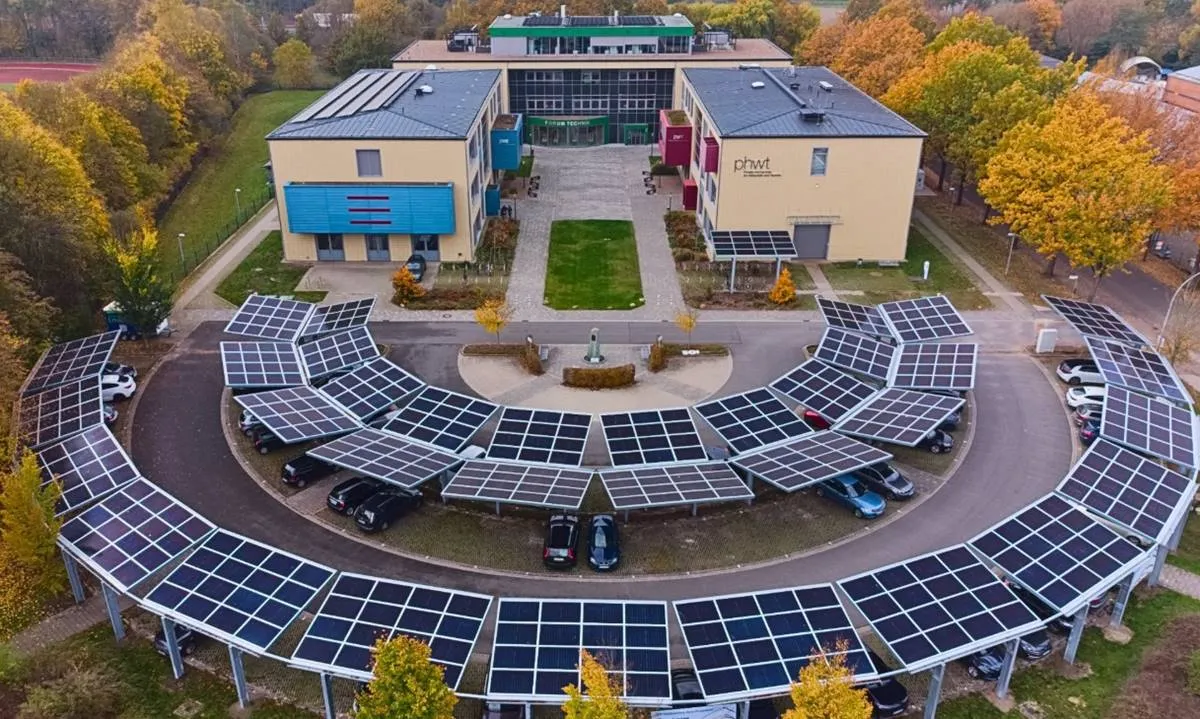
Outdoor parking lots occupy vast areas that, in many cases, serve little other purpose than to park cars for hours. But they also represent an opportunity to generate renewable energy without the need to acquire new land. And that is exactly what a German university has done with a facility that, in addition to producing electricity, incorporates a storage technology that is still relatively uncommon in Europe.
The Private University of Applied Sciences for Economics and Technology (PHWT), located in Diepholz, Germany, has opened a solar canopy with a total capacity of 237 kWp and a 200 kWh sodium battery. This installation can cover 90 parking spaces and utilize the electricity generated during the day to meet the campus’s energy needs.
The project, launched on November 9th last year, has another unique feature. It is the first stationary storage system with sodium-ion batteries installed in Germany’s Lower Saxony state and, according to its organizers, the third of its kind in Germany.
A 1,150 square meter solar parking lot with an unusual design
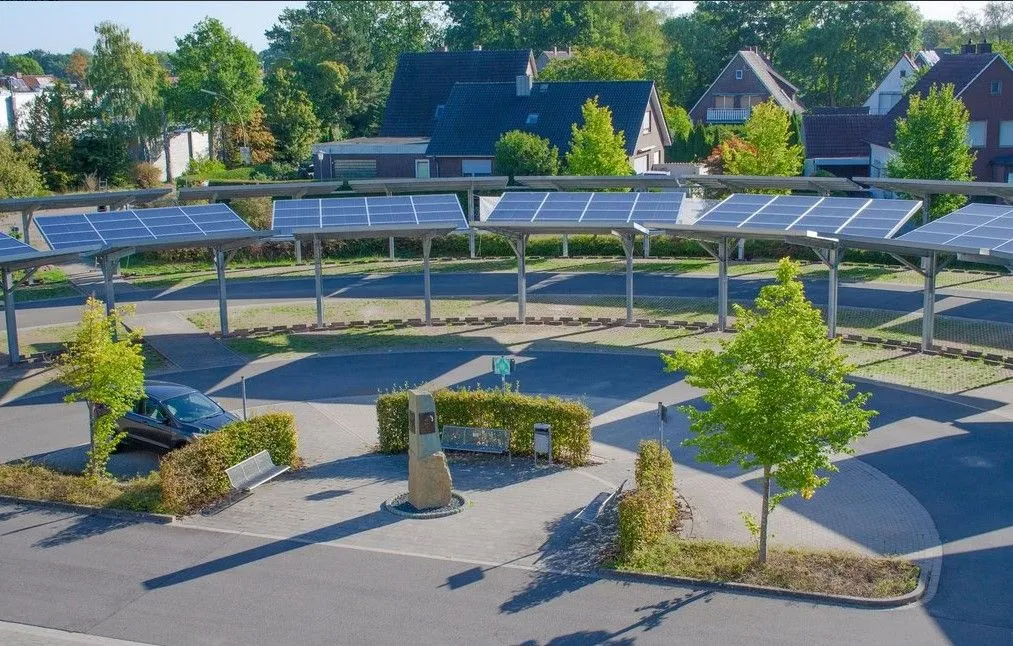
The installation is not a conventional canopy. The original parking lot has a semi-circular layout, with two rows of spaces following a curved path. Rather than altering this layout, the project’s organizers decided to adapt the photovoltaic structure to the existing geometry.
PfefferKnecht, a company specializing in solar solutions, designed a custom metal structure that replicates the curvature of the parking lot. Its construction was carried out by Böckmann Maschinenbau, a local engineering firm that maintains a regular partnership with the university.
The result is a roof covering approximately 1,150 square meters, equipped with double-glazed photovoltaic modules that provide around 230 kWp of power. An additional 7.3 kWp is installed on a covered parking area for 20 bicycles, raising the total power output to about 237 kWp.
One of the most interesting details lies in the construction of the roof itself. The solar panels also serve as a waterproof roof, thanks to a patented system that eliminates the need for an additional rain protection layer. This simplifies the structure and allows for better utilization of materials.
The canopies also feature integrated LED lighting, providing users with shaded areas protected from rain and sun, as well as lighting during nighttime hours.
A 200 kWh sodium battery to harness solar power

But the most innovative element of this installation isn’t on the cars; it’s in the system responsible for storing electricity. Instead of relying on conventional lithium batteries, the university has opted for a sodium-based solution, a technology that is beginning to play a key role in stationary energy storage.
The system was supplied by the Swiss company Phenogy and consists of two battery cabinets that provide a combined capacity of 200 kWh. The maximum charging and discharging power is 100 kW, allowing the storage of some of the solar energy produced and its use later when the campus’s electricity demand increases.
The main advantage of this technology lies in its materials. Sodium is an abundant and widely available element, which helps reduce reliance on raw materials such as lithium, cobalt, or graphite. Additionally, sodium batteries exhibit interesting characteristics in terms of safety and thermal behavior.
In a stationary application like this, where weight and volume are less critical than in an electric car, sodium batteries can be particularly attractive. They do not need to achieve the energy densities of the best lithium batteries, but they do need to offer good durability, safety, and competitive costs.
With a capacity of 200 kWh, the system could supply 20 kW for about ten hours, or deliver its nominal power of 100 kW for roughly two hours, without accounting for conversion losses or operational reserves. This allows some of the electricity generated during sunny hours to be used during periods of higher demand.
The university hopes that this combination of solar generation and storage will reduce its reliance on the electrical grid and help limit demand peaks, which can significantly affect the energy costs of facilities of this size.
Built in just ten weeks and combined with thermal storage
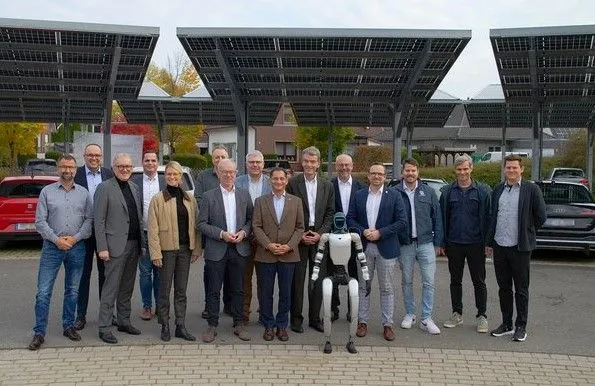
Another notable aspect of the project is its timeline. Although planning and development took about 18 months, the actual construction was completed in just ten weeks, taking advantage of the university’s holiday period.
During that time, foundation work, the installation of the metal structure, the setup of photovoltaic panels, and the integration of electrical and storage systems were carried out. All of this was achieved without the need to build a new facility on additional land, as an existing parking lot was utilized.
In addition, the project is part of a broader energy strategy. The Diepholz campus already has an ice-based thermal storage system in place, which is used to meet part of its heating and cooling needs. The new solar installation adds renewable power generation and electrical storage to this infrastructure.
The combination is interesting because it allows addressing different energy needs of a building. On one hand, photovoltaic electricity can power regular consumption and charge batteries. On the other hand, thermal storage enables managing part of the heating and cooling demand without relying solely on immediate electricity consumption.
There is another aspect worth noting. Although the project is located in a parking lot, the information published does not confirm that it includes charging stations for electric vehicles. Its primary function is to generate electricity and store it for the needs of the campus, though such infrastructure could be supplemented in the future with chargers.
The experience of this German university shows that large open areas are not always necessary to increase renewable energy production. Thousands of parking lots at universities, hospitals, shopping malls, and businesses could utilize their rooftops to generate electricity, provide shade for cars, and reduce grid consumption.
And if they are combined with sodium batteries—a technology that doesn’t need to compete with lithium in energy density to be useful—these spaces can become small distributed power plants. This is a way to utilize already urbanized surfaces that have so far remained underutilized in terms of energy generation.