
Testing the Zendure Solarflow 4000 Mix Pro: Can this massive solar battery truly help save money?
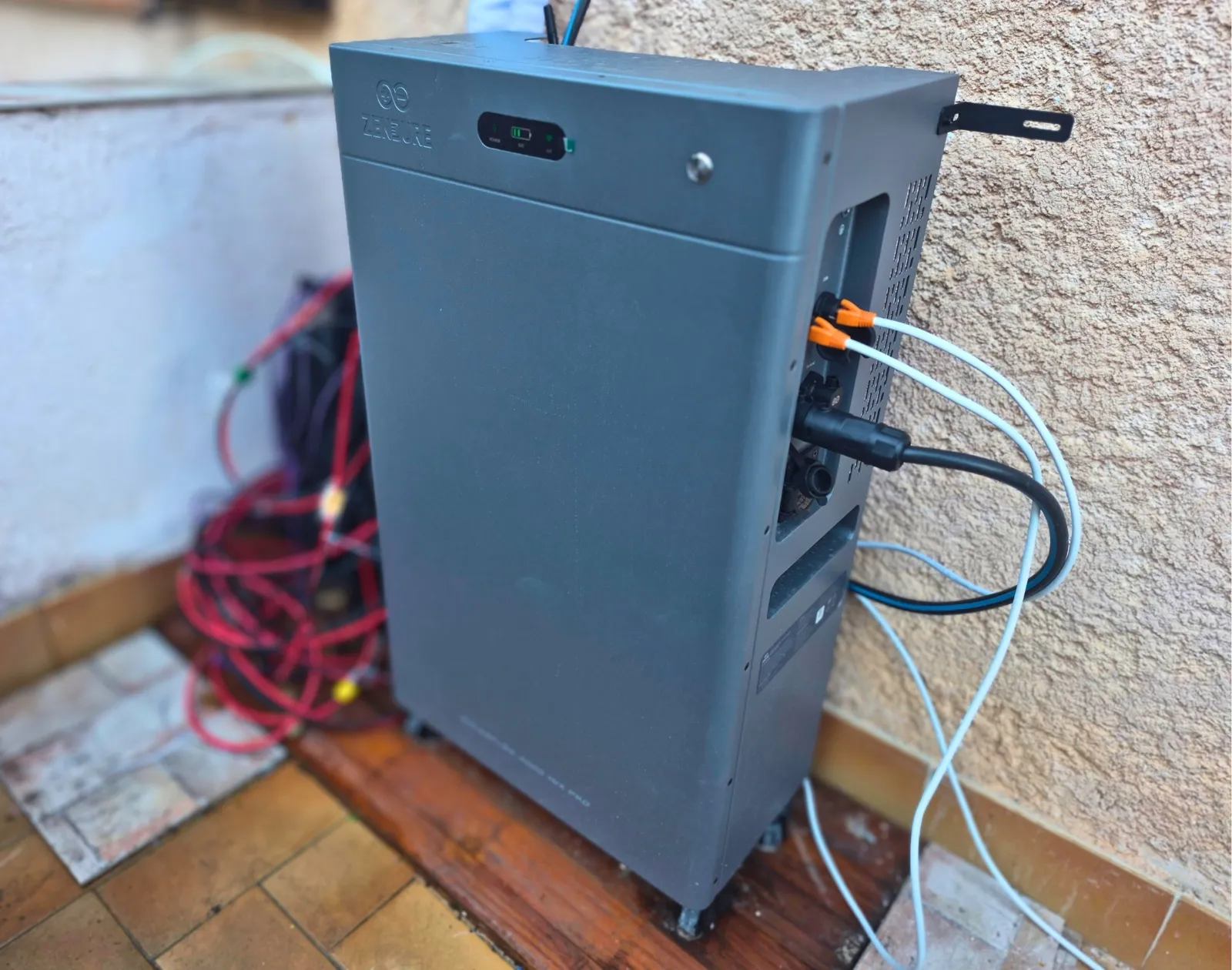
We needed an electric winch to lift it onto our terrace. At 82 kg, the Zendure Solarflow 4000 Mix Pro is almost like an industrial machine. This model is the flagship of the Chinese brand, which is among the leaders in residential solar energy storage.
Launched in early summer 2026 in France, the SF 4000 Mix Pro stands in sharp contrast to the lineup previously developed by Zendure. Gone are the battery modules and stackable units; here, everything is combined into a single massive unit. It features 8 kWh of storage capacity, an inverter capable of feeding up to 5 kW into the grid, and two MPPT controllers that can handle a total of 8 kW of solar panels.
This is a true powerhouse with an impressively impressive specification sheet, and all this at a price that isn’t too high considering its performance: 2899 € on Zendure’s website and 2400 € at some retailers. It’s worth noting that the SF 4000 Mix Pro is the top-tier version of Zendure’s “4000 Mix” series, which also includes cheaper models without solar inputs.
Zendure Solarflow 4000 Mix Pro Specifications
DC Solar Specifications
Maximum PV voltage range.
30 – 400 V
Maximum PV input current.
2 x 17.2 A
Maximum PV short-circuit current (Isc)
2 x 18 A
Maximum MPPT input power.
8000 W (2 x 4000 W)
Number of MPPTs and MC4 inputs
2 / 2
AC Grid Specifications
Maximum output power.
- 5000 W when connected to an inverter – 4000 W after installation verification via the Zendure app
- 800 W by default
Rated output current
3.5 to 21.7 A
Rated output voltage and frequency
Single-phase, 230 V @ 50 Hz
Maximum input power.
-4000 W after verification
- 800 W by default
Maximum input current.
3.5 to 17.4 A
Power factor
0.8
AC off-grid outlet specifications
Max output power.
3680 VA
Rated output voltage and frequency
Single-phase, 230 V @ 50 Hz
Rated output current
16 A
Max input power.
3680 VA
Max input current.
16 A
Battery specifications
Chemistry
LiFePo4
Storage capacity
8038.4 Wh (314 Ah)
Rated voltage
25.6 V DC
Voltage range
21.6 – 29.2 V DC
Max charge and discharge current.
185.1 A DC
Expandable capacity
Yes, by connecting modules in parallel
Other features
Operating temperature range
-20 to +55 °C
Protection rating
IP 65
Weight
82 kg
Dimensions
462 x 234 x 820 mm
Communication
Wi-Fi 2.4 GHz Bluetooth 5.0
LAN/WLAN (Ethernet)
RS485
Integration
Third-party MQTT meters
With such advanced equipment, the solar battery is particularly heavy. At 82 kg, it’s difficult to move alone without specialized equipment. The four small wheels at its base provide some assistance on perfectly hard and flat surfaces, but are useless on soil or gravel.
We carefully transfer the still-packed SF 4000 Mix Pro onto a wheelbarrow to carry it under an electric winch. This tool is essential for lifting the battery to our terrace, where the connection point to our rooftop solar panel system is located. Moving it up the stairs seemed too risky, unless we used the cart specifically designed for this battery model, sold by Zendure.
The battery is delivered on a half-pallet, inside its thick cardboard box. Inside, it is held in place by two dense polystyrene molds and covered with a synthetic sheet. The amount of packaging waste is quite low considering the size of the battery and compared to other competitively overpackaged models.
A small box contains all the accessories needed for its installation: a network cable ready to use, two connectors for making your own cable directly connected to a socket, cable ends, two pairs of MC4 terminals to crimp, two wall mounting brackets, a tool for disconnecting MC4 connectors, and screws.
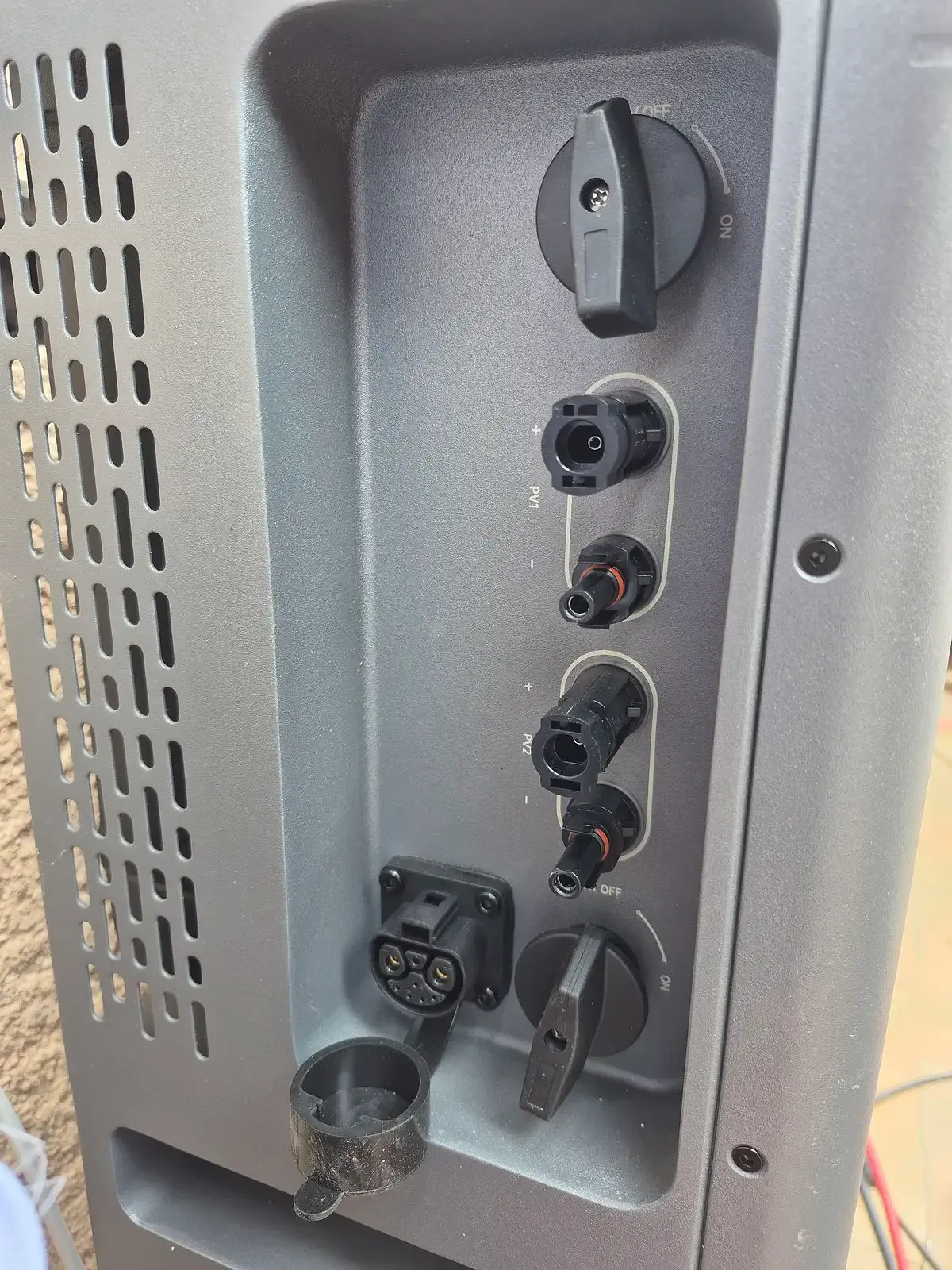
Before installing the battery in its slot, we prepare both the network cable and the wiring for our solar panel system. The SF 4000 Mix Pro only accepts solar connections in series through its two MC 4 inputs, with each input powering a 4 kW MPPT controller (resulting in a total of 8 kW). Therefore, it’s essential to modify the wiring of our original system, which consisted of six 450 Wc panels connected in parallel.
For the network side, Zendure offers a choice between a pre-made AC cable that allows a maximum power input of 2500 W, or bare connectors to build one’s own cable and achieve maximum performance (4 kW or even 5 kW with an external AC inverter). We decided to connect the battery directly to the terminal of our dedicated input line, so we assembled our own 4 mm² cable.
The battery-side connector is a “PVAC 05-03” from CNNT, a major Chinese manufacturer of electrical equipment. It’s easy to cable: simply insert the strain relief clip, tighten the wires firmly but not excessively using the connectors provided on each terminal, then secure everything by screwing it shut. It’s unfortunate that there’s no clear indication of the torque required for tightening.
The other end of the cable remains bare since the wires are connected directly to our circuit through Legrand DIN terminals protected inside a waterproof junction box.
+3
While the included manual (in French) clearly explains all the steps, this setup is typically intended for professional installers. Zendure emphasizes this point several times and requires proof of professional installation in the smartphone app to unlock network injection power above 2500 W.
These are entirely understandable precautions, as the current can reach 17.4 A and even 21.7 A when coupled with an inverter. This exceeds the 16 A limit allowed for short periods by a standard outlet. At such high currents, it’s best to avoid any mistakes to prevent the risk of fire. It is absolutely crucial to use a 4 mm² cable dedicated solely to the battery, wired directly from the main panel, and to ensure perfect tightness in the connections.
Beyond electrical wiring, the Zendure Solarflow 4000 Mix Pro can also be connected wirelessly to the internet (via the LAN port) and to a connected meter (via the RJ45 format RS485 port). While the battery can connect via Wi-Fi, it remains highly advisable to use wired connections for a more robust and reliable connection.
Such a connection seems crucial, especially between the battery and the Zendure Smart 1 CT-S connected meter (not included by default but often offered during promotional campaigns). The meter provides the battery with real-time information on the power consumed by the home. Using this data, the battery delivers the appropriate amount of electricity to maximize self-consumption while minimizing the amount of power sent freely into the public grid.
With a direct RS485 wired connection, information travels more quickly between the battery and the meter. There is less latency, and thus, in theory, fewer losses. During our test, we used exclusively this connection method, running a 15 m RJ45 cable (a very basic Ethernet cable) between the SF 4000 Mix Pro and our electrical panel, where the connected meter is located.
Installing the Zendure Smart 1 CT-S meter is not particularly complicated. This is especially true since the device comes equipped with a detachable terminal block, which makes wiring its power supply line a bit easier. This single-phase version has only one measuring torus, which should be placed on the main power phase of the residence (make sure to position it according to the direction of the current). The small wire from the torus simply clips onto the L1 port of the meter.
It features a LAN port that can be used to connect it to the internet via an Ethernet cable or, in our case, directly to the RS485 port of the battery. Of course, a Wi-Fi connection is also available for those who prefer a wireless link.
Alternatively, the SF 4000 Mix Pro can also be connected to a third-party meter such as the Shelly Pro 3 EM. However, we were unable to properly pair the two devices in the Zendure smartphone app, despite following the guided setup process. The app never managed to correctly identify the phase corresponding to the main power supply in our home.
+2
Once the installation is complete, all we need to do is flip the circuit breakers located on the left side of the battery. One isolates the solar inputs, while the other isolates the battery itself. The presence of these switches offers a significant safety advantage. The tiny screen on the front simply indicates, through three icons, whether the battery is powered on and its charging status.
In practice, everything is managed through the Zendure smartphone app. It is essential for checking operational data and configuring the energy strategy. Pairing is done quickly via Bluetooth, and optionally via Wi-Fi. After that, the user must select the battery’s operating mode from five available options:
“Auto Mode,” which supplies electricity based on the home’s consumption as well as electricity prices (you can input the cost per kilowatt-hour from your contract, and the app also supports dynamic pricing plans).
“Zenki Mode,” an AI-driven mode designed to optimize savings by allowing it to manage energy flows according to solar production, energy prices, and weather forecasts.
“Self-Consumption Mode,” the simplest and most efficient in our view. It is the mode we used exclusively during our testing. It supplies only the amount of electricity equivalent to what the home consumes. Any excess is stored and then injected as needed to minimize losses from “free” injection into the public grid.
The “TOU mode,” similar to the “Auto” mode, is designed for households using a dynamic pricing supply contract.
The “Custom mode” allows for manual scheduling of daily charging times and power levels.
Once the mode is selected, other parameters can be adjusted to fine-tune device management. It is still possible to allow the export of excess solar energy (useful in the rare cases where you sell your generated power at an attractive rate other than through an EDF OA contract). You can also set the battery charge and discharge depth (between 5% and 100%), adjust electricity prices, and set the maximum discharge power to the grid.
By default, the battery supplies a maximum of 900 W to the grid. This power can be increased to 2500 W without verification. To reach 4000 W (and even 5000 W with an AC inverter connected to the battery), Zendure requires proof of professional installation, which must be uploaded to the app. Within 48 hours at the latest, the brand approves or rejects the request and unlocks the menu. Our request was accepted with just a PDF installation invoice.
The app is quite well-designed. We didn’t encounter any bugs, except for the pairing process with a third-party meter (a Shelly Pro 3 EM), which didn’t work properly. The energy flows are accurately represented, and the data is quite comprehensive, complete with useful graphs. It’s easy to find key information such as production summaries, injection details, savings achieved, and battery charge and discharge levels, among others.
We only regret that we can’t access more advanced battery information, such as the number of cycles, state of health (SOH), and the total amount of energy charged/discharged. These are important details that other domestic battery manufacturers like Ecoflow have chosen to make available to their users.
We used the Zendure Solarflox Mix 4000 Pro for two months, in September and October. Connected to a 2700 Wc south-facing rooftop solar panel array with some occasional shading, it was able to generate a peak power of 2026 W according to the app. Slightly disappointing. In a previous test, the competing Jackery Solar Vault 3 achieved a peak power of 3100 W on a 3600 W system. Since the Jackery model has 4 MPPTs, we were able to connect more panels than with the Mix 4000 Pro, which has 2 MPPTs.
These two MPPT controllers allow for the use of two solar panel arrays with different orientations. However, due to the required series connection, the battery struggles to extract maximum power when shadows are cast on our solar system. The same issue occurs on days with heavy cloud cover, resulting in only a few hundred watt-hours of power generated, whereas other batteries equipped with more MPPT controllers perform slightly better.
The highest daily production was recorded at the beginning of September, at 12.55 kWh. Over the two months of testing, we generated a total of 447.7 kWh, with 13.4 kWh fed back into the grid, resulting in an exceptionally high self-consumption rate of 97.15%. The actual savings on our electricity bill amounted to 71 euros during this period.
Production and Self-Consumption
Zendure Solarflow Mix 4000 Pro
Month
Raw solar production (Zendure measurement)
Raw solar production
(independent measurement)
Grid feed-in
(independent measurement)
Self-consumption rate
Savings achieved
09/26
303.39 kWh
265.3 kWh
9.6 kWh
96.4 %
42.45 €
10/26
203.36 kWh
182.4 kWh
3.8 kWh
97.9 %
28.58 €
TOTAL
506.75 kWh
447.7 kWh
13.4 kWh
97.15 %
71.03 €
It should be noted that these readings do not come from the Zendure app, but from our Shelly Pro 3 EM meter installed on the injection line dedicated exclusively to the SF4000 Mix Pro. This allows us to use the same counting system for all solar batteries we test, regardless of the measurement method built into each product.
We observe a significant discrepancy between the production amount shown in the Zendure app and that measured by our meter, which is considerably lower. The difference amounts to 59 kWh, which is quite high for just two months of production. It is likely that the SF4000 Mix Pro displays raw data, without accounting for losses related to the inverter, among other factors, which skews the profitability calculation provided by Zendure.
On the power injection side, the battery delivers as promised, with a maximum of 3999 W (just under the specified value) being sent to our network until the storage is completely depleted. At full capacity, however, the device generates significant noise that can be quite disruptive, especially at night in summer when windows remain open.
This noise, which comes from the upper part of the battery and thus presumably from the inverter, resembles an electrical humming sound. Using a sound meter, we measured a maximum of 43.2 dBA just a few centimeters in front of the battery. The sound level is proportional to the power injected, and it disappears completely when the output is below around 1000 W.
The Zendure SF4000 Mix Pro features a off-grid household outlet on its right side. It allows connecting any device up to 16 A or 3680 W, which continues to receive power even during a power outage. We tested it by connecting two fan heaters totaling 4000 W. The result was that the battery cut off power 17 seconds after startup once the current exceeded 16 A. Maximum power output: 3970 W.
We also tested another configuration: a 2000 W radiator and a 1000 W drill, both set to full power, without causing a circuit breaker to trip. With the load disconnected, our multimeter showed that the alternating current output was indeed sinusoidal, with a voltage of 246.8 V and a frequency of 49.97 Hz, which is fully compliant.
Ideally, the off-grid outlet should be connected to ground (through the dedicated screw hole on the battery) for maximum safety. Keep in mind that only this outlet powers devices during a power outage. To protect the entire home from power cuts, an optional device is required: the Power Hub, which must be installed by a professional on your main power supply.
Priced at 2899 € on Zendure’s website, the largest battery from this Shenzhen-based manufacturer requires a substantial solar installation to be cost-effective. In our situation (a 2700 Wc solar power plant in southeastern France), it would take nearly 10 years to recoup the cost, which isn’t extremely long according to our profitability simulator. It gets slightly better with 8 kW of photovoltaic panels connected: the battery is paid off in 8 years. Assuming an optimistic 15-year lifespan, this only allows for some long-term savings.
In France, at present, solar batteries are not necessarily financially viable due to relatively low electricity costs. In our neighboring countries like Germany and the Netherlands, where electricity costs are twice as high, these batteries are much more cost-effective.
Zendure - SolarFlow 4000 Mix Pro starting at 2,898.00 € at Zendure FR