
Charging Station: BYD Continues to Innovate
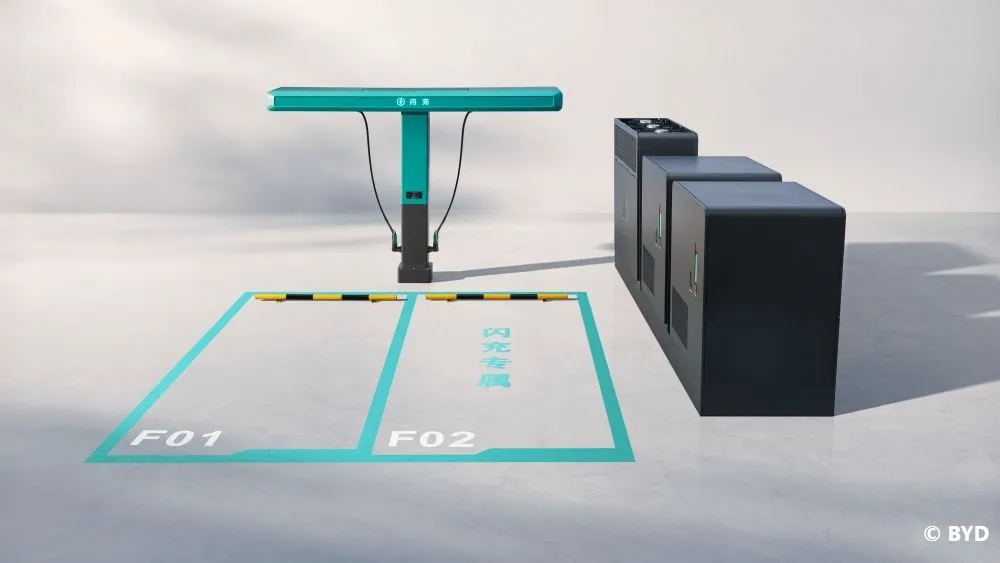
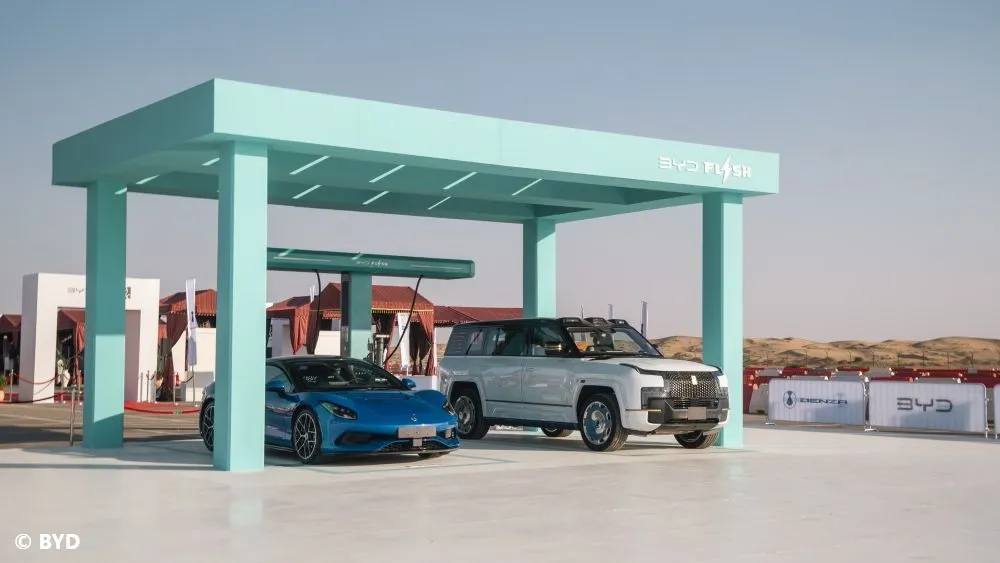
As the world’s leading seller of electric vehicles, BYD also has ambitious goals in the field of charging. To secure a strong position in this sector, the Chinese brand relies on innovation. An example of this is the highly innovative charging station it recently unveiled in Abu Dhabi. This charging station combines solar energy generation with energy storage—a winning combination. For BYD, it also serves as a model for Flash Charging, which the company aims to deploy globally. This ultra-fast charging method allows a vehicle to be fully charged in less than 10 minutes. In addition to speed, BYD wants to simplify charging as much as possible by using a robot to handle everything. This model station in Abu Dhabi represents an important step toward realizing BYD’s “Three Green Dreams.”
Solar Energy and Storage: The Winning Combination
Located in the heart of the desert, Abu Dhabi’s BYD charging station combines solar energy production with energy storage. The infrastructure is built around BYD’s Solar Storage Charging system, which links solar energy generation to battery storage. With over 16 years of experience, BYD Solar already serves customers in more than 100 countries. Backed by a team of 300 specialists, it brings its expertise to the solar power generation aspect of the Abu Dhabi site. By integrating solar production with battery storage, the SSC system can operate independently of the electrical grid. This reduces reliance on existing power infrastructure and provides greater flexibility in deployment, even in areas with limited grid access.
A Model for the Development of Flash Charging
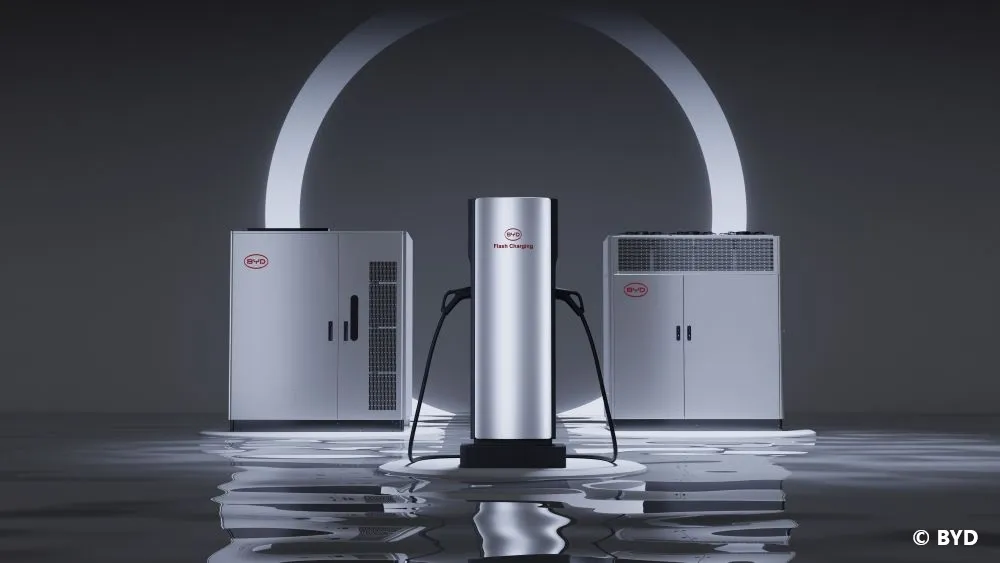
The Abu Dhabi charging station also serves as a model for Flash Charging. It is a high-power charging technology that BYD aims to deploy worldwide. Flash Charging reduces charging times to those of a traditional fuel fill-up. The various charging stations are capable of delivering up to 1,000 kW. For compatible vehicles, the battery charge can go from 10% to 70% in just five minutes. In China, BYD targets 20,000 Flash Charging stations, covering 325 cities by the end of 2026. In Europe, BYD plans to launch 100 stations by the end of the year, starting with Germany. Deployment is then set to continue in several other countries, aiming to reach 3,000 charging stations by spring 2027.
A robot taking charge of charging
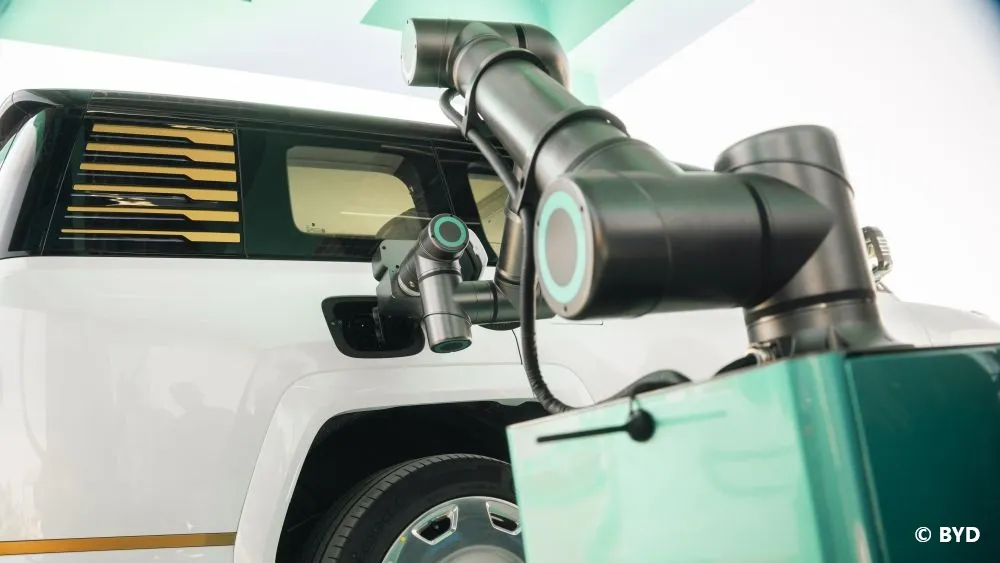
With its charging stations, BYD aims not only to provide faster charging but also to make it simpler. To achieve this, it uses a robot to handle the entire charging process. This system is in use at a station in Abu Dhabi, where a robotic arm manages the connection to the vehicle. It automatically locates the charging port, opens it, and inserts the connector. The robotic arm ensures precise alignment and a secure connection to the Flash Charging system. Additionally, BYD combines this robotic charging with an autonomous valet service. Drivers can simply get out of the vehicle and walk away while the car moves autonomously to the designated charging spot. Once the vehicle is parked, the robotic arm takes over. Together, these two technologies make the entire process smoother and more convenient for users.
A step toward realizing BYD’s Three Green Dreams
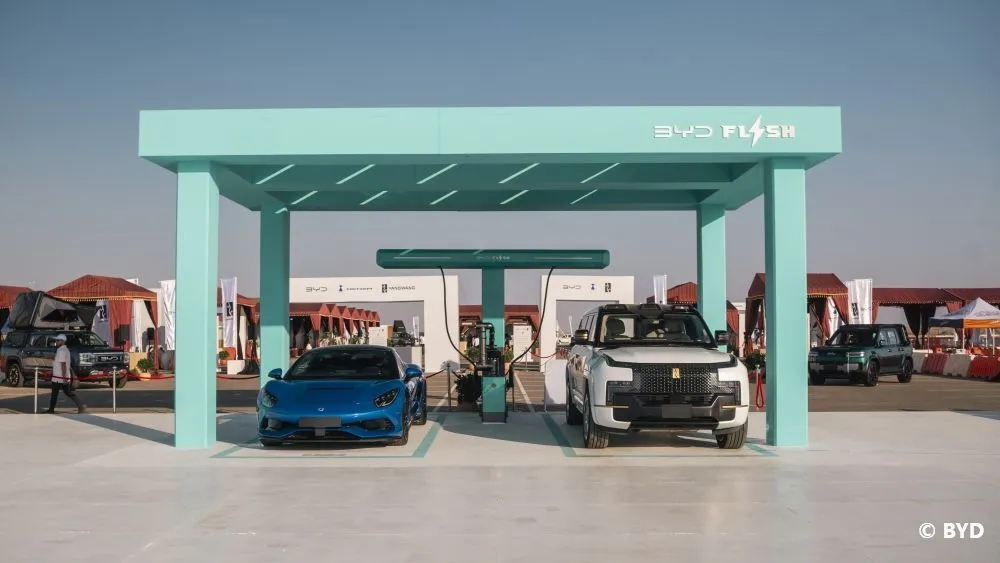
The construction of the Abu Dhabi station represents a significant milestone in realizing BYD’s Three Green Dreams. This vision, which has guided the Chinese company’s long-term development strategy since 2006, encompasses three goals. The first is to utilize solar energy to generate clean power. The second focuses on the ability to store this energy in batteries. Finally, the third aims to replace gasoline vehicles with electric vehicles that can use this energy. Two decades of technological innovation have brought these goals closer to reality. Thus, at the Abu Dhabi site, a unique system integrates solar power generation, energy storage, and electric mobility. Additionally, ongoing advancements in batteries and charging technologies are making electric mobility more practical.