
Charging solid-state batteries in 5 minutes? QuantumScape believes it’s possible
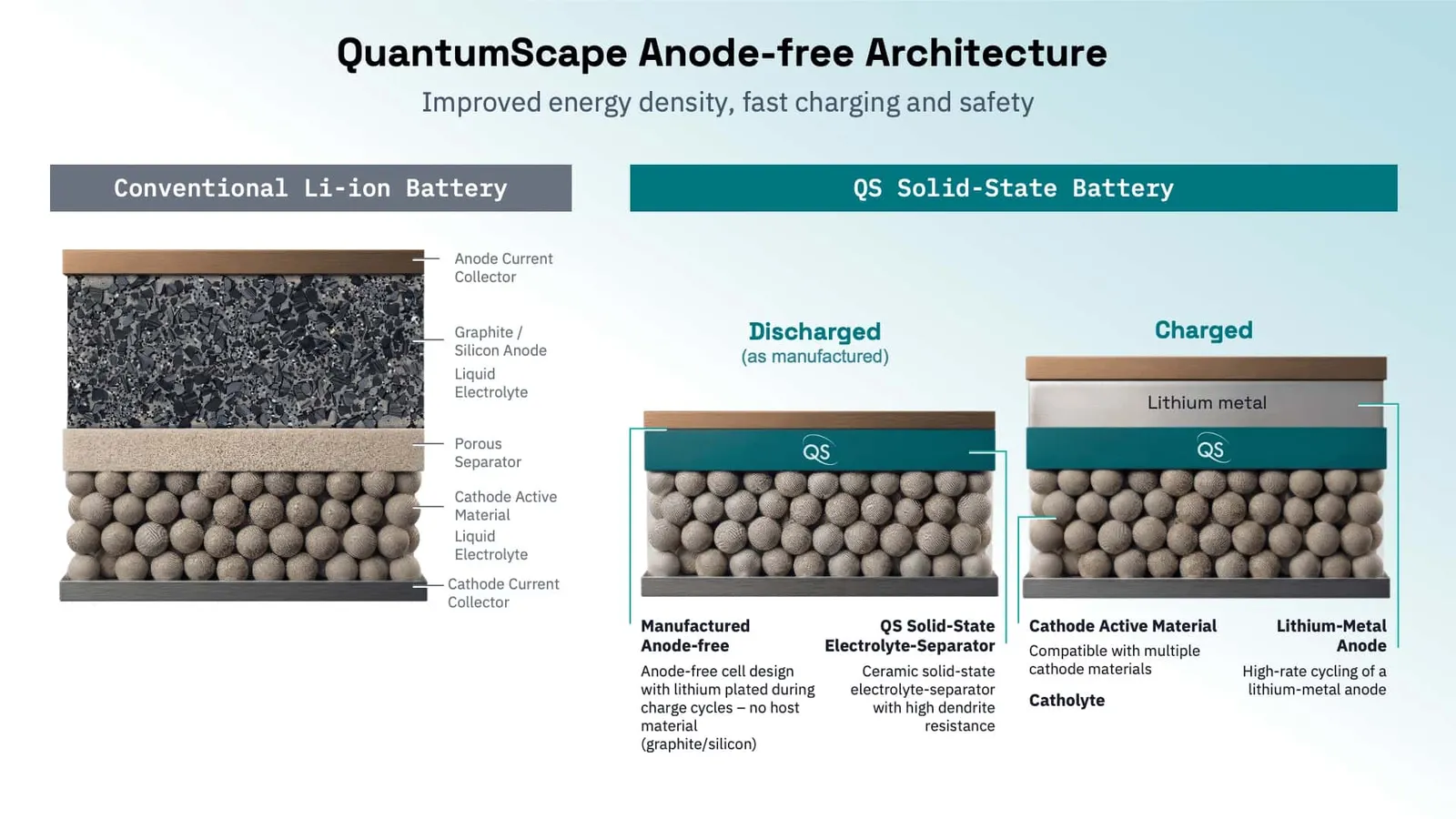
QuantumScape has released for the first time the results of its Osprey cells, a solid-state platform designed to overcome the historical shortcomings of sulfur-based electrolytes. According to the company, these cells have completed over 1,000 cycles while retaining 80% of their capacity under conditions considered industry standards, all while maintaining only 1 atmosphere of pressure—much lower than the levels required by sulfur-based batteries to date.
Another key advantage is rapid charging in just five minutes, along with an energy density that can reach up to approximately 1,100 Wh/L. If these figures are confirmed at an industrial scale, they could address two of the most discussed limitations of today’s electric vehicles.
The QS ceramic separator and the role of sulfurs
At the heart of QuantumScape Osprey technology is its proprietary ceramic separator, produced using a continuous flow process that the company calls Cobra. This material is chemically stable when in contact with metallic lithium. This property enables high coulombic efficiency and allows for a "anode-free" design, meaning no excess lithium is deposited on the anode.
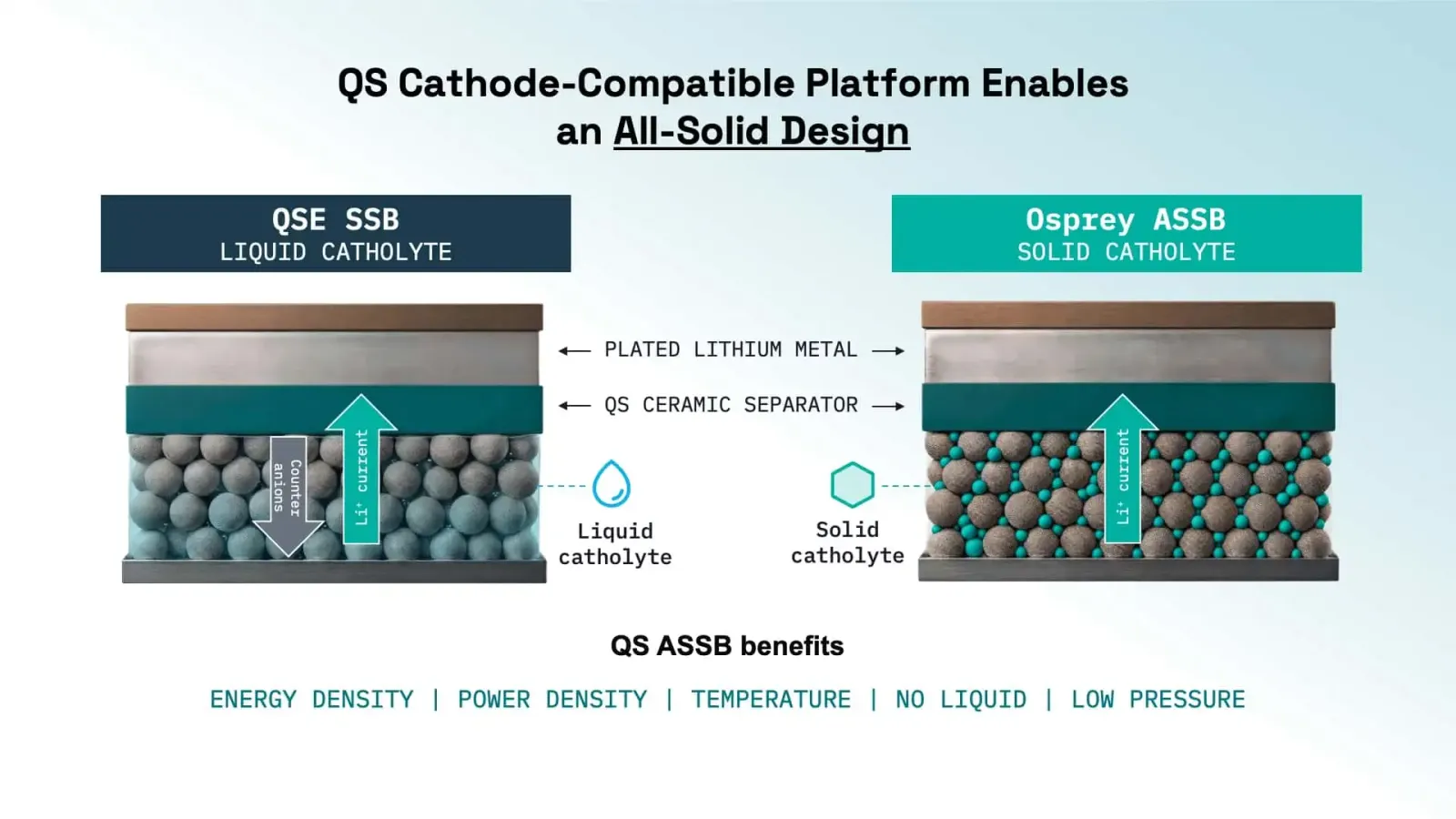
QuantumScape Osprey: The principle behind a fully solid-state battery
Photo by: QuantumScape
The separator offers mechanical resistance to dendrites, which are lithium protrusions that can pierce polymer or sulfur-based separators and cause the cell to short-circuit. In safety tests conducted by the company, commercial cells withstood temperatures over 300°C without experiencing thermal runaway. In the current generation, the QSE platform combines this same separator with a high-nickel NMC cathode and a liquid catholite—it forms the basis of the QSE-5, the company’s first commercial product.
Sulfide-based electrolytes remain among the most studied for solid-state batteries due to their good ionic conductivity and relative ease of processing at low temperatures. Manufacturers that have used them as separators have faced the same challenges for over a decade, according to the company: short cycle life, the need for high pressures, poor performance at low temperatures, and slow charging.
How Osprey Works
QuantumScape’s proposed solution is to separate the two problems: using sulfur not as a separator but as a solid catholite combined with the ceramic QS separator. In this configuration, lithium ions move through the sulfur structure via ion hopping. This mechanism eliminates the polarization phenomenon typical of liquid electrolytes, which is what allows for a five-minute charge time, according to the company.
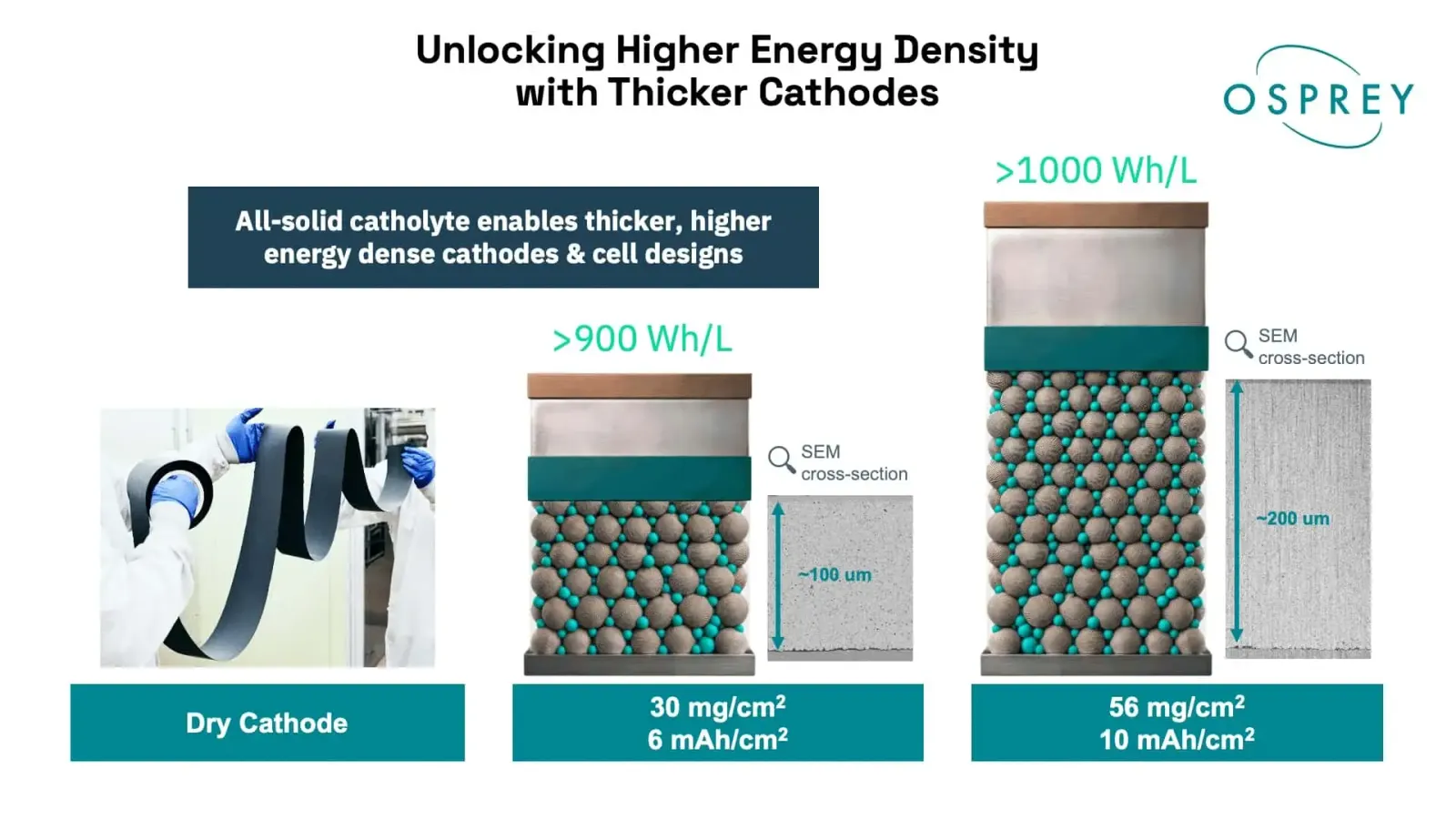
QuantumScape Osprey: higher energy density thanks to much thicker cathodes
Photo by: QuantumScape
The same property allows for much higher cathode capacities: up to 10 mAh/cm2, roughly double the 3-5 mAh/cm2 typical of conventional lithium batteries. A higher cathode capacity requires fewer cell layers, along with less separator and current collector material. The result is a battery that is overall more energy-dense.
The reported results pertain to two-layer single cells with cathode areas and capacities that are commercially significant: 1,000 cycles at 80% capacity retention at room temperature, at a rate of 1C/1C with full discharge, as well as accessible capacity down to -20 °C. The company claims that no other sulfur-based solid-state cell has yet demonstrated the same combination of results.
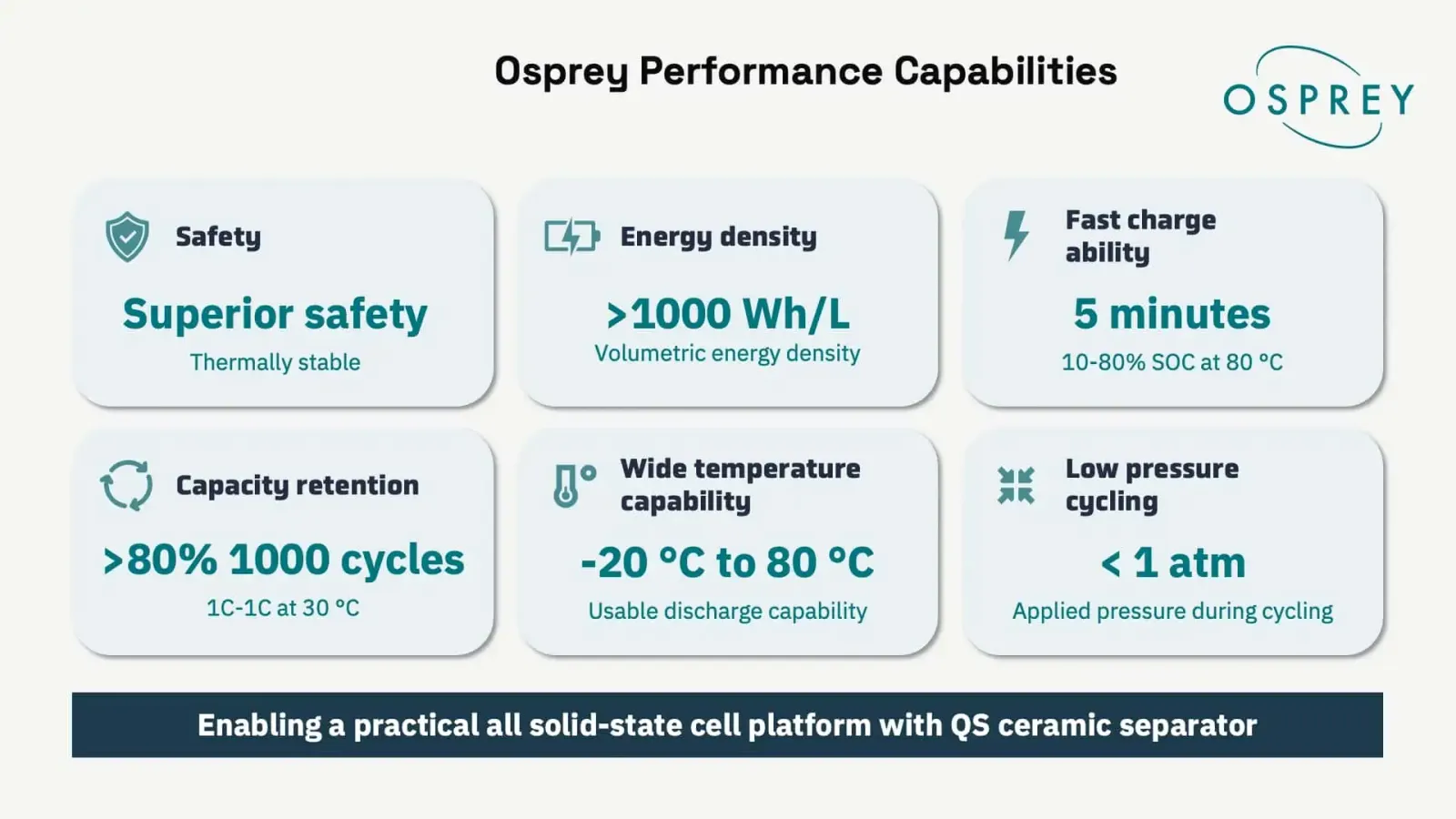
The promised advantages of QuantumScape Osprey solid-state batteries
Photo by: QuantumScape
Next steps toward production
Osprey is designed as an open platform: customers can choose QuantumScape’s proprietary sulfide cathode or bring in their own cathode technology, while still benefiting from the ceramic separator and anode-free design. The company is partnering with automakers to develop the project.
Photo gallery: QuantumScape Osprey solid-state battery platform
However, there are still engineering steps to complete before large-scale production. The published results come from two-layer cells with the same area as the QSE-5. Automotive industry clients typically require larger prismatic cells with more layers and higher capacity.
Osprey’s manufacturing process has so far only been demonstrated on a laboratory scale. Developing faster production processes is still underway.
On solid-state batteries