
QuantumScape introduces a solid-state battery that charges in 5 minutes and retains 80% of its capacity after 1,000 cycles.

For years, solid-electrolyte batteries have been presented as the Holy Grail of electric vehicles. They offer greater range, much shorter charging times, and superior safety compared to conventional batteries. However, turning these theoretical advantages into a product that can be manufactured on a large scale and last hundreds of thousands of kilometers has proven to be far more complicated than expected.
One of the manufacturers that has been trying to overcome these challenges for the longest time is QuantumScape. This American company, which has a close industrial relationship with the Volkswagen Group, has now announced a new platform called Osprey, with which it aims to accelerate the development of fully solid batteries and make its technology available to other manufacturers.
The innovation does not lie solely in achieving a battery with excellent performance. QuantumScape claims to have solved one of the most significant technical challenges in sulfide-based batteries: the need for high mechanical pressure to maintain stable operation during charge and discharge cycles.
A battery that charges in five minutes and retains 80% of its capacity after 1,000 cycles
The new Osprey platform combines several technologies that QuantumScape has been developing for years. It uses its patented ceramic separator, designed to facilitate the transport of lithium ions and prevent issues related to the growth of unwanted metallic structures that degrade battery cells. Additionally, it features a metal lithium design without a conventional anode and a fully solid cathode.
This final feature represents a significant difference compared to other architectures that combine solid components with liquid materials. In Osprey, QuantumScape aims to eliminate the liquid electrolyte and leverage the advantages of a completely solid architecture.
The initial tests published by the company show particularly interesting results. The cells have managed to complete 1,000 full charge and discharge cycles while retaining approximately 80% of their initial capacity. This outcome suggests potentially competitive durability for use in vehicles.
To put this figure in perspective, if a battery could cover 500 kilometers per full charge cycle, 1,000 cycles would theoretically equate to about 500,000 kilometers of total usage. Obviously, this is an approximate equivalence, as actual degradation also depends on time, temperatures, and usage conditions.
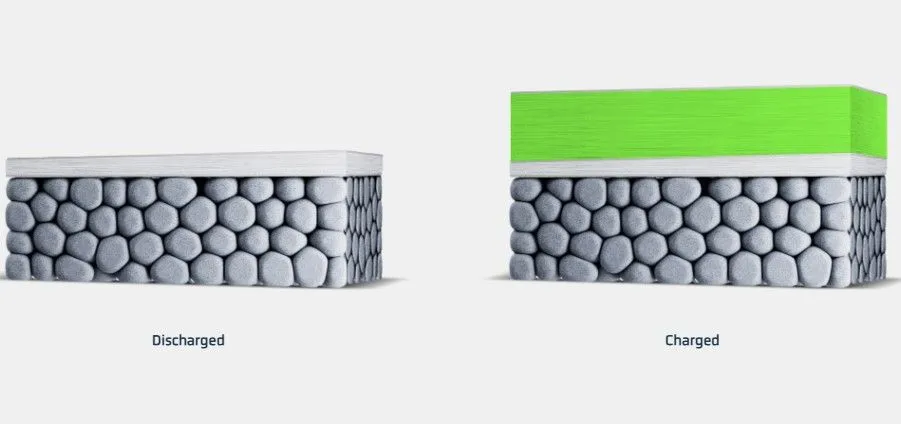
But perhaps the most striking feature is its charging speed. QuantumScape claims that Osprey can go from 10% to 80% battery charge in just five minutes. Thus, we’re talking about powers exceeding 500 kW.
The company also targets a potential volumetric energy density of up to 1,100 Wh/L, a very high figure that would allow more energy to be stored in the same space. This presents two options for manufacturers: either increase range without enlarging the battery size or maintain the current capacity using a more compact design.
In addition to these capabilities, it can operate at temperatures below -20 °C, a feature particularly useful for markets with harsh winters, where conventional batteries may experience significant drops in performance and charging capacity.
However, the most significant advancement might be another one that seems less impressive on paper but is crucial for bringing this technology to production facilities.
Sulfide-based solid-state batteries typically require considerable mechanical pressure to maintain good contact between their internal components. If this contact deteriorates during charging and discharging cycles, internal resistance increases, which can accelerate battery degradation. This necessitates the use of systems to keep the cells compressed, adding complexity, weight, and cost to the overall design. This is a particularly significant issue in vehicles, where every kilogram and every centimeter counts.
QuantumScape claims that Osprey has managed to complete its tests using only one atmosphere of pressure, roughly normal atmospheric pressure. The company presents this result as a particularly important advancement for solid-state batteries with sulfide-based cathodes.
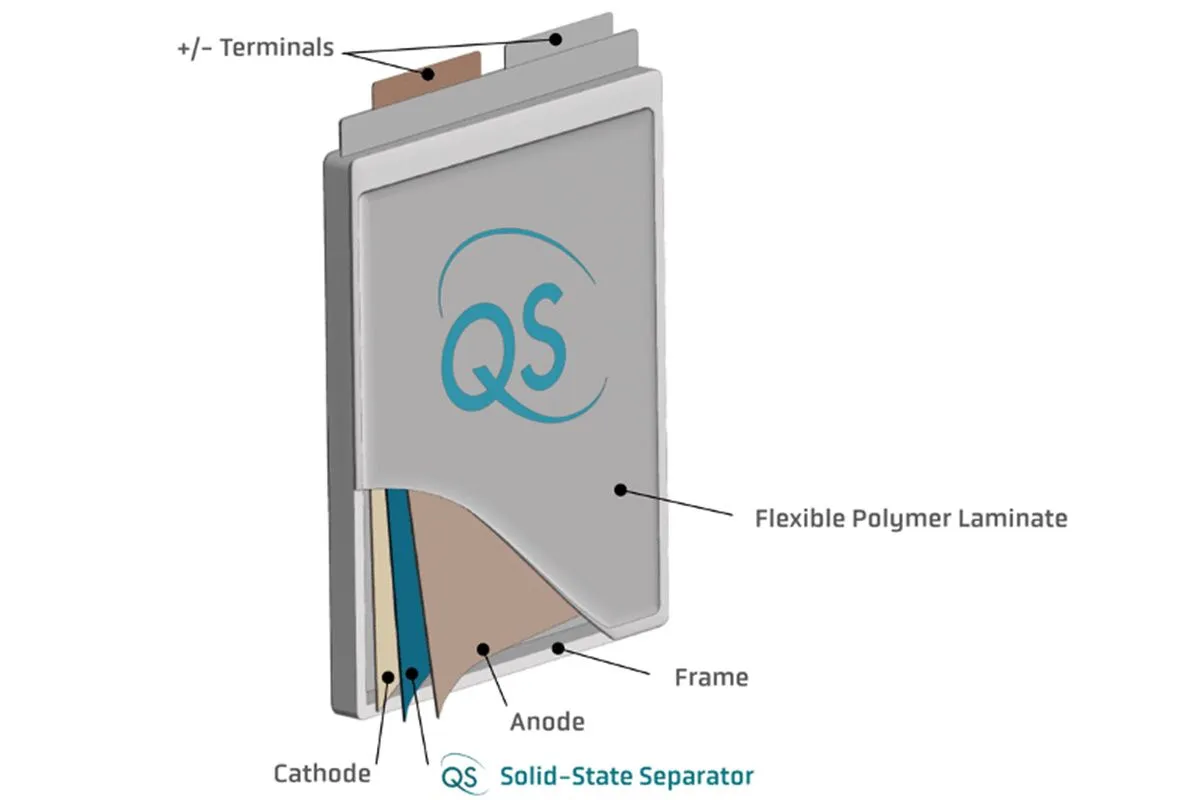
Achieving a long lifespan without relying on high pressures could significantly simplify the design of future battery packs and facilitate their integration into mass-produced electric vehicles.
The company claims to have tested this architecture using various solid cathode formulations, both developed in-house and provided by its automotive industry clients. This would allow other manufacturers to utilize QuantumScape’s ceramic separator and architecture to develop their own batteries.
What’s missing are the dates. QuantumScape has not announced a specific date for large-scale commercial production, nor has it detailed the cost of this technology compared to current LFP or NMC batteries.
But the advancements announced are interesting because they address several of the major challenges of solid-state batteries simultaneously: durability, charging speed, energy density, and operating pressure.
If QuantumScape manages to apply these results to larger cells and competitive industrial processes, Osprey could become one of the platforms that help drive the final leap toward fully solid-state batteries. A technology that has been promising to transform electric vehicles for years and is gradually starting to deliver increasingly concrete results.