
SAF fuel: Poland has the raw materials for aviation fuel, but there are no factories.
In the article:
Starting in January 2025, fuel at larger EU airports must contain at least 2% SAF, rising to 6% by 2030 and 70% by 2050
In 2024, a ton of SAF cost 2300-3000 euros in Europe, roughly three times more than a ton of conventional Jet A-1
In 2025, 1.9 million tons of SAF were produced globally, accounting for less than 0.7% of total aviation fuel
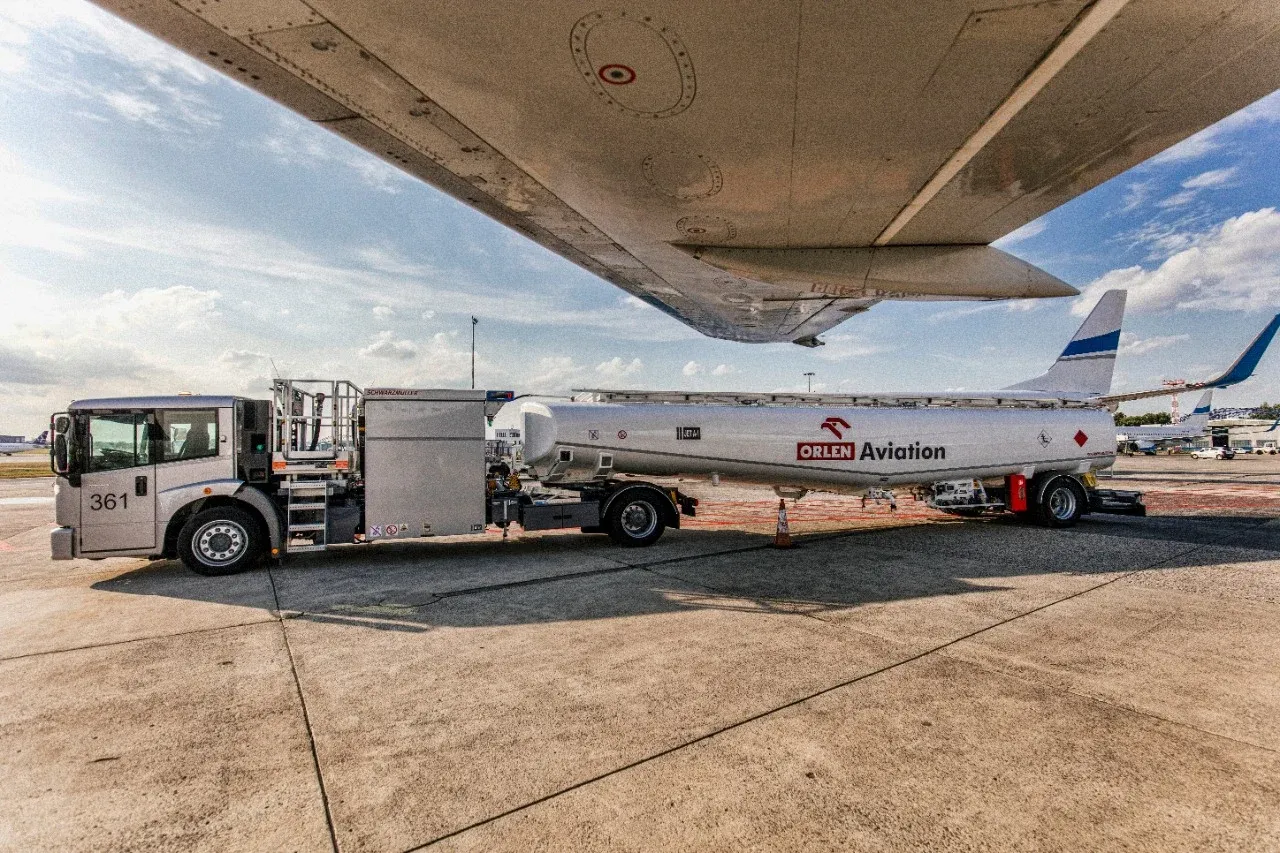
SAF is available in Warsaw, Krakow, and Katowice starting in July 2025, but ORLEN imports it
Poland has an annual surplus of 12.5 million tons of straw and the Bełchatów Power Plant, which emits about 33 million tons of CO2
The report identifies six locations for future production: Płock, Gdańsk, Jedlicze, Bełchatów, Police, Puławy, and Silesia
Less time remaining
Poland does not produce a single ton of sustainable aviation fuel today. The SAF fuel that must be supplied to airports in the European Union starting in 2025 is entirely imported from abroad. At the same time, we have resources that will be the most valuable after 2030: massive surpluses of straw and the largest point source of CO2 in Europe. This is the picture that emerges from the report “Sustainable Fuels in Aviation: A Step Toward Climate Neutrality,” prepared by the Polish Association for New Mobility and the Institute of Propulsion and Aviation at Poznań University of Technology. The authors warn that little time remains to establish a domestic market.
What is SAF fuel?
SAF (Sustainable Aviation Fuel) is a sustainable aviation fuel produced from waste materials such as used cooking oil and animal fats, biomass, as well as synthetically from green hydrogen and captured CO2. This latter type is known as e-SAF. The biggest advantage of SAF is that it does not require new aircraft or new infrastructure. It can be pumped into the same machines and using the same facilities as conventional fuel.
Standard ASTM D7566, which specifies which synthetic and renewable fuels can be used in aviation, currently approves eight SAF production processes. The finished fuel can be mixed with conventional Jet A-1 in a ratio of up to 50%. The most mature technology is HEFA, which involves hydrogenating oils and fats, such as those from waste.
ReFuelEU Aviation requirements and penalties for suppliers
The EU’s ReFuelEU Aviation regulations require fuel suppliers to gradually increase the share of SAF: 2% by 2025, 6% by 2030, and 70% by 2050. Suppliers must also report annually on the volumes of aviation fuel and the types of SAF supplied to EU airports, along with the emission reductions achieved. It is worth noting that the European Commission’s initial proposal set a 63% share target for 2050 — this target was eventually raised to 70%.
Fines are imposed for failing to meet these requirements. In Germany, according to a report, suppliers must pay 4,700 euros for each ton of SAF that is not supplied starting from December 2025.
Why aviation needs new fuel
Air transport accounts for about 2-3% of global CO2 emissions, but it is the sector with the fastest-growing emissions. According to a report, these emissions increased by 146% between 1990 and 2019, and ICAO (International Civil Aviation Organization) estimates that without additional measures, they could rise another 3-4 times by 2050.
The actual impact of aviation on the climate is 2-4 times greater than what would result from CO2 alone. About 66% of the total impact comes from other factors: nitrogen oxide emissions, particulate matter, and contrail formation. Unlike car engines, aircraft engines do not have any exhaust purification systems. The result? Since 1990, nitrogen oxide emissions from road transport in the EU have decreased by 69%, while those from international aviation have increased by 139%.
How much does SAF reduce emissions?
Fuels derived from waste and residues can reduce greenhouse gas emissions across the entire life cycle by up to 80-90%, and particulate emissions by 50-70%. Contrails behind engines powered by SAF are thinner, shorter, and less persistent. According to the models cited in the report, using 100% SAF can reduce their greenhouse effect by about 26%.
"Sustainable aviation fuels are today the only solution that we can implement on a large scale immediately, with the current fleet, without waiting for a new generation of aircraft. Research on turbine engines confirms that even a small addition of HEFA significantly reduces the quantity and mass of airborne particulate matter emitted, and the greater the proportion of SAF, the stronger the effect. This is most evident at low thrust levels, that is, where aircraft operate at the airport," says Dr. hab. inż. Remigiusz Jasiński, head of the Aviation Department at the Institute of Propulsion and Aviation at Poznań University of Technology.
The expert cautions, however, that the raw material determines the outcome: “Fuel from waste can reduce emissions over its lifetime by as much as 80-90%, while fuel from cultivated plants, after accounting for land-use changes, only reduces emissions by a few percent in some cases. Therefore, Polish production should rely from the start on waste, residual biomass, captured CO₂, and green hydrogen.”
How much does SAF fuel cost compared to Jet A-1?
The main barrier remains cost. In 2024, a ton of Jet A-1 cost 800-950 euros in Europe, while a ton of SAF cost 2300-3000 euros. Synthetic e-SAF was even more expensive—around 5500 euros per ton. However, the report indicates that costs drop by 10-20% with each doubling of production scale. By 2030, fuel produced using HEFA technology could cost 1200-1500 euros per ton.
The second issue is the shortage. In 2025, 1.9 million tons of SAF were produced worldwide, accounting for less than 0.7% of aviation fuel. In the EU, sustainable fuels made up only 0.6% of the fuel supplied to airports in 2024, with 99% of this amount being taken up by ports in Germany, France, Spain, the Netherlands, and Sweden. Central Europe is virtually absent from this market.
Ormus Strait and energy security
The importance of SAF has also increased due to the crisis in the Middle East. According to a report, after restrictions on shipping through the Strait of Hormuz, aviation fuel prices in Europe doubled, reaching $1,800 per ton by March 2026. Some airlines, including KLM and SAS, were forced to reduce their flight schedules. Domestic production of aviation fuel is no longer solely a matter of climate policy but has become an issue of energy security.
Straw, poultry, and Bełchatów – Poland’s potential
Since July 2025, SAF has been available at airports in Warsaw, Krakow, and Katowice, but ORLEN imports it from abroad. Meanwhile, according to a report, Poland has average resources of used oils, but it has above-average potential in two categories that will determine the market after 2030.
The first is biomass. The surplus of straw, that is, the amount left after meeting agricultural needs (mulch, feed, plowing), amounts to 12.5 million tons per year. Additionally, Poland, as the largest poultry producer in the EU, generates about 2 million tons of animal by-products annually.
The second category is CO2 for producing e-SAF. The Bełchatów power plant emits around 33 million tons of CO2 per year and is the largest single emitter in Europe. Other major sources are located in Puławy (3.4 million tons) and Police (1.5 million tons). The carbon dioxide captured from these sources, combined with green hydrogen, can become a raw material for synthetic fuels.
Where in Poland could SAF factories be established?
The report’s authors identify locations where the production of sustainable aviation fuel makes the most sense:
Płock and Gdańsk – HEFA technology, based on oils and fats
Jedlicze – Alcohol-to-Jet technology, which converts alcohol into aviation fuel; it will host Poland’s first second-generation bioethanol plant.
Bełchatów, Police, Puławy, and Silesia – synthetic e-SAF fuels.
Chopin Airport could serve as a central SAF distribution hub, with Port Polska potentially taking on a similar role in the future.
Implications for the Polish market
The report was prepared by organizations promoting new technologies in transportation, so it is not a neutral document. However, it is difficult to dispute the figures. The requirement to blend SAF will increase regardless of whether Poland builds its own factories. If it does not, it will have to pay for imported expensive fuel, and Polish raw materials, instead of benefiting the domestic economy, could supply foreign refineries. SAF fuel is currently the only way to rapidly reduce emissions in aviation, while also offering opportunities for industry and agriculture. However, the window to get involved is short—the next thresholds for EU requirements are already scheduled.
Cyprian Nowak