
Starting November 21, you will lose your driving license for crossing railway tracks. A red light or traffic jam right behind the tracks is enough.
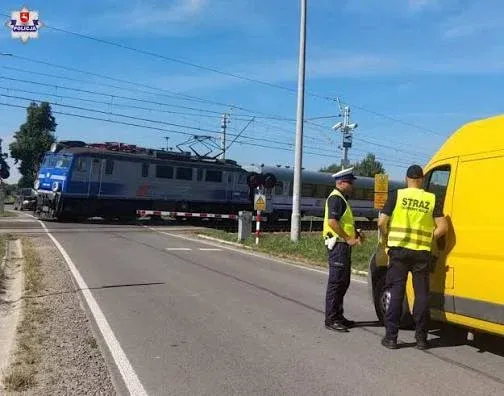
On Saturday, November 21, 2026, regulations taking effect will significantly increase penalties for drivers who violate rules at railroad crossings. In addition to fines and demerit points, drivers will be required to have their driver’s licenses suspended for three months, and courts will be mandated to impose long-term driving bans.
The amendments to the Road Traffic Act and the Criminal Code were published in the Official Gazette on November 6, with a 14-day legislative grace period. This is a response to a series of serious incidents on railway tracks and police data showing that drivers are responsible for the vast majority of accidents at these crossings.
Article contents
Which behaviors will result in the police seizing a driver’s license
Fines and demerit points that still apply
Mandatory court-ordered driving bans
How many drivers die at railroad crossings
What to do when you get stuck between railway tracks
Railroad crossing – four violations that can result in the loss of your driving license
The amendment adds new grounds for immediate suspension of a driving license upon receipt to Articles 135 and 135a of the Road Traffic Act. A police officer will take the driver’s document if they:
drive around abandoned barriers or partial barriers,
enter the railroad crossing when the barriers or partial barriers have already started to lower or have not yet finished raising,
enter the railroad crossing with a red light, a flashing red light, or two alternating red lights,
enter the railroad crossing when there is no space to continue driving on the other side.
The final point will surprise many drivers. A driving license can be revoked even when the barrier is raised and traffic lights are off, if a car gets stuck in traffic on the tracks. The police hand over the seized document to the district official, who then issues a decision to suspend the license for three months. It’s not worth taking the risk of driving during this time either. Starting from September 3, 2026, driving without a valid license will result in its suspension for five years.
Penalties for drivers – fine and points remain
Suspension of the driving license does not replace existing sanctions but supplements them. For these offenses, the regulations prescribe a fine of 2000 zł and 15 penalty points. If a driver commits such an offense again within two years, the fine increases to 4000 zł.
There are so many points that two such violations in a short period of time mean exceeding the 24-point limit, and for drivers in their first year of holding a license, the 20-point limit. The consequence is being sent for a retest or having their license revoked.
Criminal Code – mandatory driving ban for up to 3 years
The most significant changes apply to those responsible for accidents that ended in tragedy or came very close to one. New paragraphs have been added to Article 42 of the Criminal Code. If convicted of causing a traffic disaster (Article 173 of the Criminal Code), the court will have to impose a driving ban of at least 3 years. For causing an immediate threat of such a disaster (Article 174 of the Criminal Code), the ban will be at least one year.
Until now, issuing a ban in such cases depended on the court’s discretion. Now it will be mandatory. The regulations are not formally limited to level crossings, but collisions between vehicles and trains are the most common example of such incidents on roads.
Accidents at level crossings – drivers are at fault in over 80 percent of cases
According to data from the Police Headquarters cited by the Ministry of Infrastructure, 39 accidents occurred at railway level crossings in 2024, resulting in 23 deaths and 29 injuries. By 2025, the number of accidents had risen to 51, with 27 fatalities. As of the end of August 2026, 35 accidents had been recorded, with 16 deaths and 40 injuries. In over 80 percent of these incidents, the driver of the vehicle was at fault.
By the tracks, the driver has no room for error. The braking distance for a speeding train can reach several hundred meters or even over a kilometer, and the train operator cannot leave the tracks to avoid an obstacle. That’s why regulations prohibit entering an intersection as soon as the barriers begin to lower.
Stuck at an intersection – break the barrier and call 112
If a car gets trapped between barriers, it’s necessary to leave the tracks immediately, even if it means breaking the barrier. The barriers are designed to give way under the pressure of a vehicle, and the cost of repairing them is covered by the at-fault driver’s insurance. Life is more important than scratches on the car body.
After leaving the level crossing, it is necessary to inform the railway. The Yellow PLK Sticker, located on the St. Andrew’s cross or on the barrier post, helps with this. It contains the nine-digit identification number of the level crossing, the emergency number 112, and the number for PKP Polskich Linii Kolejowych’s technical services. In cases of threat to life or health, such as when a car is stuck on the tracks, one must call 112 and provide the number from the sticker. The operator immediately knows which level crossing is involved, allowing railway workers to stop train traffic. During the 2026 holidays alone, the information from these stickers was used in 3,333 calls to 112. Trains were stopped in 91 cases, and in 260 cases, train drivers were instructed to slow down.
New regulations – another step in tightening road laws
The changes were prepared by the Ministry of Infrastructure headed by Dariusz Klimczak, which believes that previous penalties have not effectively deterred drivers. After the parliament passed the law, it was signed by President Karol Nawrocki. This is another change to road regulations this year. On March 30, the list of situations requiring the suspension of a driver’s license was expanded, and on September 3, the final phase of an earlier reform took effect.
Starting November 21, the rule is simple: a red light, falling barriers, or no space behind the tracks mean an absolute ban on entry. Those who ignore this rule will have to do without a car for three months.
Maciej Gis