
The next Mercedes-Benz eCitaro will be developed from the ground up as an electric bus.
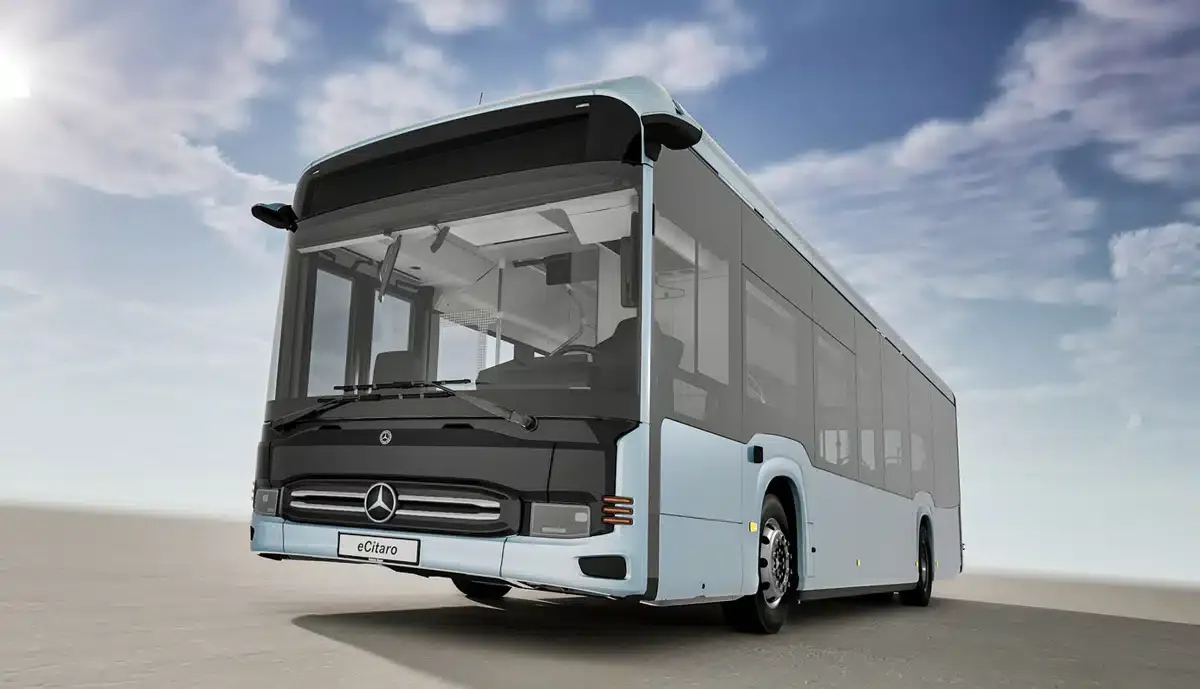

Image: Daimler Truck
Daimler Buses continues to focus on Europe for the next generation of the battery-electric Mercedes-Benz eCitaro. The manufacturer has unveiled a near-production prototype set to enter the European market in 2028. Development is led in Mannheim, while production is planned in Germany, France, and the Czech Republic. Starting in 2030, the company aims to offer only electrically powered city buses in Europe under its new vehicle lineup.
Unlike the current model, which is based on the platform of the conventionally powered Citaro, the next generation of eCitaro will be developed entirely as an electric bus for the first time. Daimler Buses relies on lithium-iron-phosphate batteries (LFP), with single buses capable of having six to twelve battery packs and articulated buses equipped with eight to 14 battery packs. The low-floor version features electric motors located near the wheels, while the Low-Entry version uses a central motor to achieve speeds of up to 100 km/h and can also be used for intercity travel.
According to the manufacturer, the new design reduces the curb weight of the articulated bus by around 750 kilograms and enables software updates as well as remote activation of additional functions through a new electronic architecture.
In the European urban bus market, electric drives are gaining increasing importance: According to Daimler Buses’ analyses, by 2025 two out of three urban buses sold were electric. Since the introduction of the eCitaro in 2018, the manufacturer has delivered over 4,600 vehicles across Europe. Daimler Buses calls for the continuation of national subsidy programs and criticizes in particular the proposed cuts in Germany for 2027. At the same time, the company supports the planned European Industrial Accelerator Act (IAA), but warns against additional complex requirements and calls for uniform competitive conditions.
Electric intercity bus to launch in 2026
The electrification of long-distance and tour buses is also part of the company’s strategy. At the end of 2025, Daimler Buses introduced the Mercedes-Benz eIntouro, its first battery-electric long-distance bus with a range of up to 500 kilometers, with the first deliveries to customers scheduled for November 2026. By the end of the decade, battery-electric tour buses are set to be part of the portfolio, followed later by fuel cell-powered tour buses. According to the company, the expansion of public charging stations along routes and in tourist destinations is crucial for these vehicle segments.
The EU mandates that by 2030, 90 percent of newly sold, approved, or put into service urban buses must be carbon neutral, a goal that Daimler Buses fully supports. For intercity and tour buses, the EU sets a target of 43 percent emission reduction compared to the 2025/2026 baseline. Since the development of the necessary charging infrastructure is at least three years behind schedule according to the company, Daimler Buses calls for the target year for these segments to be extended from 2030 to 2033.
“We support ambitious CO₂e targets in Europe”
"We support ambitious CO₂e targets in Europe," emphasizes Till Oberwörder, CEO of Daimler Buses. "It’s crucial that the regulatory framework supports these goals. Our vehicles will be available in time, but the necessary public charging infrastructure is unlikely to be ready. Without it, our customers cannot use the vehicles cost-effectively. Building such infrastructure is not the responsibility of vehicle manufacturers. Those who set targets must also create the conditions needed to achieve them. Otherwise, the transition will become a competitive disadvantage for Europe’s industry."
According to the industry association ACEA, around 35,000 charging points for heavy commercial vehicles will be needed by 2030 along Europe’s main traffic routes, along with more than 14,000 additional charging points for buses. Daimler Buses plans to build and operate its own public charging stations at key locations for intercity and tour buses through its subsidiary Daimler Buses Solutions, with initial projects already underway in Hamburg, Cologne, and Munich. Additionally, the company offers turnkey solutions for electric bus fleets in partnership with other firms.
Have you found any errors? Please let us know
by email
about them. Thank you!
Also interesting
About the author
Thomas Langenbucher is an expert in electromobility with professional experience in the automotive industry and finance sector. Since 2011, he has been covering electric vehicles, sustainable technologies, and mobility solutions for ecomento.de. Learn more.
Reader interactions