
Mercedes eCitaro (2028): A new generation with LFP batteries and up to 360 kW of power.
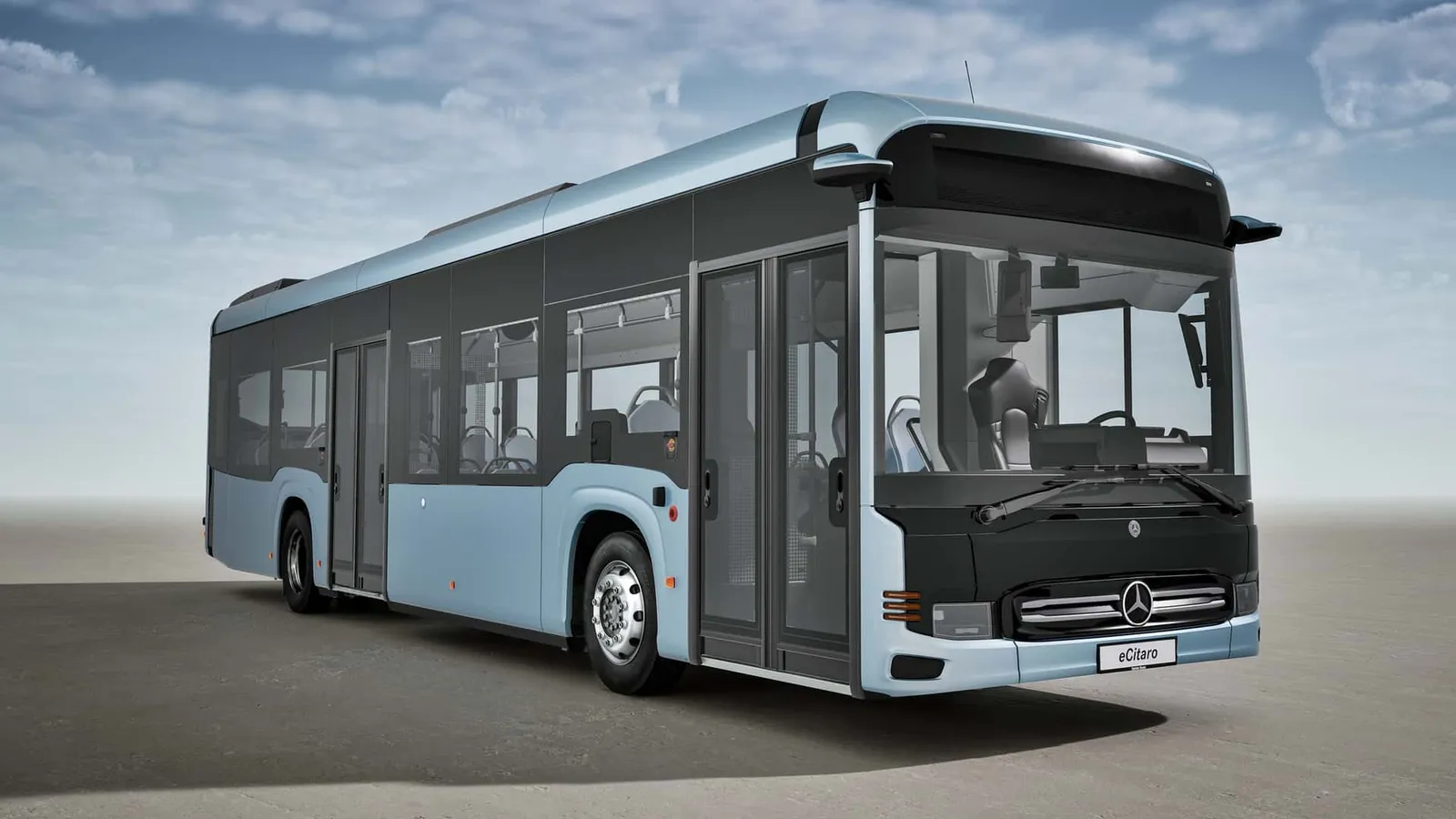
A new generation of Mercedes eCitaro electric city buses is set to launch in 2028. The updated version will be developed from the ground up as an electric bus, based on a new platform designed specifically for electric propulsion. This reduces the curb weight of the articulated bus by about 750 kilograms. Various single-axle buses will also be available. Daimler Buses is now showcasing a prototype that is close to production-ready.
The design incorporates elements from historical models such as the Omnibus O321 and the W123 sedan series. The concept of the passenger cabin as a “functional tube” served as the foundation. A subtle radiator grille with the Mercedes star, along with a three-strip light bar for daytime running lights, position lights, and turn signals, defines the front end. At the rear, LED lights create a distinctive lighting pattern. Identically designed wheel arches at the front and rear, along with the Abbraccio design element featured on the display car, which visually connects the front, rear, and center sections, complete the prototype’s appearance.
The chassis, roof, and floor have been completely redesigned. A modular design with uniform front and rear modules allows for seven versions: three lengths in low-floor city bus format (10.63, 12.13, and 18.13 meters) and four lengths in low-entry version (10.63; 12.34; 13.08; and 14.68 meters). This aims to cover both urban and intercity bus services.
A new sandwich roof with a height of around 42 millimeters instead of the previous 70 millimeters positively affects the overall height and reduces the vehicle weight by up to 100 kilograms for single-axle buses and 150 kilograms for articulated buses. With eight compact battery packs, the new city bus generation weighs around 13,050 kilograms, compared to around 13,800 kilograms for the current eCitaro with five NMC4 battery packs. This represents a weight reduction of around 750 kilograms.
A continuously straight side wall enables high standardization of the roof and floor across all vehicle variants. Defined crash zones protect the high-voltage systems in the rear of the vehicle, while front impact protection is used at the front — a concept that has already proven effective in today’s eCitaro.
Instead of NMC cells, LFP cell chemistry will be used for the batteries in the future. The foundation is a unified battery pack with around 50 kWh of capacity. The solo bus comes standard with four batteries mounted in the floor. Depending on the application profile, two, four, six, or eight additional battery packs are installed on the roof, resulting in a total of six to twelve packs.
In the articulated bus, four battery packs are located under the floor of the front vehicle, while the remaining up to ten battery packs are placed on the roof — up to six on the front vehicle and up to four on the rear vehicle. In addition to charging via a CCS2 port with a capacity of up to 400 kW, pantographs and a charging rail with a charging capacity of up to 450 kW are also available. These options can be combined, such as three CCS2 connectors or two CCS2 connectors together with a pantograph. Possible locations for the CCS2 port are — as before — on the left and right above the front axle, at the rear, and at the front.
Low Floor (LF) 12m
Low Entry (LE) 12m
Powertrain
2 permanent magnet synchronous motors, totaling 360 kW
1 central motor
Front axle
ZF RL 82 EC, independent suspension
ZF RL 82 EC, independent suspension
Rear axle
ZF AxTrax 2 LF, low-floor portal axle
RO 440
Batteries
300/400/500/600 kWh (LFP)
300/400/500/600 kWh (LFP)
Charging capacity
400 kW (CCS 2) /
450 kW (pantograph or charging rail)
400 kW (CCS 2) /
450 kW (pantograph or charging rail)
Length
12.135 mm
12.335 mm
Two different systems are used for propulsion: the low-floor version utilizes the ZF AxTrax 2 LF electric portal axle with motors located close to the wheels. With a system capacity of up to 360 kW, it is significantly more powerful than the axle in the current eCitaro, which has a capacity of around 280 kW. Thanks to its high power output, this articulated bus can function with just one drive axle, resulting in a lower curb weight.
The low-entry version relies on a central motor combined with Mercedes’ RO 440 rear axle. This setup enables speeds of up to 100 km/h for long-distance use. The independent front suspension provides a wide cabin space and balanced handling.
The new Modular Multi Torque Interface (MMTI) controls regenerative and braking behavior for each wheel in real time. The system determines on a per-wheel basis whether to use regeneration or mechanical braking depending on the situation. This is intended to extend regenerative phases, reduce wear on the mechanical brakes, and improve driving stability at the same time.
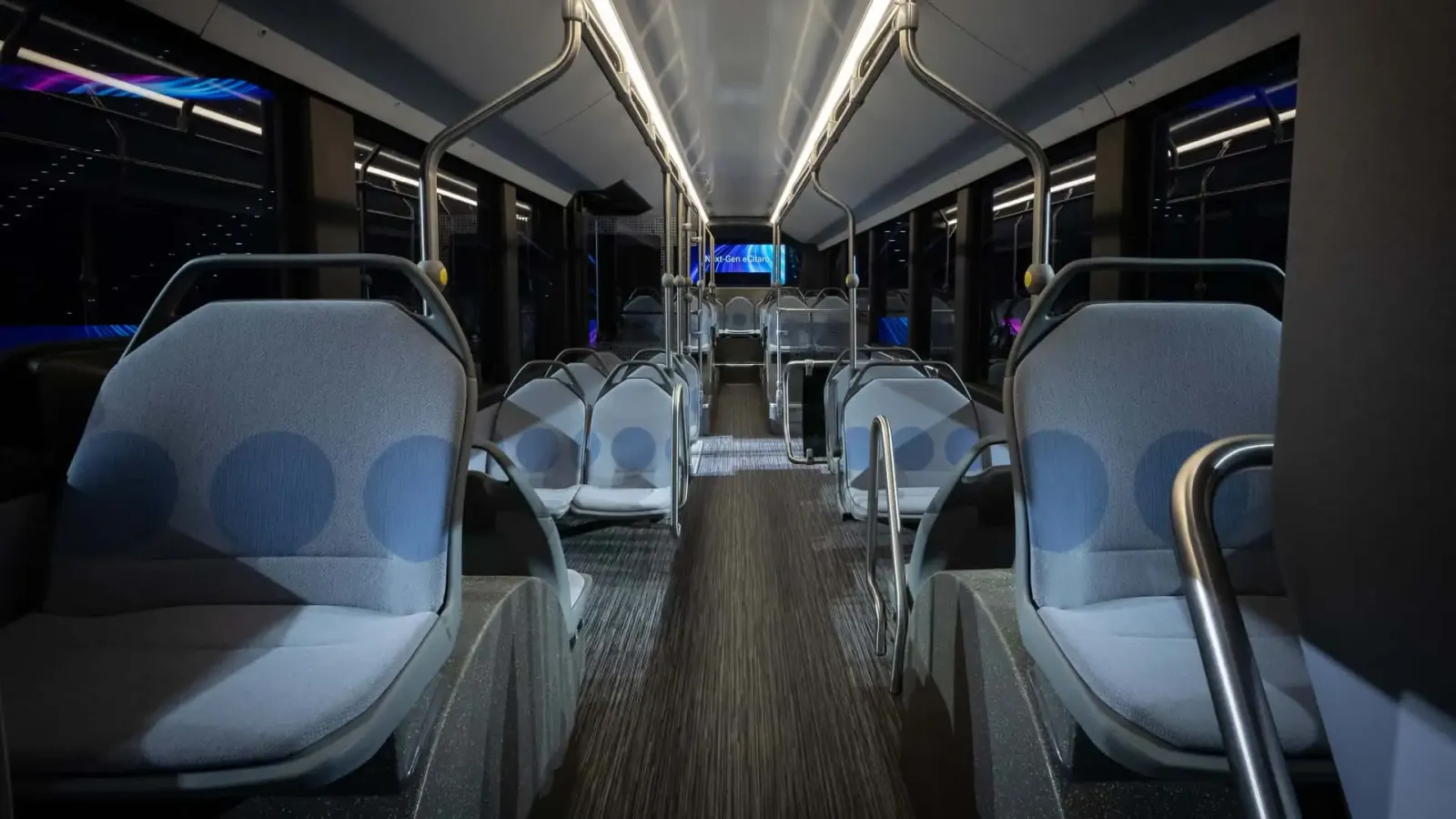
Image courtesy of: Daimler Truck
The elimination of the traditional engine tower creates additional space for a continuously low-floor passenger area extending to the rear. With the Thermal Exchange Module (ThexMO), Daimler Buses introduces a thermal management system using propane as a refrigerant. It integrates heating, ventilation, and air conditioning while utilizing waste heat from the drive system and auxiliary devices.
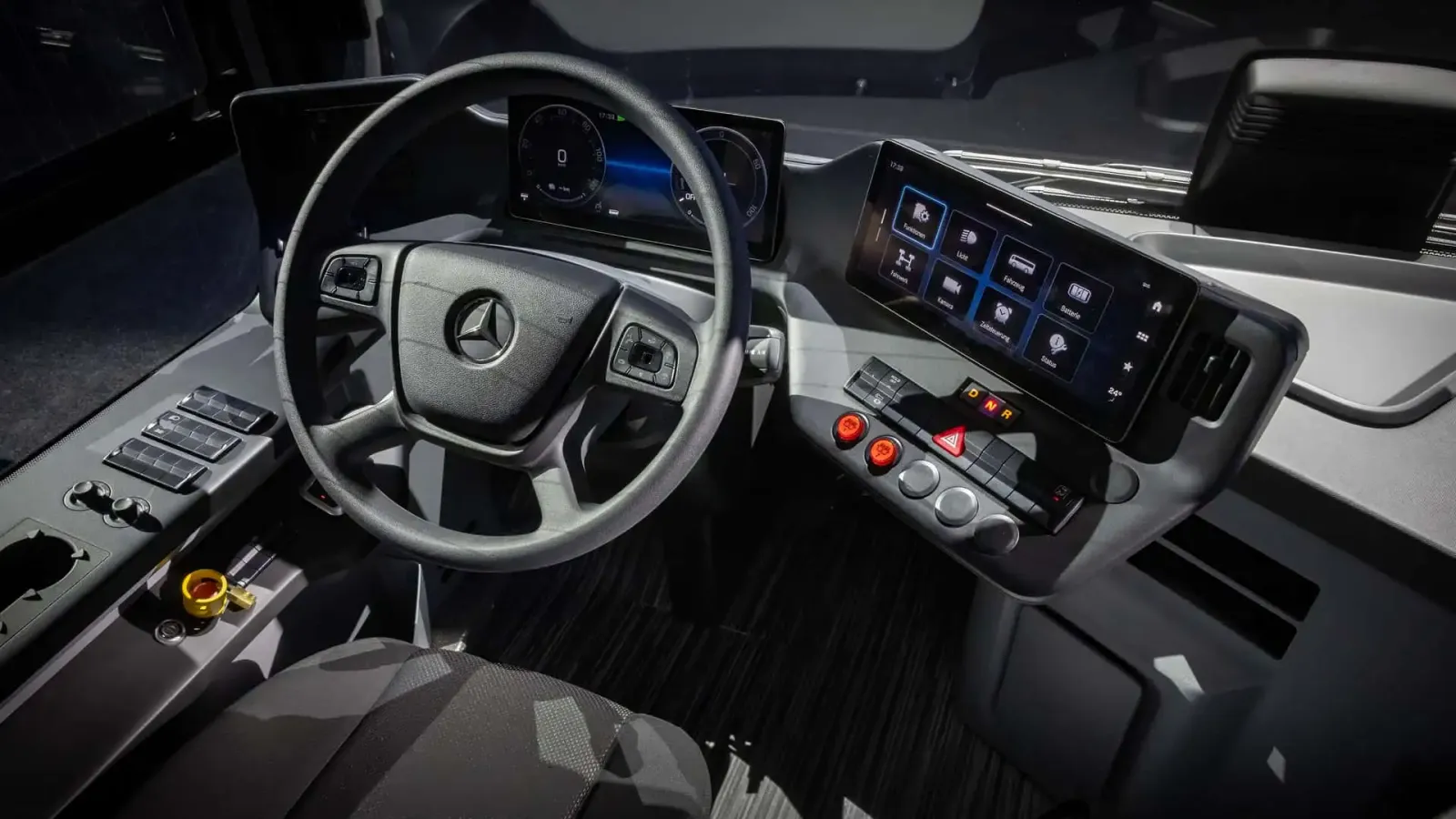
Image courtesy of: Daimler Truck
The cockpit features two 12-inch displays. The instrument panel and steering wheel offer greater adjustability for personalized ergonomics. Custom driver and depot profiles, along with a software platform that can be flexibly expanded, enable future functions to be added later.
Safety is ensured by a crash-resistant vehicle structure and a comprehensive portfolio of assistance systems. These include the active braking assistant Preventive Brake Assist 2 with pedestrian detection, the radar-based turning assistant Sideguard Assist 2, the Frontguard Assist for close-range situations during acceleration, and the camera-based Attention Assist 2, which detects signs of fatigue or distraction. For the first time, an ESP is also available for articulated buses.
A high degree of component consistency across the entire series is intended to optimize maintenance efforts and the availability of spare parts. With Omniplus, Daimler Buses provides a bus-specific service network and digital services such as over-the-air updates. The manufacturer also supports the setup and operation of charging infrastructure through Omniplus Charge.
The official world premiere of the new city bus generation will take place in October 2027 at Busworld Europe in Brussels. Market launch is scheduled for 2028 – exactly ten years after the world premiere of the first Mercedes eCitaro in 2018.
More on the current eCitaro:
In summary
In 2028, a new generation of the Mercedes eCitaro will be introduced. It will use LFP batteries instead of NMC batteries for the first time. Additionally, both single-decker and articulated buses will be built on a new all-electric platform. The propulsion system will also change, with two variants available going forward. The technical specifications are already quite specific, but the driving power of the low-entry bus has not yet been disclosed. We will likely learn more in a year, when the production version of the bus is expected to be unveiled.