
The Mercedes CLA EQ 350 impressed in the test
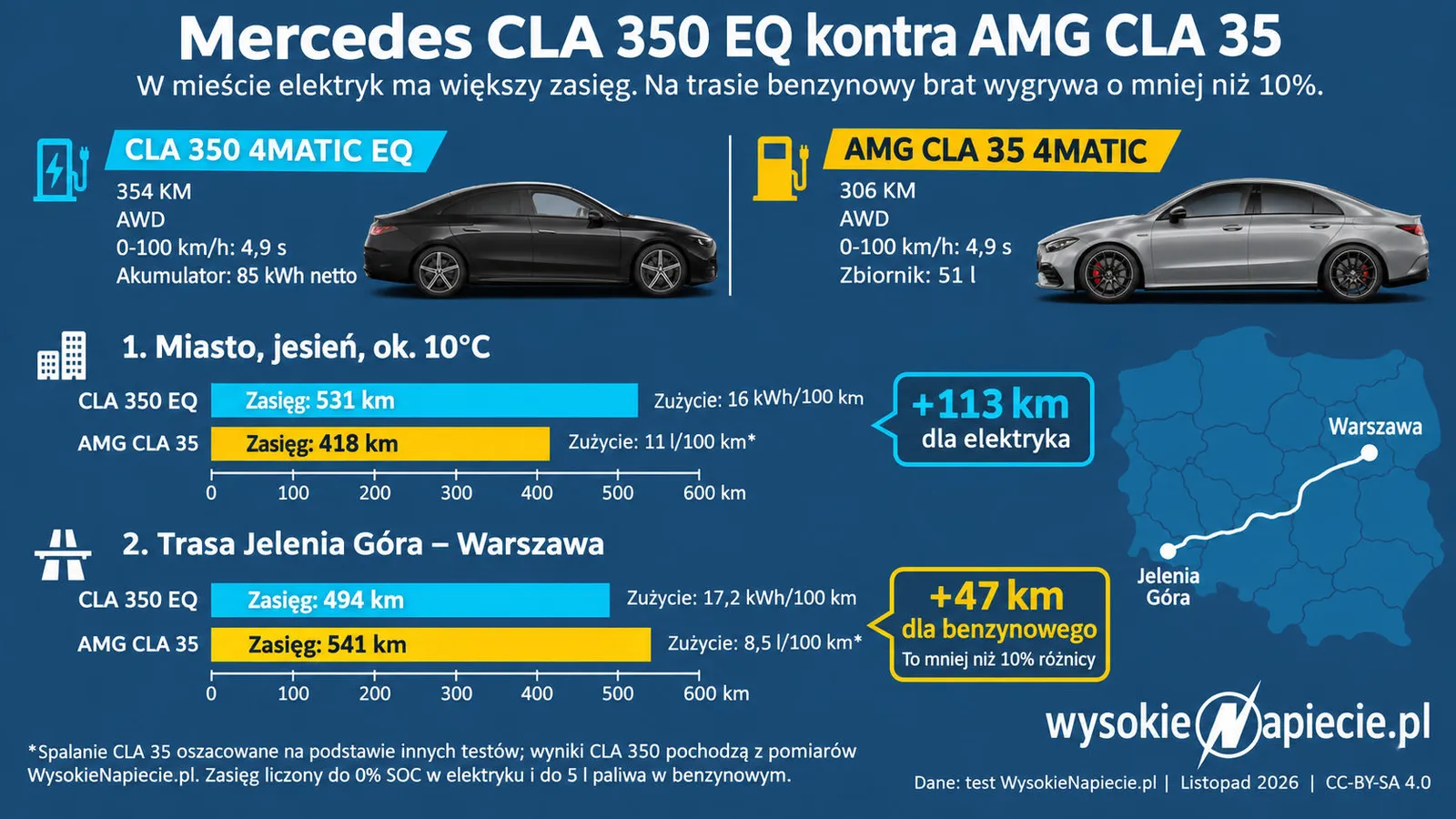
The electric Mercedes CLA 350 has a longer range than the gasoline-powered AMG CLA 35. At least in the city. On the highway, the gasoline version still has the edge, but the advantage has shrunk to just a few dozen kilometers. We tested how far the new electric Mercedes can actually go, how quickly it can be charged, and whether it matches its gasoline counterpart in terms of practicality.
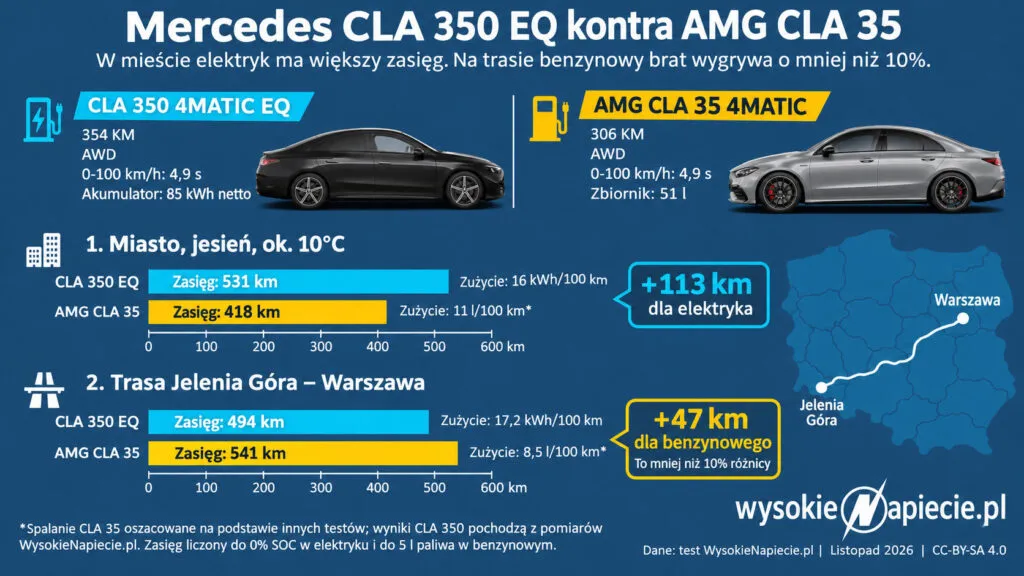
Table of Contents
Not long ago, driving an electric Mercedes from Jelenia Góra to Warsaw required two stops for charging. That was the case in January 2022 when we tested the EQA. At temperatures around zero degrees, the car consumed an average of 26.3 kWh per 100 kilometers throughout the route, and over 30 kWh per 100 kilometers on the expressway alone.
Less than five years later, we covered this route in the most powerful of the base electric CLA models – the 350 4MATIC with EQ technology. We reached Warsaw in 4 hours and 35 minutes, without any stops, with 4% battery charge left (plus a reserve below 0%). The average energy consumption was 17.2 kWh/100 km.
The new CLA 350 thus required 35% less energy than the EQA (with the temperature being 5°C higher in favor of the CLA). There are many differences between the two cars – from the body style, to battery capacity, charging speed, power, acceleration, to drive type. So it’s not about comparing the two Stuttgart models 1:1, but rather showing how significant an impact these parameters can have on long highway trips.
Mercedes CLA 350: Nearly 500 km without charging on a real route
We set off from Jelenia Góra with the battery fully charged at 100%. We covered the first 82 km on national roads in 1 hour and 20 minutes. After that, we took expressways and the highway, where we tried to maintain the maximum allowed speeds—120 km/h and 140 km/h respectively (according to GPS).
The entire 475 km journey took us 4 hours and 35 minutes, resulting in an average speed of 104 km/h (including travel through cities and mountain roads). The temperature ranged from 5 to 8 degrees Celsius. It was dry with light wind.
We arrived in Warsaw with 4% remaining battery energy. This means that with such consumption, the electric CLA could travel about 495 km before the SOC reaches 0%. There is still a small reserve that the car can use below zero, but we shouldn’t factor this into our travel planning (according to journalist tests, it ranges from 10 to 30 km).
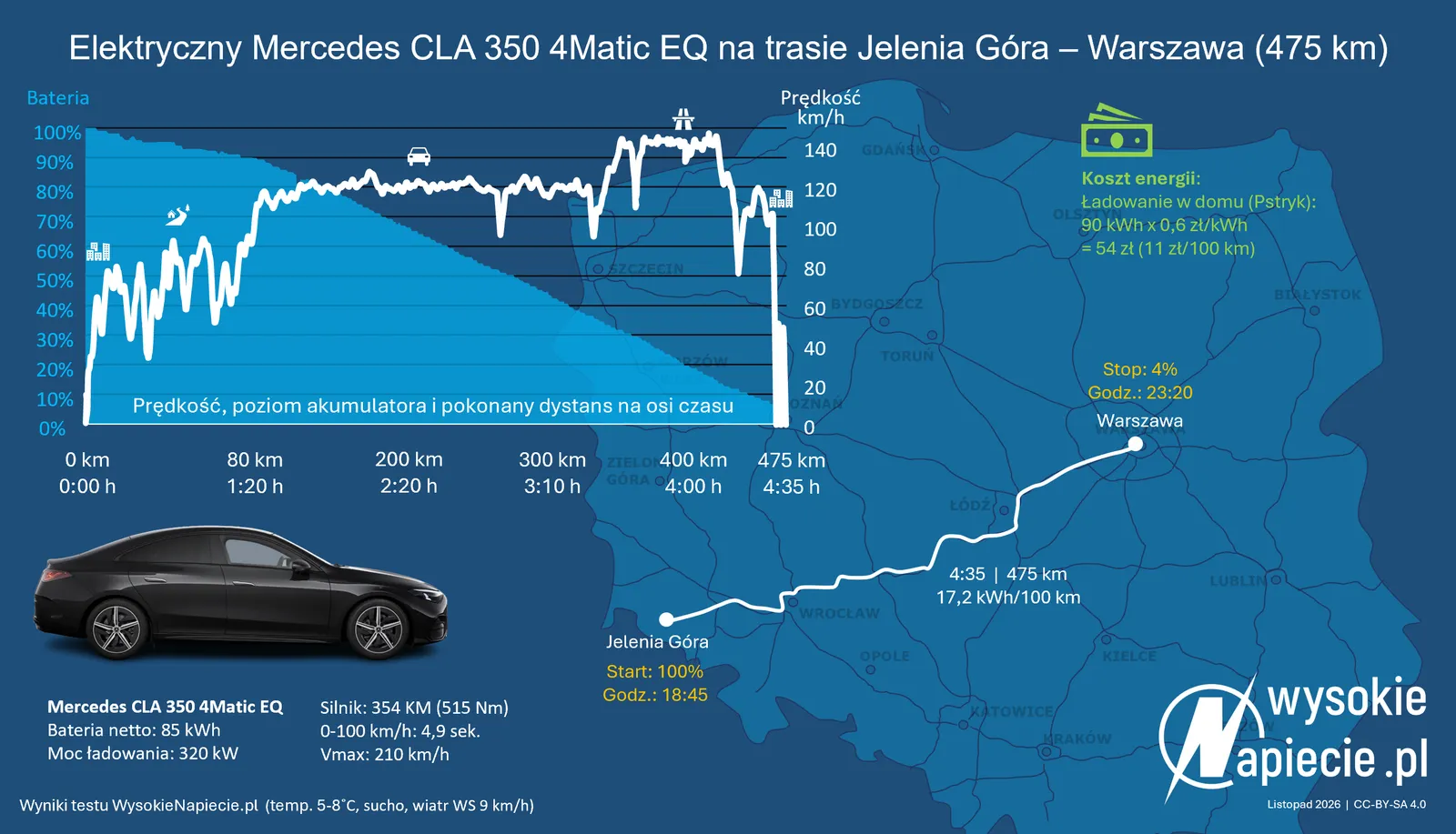
This is an excellent result considering the car’s power, AWD drive, and the fact that a significant portion of the journey was covered at 140 km/h.
By the way, we also tested the CLA’s range in the opposite direction, from Warsaw to Jelenia Góra. This time, the first 380 km were covered almost entirely on highways and express roads. The average energy consumption there was 18.5 kWh/100 km, with an average speed of 94 km/h (due to traffic on Warsaw’s ring road and the A2). The overall average consumption for the 475-kilometer journey was 18 kWh/100 km. If we hadn’t charged the car along the way, we would have needed around 85.5 kWh of energy, which is almost exactly equal to the battery’s usable capacity (85 kWh).
In other words, we were also very close to completing the entire route without recharging in this direction. However, in practice, starting with zero energy would not be a sensible travel plan.
Will the gasoline-powered Mercedes CLA 35 go further? Not necessarily.
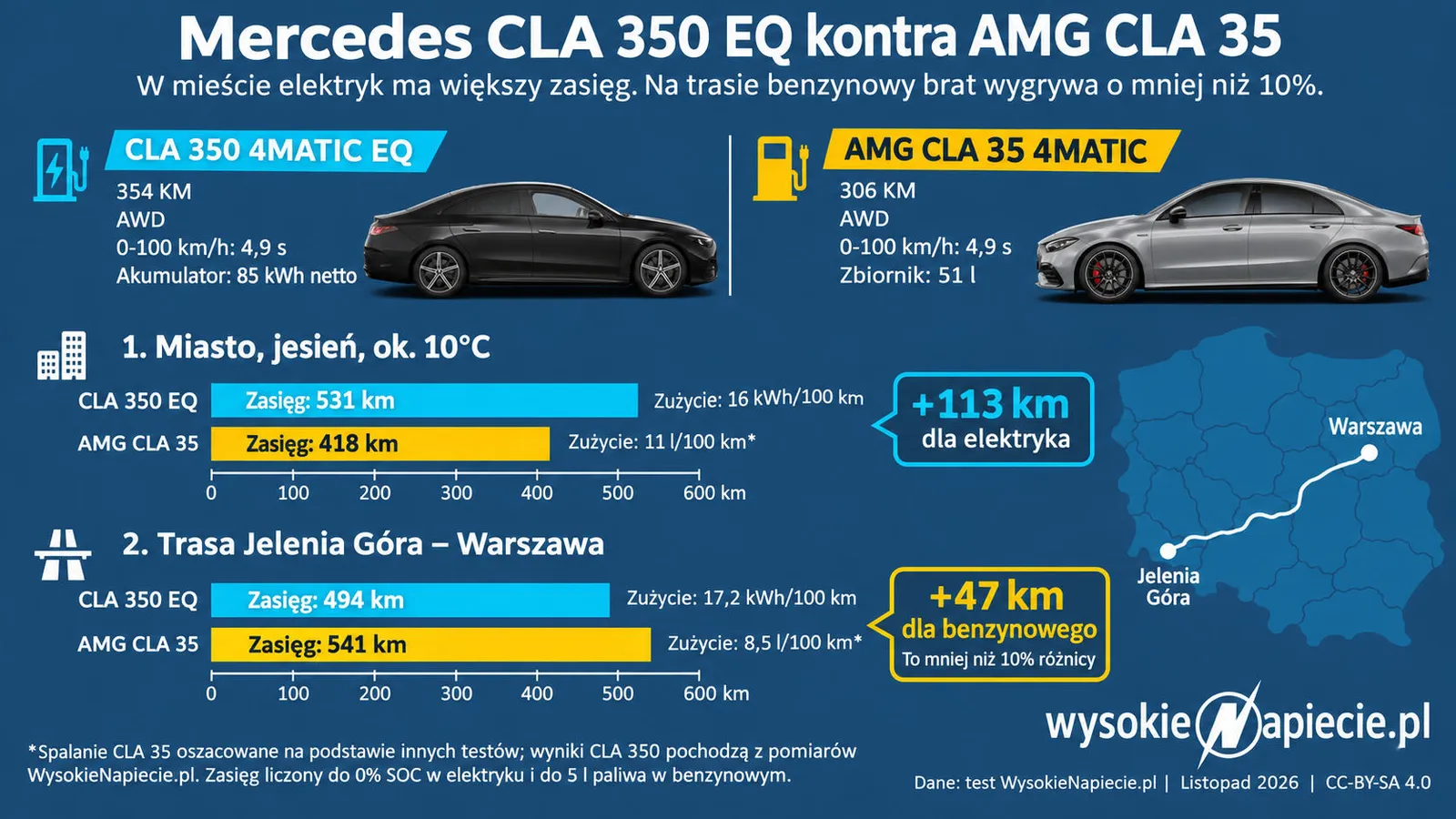
To compare ranges, we chose the previous generation Mercedes-AMG CLA 35 4MATIC. It is the closest gasoline counterpart in terms of performance. The gasoline engine has 306 horsepower, all-wheel drive, and—like the electric version—it accelerates to 100 km/h in 4.9 seconds.
The CLA 35 has a fuel tank capacity of 51 liters, including 5 liters of reserve, after which it no longer displays the remaining range. We treat this as a 0% indication like in the electric version, as both drivetrains still have reserve capacity below this level (although it will be greater in the gasoline version).
For comparison, we used our own measurements of the CLA 350’s energy consumption along with results from previous tests on the CLA 35. For the latter, we used 8.5 l/100 km on the highway and 11 l/100 km in urban driving conditions during autumn.
Parameter
CLA 350 EQ
AMG CLA 35
Power
354 HP
306 HP
Drive Type
AWD
AWD
0–100 km/h acceleration
4.9 s
4.9 s
Battery / Tank Capacity
85 kWh net
51 l
Urban fuel consumption
16 kWh/100 km
11 l/100 km
Urban range
531 km
418 km
Highway fuel consumption
17.2 kWh/100 km
8.5 l/100 km
Highway range
494 km
541 km
On the highway, the gasoline AMG can travel 47 km further, meaning it has a slight edge over the electric version, but in the city, the electric CLA 350 EQ already has a 113 km advantage. Of course, the difference can vary depending on traffic, temperature, and driving style.
For comparison, we also have figures for the less powerful Mercedes A180 Limousine (136 HP, FWD), which we used for a year. During urban driving in autumn over a distance of 1000 km, the car averaged 9.8 liters per 100 km at an average speed of 20 km/h.
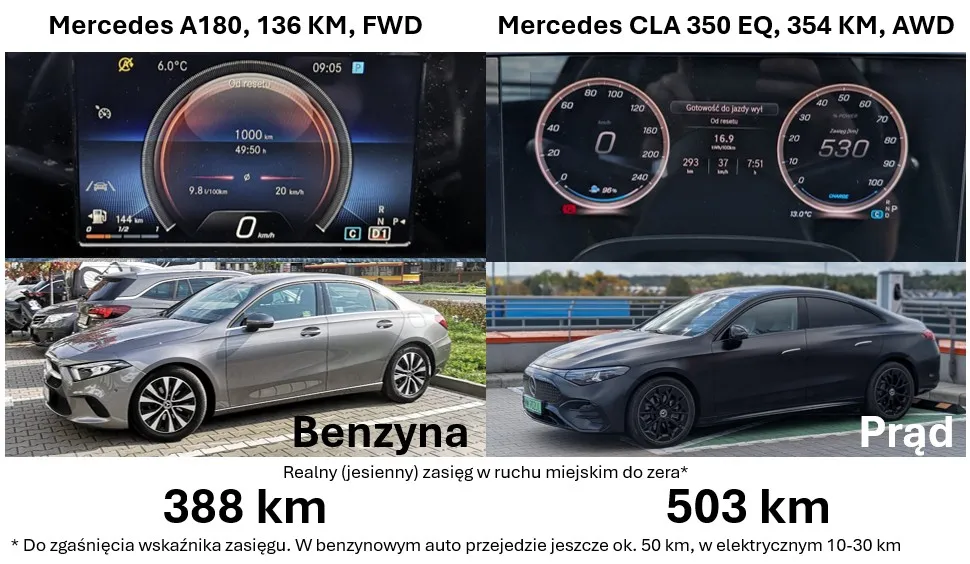
On the Jelenia Góra – Warsaw highway route, the Mercedes A180 achieved around 6.5 liters per 100 km. With a smaller fuel tank, this gave it a 422 km urban range (plus reserve), while on the Jelenia Góra – Warsaw route it only reached 585 km (plus reserve).
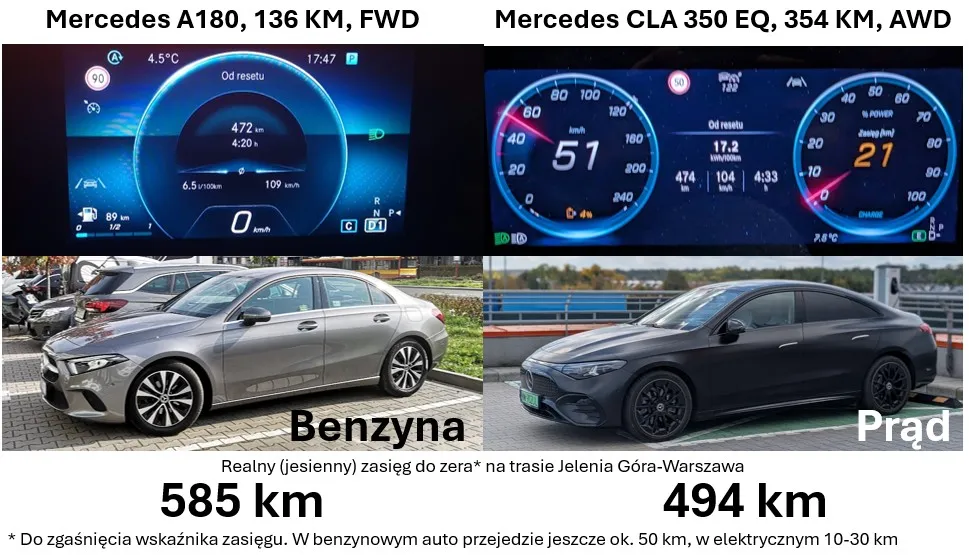
And so we’ve reached a point where electric vehicles — still in the early stages of rapid technological development — can already offer range that is only slightly less or even greater than that of their gasoline counterparts, even those with significantly lower power output.
And how much does it cost to drive 475 km?
To replenish the energy used during the CLA test drive to Warsaw, we used about 90 kWh of power drawn from a home charging setup, already accounting for charging losses. At a rate of 60 groszy per kWh under Pstryk’s dynamic tariff, this amounts to 54 zł for 475 km, or roughly 11 zł per 100 km.
The CLA 35, with a fuel consumption of 8.5 liters per 100 km, would use over 40 liters of gasoline on this route. At an estimated price of 6.50 PLN per liter (the gasoline cost 6.90 PLN during testing, and 6.02 PLN today under the government’s maximum price), that would amount to around 263 PLN, nearly five times more.
Of course, the calculation is different when charging the electric vehicle only at public fast charging stations. For this Mercedes, however, the charging speed is one of its biggest advantages.
354 HP and over two tons of weight
The electric CLA 350 weighs 2135 kg, while the previous generation’s gasoline-powered AMG CLA 35 weighs 1680 kg. That’s a difference of 455 kg. Despite the extra weight, both cars accelerate to 100 km/h in the same time.
In electric vehicles, torque is available immediately upon pressing the accelerator pedal, while the AWD system provides traction to both axles. Such high power isn’t necessary for normal driving, but it offers a significant advantage when overtaking.
Mercedes has implemented interesting solutions to reduce energy consumption. A two-speed transmission is located on the rear axle, allowing the engine to operate efficiently even at high speeds. The front engine is mechanically disconnected when additional power and AWD drive aren’t needed.
As a result, the CLA 350 can rely primarily on rear-wheel drive for most highway trips, minimizing unnecessary losses.
Aerodynamics also play a significant role. The coefficient of drag Cx is 0.21. At highway speeds, this matters more than at urban speeds of 50 km/h, as aerodynamic drag increases with the square of speed.
However, not everything has been optimized equally well.
During our test, the cracking noises from the plastics around the left air vent, next to the driver, drove me crazy. This is not what one would expect from a Mercedes priced at over a quarter million zlotys. Eventually, it was possible to press one of the dashboard components firmly enough, and the problem disappeared. Of course, this could be a flaw specific to that particular unit, but it shouldn’t occur at this price point.
Mercedes has also followed the trend of replacing regular buttons with touch controls. Even adjusting the lumbar support of the seat or turning on its heating requires reaching for the screen. It’s hard to understand why, instead of four switches for the electric windows, we have only two plus an additional button to select which windows to control, just like in the VW. There’s no savings in space or production costs, and the comfort is reduced. Added to this are the hard plastics in the lower parts of the cabin, which don’t quite match the car’s price point. However, the software runs quickly and efficiently, though in this category the new BMW (Neue Klasse) has already far surpassed Mercedes.
How much space is there in the electric CLA?
The new CLA is 4723 mm long with a wheelbase of 2790 mm. It’s not a small car, though its low, sloping roofline and four-door coupe proportions don’t contribute to a spacious interior.
Indeed, there’s no real revolution in terms of cabin space here. The front seat area is comfortable, but the back doesn’t offer the space found in larger sedans. Still, it’s hard to criticize the CLA heavily for this—its gasoline-powered predecessors also prioritized style over some of the interior space.
The trunk comparison is more interesting.
The gasoline-powered CLA 35 has a trunk capacity of 460 liters, while the electric CLA 350 has 405 liters. However, the electric version offers an additional 101-liter trunk space under the front bumper, known as a frunk. In total, this gives 506 liters of cargo space.
The new CLA also boasts a rich standard equipment package, including a heat pump, heated front seats, a panoramic roof, and the advanced MBUX multimedia system. However, not all features shown in advertisements and demo screens are standard — some require additional packages.
The Mercedes can be charged at 320 kW. But not on every charger.
During our test, we used a 400 kW GreenWay charger in Kąty Wrocławskie. There, the Mercedes demonstrated the capabilities of its new 800 V architecture. We started charging with 16% SOC. The charger delivered a maximum power of 314 kW. At 31% SOC, the power dropped to 277 kW, and around 75% SOC, it was 119 kW. After 17 minutes, we finished charging at 76% SOC. During that time, the charger supplied 56 kWh of energy, achieving an average power of about 193 kW.
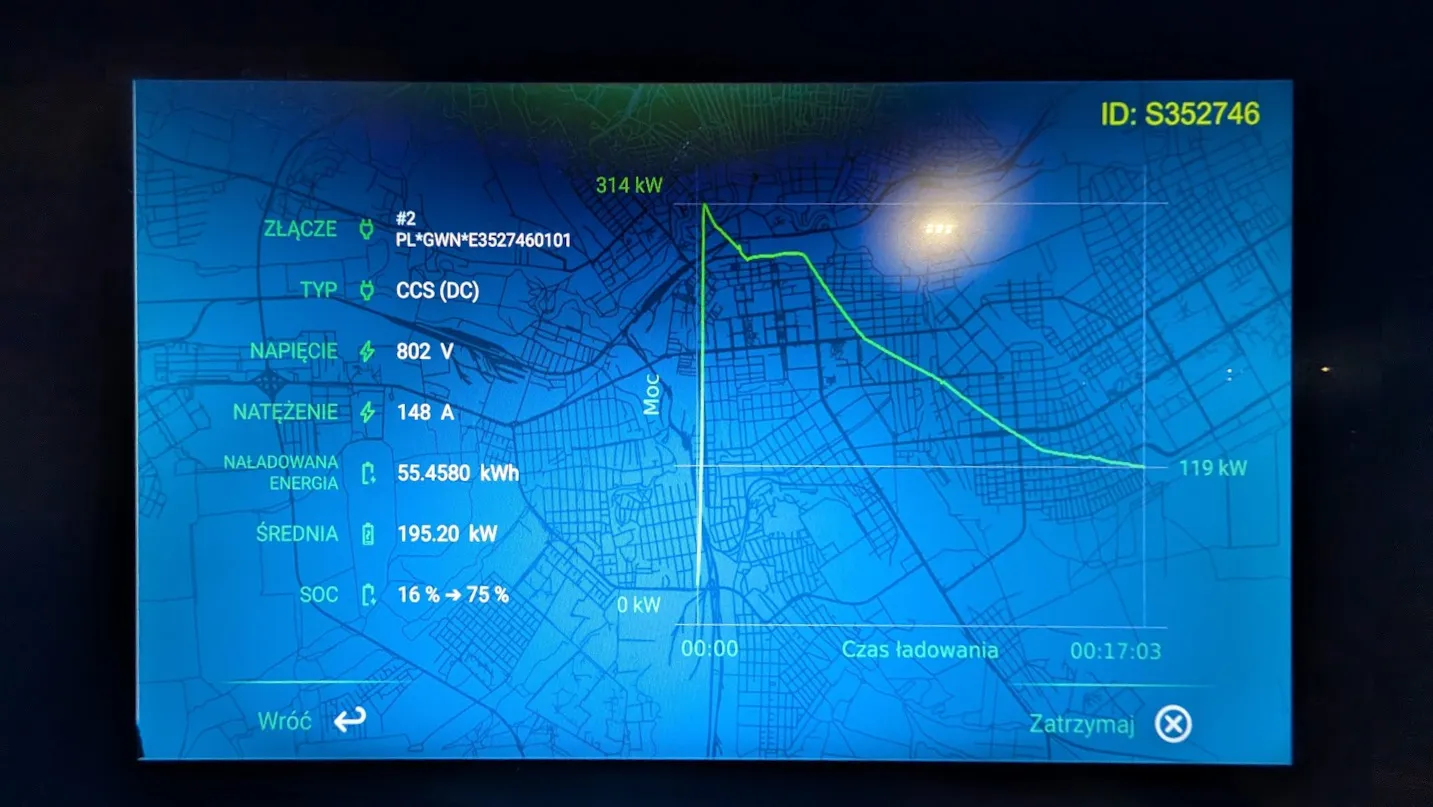
The battery itself gained approximately 51 kWh of usable energy. With an average consumption of 18 kWh per 100 km, this equates to an additional range of 280 km. Thus, less than 18 minutes of stopping time was sufficient to recharge the battery to over half of our 475-kilometer journey.
Mercedes claims a maximum charging power of 320 kW and a charging time of 22 minutes to reach 80% SOC from 10%. Our measurements confirm that these are not merely laboratory results, although the charging time depends on battery temperature, its initial charge level, and the capabilities of the charging station.
However, there is one very serious caveat
The CLA I tested didn’t have a converter that allowed charging via direct current from older 400 V stations. I forgot about this twice and drove to a public charger that the car couldn’t use.
It’s an absurd situation: we have a car capable of accepting over 300 kW, but without the proper equipment we can’t charge it at public DC stations. The issue isn’t just the charger’s power but also the voltage it can supply.
Mercedes has already introduced an optional system that works with 400 V DC stations as well, offering a charging capacity of up to 100 kW. In Poland, however, it requires an additional cost of around 2900 zł. Therefore, when purchasing a CLA, one must check whether a specific unit is equipped with this system. Don’t assume that every new CLA will automatically work with all chargers.
This is one of the most baffling decisions by the manufacturer. In a car also designed for long trips, compatibility with existing charging infrastructure should be self-evident.
From EQA to CLA: How much have Mercedes electric cars changed?
When we tested the EQA in January 2022, Mercedes already had experience in producing electric vehicles, but the efficiency of its powertrain wasn’t yet its strongest point.
The EQA on the highway could consume over 30 kWh per 100 km. On top of that, its maximum DC charging capacity was around 100 kW. As a result, long trips required not only more frequent but also longer stops. Over a distance of just under 500 km, the time disadvantage for the EQA amounted to an hour and a half.
Later, Mercedes unveiled the EQS, which impressed us with its aerodynamics and long-range capabilities. We also observed significant progress with the EQE in tests, although its large size, high weight, and charging limitations didn’t always allow it to achieve the excellent results we would expect from the latest electric vehicles.
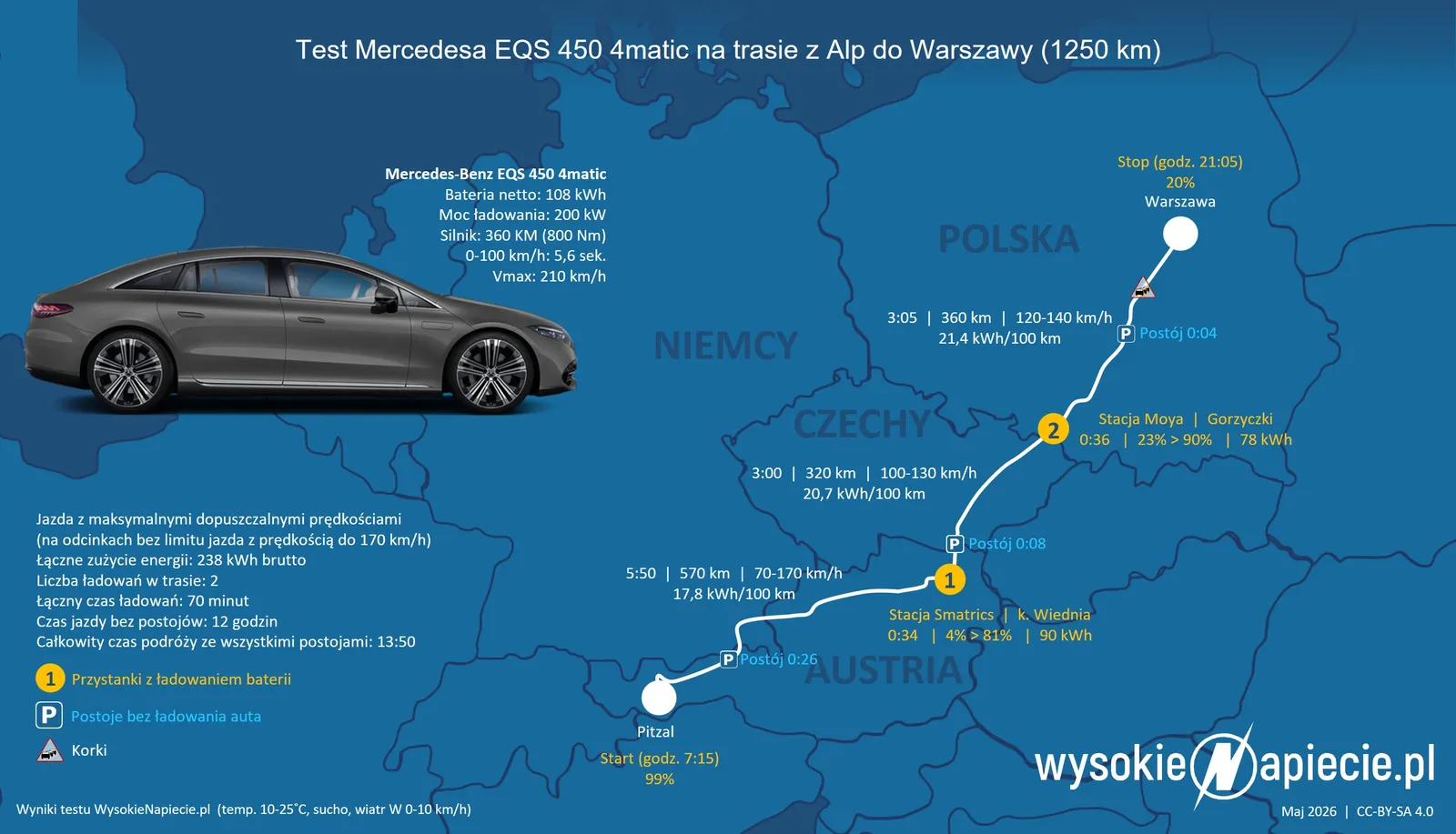
The CLA represents the next step in this development. Mercedes combined a highly efficient powertrain with an 800 V architecture, fast charging, a heat pump, and advanced management of both engines.
We can’t attribute all the improvements in energy consumption to a single solution. The 800 V architecture delivers the greatest benefits during charging, while during driving, factors such as engine and transmission losses, aerodynamics, tires, and temperature management also play a role.
Yet the overall result is clear. Four years ago, we needed two stops on the route. Now we didn’t have to stop at all, and when we did decide to charge in the opposite direction, we replenished over 50 kWh of usable energy in just under 18 minutes.
Tesla still shows how much more can be improved
However, the excellent efficiency of the CLA doesn’t mean that Mercedes has already reached the limits of electric drive development.
In November 2023, we drove almost the same route from Jelenia Góra to Warsaw in a Tesla Model 3 Long Range RWD under very similar conditions (temperature of 9–12°C), achieving an average fuel consumption of 15 kWh/100 km. We covered the 472 km distance in 4 hours and 28 minutes, the same time as the CLA 350 EQ. Therefore, the Mercedes used 15% more energy than the Tesla.
This is not a comparison of identical vehicles. The Tesla had only rear-wheel drive, lower power, and weighed over 300 kg less. The Mercedes features AWD, 354 HP, and accelerates from 0 to 100 km/h in 4.9 seconds, while the tested Tesla took 5.9 seconds.
To properly assess performance, it would also be necessary to compare results with a comparable Tesla Model 3 Long Range AWD. Nevertheless, the RWD version’s results show that there is still room for improvement in aerodynamics, weight, and drivetrain efficiency.
Mercedes, on the other hand, has a significant advantage in terms of energy replenishment speed. The Tesla Model 3 LR can charge at up to 250 kW (on paper... because in nearly 3 years of using this car, we saw such a charging rate on the display maybe 3 times), while the CLA achieves 320 kW (in reality) and maintains a very high charging rate for most of the charging process.
For drivers, the amount of energy replenished during a short stop of a few minutes is more important than the peak charging power itself. Here, the CLA performed very well.
How much does the electric Mercedes CLA cost compared to its gasoline version?
That leaves the price. Until recently, electric premium cars were much more expensive than their gasoline counterparts. In the new generation of CLA, the differences are different now.
The base gasoline-powered CLA 180 Hybrid costs from 192,500 zł. It has 156 hp of system power and front-wheel drive. The cheapest electric CLA 200 EQ costs from 209,900 zł, which is 17,400 zł more. However, it offers 224 hp, rear-wheel drive, and a 0-100 km/h acceleration time of 7.5 seconds instead of 8.8 seconds.
The difference between the CLA 200 Hybrid and the CLA 200 EQ is even smaller—the electric version costs only 7,400 zł more according to the catalog price.
For the most powerful electric model we tested, the comparison is slightly more difficult because Mercedes does not offer a new gasoline-powered CLA 35 AMG of the same generation. We can, however, compare its price with the latest available Polish price list for its predecessor.
Thus, the difference between the gasoline-powered CLA 35 and the electric CLA 350 is 13,300 zł, which is only 5% of the car’s price.
For this extra cost, we get a newer design, a more powerful engine, greater urban range, and significantly lower energy costs. On fast roads, we still have to deal with slightly shorter range compared to a gasoline car, but the advantage of the internal combustion engine is now relatively small. In terms of charging speed, however, the electric Mercedes has made enormous progress.
This doesn’t mean the CLA 350 is a flawless car. A cramped cabin, rattling interior components, or the lack of a 400 V converter in the tested unit show that even a highly technologically advanced car doesn’t have to be perfect in every aspect.
The biggest change, however, is that with the electric CLA, we no longer have to accept significant range limitations and long charging stops in exchange for low operating costs. Today, Mercedes offers almost the same performance in this regard as its comparable gasoline version, and in some scenarios even more. The price difference is no longer large enough to dictate the choice of powertrain in advance.