
The humanoid enters the scene and picks fruits, as we saw at Eima
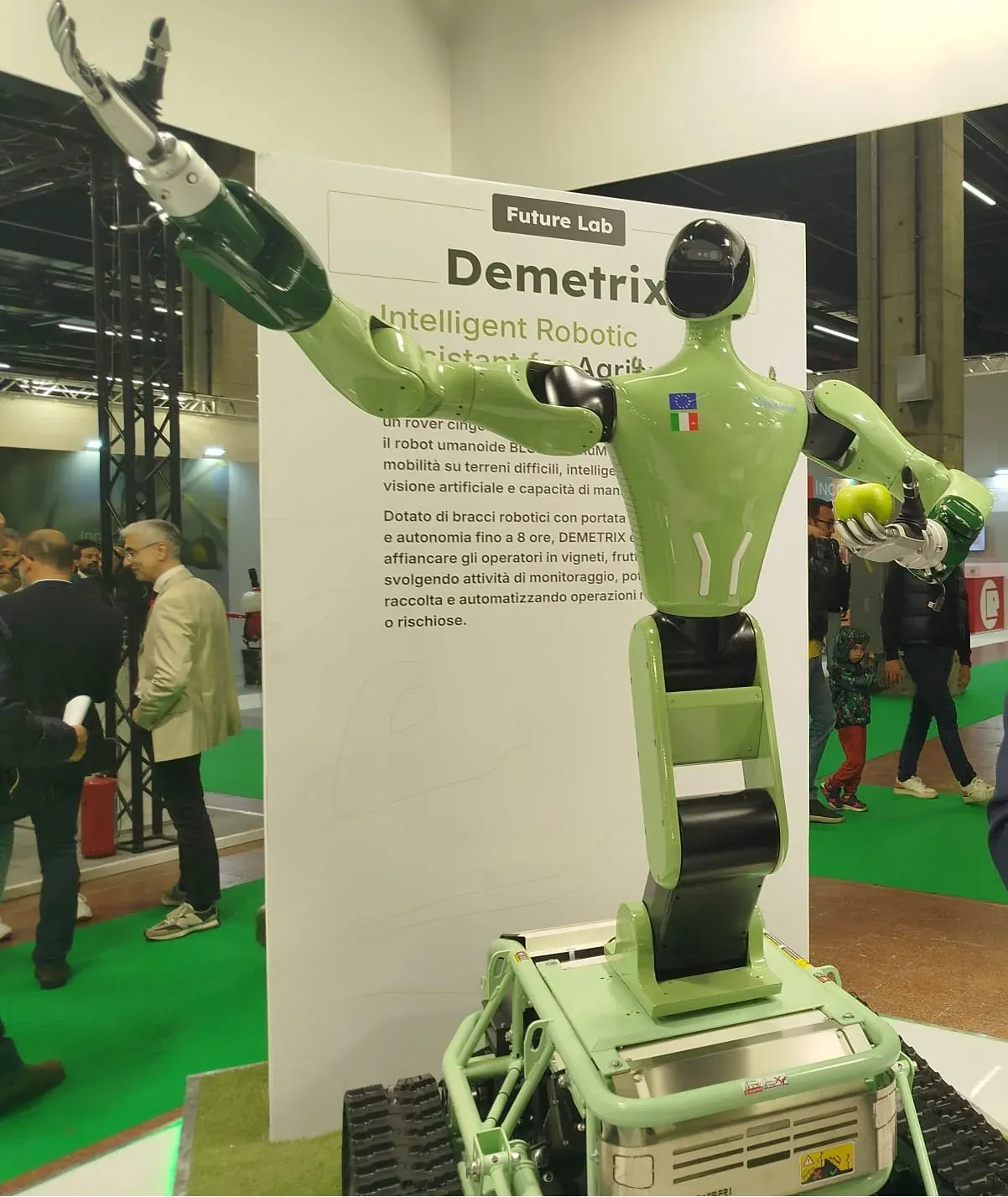
We’re aware of humanoid robots in factories — from Mercedes testing the Apollo to BMW, as well as Xpeng or Elon Musk’s Tesla facilities — but at the Bologna Fair, Eima, the agricultural machinery exhibition, we saw the rural version. And as its developer, Giampaolo Barbieri, CEO of Barbieri Group, puts it, it will be more successful in agricultural settings than in industrial ones. Why? “There’s a shortage of labor in the countryside.” And there are fewer and fewer skilled workers even for simply picking apples in the most efficient way. But is it ready to help in orchards? The engineer is optimistic: “We need to test and validate it; I think we’ll be ready by 2027.” Times may change, but we’re on the verge of an epochal shift — countryside populated by humanoids.
An autonomous rover with a humanoid on board
Following autonomous tractors and lawn mowing robots, agriculture is taking another step toward automation. At Eima International, Giampaolo Barbieri, manager of Barbieri Group, introduced us to an innovative platform that combines an autonomous rover with a humanoid robot designed for work in vineyards and orchards.
The goal is to address one of the most pressing challenges facing European agriculture: the increasing difficulty in finding skilled labor for tasks such as fruit harvesting and pruning. Regarding the latter, the group’s CEO explained that human hands are removed and replaced with cutting tools—a kind of Edward with scissor hands among the rows of plants.
BYD Enters the Humanoid Robot Market: Will They Be Sold at Dealerships?
The system developed by Barbieri Group stems from a collaboration with Blue Mentis, a Tuscany-based company specializing in artificial intelligence that has already introduced the humanoid Blue-1, built in Viareggio and China.
In summary, the core of the project is a tracked vehicle capable of moving autonomously along rows thanks to advanced navigation and vision systems. On this platform operates a humanoid robot equipped with cameras and artificial intelligence algorithms that can identify tasks to be performed. The first applications involve two fundamental operations in fruit and vine cultivation: harvesting and pruning.
Catl Launches the World’s First Industrial Use of Humanoid Robots
"We decided to launch this project to produce in Italy a humanoid robot capable of moving, using a vision system, and deciding on the tasks to perform, specifically pruning or harvesting," explained Giampaolo Barbieri.
Designed for work in vineyards and apple orchards
The platform was specifically designed for agricultural environments with limited spaces and repetitive paths. The rover autonomously follows the rows of vines or apple trees, while the robot carries out the assigned tasks at a speed compatible with the vehicle’s movement. The goal is to create a true agricultural assistant capable of supporting human workers in the most repetitive and labor-intensive tasks, increasing productivity and making work organization more sustainable.
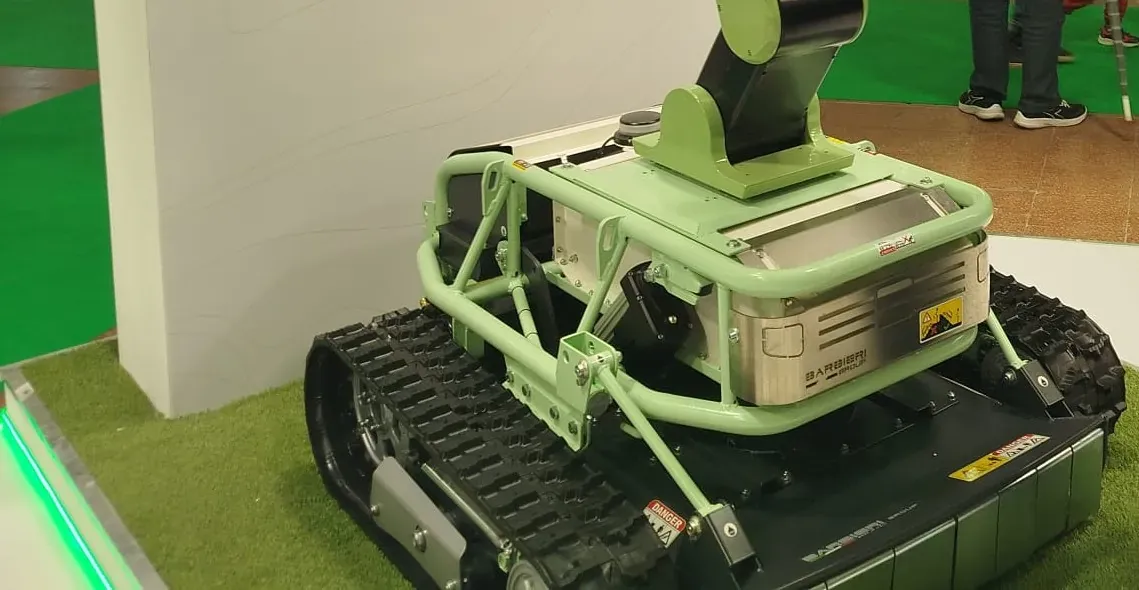
The technology is still in the validation and testing phase. According to Giampaolo Barbieri, commercial deployment is expected in 2027. Before entering the market, the team aims to verify the system’s effectiveness in real conditions and achieve performance levels that justify the investment required from agricultural companies. This innovation is adopted only when it can generate tangible economic benefits by reducing operational costs or compensating for labor shortages.
On the market: hybrid and electric autonomous robots, working on tractors
At Barbieri’s booth, there are numerous autonomous robots on display that are already available on the market. “They have been purchased by some companies, especially the hybrid models that provide the necessary autonomy for carrying out tasks, but we also have a fully electric version that is attracting attention particularly in the landscaping sector.”
Italian humanoid robots? They exist and will be built for Fincantieri thanks to Generative Bionics
That’s the present, but work is also underway for the future. The project involves the design, construction, and testing of three specialized fully electric tractors along with the equipment needed for major operations in vineyards and orchards. Funded by the European Union’s LIFE program, the LIFE X-TRON project develops a new generation of specialized, modular, and intelligent fully electric tractors.
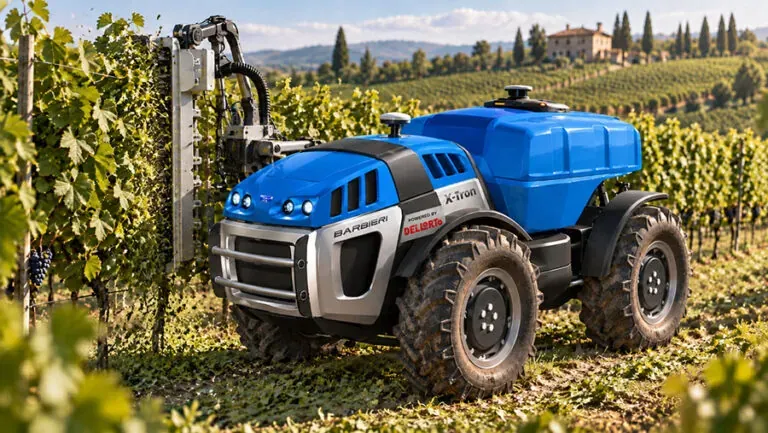
The project was created to “redesign the agricultural machine from scratch, focusing on the practical needs of working in the fields: precision, operational autonomy, versatility, and reduced environmental impact.” These are the goals for the team, which includes Barbieri—who leads the vehicle design, prototype development, autonomous driving function creation, and field testing—as well as Dellorto, the project coordinator who develops and integrates the key components of the electric powertrain and battery. ARCA Tecnologie, an affiliate of Dell’Orto specializing in power electronics, is responsible for developing the onboard battery charger.
A signal for agriculture’s future
If tests meet expectations, Barbieri Group’s project could become one of the first European examples of humanoid robots designed for agricultural tasks. It’s not just a prototype for display, but a tool intended for fruit harvesting and work in rows of crops.
With artificial intelligence entering vineyards and apple orchards, a new phase of agricultural mechanization may begin—one that includes not only autonomous tractors but also robotic assistants capable of working side by side with farmers.
READ ALSO: Solar robots and drones: High-tech is transforming fields in Emilia
Previous Article
Cost of home charging: Italy is fifth most expensive in Europe
Next Article
Can I use V2L to charge another electric car?