
Lucid Air Grand Touring: a long-distance champion with plenty of power
Some cars you reluctantly return after two weeks. Others leave your notebook overflowing with observations. The Lucid Air Grand Touring managed to do both, which aligns perfectly with what the brand has represented over the years. Technically, Lucid outpaces the established premium class in many areas. Yet, in some respects, it’s clear this is not the work of a corporation with a century of experience.
I tested the Lucid Air during a turbulent phase. Lucid is in the midst of a restructuring that new CEO Silvio Napoli himself describes as an operational restart. The company aims to save $1.4 billion this year; around 18 per cent of the workforce has been let go, and the launch of the more affordable mid-range models has been postponed by Lucid to the second half of 2027.
In the third quarter, 3,806 vehicles were delivered to customers. At the same time, Lucid is exploring new business areas, such as a robotaxi service for Europe, which the company is planning together with mobility provider Bolt. It is set to be based on the upcoming mid-range platform. Until then, the Air and the Gravity SUV will carry the business alone.
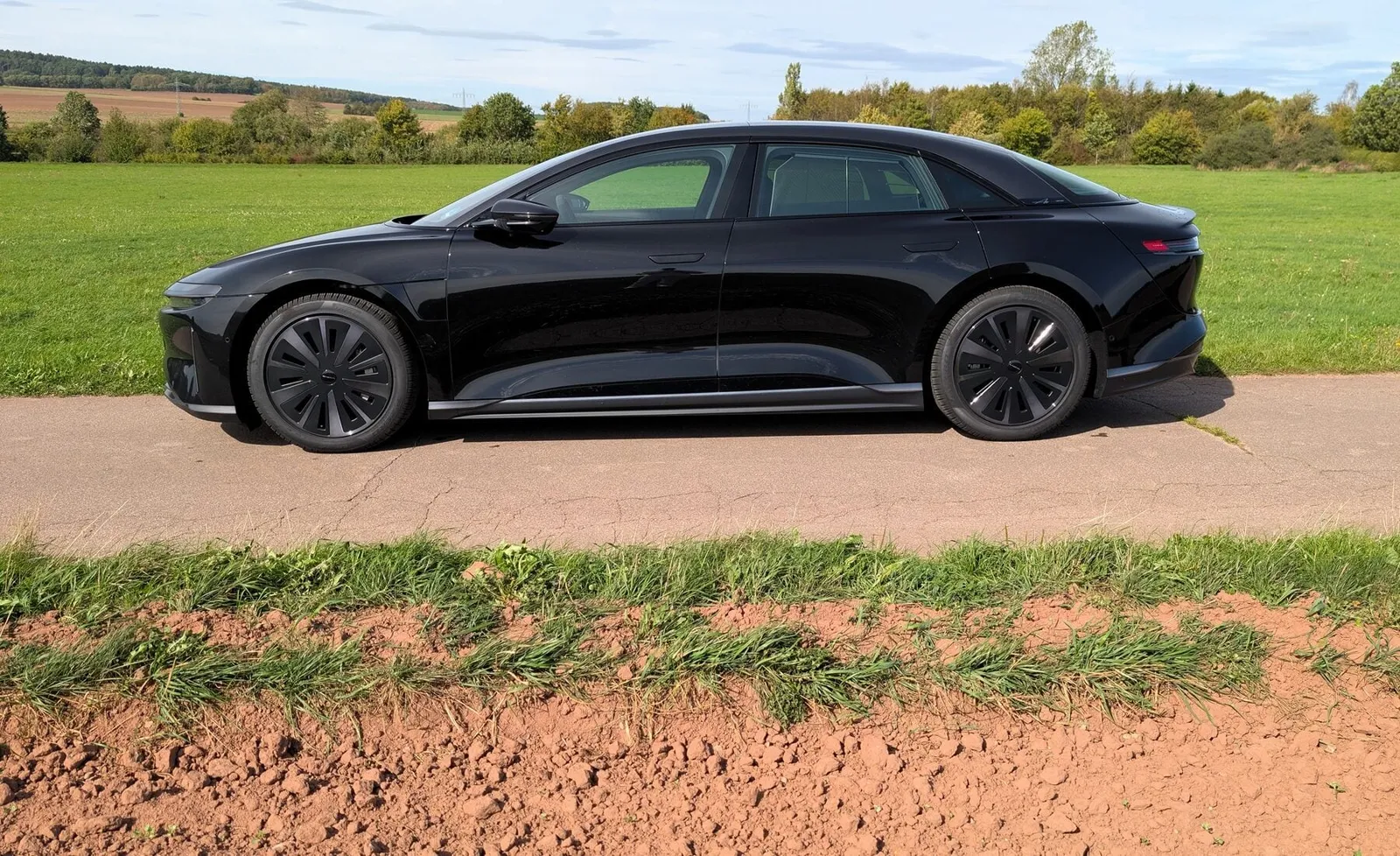
My test car was a Lucid Air Grand Touring in the colour ‘Infinite Black Metallic’ with the ‘Stealth Pack’, which blackens the body’s decorative elements. It also featured the Aero Range Stealth wheels in 19 inches, a glass roof, Mojave Extended Leather, and comfort seats with massage and ventilation functions. The total price for the test vehicle was a hefty €144,500. I drove it for two weeks in everyday conditions: on the motorway, in the city, and on country roads.
| | Air Pure | Air Touring | Air Grand Touring | ****Air Sapphire** |
| --- | --- | --- | --- | --- |
| Drive | Rear-wheel drive (RWD) One motor at the rear | All-wheel drive (AWD) Two motors | All-wheel drive (AWD) Two motors | All-wheel drive (AWD) Three motors |
| Power | 325 kW | 462 kW | 611 kW | 920 kW |
| Torque | 550 Nm | 1,200 Nm | 1,200 Nm | 1,940 Nm |
| Acceleration (0–100 km/h) | 4.7 s | 3.6 s | 3.2 s | 2.0 s |
| Top speed | 200 km/h | 225 km/h | 270 km/h | 330 km/h |
| Battery capacity (net) | 88 kWh Nickel-Manganese-Cobalt (NMC) | 96 kWh Nickel-Manganese-Cobalt (NMC) | 117 kWh Nickel-Manganese-Cobalt (NMC) | 118 kWh Nickel-Manganese-Cobalt (NMC) |
| Range (WLTP) | 751 to 831 km | 715 to 780 km | 817 to 960 km | 694 km |
| Combined consumption (WLTP) | 11.8 to 13.3 kWh/100 km | 13.6 to 15.0 kWh/100 km | 13.5 to 16.0 kWh/100 km | 19.1 kWh/100 km |
| DC charging power | 210 kW | 250 kW | 300 kW | 300 kW |
| DC charging time (10–80 %) | 28 min | 31 min | 28 min | 28 min |
| AC charging power | 22 kW | 22 kW | 22 kW | 22 kW |
| AC charging time (0–100 %) | 4 h 45 m | 5 h 15 m | 6 h 15 m | 6 h 15 m |
| Kerbside weight | 2,145 kg | 2,337 kg | 2,435 kg | 2,495 kg |
| Permissible gross vehicle weight | 2,550 kg | 2,850 kg | 2,850 kg | 2,850 kg |
| Length / Width / Height | 4.97 m / 1.94 m / 1.41 m | 4.97 m / 1.94 m / 1.41 m | 4.97 m / 1.94 m / 1.41 m | 4.97 m / 1.94 m / 1.41 m |
| Turning circle | 12 metres | 12 metres | 12 metres | 12 metres |
| Boot capacity | 627 to 1,835 litres | 627 to 1,835 litres | 627 to 1,835 litres | 627 to 1,835 litres |
| Frunk capacity | 283 litres | 283 litres | 283 litres | 283 litres |
| Base price** | €85,900 | €99,900 | €130,900 | €250,000 |
Sleek instead of showy
At 4.97 metres, the Lucid Air is shorter than its competitors. A Mercedes EQS measures 5.23 metres, while a BMW i7 is even longer at 5.40 metres. The Lucid Air is also only 1.41 metres tall and 1.94 metres wide (excluding mirrors), with a wheelbase of 2.96 metres. The vehicle’s shape appears to have been honed in the wind tunnel. The front is flat and elongated, the windscreen is pushed far forward, and the roof slopes in a wide arc into the short rear.
On its 19-inch wheels, Lucid states an impressive drag coefficient (c w) of 0.197 for the Air, which indicates how easily a body moves through the air. This is particularly important for electric cars, as above approximately 100 km/h, most of the propulsion energy is consumed by air resistance. Every improvement in the c w value translates into slightly more range on the motorway.
In the ‘Infinite Black Metallic’ colour with the ‘Stealth Pack’, the Lucid Air is barely noticeable, and that suits it well. Only on second glance do you notice the flat headlights made of tiny lenses, the narrow light strip running across the entire front, and the continuous rear light. Chrome elements and large lettering are nowhere to be found with the “Stealth Pack”, which gives it a very modern look.
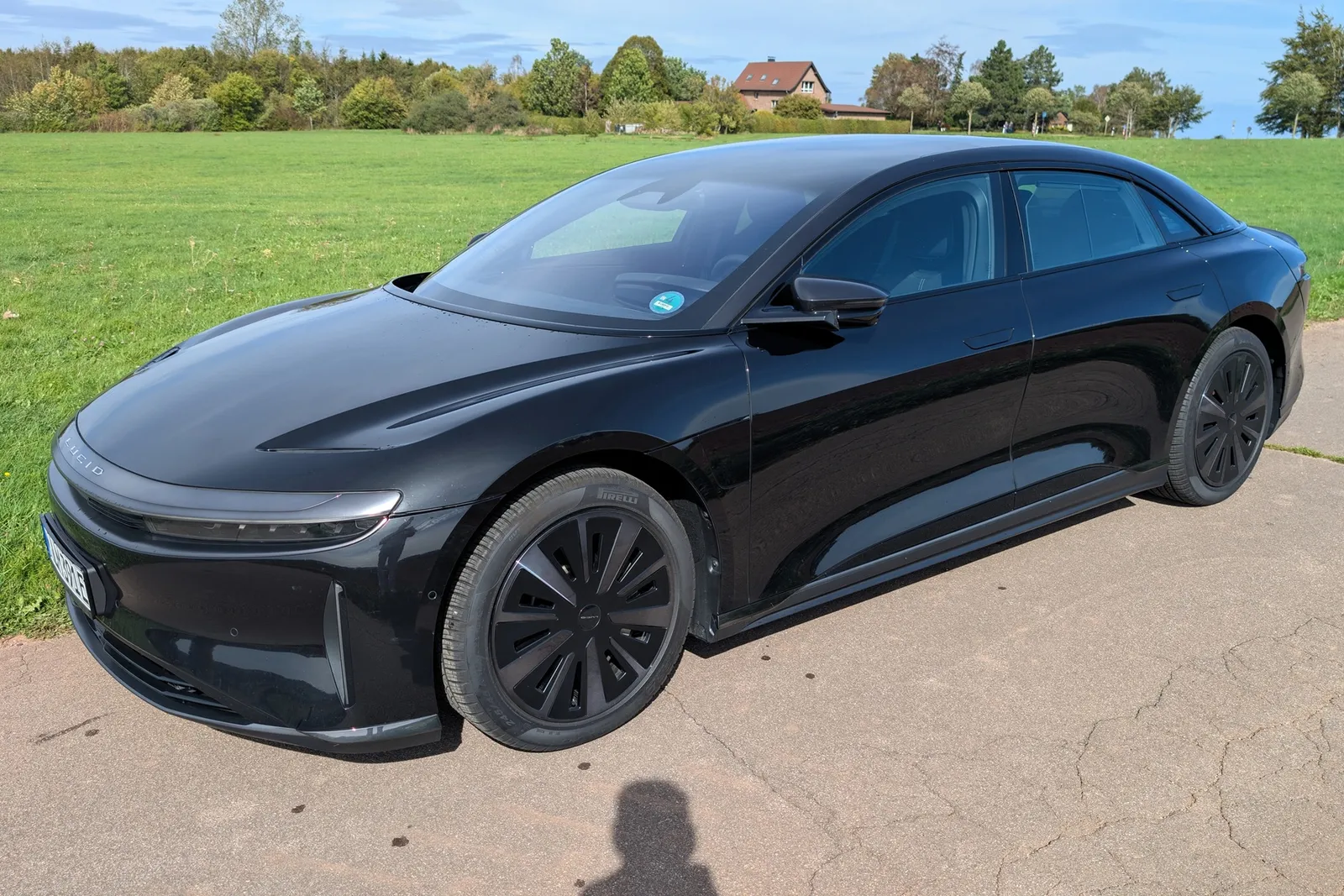
Image: Kasimir Hupe
- 1/6
- 2/6
- 3/6
- 4/6
- 5/6
- 6/6
Plenty of space for all kinds of cargo
Things get interesting under the front bonnet. Lucid develops its own powertrain units, and they are remarkably compact. According to the manufacturer, the motor, inverter, and transmission together weigh just 74 kg. As a result, the Lucid Air has plenty of space for a ‘frunk’, which offers a capacity of 283 litres – more than some small cars have in their rear boot.
The front bonnet also opens and closes electrically at the touch of a key fob button, a display button, or via the app. This is more useful than you might think when you’re standing in front of the car with your hands full of shopping bags. For me, the electric frunk is one of the coolest details of the entire car.
At the rear, the boot holds 627 litres, and with the frunk, the total capacity is 910 litres. With the rear seats folded down, the total capacity – including the frunk – is even 1,835 litres. Without the frunk, it’s around 1,552 litres. However, as the Lucid Air is a classic notchback saloon, the boot opening is smaller than that of a hatchback.
The compact technology also pays off inside the cabin. Up front, there’s 115 centimetres of legroom, and 93 centimetres at the rear. Headroom is just over a metre at the front, while at the rear, depending on the roof, there’s 96 to 97 centimetres of space. However, the low roofline still requires a slight bend when getting into the back. A tow hitch is not available for the Lucid Air. Anyone wanting to tow a caravan or horse trailer will need to look for another solution.
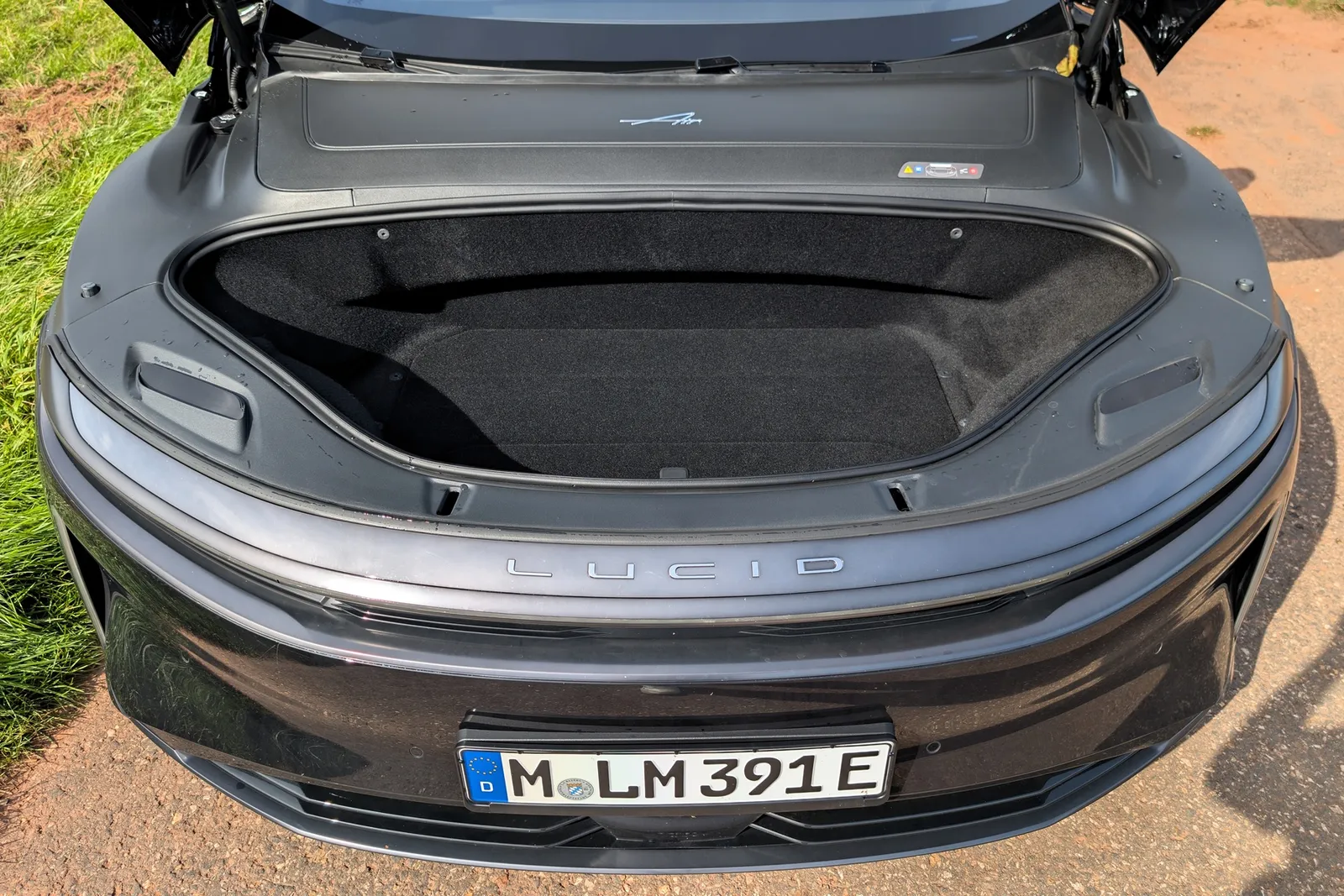
Image: Kasimir Hupe
- 1/3
- 2/3
- 3/3
An intuitive menu
In front of the driver stretches the 34-inch Glass Cockpit, a curved display that appears to float above the dashboard. On the left, you can see the speed, driving mode, and assistance system information, while on the right, there’s a touch area for navigation and media. Below this in the centre console is the central control unit, called the ‘Pilot Panel’. This second screen allows you to control the climate, seats, and vehicle settings. It can also be electrically raised, revealing a storage compartment behind it. Cleverly done.
The menu structure is highly intuitive. After a short time, you can find everything without searching, as the structure is logical and the graphics are clean. I was also impressed by the route guidance. It calculates reliably, automatically plans charging stops, and can be filtered by charging power and operator. On long journeys, you can rely on its suggestions.
However, there are issues with smartphone connectivity. Apple CarPlay and Android Auto only run in the smaller right section of the Glass Cockpit and not on the Pilot Panel or in the view behind the steering wheel. Google Maps or Spotify from your phone are thus confined to a relatively small window. Lucid has recognised this itself. Since the end of September, the manufacturer has been rolling out the new Air UX 3.0 interface (UX stands for User Experience) via a software update to vehicles from model year 2025. After this, both systems should use the entire right half of the cockpit display. Unfortunately, I wasn’t able to test this during my review.
A head-up display (HUD) is not even available as an optional extra. At this price, that’s a real oversight, especially since all the main competitors offer one. There are also deductions for the haptics. The rotary controls on the steering wheel click in harshly and don’t feel as smooth to operate as you’d expect. Tall drivers will also notice that the sun visor protrudes slightly into the upper field of vision.
The key is also somewhat cumbersome to use. It’s not immediately obvious what each button does. It’s better to use the well-designed smartphone app. It’s clear, shows the status of doors, windows, and flaps at a glance, and responds quickly, whether for locking, opening the frunk, or pre-conditioning the climate.
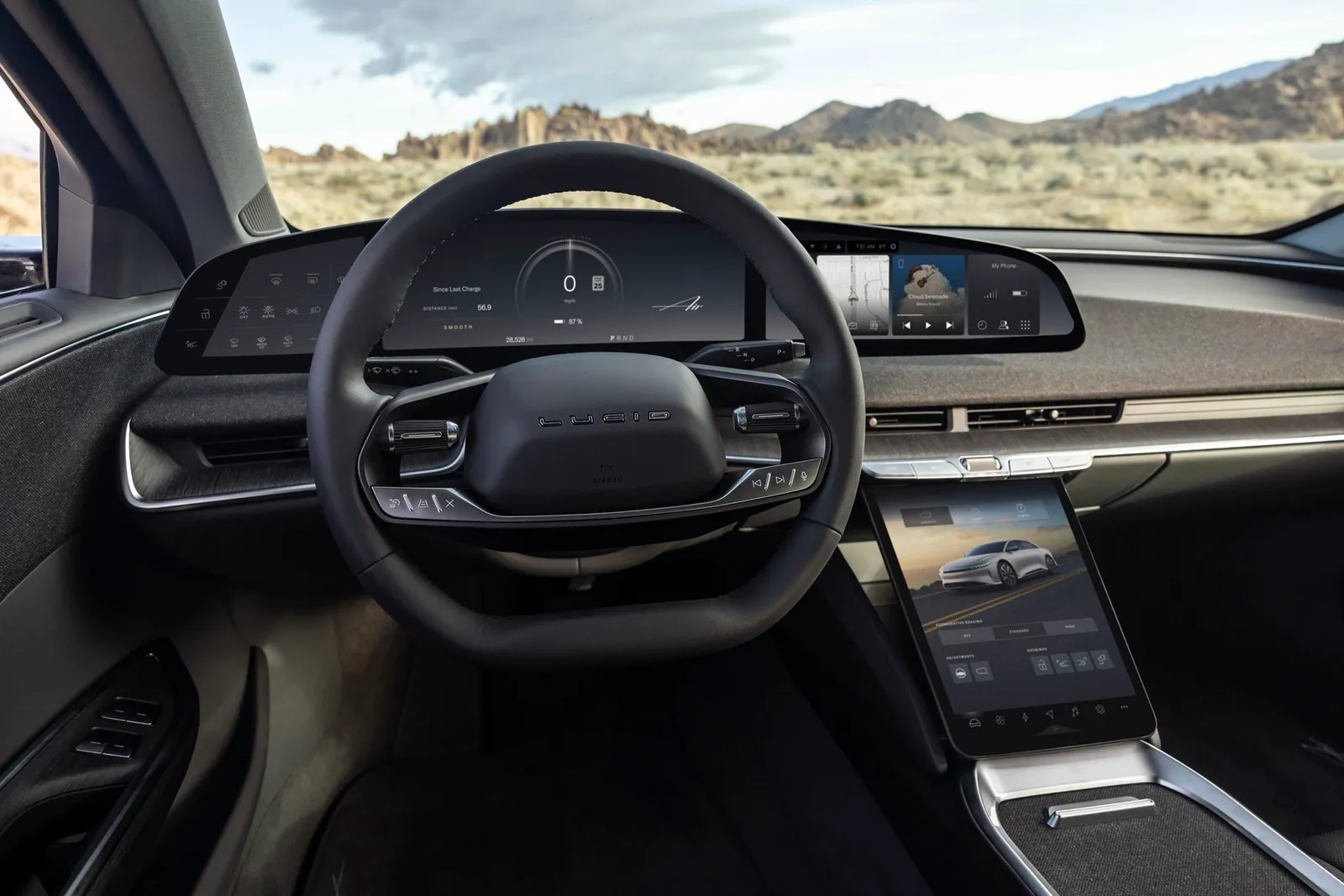
Image: Lucid
- 1/5
- 2/5
- 3/5
- 4/5
- 5/5
Massages and silence among the Lucid Air’s luxury features
What I remember most is the quietness inside the cabin. The Lucid Air is extremely quiet even at high speeds on the motorway. Wind and rolling noise are only faintly audible, and even well above the speed limit, you can hold a conversation at normal volume.
It’s precisely in this silence that one detail stands out. The massage function is noticeably firmer than in many other cars, but you can also hear it clearly when it’s switched on. The front seats with 20 electric adjustment options, ventilation, and massage function are standard on the GT.
The rest of the standard equipment is what you’d expect from this vehicle class. There are four climate zones, heated front and rear seats, a heated steering wheel, self-closing doors (Soft Close), a wireless charging pad for your phone, and the Surreal Sound Pro audio system with 21 speakers.
The Lucid Air GT also comes as standard with the ‘DreamDrive Premium’ assistance package, which includes adaptive cruise control and lane-keeping assist, as well as cameras all around the car. The latter work very well and are extremely helpful when manoeuvring, as the rear window is shallow. The ACC (_Adaptive Cruise Control_) also works well in principle and makes driving on the motorway easier. The Auto Park mode, on the other hand, is unfortunately a bit sluggish. In everyday use, it often misses free spaces or takes significantly longer to park than manual control. Additionally, the assistants do not actively and permanently keep the car centred in the lane on the motorway. For that, you need the Pro package.
The ‘DreamDrive Premium’ package does not include the laser-based LiDAR sensor in the front of the vehicle. The Pro version (€4,200 surcharge) does, however, and also adds extra cameras and computer components that are essential for future hands-free driving (Hands-Free Drive Assist). A retroactive upgrade from Premium to Pro is not possible due to hardware limitations. If you value semi-automated driving, you should definitely pay the extra for DreamDrive Pro. Only the Pro hardware (including LiDAR) provides smart lane-keeping and the necessary systems for future hands-free driving functions.
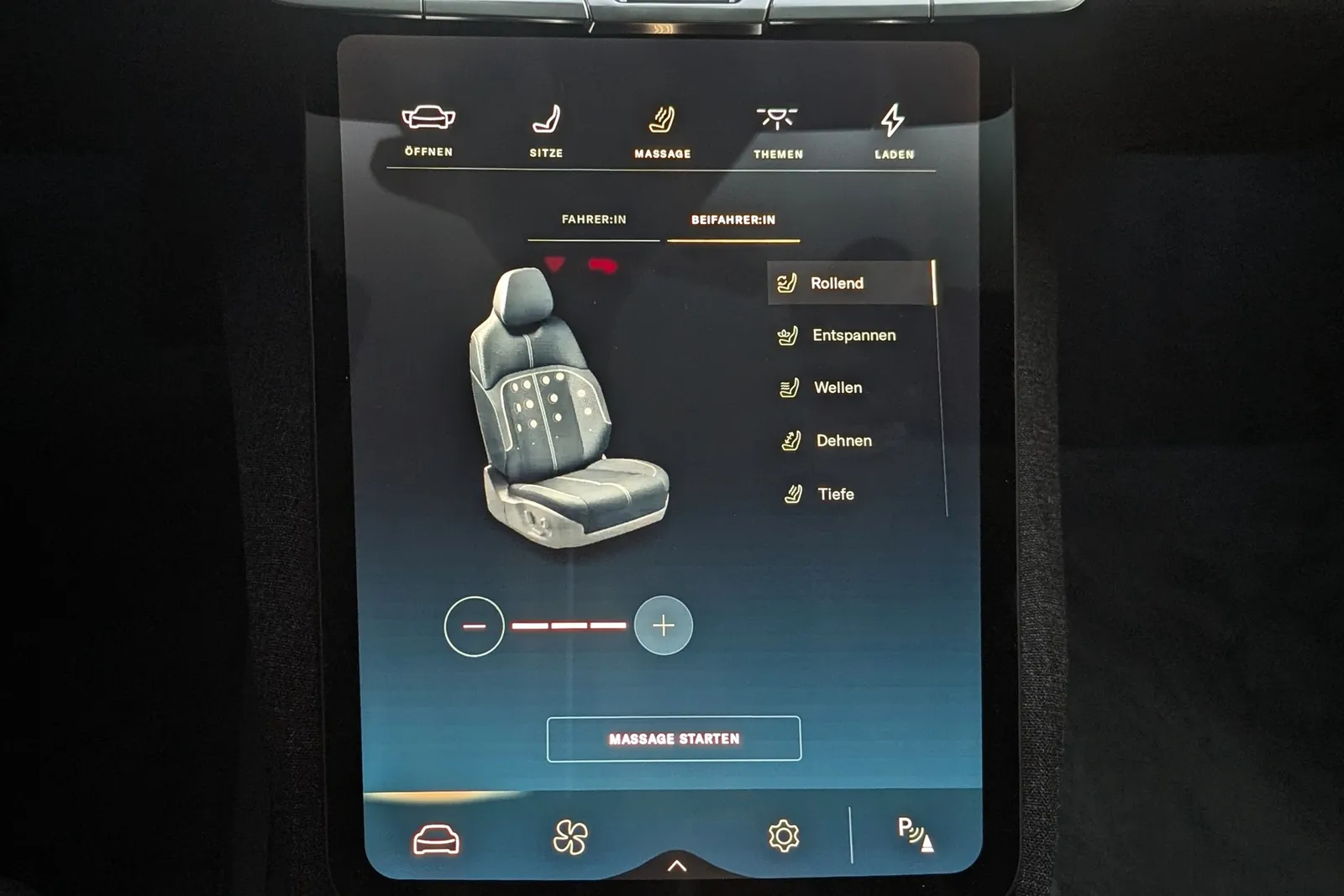
Image: Kasimir Hupe
- 1/3
- 2/3
- 3/3
611 kW that you rarely need
Two permanently excited synchronous motors, one on each axle, deliver a combined 611 kW and 1,200 Nm of torque. ‘Permanently excited’ means that the rotor contains magnets whose magnetic field does not need to be generated with electricity. This design is particularly efficient. The power is transmitted to the wheels via a fixed gear ratio of 7:1. The Lucid Air GT accelerates from 0 to 100 km/h in just 3.2 seconds, and it only stops at 270 km/h. This is particularly fun on the motorway.
There are three driving modes to choose from. In ‘Smooth’ mode, the Lucid Air glides along with gently metered power. ‘Swift’ makes the throttle response noticeably more direct. In ‘Sprint’ mode, the powertrain unleashes everything and presses you into the seat with a force you wouldn’t expect from a saloon of this size. Overtaking on country roads is done in the blink of an eye. It’s a great feature, but for everyday use, Smooth is more than enough.
The regenerative braking – i.e., the recovery of energy during deceleration – is well calibrated in the Lucid Air. In the strongest setting, the brake pedal has hardly any function in city traffic, allowing for one-pedal driving. If you do need to brake hard, six-piston callipers grip 380-millimetre discs at the front, while four-piston callipers grip 375-millimetre discs at the rear. This is sufficient for the performance, and the brakes work very well.
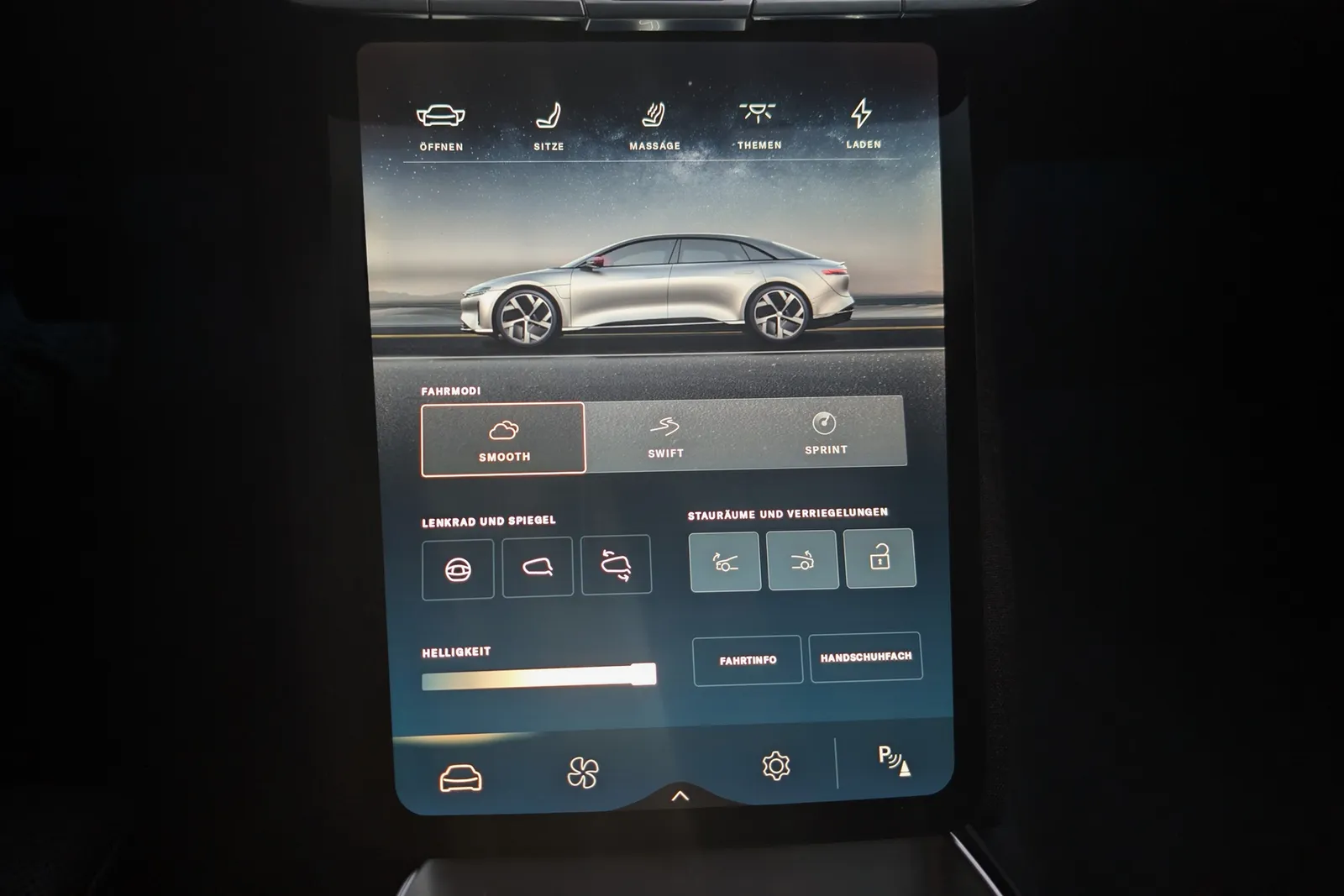
Image: Kasimir Hupe
- 1/2
- 2/2
Confident on the motorway, but less so on corners
After the first few kilometres, I would have bet that the Lucid Air was riding on air suspension – but this is not the case. At the front, there are double wishbones, and at the rear, a multi-link axle, each with steel springs and adaptive dampers. These control the rebound (extension) and compression (retraction) separately from one another – and do so at 500 times per second. The result is excellent. Cross joints, manhole covers, and poor country roads are ironed out, and the body remains calm. Even at high speeds, the Lucid Air sits firmly and stably on the road. This setup is perfect for long-distance driving.
That doesn’t make it a corner carver, though. The 2,360 kg (manufacturer’s figure without driver) or 2,435 kg (EU norm with driver) and a length of almost five metres are undeniable. The steering has a direct ratio of 2.2 turns from lock to lock and operates precisely. However, when cornering at speed, you can feel the mass pushing outward. The low centre of gravity, thanks to the battery installed in the underbody, helps somewhat. But you shouldn’t expect agile handling from the Lucid Air. For brisk, relaxed long-distance driving, however, it’s perfect.
In the city, however, another point comes into play. There’s no rear-wheel steering, and the turning circle is 12 metres. In tight car parks, this makes manoeuvring more cumbersome than in an EQS or i7, both of which have rear-wheel steering.
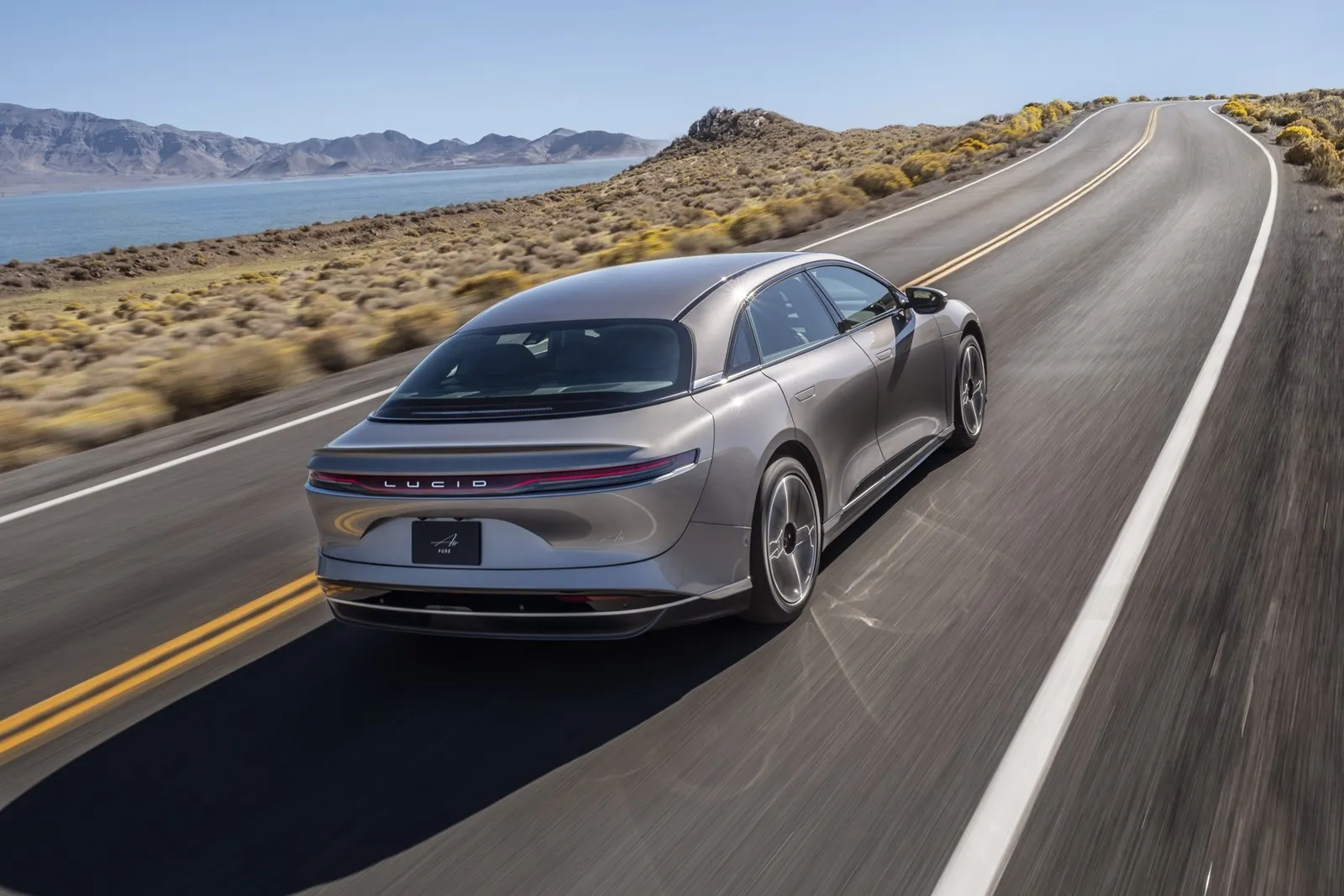
Image: Lucid
- 1/2
- 2/2
Consumption and range: built for long distances
With a full battery, the on-board computer indicated a remaining range of 935 km. That’s impressive, but it’s just a forecast. The figure is slightly below the official range of 960 km that Lucid quotes for the test car with 19-inch wheels according to WLTP (Worldwide Harmonised Light Vehicle Test Procedure).
My own figures varied greatly depending on the driving profile. In the city and with an economical driving style, the on-board computer showed 14 to 15 kWh per 100 kilometres. With a mix of city, country roads, and motorway, consumption varied between 19 and 23 kWh depending on temperature and driving style. On the motorway at the speed limit and above, it was 22 to 25 kWh.
On a particularly brisk 500-kilometre stretch, the on-board computer even recorded 129 kWh consumed, which equates to 25.8 kWh per 100 km. All figures are from the on-board computer and do not include charging losses. If you calculate the energy from the socket, you need to add around 10 per cent. Based on the 117 kWh battery, this results in the following ranges:
- In the city, theoretically around 780 to 835 km
- In everyday mixed driving, around 510 to 615 km
- On the motorway at high speeds, around 470 to 555 km
This means you can even drive from Cologne to Munich with just one charging stop at a brisk pace.
How far the Air can go under less favourable conditions is shown by other tests. In the Norwegian Automobile Federation (NAF – Norges Automobil-Forbund) winter test in January 2026, it still managed 520 km at temperatures as low as -31°C, which is almost 100 km more than the second-placed car. In July 2025, a Lucid Air Grand Touring even drove 1,205 kilometres without stopping to charge through the Alps during a record-breaking drive. This involved travelling from St. Moritz at 1,800 metres to Munich at 500 metres, with long downhill sections.
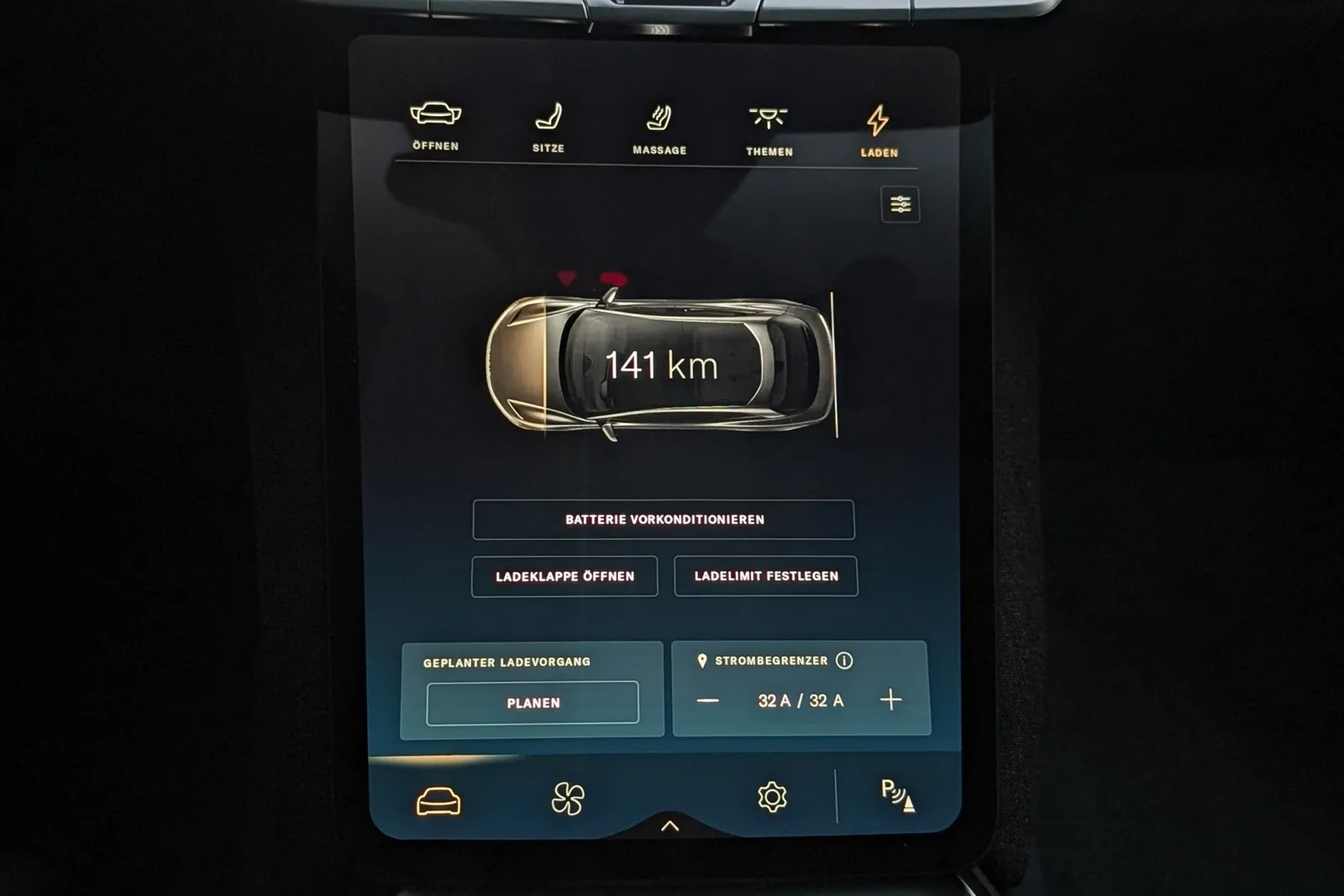
Image: Kasimir Hupe
- 1/3
- 2/3
- 3/3
22 kW AC charging as standard
The battery has a net capacity of 117 kWh and operates with a 900-volt architecture. The advantage of this is quickly explained: at the same charging power, less current flows, so cables and cells heat up less, and the charging power remains high for longer. At a DC fast charger, the Lucid Air charges via a CCS (Combined Charging System) plug with up to 300 kW. According to Lucid, enough power for 400 kilometres is recharged in around 16 minutes. In my test, it took about 28 minutes to go from 10 to 80 per cent SOC (State of Charge), and it even reached a peak of 305 kW, slightly more than the stated maximum charging power.
With alternating current (AC), the Grand Touring can draw up to 22 kW as standard, both at home and at public charging stations. This makes a lot of sense with such a large battery and is often an optional extra with many competitors. A full charge takes just over six hours. The on-board charger is bidirectional and can therefore also supply power. Additionally, in everyday use, it’s practical that the charging status is displayed directly at the charging port and the charging flap opens electrically. The route planning can also be adjusted according to preferred charging networks and a desired remaining range at the destination.
In North America, Lucid has already made the 2026 model year compatible with Tesla’s Superchargers. In Europe, this isn’t an issue thanks to CCS. Here, the Lucid Air can charge at all common fast chargers, including the Superchargers opened to other brands. At older 400-volt stations, a built-in converter kicks in, but this makes the charging process take longer.
Lucid Air GT price: a whole lot of car for a whole lot of money
For the Lucid Air Grand Touring, the Americans charge at least €130,900. My test car added €1,100 for the paint, €8,500 for the Stealth Pack with glass roof, and €4,000 for the package with ‘Mojave Extended Leather’, bringing the total price to €144,500. The price range spans from the Lucid Air Pure with rear-wheel drive at €85,900 to the Lucid Air Sapphire with three motors and 920 kW at €250,000.
Since October, Lucid has also offered a certified used car programme, which enables lower prices. The cars are no more than five years old, have fewer than 100,000 kilometres on the clock, undergo a 163-point inspection, and come with at least one year of warranty. A used Lucid Air Pure currently starts at around €77,087.
New cars are sold in Germany through studios in Munich, Frankfurt, Düsseldorf, and Hamburg, as well as online. Since spring 2026, the Wackenhut automotive group has become the first German retail partner, which also handles service in Baden-Baden. In October, Autohaus Possögel in Naumburg (Saxony-Anhalt) joined as another service partner, taking over maintenance and repairs from December. Additionally, Cloppenburg Automobil SE plans to open a dedicated Lucid sales and service location in Duisburg in January 2027. This doesn’t yet match the dense workshop network of Mercedes or BMW, but it’s clear that Lucid Motors is working to expand its network.
Image: Kasimir Hupe
* 1/1
Comparison with the Lucid Air’s competitors
An obvious rival to the Lucid Air Grand Touring is the Mercedes EQS 580 4MATIC. With a base price of €134,732, it costs almost the same but also has additional costs for equipment. It delivers 430 kW, has a 122 kWh battery with a WLTP range of up to 869 km, and charges at up to 350 kW. Although it is 25 centimetres longer than the Lucid, it offers less boot space at 610 litres and has no frunk. However, the Mercedes has what the Lucid Air lacks: a head-up display, optional rear-wheel steering, and a towing capacity of 1,700 kg. In terms of powertrain and efficiency, the Lucid is clearly ahead and accelerates to 100 km/h almost a second faster.
The BMW i7 60 xDrive is the most expensive at €140,100 and the longest at 5.40 metres. BMW has designed it as a chauffeur-driven limousine, with the focus on the rear. With 400 kW, it sprints to 100 km/h in 4.8 seconds, making it the slowest in the comparison. The net 112.5 kWh battery provides a WLTP range of up to 727 km. It is also the only one in the comparison to still use 400 volts, which is why the charging power is limited to 250 kW. The boot holds 500 litres. If you mainly want to be driven, the i7 offers more comfort. For frequent drivers who drive themselves, the Lucid might be the better choice.
The most exciting competitor comes from Sweden. The Volvo ES90 Twin Motor Performance has a base price of “only” €94,490, making it a good €36,000 cheaper than the Lucid. It delivers 500 kW, charges at up to 350 kW, and has a WLTP range of up to 686 km with a net 102 kWh battery. In terms of storage, it lags behind with 446 litres of boot space and a small 22-litre frunk, but it does offer a large tailgate and a towing capacity of 2,000 kg. However, it cuts out at 180 km/h. If that’s enough for you, the Volvo offers the more sensible package.
The Lucid Air’s strengths lie in its performance, space, and efficiency. At 2,435 kg according to the European standard, it is also the lightest in the field. The competition counters with features such as a head-up display, rear-wheel steering, and a tow hitch, as well as a denser dealer network.
Conclusion: one of the best long-distance electric cars
After two weeks with the Lucid Air Grand Touring, my verdict is clear. This luxury saloon, with its impressive range, is one of the best long-distance electric cars currently available on the market. The suspension is excellent, the interior is exceptionally quiet, and the powertrain is immense yet pleasantly understated. The menu is self-explanatory, and the navigation reliably plans charging stops. With a total of 910 litres of storage space and a frunk big enough to fit a small person, the Lucid Air also beats every competitor in this area. Plus, the 611 kW powertrain is genuinely fun.
The weaknesses lie in the details and are all the more annoying at this price. There’s no head-up display, Apple CarPlay and Android Auto still have to make do with a small section of the screen, the rotary controls on the steering wheel feel a bit notchy, and the key is cumbersome to use. Additionally, the DC charging power, while good compared to the competition, could still be better for such an expensive car with such a large battery. If you’re also expecting a lot of agility in corners, you’ll likely be disappointed.
The Lucid Air is therefore aimed at those who are looking for an elegant, electric travel car, don’t want to tow a trailer, and can live with a still rather sparse service network. However, you should keep an eye on Lucid’s restructuring. The car itself isn’t the issue, as it demonstrates what Lucid is technically capable of. Now, the brand just needs to optimise the final details to continue thriving in Europe.
Image: Lucid
* 1/1
All prices in this article are as of November 2026 and include 19 per cent VAT.
_Sources: lucidmotors.com (Lucid Air Configurator), media.lucidmotors.com (Press Release Air UX 3.0), media.lucidmotors.com (Press Release Q3 2026 Deliveries), media.lucidmotors.com (Press Release NAF Winter Test), Technical Data Sheet and Equipment List Lucid Air Grand Touring (Lucid Press Materials)_