
Electric car batteries are surprising: significant differences even within the same model
A study by specialist company Aviloo on 20 electric cars reveals significant differences in battery degradation, even among units of the same model. The results help identify which cars age better and highlight the importance of checking their condition before purchasing a used electric vehicle.
Purchasing a used electric car has a unique aspect that sets it apart from a gasoline car: the battery’s condition can be far more crucial than the mileage shown on the dashboard. And although we know that modern batteries exhibit considerable durability, a new analysis shows that not all batteries age equally, even when referring to exactly the same car.
The battery diagnostics company Aviloo analyzed the results of its degradation tests on 20 popular electric vehicle models, including units from 2022 to 2026 with reference mileage levels of 50,000, 100,000, and 150,000 kilometers. The goal was to determine which models retain their original capacity best and, more importantly, to assess how reliable the average values are when considering a used vehicle.
Mercedes, Hyundai, and BMW batteries perform best over time
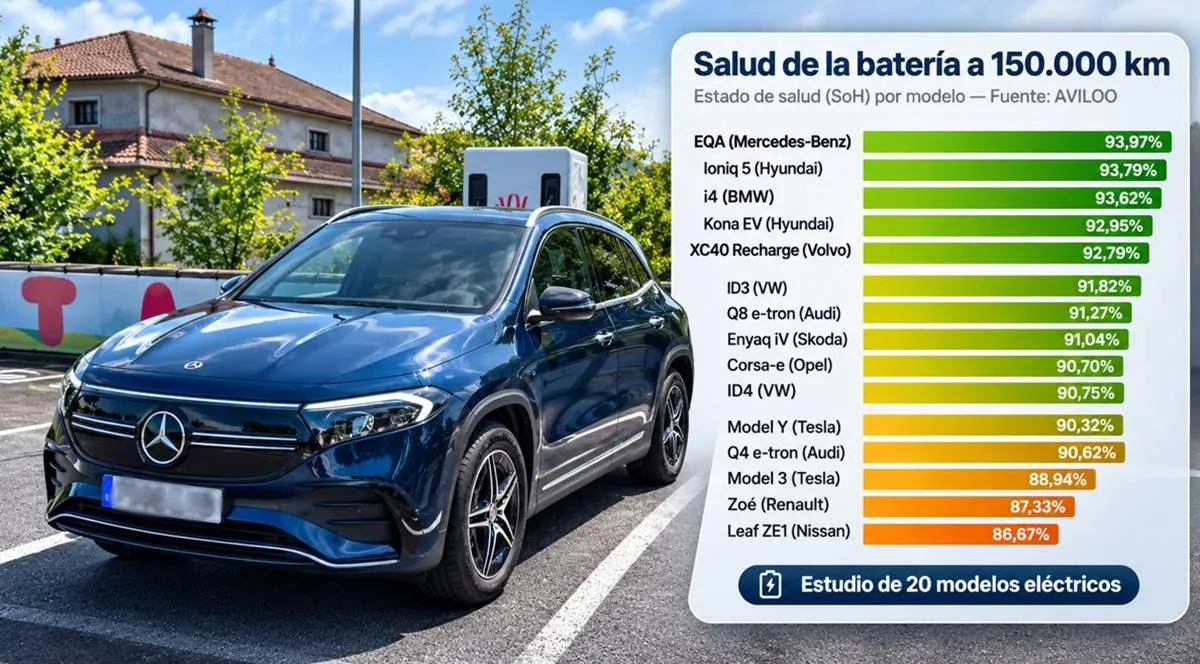
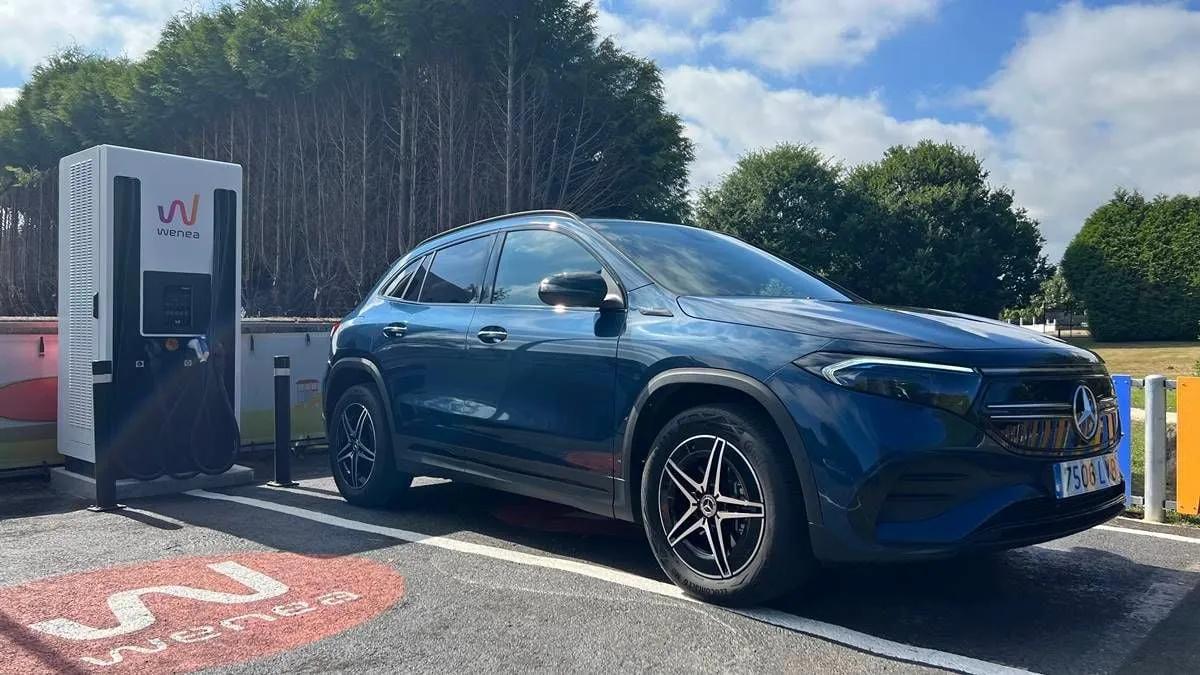
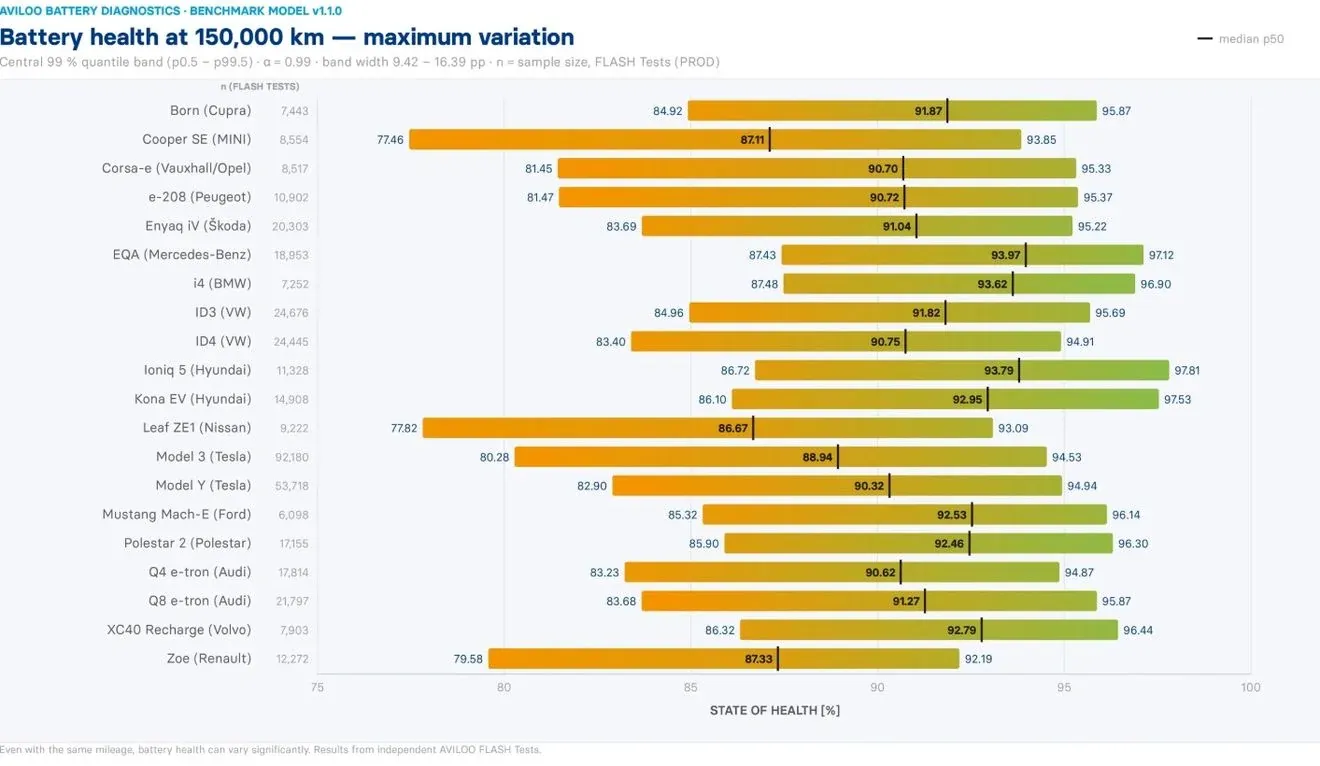
The results reveal some interesting surprises. Among the cars that have covered 150,000 kilometers, the Mercedes-Benz EQA comes out as the model with the best battery preservation, maintaining an average remaining capacity of 93.97%. In other words, it loses only 6.03% after a distance that represents eight to ten years of use for many drivers.
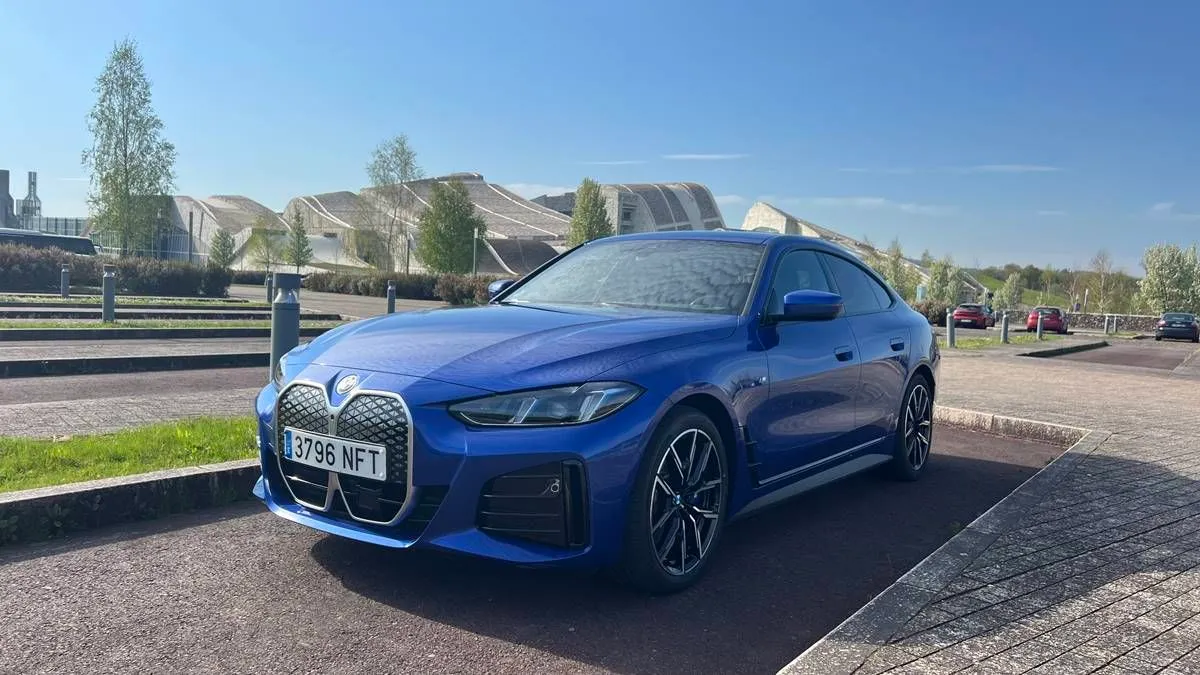
Very close behind is the Hyundai Ioniq 5, which retains 93.79% of its original capacity, followed by the BMW i4 at 93.62%. The Hyundai Kona electric and the Volvo XC40 Recharge round out the top positions with 92.95% and 92.79%, respectively. These results indicate that the batteries in these models can retain a significant portion of their capacity even after accumulating substantial mileage.
At the opposite end, two older models, the Nissan Leaf and the Renault Zoe, show average remaining capacities of 86.67% and 87.33%, respectively, after 150,000 km. This represents losses of 13.33% and 12.67%, figures higher than those of the better-ranked models, though they still retain over 85% of their initial capacity.
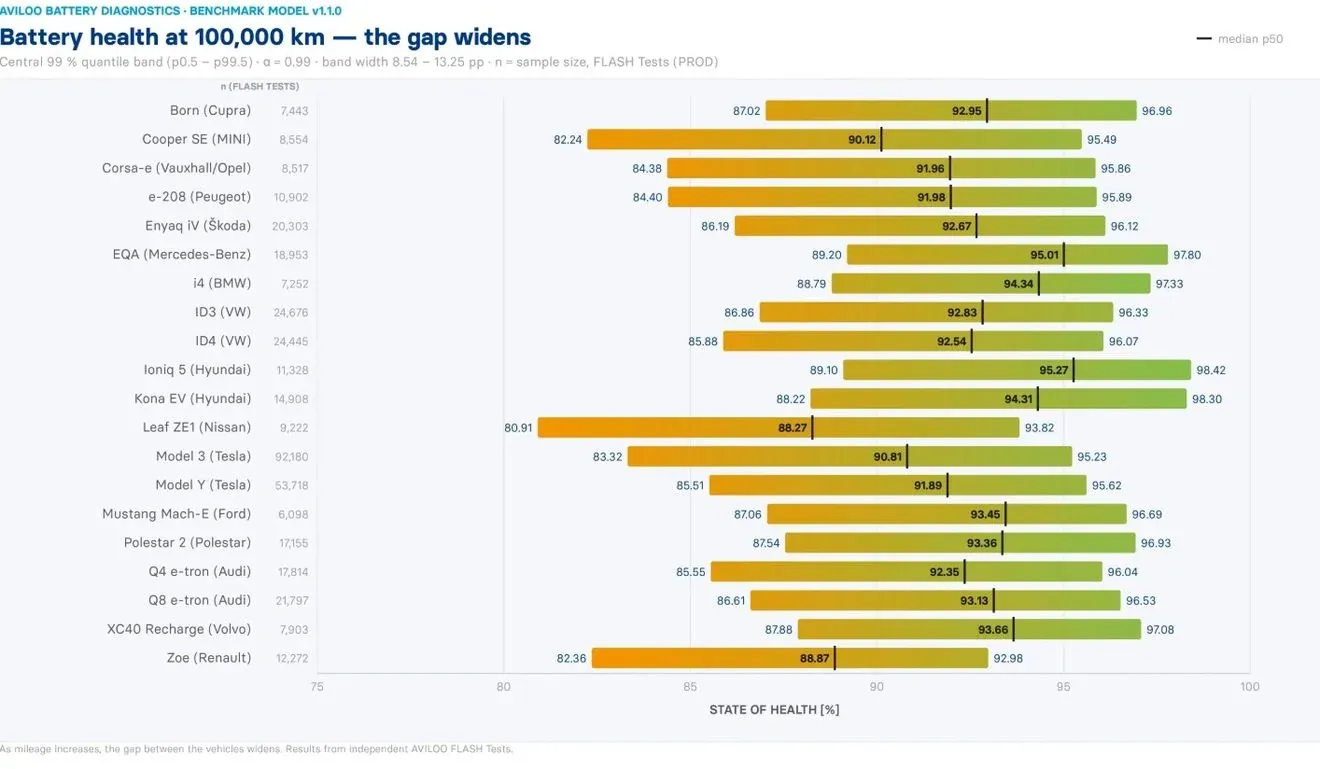
Interestingly, the top positions change little when the mileage is reduced. At 100,000 km, the Hyundai Ioniq 5 manages to surpass the Mercedes-Benz EQA, while the BMW i4, Hyundai Kona, and Volvo XC40 Recharge remain among the best. This consistency indicates good average battery performance based on the analyzed data.
Up to 13 points of difference between two identical cars
But perhaps the most important figure in the report isn’t which car tops the rankings, but rather the differences Aviloo has found between units of the same model. According to the company, it’s not unusual to see differences of 10 to 13 percentage points in the health status of two equivalent batteries, even when the cars have similar mileage.
This means we can find two electric cars from the same year, with the same battery capacity and 100,000 kilometers driven, but with quite different health levels. For example, one might retain 95% of its original capacity while another has only about 82%. These are not figures for two specific vehicles in the study, but an example of what a 13-point difference entails.
The explanation is that mileage doesn’t tell the whole story. Battery performance depends on factors such as the temperatures it has been exposed to, charging habits, how long it has been at very high or very low charge levels, and how it has been used over its lifetime.
The size of the battery also plays a role. Smaller electric cars with more limited capacity usually require more charge and discharge cycles to cover the same distance as a model with a larger battery. This can lead to greater wear, although cell chemistry and thermal management also play a crucial role.
That’s why buying an electric car with 60,000 km on it doesn’t guarantee its battery is in better condition than one with 120,000 km. Mileage remains a useful reference, but it’s insufficient to determine the actual condition of the car’s most expensive component.
Aviloo recommends conducting an individual test of the battery’s health status, known as SoH, before making a purchase. This check helps determine how much capacity the battery still has compared to its original condition and identifies any differences from other units of the same model.
This has a direct impact on the used car market. Two cars that appear identical should not necessarily have the same value if one has a battery in excellent condition while the other has suffered significant degradation. Just as we examine a used car’s maintenance history, accidents, or mechanical wear, a battery health certificate should become a standard part of the buying and selling process.
The results also show a positive outlook. Even after 150,000 kilometers, the five best-performing models retain an average of over 92% of their original capacity. Degradation does occur, but in many modern electric cars it is far from being the catastrophic problem some imagined a few years ago.
What is becoming clear is that when buying a used electric car, it’s not enough to ask how many kilometers it has traveled. We should also ask about the condition of its battery and, most importantly, request that they demonstrate it to us.