
AI also pollutes the air: what are we breathing near data centers
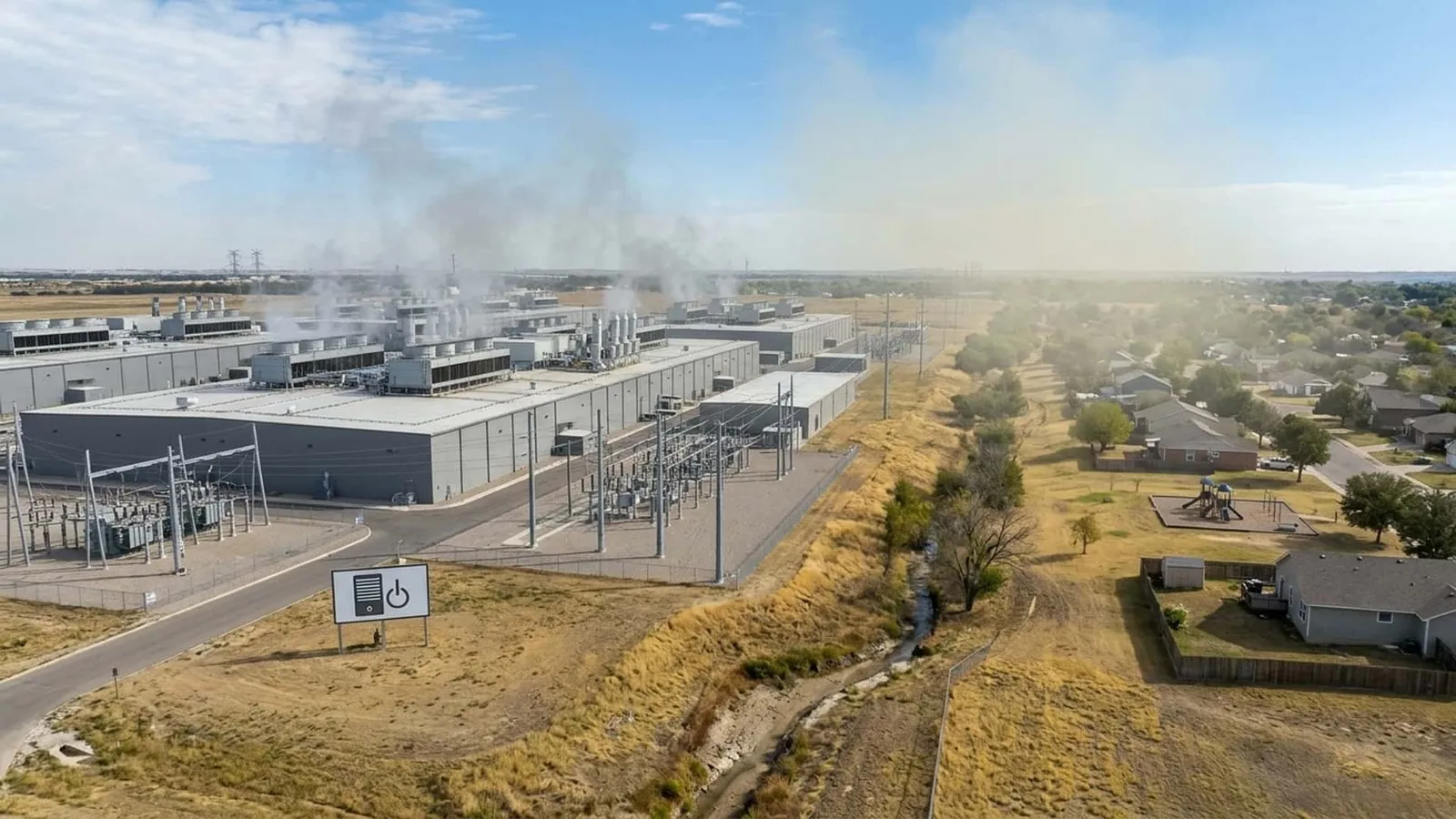
Artificial intelligence comes with environmental costs that go far beyond the energy needed to power servers and computing systems. As data center growth drives an increasing demand for electricity and water for cooling, another aspect risks being overlooked: the air quality in the areas where these infrastructure facilities are built and operated.
Glory Dolphin Hammes, CEO of IQAir North America, is drawing attention to this issue. I interviewed her to understand the potential consequences of developing the infrastructure required for AI on human health and the environment.
According to estimates by the International Energy Agency (IEA), global electricity demand from data centers is set to more than double by 2030, driven in part by the spread of artificial intelligence.
This growth affects more than just the power grid. Depending on how energy is generated and the technologies used within the facilities, data centers can contribute to emissions of fine particulates, nitrogen oxides, and other pollutants. The problem is that some of these emissions are not visible to the naked eye but can still reach communities living nearby.
From diesel generators to gas turbines: what are we breathing?
One of the key elements to consider is emergency diesel generators. Data centers must ensure continuous power supply, as even a brief interruption can disrupt the operation of computer systems. For this reason, they use generator sets that come online when power from the grid is lost and are also activated periodically for testing.
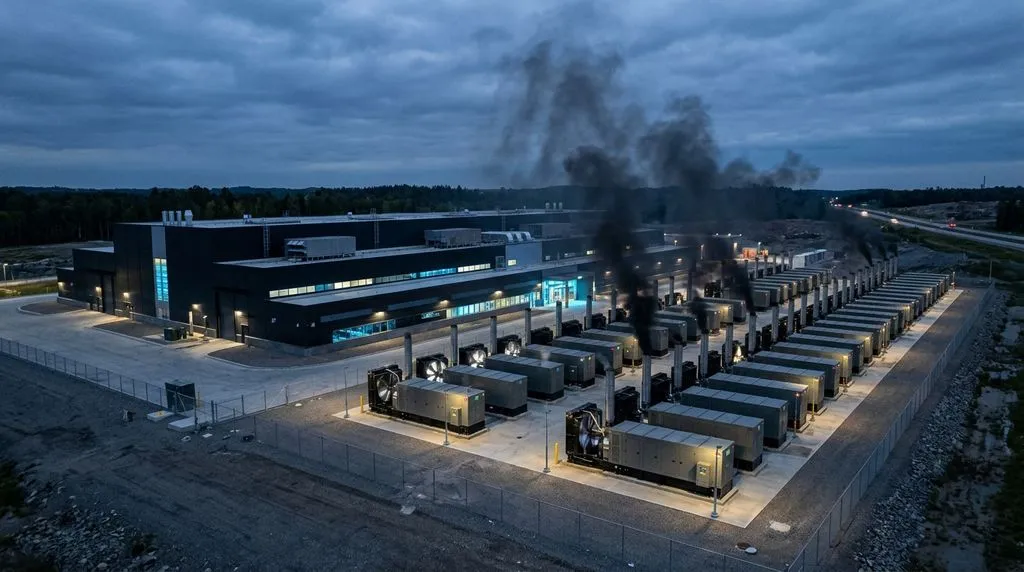
Data centers use emergency diesel generators: some facilities house hundreds of them, resulting in potentially high emissions.
Photo by: Motor1 Italia visual (AI-assisted)
Their impact depends on size, frequency of use, and emission control systems. A single large-scale facility can house dozens, and in some cases hundreds, of generators. When multiple units operate simultaneously, the total emissions can become significant, even if each generator is used only for limited periods.
Among the most problematic pollutants are PM2.5, which are particles with a diameter of less than 2.5 micrometers, and nitrogen oxides (NOx). Carbon monoxide and other compounds present in diesel engine exhausts also contribute to these issues.
PM2.5 particles are particularly dangerous because, due to their small size, they can penetrate deep into the lungs, with some even reaching the bloodstream. Exposure to them is linked to an increased risk of respiratory and cardiovascular diseases. Nitrogen dioxide (NO2), one of the components of NOx, can irritate the respiratory tract, worsen asthma symptoms, and contribute to the formation of tropospheric ozone and additional particulate matter.
The World Health Organization recommends an annual average concentration not exceeding 5 micrograms per cubic meter (µg/m³) for PM2.5 and 10 µg/m³ for nitrogen dioxide. These are guideline values based on health protection and do not necessarily match the legal limits in individual countries. As Hammes emphasizes, there is no level of air pollution that is completely risk-free.
Another factor to monitor is the increasing use of natural gas turbines, which some operators are considering to meet the energy needs of their infrastructure. Compared to similar diesel plants, these machines generally produce less particulate matter and sulfur dioxide, but they still emit NOx and carbon monoxide.
The main difference lies primarily in operational duration. Diesel generators are typically used for emergencies, whereas gas turbines can operate for extended periods, directly supplying part of the electricity needed by data centers. Even though they emit less per unit of energy produced, continuous operation can still result in significant cumulative pollution.
We must also consider what happens outside the facilities. The electricity used by data centers must be generated somewhere, and depending on the local energy mix, rising demand may require increased production from coal and natural gas power plants. This refers to indirect emissions, which should be distinguished from the direct emissions generated by the engines and equipment within data centers.
To properly assess the environmental impact of artificial intelligence, it is not enough to measure how much pollution a single facility generates: one must also consider the emissions associated with the electricity it consumes and its effects on the entire power grid. As Glory Dolphin Hammes said:
"A data center may produce relatively little pollution on site but still contribute to emissions elsewhere through the electricity it uses."
The Virginia case and the importance of monitoring air quality
A concrete example comes from the United States, specifically Northern Virginia, one of the areas with the highest concentration of data centers in the world. Here, according to a study by Virginia Commonwealth University published in February 2026, emissions from emergency generators associated with data centers increased significantly between 2015 and 2023: particulate emissions rose by 139%, while nitrogen oxide emissions increased by 111%.
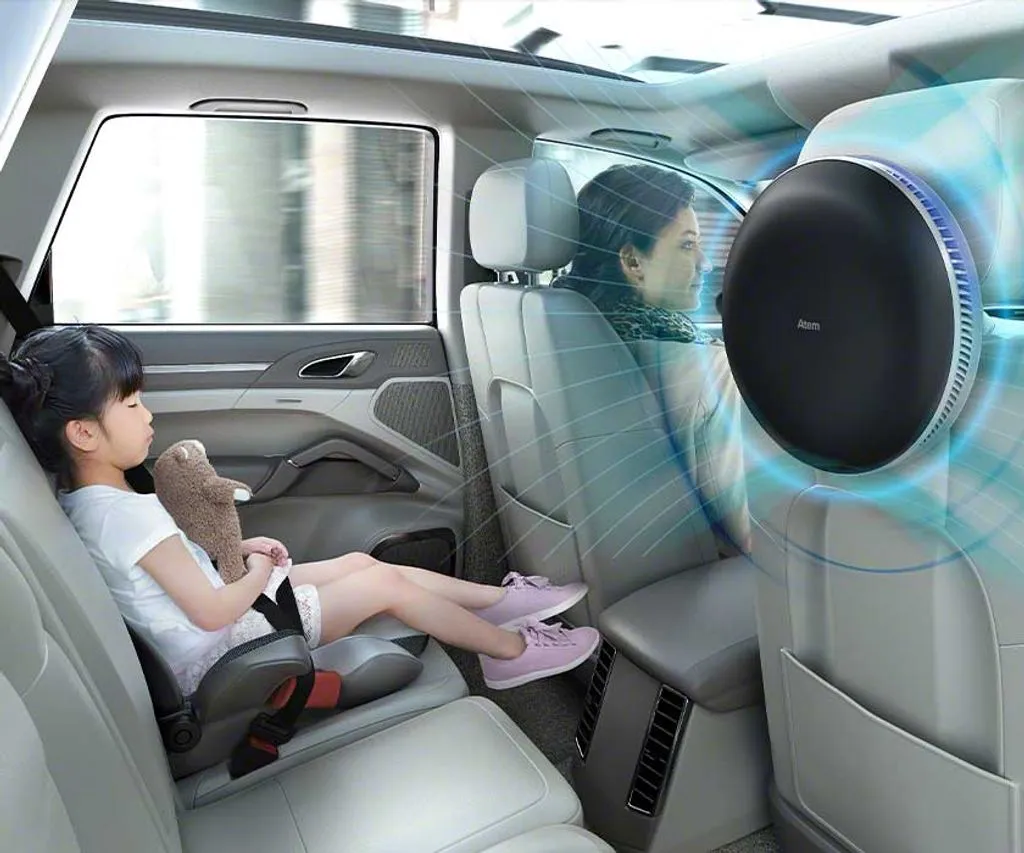
Atem Car is an IQAir device that purifies the air inside the vehicle using a HyperHEPA Plus filter.
Photo by: IQAir
These are data that show an increase in emissions, but they alone do not allow us to determine what proportion of pollutants actually reaches homes and people living in the vicinity. For this reason, Virginia’s Department of Environmental Quality has launched a specific monitoring project in Loudoun and Prince William counties, aiming to investigate the potential impacts on air quality associated with data center infrastructure.
It is here that real-time monitoring technologies come into play. Institutional monitoring stations are essential for ensuring compliance with air quality standards, but they may also be located several kilometers away from the facilities in question. As a result, they cannot always detect local variations, which can change significantly even over a few hundred meters.
A distributed network of sensors can complement official measurements by identifying any increases in pollutant concentrations near data centers, even during generator tests or emergency operations. Some specialized devices can also detect specific substances such as nitrogen dioxide.
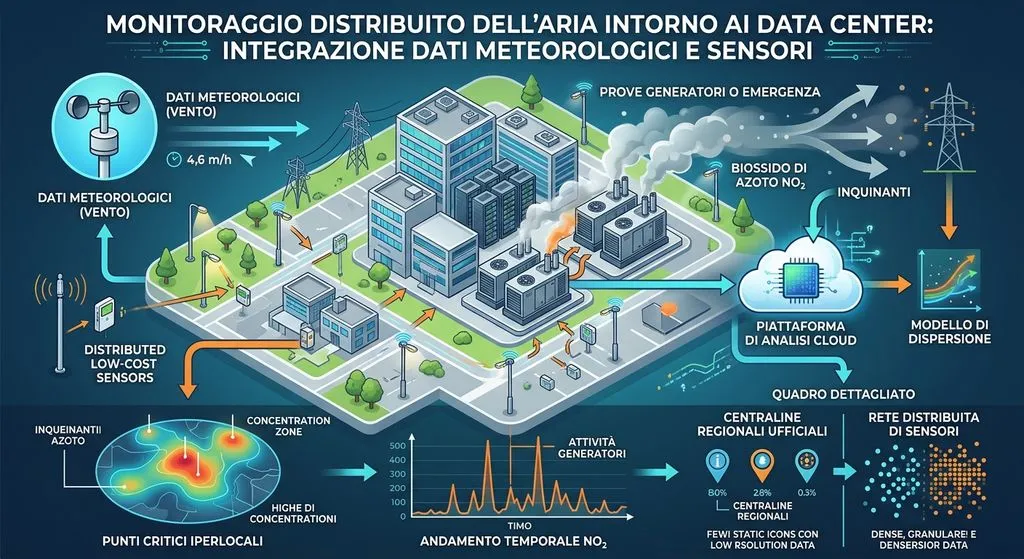
Distributed sensors detect increases in pollutants near data centers, cross-referencing this data with weather information to identify potential sources.
Photo by: Motor1 Italia visual (AI-assisted)
Combining this data with weather information, especially wind direction and speed, helps pinpoint possible critical areas and further investigate the origin of pollution. This doesn’t mean that every increase detected by a sensor must be attributed to a data center, but it provides a more detailed overview compared to what regional monitoring stations alone can offer.
For Hammes, transparency must be an integral part of the development of these infrastructure projects. Operators should disclose information on emissions, the number of hours generators operate, and the emission reduction systems used. Authorities, on the other hand, are responsible for setting monitoring requirements and independently verifying compliance with rules. Independent organizations and citizens can also contribute by expanding the scope of monitoring efforts.
On the regulatory front, the CEO of IQAir North America believes that existing environmental rules provide an important foundation, but not always enough to address the rapid concentration of new facilities in certain areas. A single data center may have relatively low emissions, but the combined effect of multiple facilities in the same area can be quite different. Therefore, it would be necessary to assess cumulative emissions during the approval process, taking into account operating hours, periodic testing, and the effectiveness of control systems.
The proposal is to introduce regular environmental reports that include energy consumption and air quality data, along with continuous monitoring 24/7, both inside the facilities and in the surrounding communities.
Can AI grow without worsening air quality?
According to Hammes, yes, provided that operators invest significantly in renewable energies such as wind and solar, supported by energy storage systems. Batteries could also help reduce reliance on traditional diesel generators, while improved energy efficiency would limit the amount of electricity needed to power servers.

Glory Dolphin Hammes, CEO of IQAir North America
Photo by: IQAir
The challenge, therefore, relates not only to the ability to build increasingly powerful data centers but also to how they are powered.
The environmental cost of AI cannot be measured solely in kilowatt-hours and liters of water: we must also consider what ends up in the air breathed by people living near these infrastructure sites.
Read more