
Honda's first electric bicycle is entirely made of carbon fiber, with a design inspired by the Civic Type R.
Honda is one of the world’s largest motorcycle manufacturers, but it seems its expertise in two-wheeled vehicles won’t be limited to internal combustion engines and new electric motorcycles. The Japanese brand has decided to take another step and enter a market with increasing competition, especially among manufacturers aiming to offer high-performance products. It does this with a proposal that has little to do with the urban electric bikes we usually find in stores.
After several years of showcasing prototypes and exploring various solutions, Honda has introduced its first production electric bike, the Honda RN0. This high-end mountain bike was developed in collaboration with the German specialist Rotwild, combining a highly aggressive design, lightweight materials, and components typically found in the most expensive bikes on the market.
Interestingly, Honda isn’t starting from scratch. Over two decades ago, the brand already developed the RN01, a downhill bike that featured a unique continuously variable transmission, which helped it achieve significant sporting successes, including a world championship in 2005. Now it revives elements of that philosophy, but adapted for a new generation of electric-assisted bikes.
An electric bike with Honda Civic Type R DNA and a 100 Nm Shimano motor

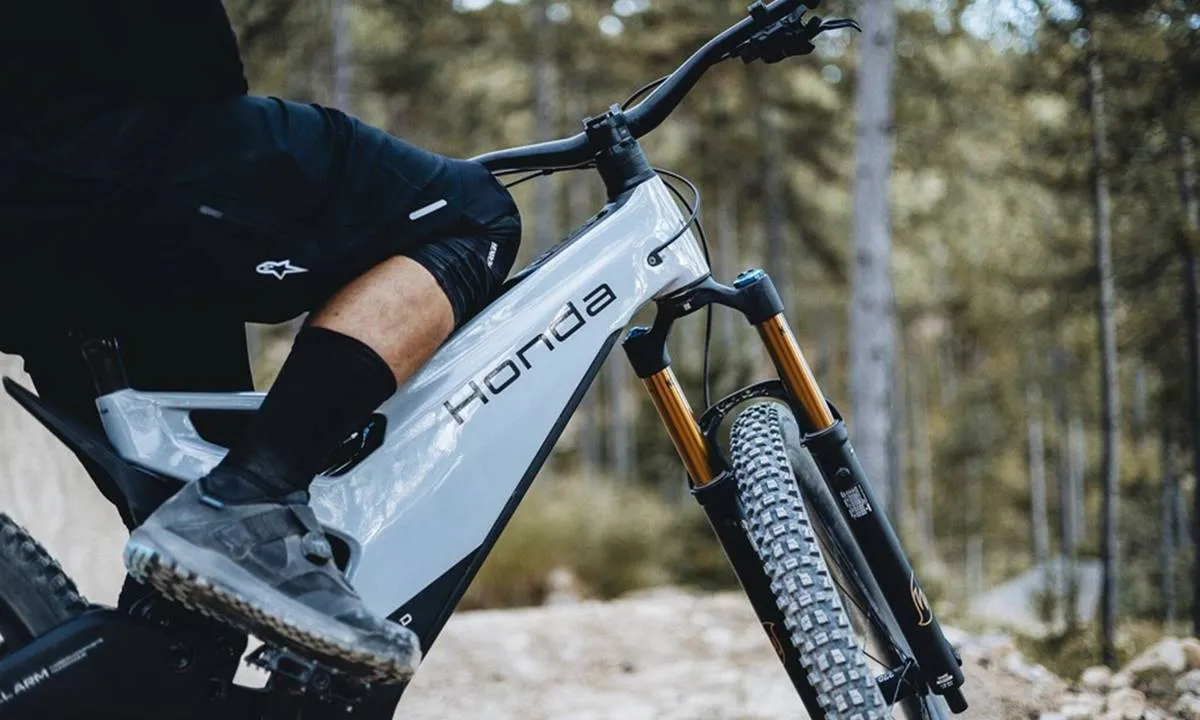
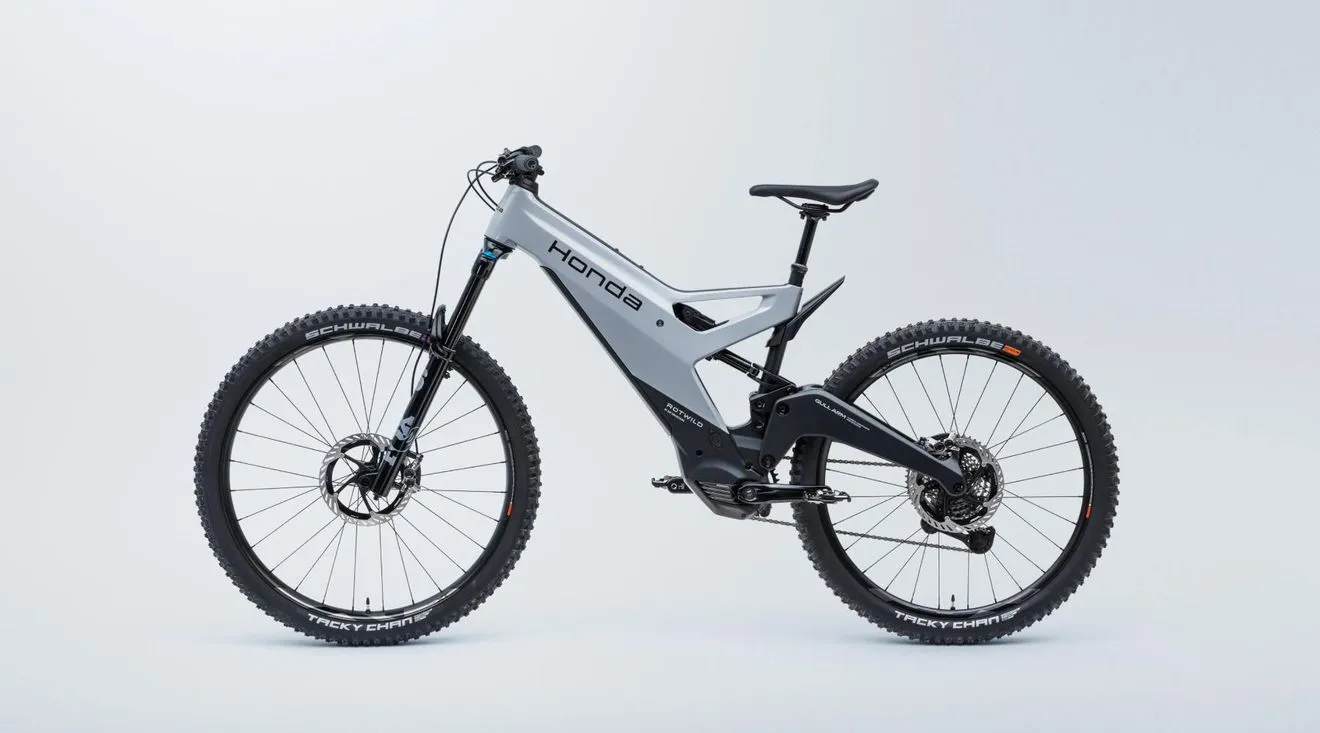
The first thing that stands out about the Honda RN0 is its design. The brand has opted for a very muscular aesthetic, with angular lines that recall some of its most sporty models, especially the Honda Civic Type R. The result is a mountain bike that almost looks like a small racing motorcycle, featuring a very bulky central section and a monocoque frame made entirely of carbon fiber.
The frame incorporates the battery inside it, protected by a small cover that helps maintain a fairly clean appearance despite its size. Honda has chosen a setup designed for demanding mountain rides, featuring a 160 mm travel front Fox 36 Factory Kashima suspension and a 145 mm travel rear Fox Float X Factory Kashima shock absorber. This combination clearly shows the intent of this model, which is designed both for climbing steep slopes and tackling technical descents.
We also found a setup with wheels of different sizes, featuring a 29-inch tire at the front and a 27.5-inch tire at the back. This configuration aims to combine the ability to overcome obstacles provided by a large front wheel with greater agility in the rear. The tires are DT Swiss H 1900, paired with 2.5-inch Schwalbe Albert EVO tires, and it comes equipped with four-piston Shimano Deore XT M8200 brakes using 203 mm discs.
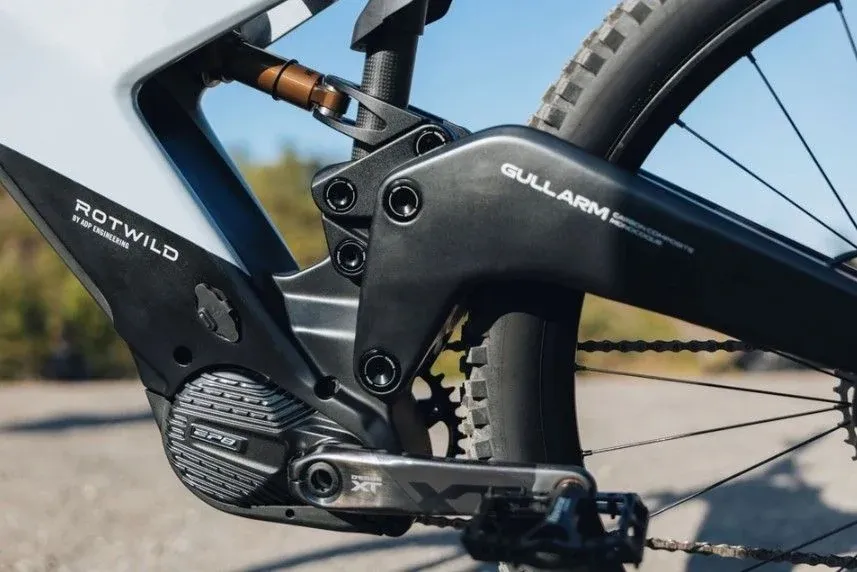
But one of the most interesting aspects lies in the propulsion system. Honda has opted for a new Shimano engine that generates 100 Nm of torque and a maximum power of 750 W, all while weighing just 2.3 kg. This represents a reduction of 400 grams compared to the previous Shimano EP801, while simultaneously increasing torque by 15 Nm and maximum power by 150 W. This significant improvement places it among the most interesting systems in the high-performance segment.
The power comes from a 720 Wh removable Shimano battery integrated into the frame. Honda has not provided an official range figure, which for a bike of these specifications depends heavily on the terrain gradient, the rider’s weight, the surface, and the selected assistance level. To monitor performance, it features a 2.2-inch Shimano SC-EN700 display mounted on the top tube, along with a 12-speed Shimano Deore XT Di2 electronic transmission system.
The electronic components also play a significant role. The RN0 features a system called Auto Assist, which automatically adjusts the electric assistance based on the terrain conditions and the effort exerted by the cyclist. This allows the motor to increase or decrease its support without the need for constant adjustment, which is particularly useful when the route includes steep climbs and easier sections.
Added to this is the Auto Shift function, which allows for automatic gear changes to maintain an appropriate pedaling rhythm. This technology can be particularly useful on technical routes, where cyclists need to focus on staying on course and overcoming obstacles without constantly worrying about selecting the right gear ratio.
But perhaps the most intriguing feature is Assist Carryover. This system enables the motor’s assistance to be maintained briefly after stopping pedaling, making it easier to overcome certain obstacles or difficult sections where it’s hard to keep pedaling. It’s a solution designed for athletic use, bringing the riding experience of this bike even closer to that of a mountain bike, while still relying on pedaling as the primary means of propulsion.
Regarding its dimensions and weight, Honda will offer the RN0 in three sizes—S, M, and L—with a single gray finish. The declared weight is approximately 23.5 kg including the battery, a reasonable figure for an electric mountain bike with this level of equipment and suspension. The maximum allowed total weight is 130 kg, including the bike, rider, and gear.
So far, Honda has not confirmed either the date of commercial release or the price of its new electric bike. However, given the carbon frame, Fox Factory suspension, and Shimano electronic transmission, it appears to be a high-end product.
The arrival of the RN0 shows that Honda wants to leverage its expertise in racing and two-wheeled mobility to enter a segment that, despite facing a challenging period in Europe, still has consumers willing to pay significant amounts for advanced technology and performance. And although this is currently a fairly exclusive model, it’s interesting to see one of the world’s largest motorcycle manufacturers begin exploring the possibilities of high-performance electric bikes.