
Kia invests billions in electric and PBV center
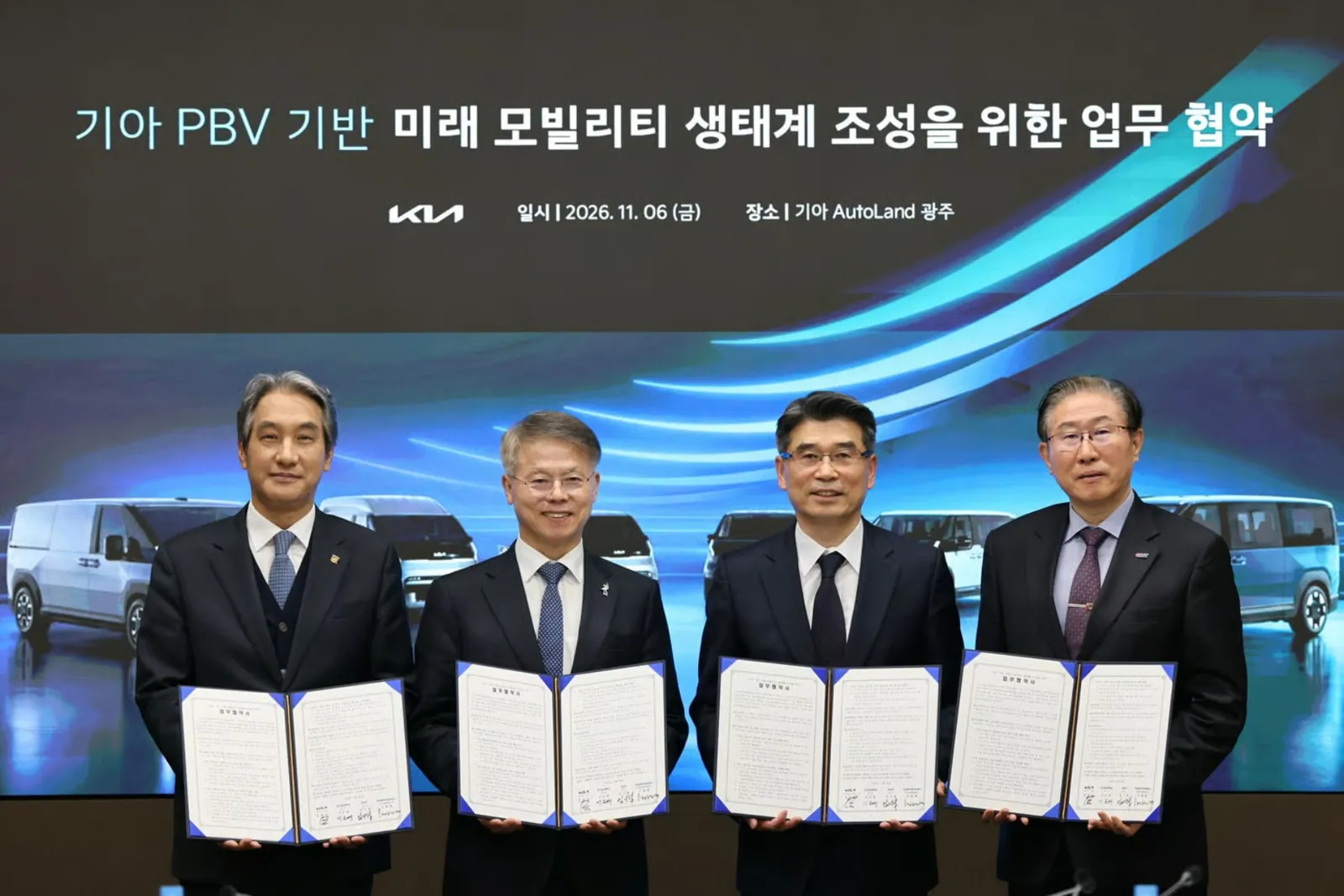
Kia plans to transform the Autoland Gwangju plant into a modern center for electric and autonomous vehicles through a billion-dollar investment, with the goal of completing the transformation by 2029. The aim is to establish an industrial ecosystem for developing modular electric vehicles in collaboration with the region and local universities.
From left: Lim Ki-chul (President of the Gwangju Institute of Science and Technology), Song Ho-sung (Kia President and CEO), Min Hyung-bae (Mayor of Jeonnam-Gwangju), and Lee Keun-bae (President of Chonnam National University) at the signing of the memorandum of understanding for a joint mobility network.
Image: Hyundai Motor Group
Kia and its parent company Hyundai have decided to invest a total of three trillion won (approximately two billion euros) by 2029 in the Autoland Gwangju plant in South Korea. This decision is part of an investment plan worth 125.2 trillion won (about 83.5 billion euros) for the South Korean site by 2030.
In addition, Kia’s corporate leadership, the Jeonnam-Gwangju region’s representatives, and the administrators of Chonnam National University and the Gwangju Institute of Science and Technology signed a joint cooperation agreement. Under this agreement, the Gwangju plant is to be modernized and expanded by 2029.
Although models such as the Kia Seltos and Kia EV5 are already being produced at the Autoland Gwangju facility, manufacturing there is still primarily focused on conventional internal combustion engines. With this investment, a new factory building dedicated to electric vehicles will be constructed, and existing production lines will be expanded to enable larger-scale manufacturing of electric vehicles and so-called software-defined vehicles in the future. For the latter, software control, digital connectivity, and automatic updates are central to the vehicle architecture.
A focus should also be placed on the development of electric purpose-built vehicles (PBVs), namely vehicles whose interiors and configurations can be modified modularly. The so-called “Easy-Swap” technology is used here, which allows for rapid reconfiguration of the vehicle bodies, enabling the same base vehicle to be used for freight transport or passenger transportation depending on current needs.
In an on-site real laboratory, flexible service buses, autonomous shuttles, and remote-controlled Kia PV5s for people with mobility limitations are to be tested. To collect real-time data and train AI control systems, a fleet of 200 autonomous Hyundai Ioniq 5s will also be deployed in regular city traffic. Additionally, the partnership includes joint initiatives for climate protection and the expansion of renewable energy.