
Auto insurance: Why premiums for electric cars from China are often significantly higher
The comprehensive insurance for electric cars of Chinese brands is sometimes significantly more expensive than that for comparable models from established manufacturers in Europe or other countries. This is shown by a new analysis by the comparison website Verivox. The main reason is not necessarily a disadvantage for Chinese models. Instead, it’s due to higher type classes assigned to new models. However, these classifications are improving steadily.
Chinese electric cars are gaining increasing market share in Germany. They often stand out due to their low prices. However, insurance costs can be higher for them, as shown by a Verivox analysis. A 45-year-old driver from Berlin pays 60 percent more, or 729 euros more, for full coverage insurance on a Nio EL6 compared to a Tesla Model Y. A Leapmotor T03 costs 33 percent more, or 199 euros more, than a comparable Fiat 500 electric car. And an MG4 Electric still costs 12 percent more, or 93 euros more, in full coverage insurance than a VW ID.3.
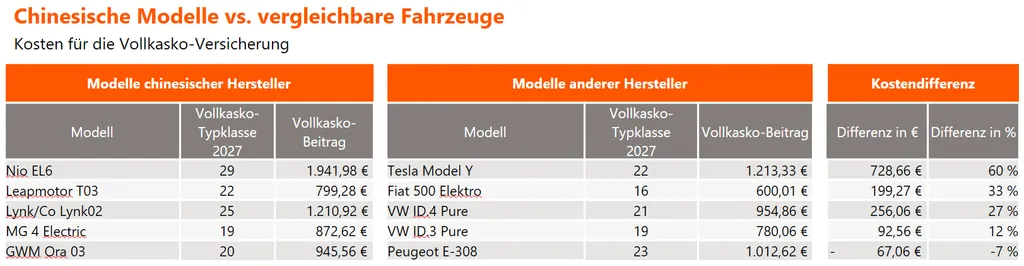
Image source: Verivox
The main reason for the price differences is the vehicle class ratings, which are often higher for cars made by Chinese manufacturers. “For new models, the risk of damage and repair costs can often only be estimated, so they are preemptively assigned to higher class ratings,” says Aljoscha Ziller, head of Verivox.
“Many Chinese automakers have only been in the German market for a few years,” the expert adds. “As a result, insurers lack experience with these manufacturers themselves, as well as information on spare parts costs and availability. Unlike new models from established manufacturers, premiums cannot therefore be calculated based on similar models.”
The average full coverage insurance class for BYD electric cars next year is 27, while that for Skoda cars is 20. Nio’s electric vehicles, although on the market for longer, are rarely purchased and will be classified in full coverage insurance as class 29 in 2027, with Tesla falling in class 26. According to the consumer portal, there is also a difference between Leapmotor at 24 and Fiat at 22.5.
However, the differences are likely to shrink. According to Verivox, significant changes in vehicle class categories often occur in the first few years after a model is introduced to the market. An analysis by the Allianz Center for Technology shows that Chinese manufacturers also benefit from these improvements. Since 2024, Chinese cars have improved by 1.5 vehicle class categories, while European manufacturers have declined by 0.5 categories. The Allianz attributes this to the high costs of spare parts and repairs for established automakers.
Individual models from Chinese brands are already cheaper to insure today than comparable models from established manufacturers. As Verivox’s analysis shows, comprehensive insurance for an Ora 03 is 7 percent cheaper for a Berlin driver than for a Peugeot E-308.
In recent years, rising repair costs have placed significant strain on insurers' balance sheets. In response, they raised prices substantially, according to Verivox. According to this source, car insurance costs increased by an average of 51 percent compared to 2022, the year before the price hikes. Prices have now largely stabilized.
"Rising repair costs will continue to put pressure on insurers," says Aljoscha Ziller. "If replacement parts from established manufacturers become more expensive, insurers will also have to raise their prices again. At the same time, this creates opportunities for new market entrants to offer cheaper repairs and parts."
The Verivox analysis for a 45-year-old resident of Berlin is based on an annual mileage of 12,000 km and a traffic safety class of 15. The vehicles compared are similar in terms of vehicle segment, body type, horsepower, acceleration, top speed, range, and weight.
More on costs:
Bottom line
The Leapmotor T03 starts at 18,900 euros, while the Fiat 500 Elektro begins at 25,990 euros. For insurance, the example driver from Berlin pays around 200 euros more per year for comprehensive coverage according to Verivox. Over a 10-year ownership period, this amounts to about 2,000 euros — not much when considering the price difference between the cars. Additionally, this is a simplified calculation, as vehicle classification tiers can change each year, and according to the report, the ratings for Chinese cars are likely to improve.