
Ionity ends the Shared Power trial. Huawei charging stations are arriving.
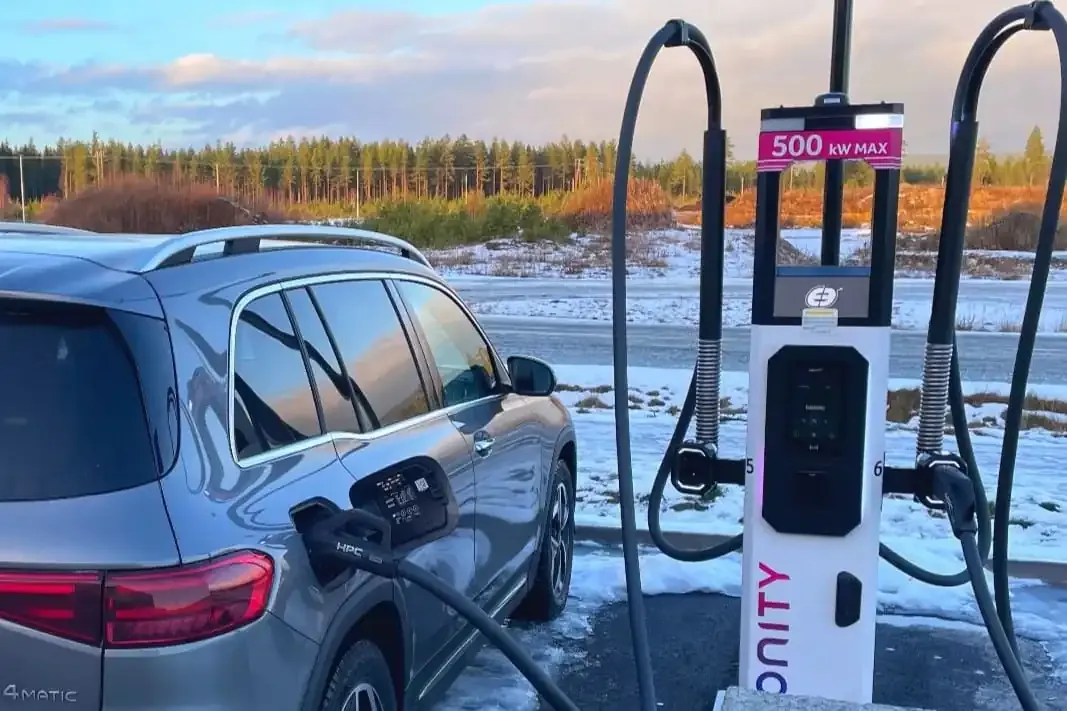
Ionity ends Shared Power testing in Norway. After repeated malfunctions, the network decided to halt the pilot project using Ekoenergetyka’s technology, removing the Polish infrastructure installed in Elverum. Huawei charging stations, with claimed capacities of up to 600 kW, will take their place.
Over the past few years, Ionity has expanded its European network by relying on various infrastructure providers. However, the change in Norway currently affects only one specific facility and does not necessarily mean an end to relations with the Polish manufacturer.
Ionity ends Shared Power testing: too many malfunctions
The charging park in Elverum was opened at the end of 2025, and for the first time ever, Ionity chose the Shared Power technology from the Polish company Ekoenergetyka. The facility included two DLBS power cabinets, capable of providing a total of 800 kW, to be distributed across six charging stations. The goal was to optimize the use of available power by adjusting energy distribution to meet the needs of connected vehicles.
However, the experiment did not work as planned. Due to repeated technical issues, Ionity decided to terminate the pilot project, remove the equipment, and install new infrastructure.
Huawei joins the Ionity network. Power up to 600 kW
Instead of Polish equipment, Huawei charging systems have been installed, marking the Chinese manufacturer’s entry into the Ionity network. The installation in Elverum is one of the first concrete applications of the agreement signed and announced by the two companies last summer.
The new setup includes three charging stations with six connection points, along with a power supply unit. According to available information, the power capacity is distributed across four points at 600 kW each and two points at 500 kW each.
In addition, at the same location, Ionity also operates an Alpitronic station with two charging points, each at 400 kW.
Detailed technical information on Huawei’s system is not yet available; it is expected to use a decentralized architecture with three vertical satellite units connected to a power cabinet.
Ionity concludes testing: just a shift in strategy
The abandonment of Shared Power technology in Elverum does not necessarily mean that Ionity has decided to cut all ties with Ekoenergetyka. The collaboration between the two companies dates back to the summer of 2023 and has already resulted in several installations across the European network.
So far, Ionity had purchased from the Polish manufacturer mainly integrated charging stations with up to 350 kW capacity, installed particularly in Croatia, Slovenia, and Finland. The Norwegian site, on the other hand, represented a specific experiment with a new architecture for dynamic power distribution.
Ekoenergetyka had also presented Elverum as a testing ground for its innovative solution.
The failure of the experiment relates to a specific technology and, at least for now, does not allow conclusions to be drawn regarding the reliability of the manufacturer’s entire product range.
Undoubtedly, with the arrival of Huawei systems, Ionity maintains its position as the operator with the highest nominal capacity at the Elverum station. This Norwegian site is actually a large energy hub shared with other operators: it also features 28 Tesla Superchargers, eight Kople charging points with up to 180 kW, and four Recharge points at 200 kW.
READ ALSO: “More charging stations at Ionity thanks to solar and storage”
Previous Article
Support issues: two cases with Peugeot and MG
Next Article
The electric sewage truck is here, also a Piaggio creation