
Fraunhofer IFAM is researching electric motors that use fewer critical raw materials.
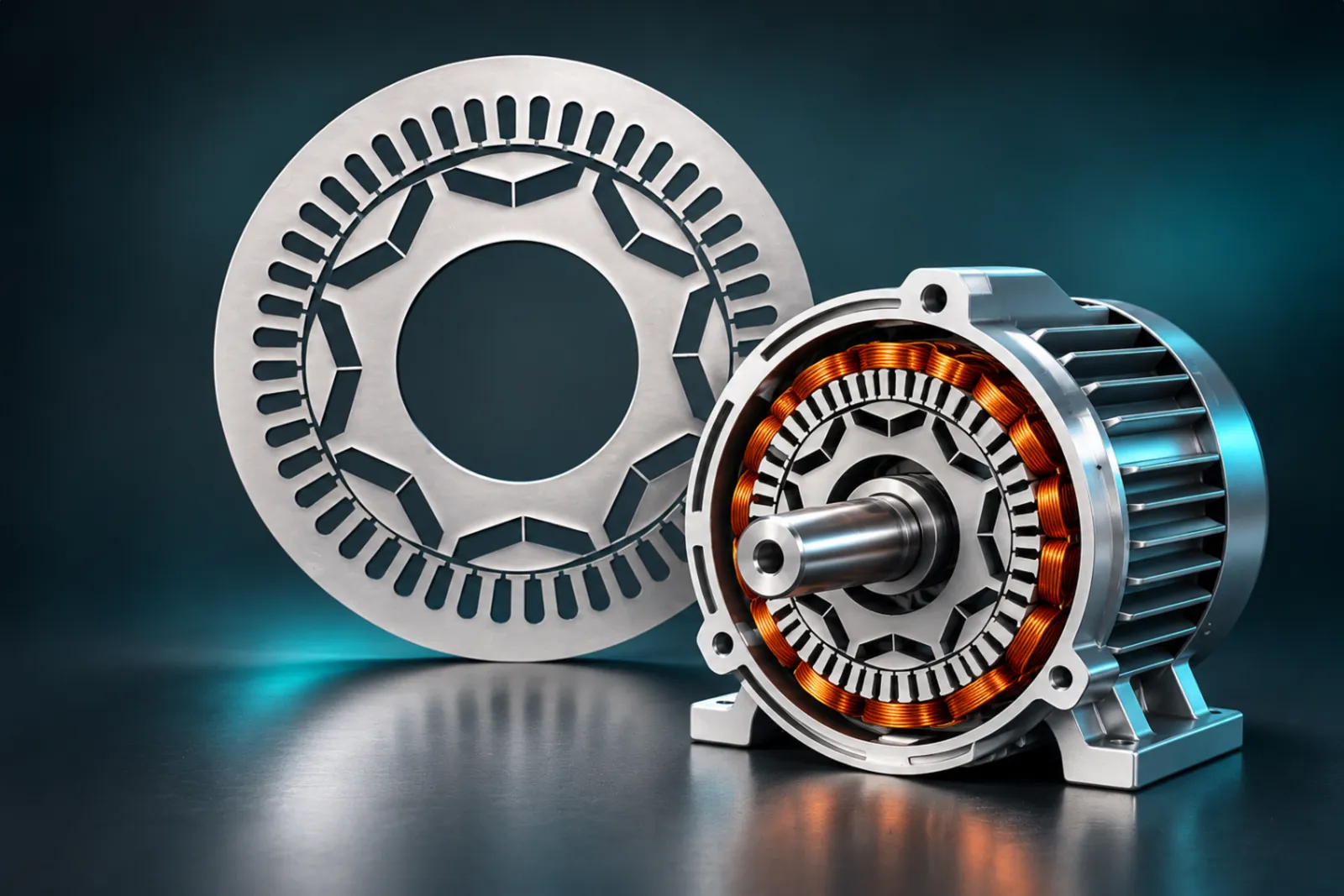
Fraunhofer IFAM is building a new research infrastructure for electric motors in Dresden that aims to use fewer critical raw materials. The SIREN project focuses, among other things, on drives that do not rely on rare earth elements and use aluminum as a substitute for copper in the windings.
SIREN is researching multimaterial sheet packages for new motor architectures.
Image: Fraunhofer IFAM
For the SIREN project (Sovereign and versatile infrastructure for resource-independent electric drives of the next generation), Fraunhofer IFAM will receive over two million euros in funding by the end of 2028. The funds come from the Free State of Saxony and the European Regional Development Fund (EFRE).
The focus is on establishing a cohesive, sinter-based additive manufacturing process chain for the development and production of electric drives. This will enable the combination of different metallic materials and the creation of component geometries that are difficult or impossible to produce using conventional manufacturing methods.
A focus is on so-called multimaterial sheet packages, which involve the intentional combination of soft magnetic and non-magnetic materials. Based on this approach, the institute aims to develop high-speed reluctance motors as well as ferrite-excited permanent magnet drives. Such motor concepts can function without rare earth elements.
Another approach relates to the electrical windings. At Fraunhofer IFAM, researchers are investigating whether copper can be replaced by aluminum. By integrating special cooling channels, the properties of aluminum windings are intended to be improved, thereby enabling high-performance electrical drives.
Aluminum to Replace Copper in Motor Windings
The background for these efforts is Europe’s dependence on critical raw materials. Especially for rare earths, supply is heavily concentrated in a few supplying countries. Copper also gains increasing strategic importance as mobility and industry become more electrified.
These projects complement other research approaches aimed at reducing such dependencies. Under the EU project NEO-CYCLE, Fraunhofer IKTS and TU Bergakademie Freiberg are developing a method to recover rare earths such as neodymium from used magnets. While that project focuses on recycling, SIREN starts with engine design and explores drive concepts that can function entirely without rare earths.
The new infrastructure is intended to cover the entire development chain, from material development and the manufacturing of complex components to the creation of functional demonstrators. According to Fraunhofer IFAM, this planned combination of processes is unique across Europe.
It targets applications with high demands for power density and space constraints. In addition to electric road vehicles, the institute also mentions aerial and underwater vehicles as well as other industrial applications.
At the same time, the infrastructure is meant to be used for joint development projects with companies. Special emphasis is placed on firms in the field of drive technology, supply industry, and sintering technology. Small and medium-sized enterprises in Saxony are also expected to gain access to the new manufacturing methods.