
Funding for charging infrastructure in multi-family buildings ends
The 500 million euro federal subsidy program for charging infrastructure in multi-family buildings expires today, November 10. By November 4, 21,400 subsidy applications had been submitted. Whether the program will be renewed remains uncertain.
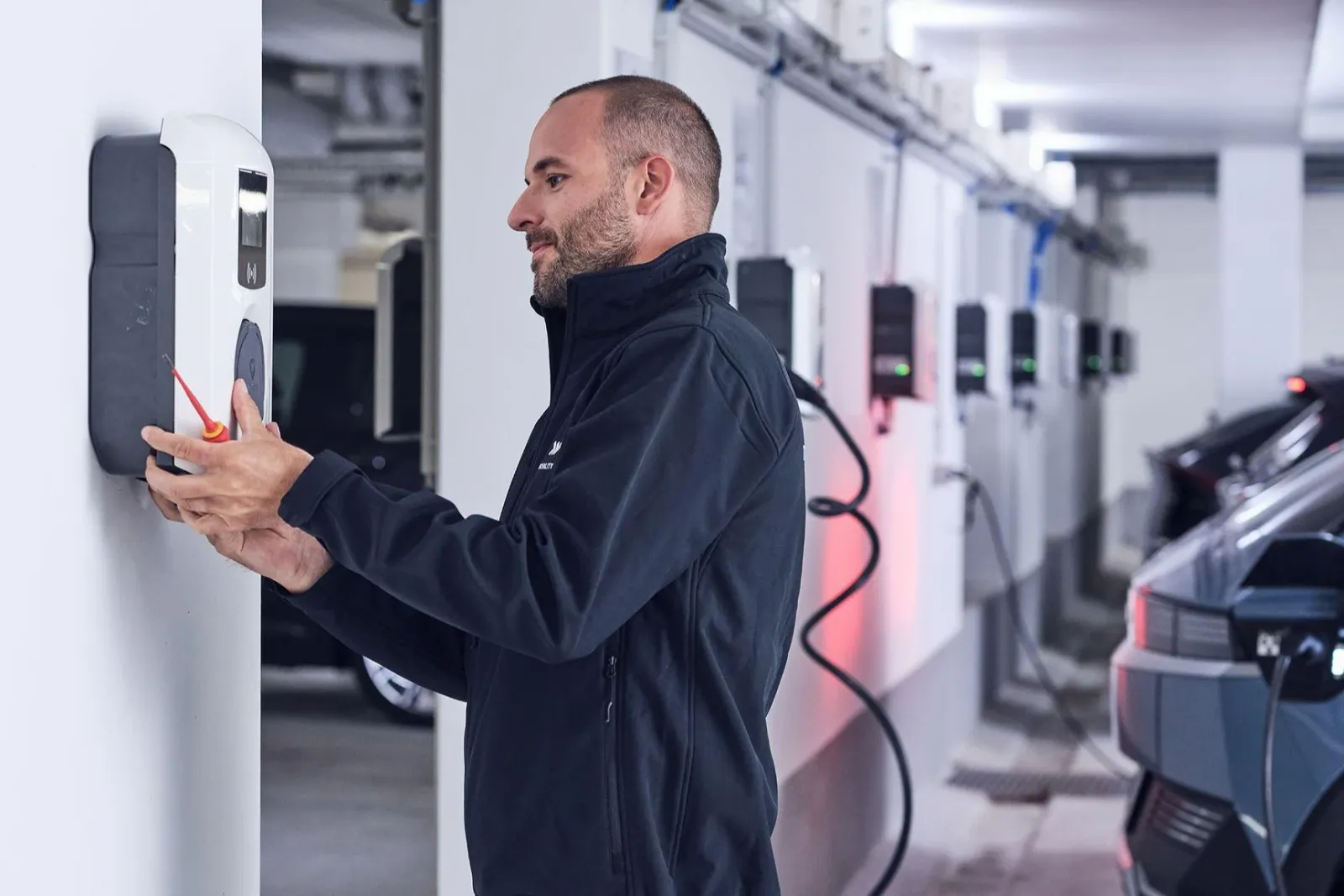
Installation of a Wallbox in a Garage (Illustrative Image)
Image: The Mobility House Solutions
The subsidy program launched in March by the Federal Ministry of Transport (BMV) with 500 million euros to develop charging infrastructure in and around multi-family buildings ends as scheduled on November 10. Applications cannot be submitted after that date.
By November 4th, a total of 21,400 grant applications had been submitted. This led to funding commitments amounting to around 310 million euros. No decision has yet been made regarding the continuation of the program.
High demand from WEGs
However, the demand varied depending on the target group. The funding program was divided into three calls for applications: residential property owners’ associations (WEGs), small and medium-sized enterprises, as well as private owners of rental apartment buildings and larger housing construction companies.
There was particularly high demand from WEGs. The application deadline for them was brought forward to November 2nd because the amount of funding requested exceeded the available funds. For the remaining applicants, the regular application deadline remains until today, November 10th.
Subsidy of up to 2,000 euros per charging spot
The program launched in March was allocated a total amount of up to 500 million euros. It aimed to accelerate the development of private charging infrastructure in existing multi-family buildings. Eligible for subsidy were not only the purchase and installation of wallboxes but also the necessary pre-wiring, technical equipment, power connections, and required construction work.
"The shift to electric cars often fails not due to a lack of willingness, but rather because of insufficient charging options at home. In Germany, in particular, many people live in multi-family buildings — yet the parking spaces associated with them are currently only inadequately equipped with charging infrastructure," said then-Federal Transport Minister Patrick Schnieder (CDU) at the launch of the program. "We are changing this now with our subsidy of 500 million euros. We are making private charging options much more attractive and bringing the infrastructure where it is needed. After all, electric mobility can succeed only if it is practical for everyday use."
For each electrified parking space, subsidies of up to 1,300 euros were provided for pre-wiring, up to 1,500 euros including a wallbox, and up to 2,000 euros for a charging point with support for two-way charging. One of the requirements was that at least six parking spaces and at least 20 percent of the parking spaces in a building be electrified.
The approximately 310 million euros in funding commitments are not equivalent to funds that have already been disbursed. The grants will only be paid out after the measures are implemented and the proof of usage is verified. Especially in residential property owners’ associations, it remains unclear whether all approved projects will actually be carried out. This is because they were initially able to submit the funding application even without a prior decision by the owners’ meeting. They must submit the corresponding decision within six months after approval.
The Association of Property Managers in Germany (VDIV) is calling for continued support given the high demand. Additionally, unclaimed grants might should be made available again for relevant projects. However, it has not yet been decided whether the federal government will establish a follow-up program or how it will handle any remaining funds.
NRW Offers Its Own Support
At least in North Rhine-Westphalia, there is an alternative to the expired federal funding. The state expanded its “progres.nrw” program in August by an additional 25 million euros for 2026 and 2027. This includes grants for charging stations in multi-family buildings. Landlords, tenants, or small homeowners’ associations can apply for up to 1,500 euros per charging station.