
Exports of electric cars and PHEVs from China rose by 140 percent
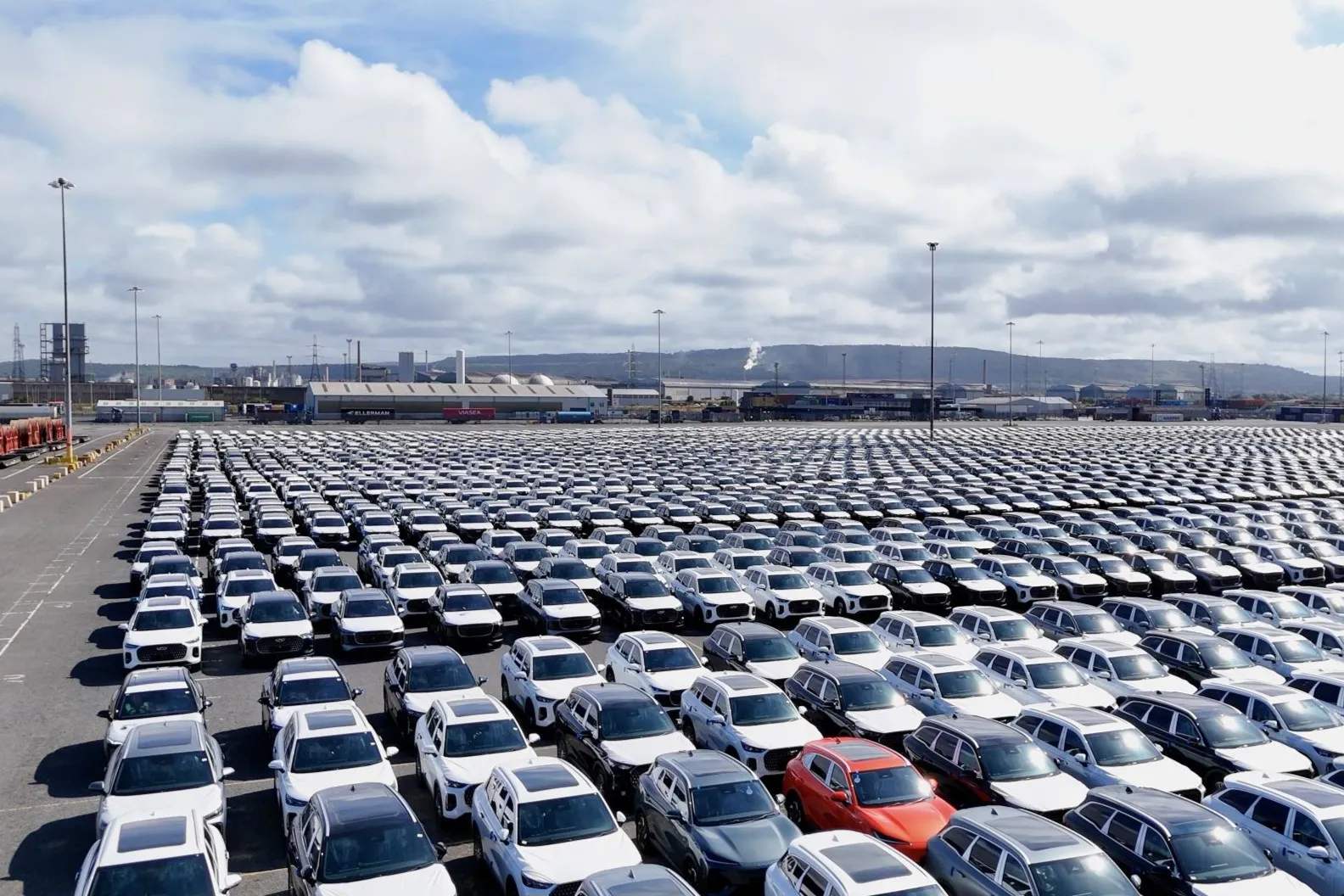
Electric vehicles and plug-in hybrids manufactured in China are increasingly becoming export hits for the People’s Republic: In October alone, 606,000 vehicles with plug-ins were exported from the country — a 140 percent increase. In contrast, domestic sales in China declined by 8.6 percent.
Chery vehicles at a British port.
Image: PD Ports
The latest wholesale figures from China’s Automobile Industry Association show once again the booming demand for so-called New Energy Vehicles (NEVs) in China. This is China’s umbrella term for battery-electric vehicles, plug-in hybrids, and range extenders — in other words, vehicles equipped with batteries and the ability to be charged externally.
Sales of these NEVs continued to rise significantly, increasing by 13.1% compared to October 2025 to reach 1.94 million units. This marks a new record for a single month. This figure includes both domestic sales, which totaled 1.334 million units, and exports: 606,000 vehicles with charging ports were shipped abroad.
Almost a third of NEVs leave the country
The 606,000 NEVs exported represents a truly impressive figure: growth compared to the previous month was 140 percent, also setting a new record. Even compared to the 571,000 units exported in September 2026, there was a 6.1 percent increase. More importantly, 31.2 percent of all NEVs exported last month were of this type.
Separately, CAAM’s figures can be further broken down into BEVs and PHEVs: of the total 1.94 million NEVs produced in China, 1.353 million were battery-electric, and 587,000 were plug-in hybrids (with CAAM including range extenders in this category).
For this as well, the foreign market share can be cited: BEV exports amounted to 374,000 units in October – a rise of around 130 percent compared to the same period last year. PHEV exports reached 233,000 units, representing an increase of about 160 percent.
Strong export performance faces political opposition
Given the strong export performance of Chinese manufacturers in BEV and PHEV sectors, a political debate has long been underway in Europe to reduce imports from that country. The EU Commission is reportedly set to introduce a “Made in EU” rule that would allow restrictions on electric vehicle incentive programs to vehicles manufactured within the EU. Additionally, the EU plans to limit the import of Chinese hybrid and plug-in hybrid vehicles to 350,000 units per year starting December 1, 2026. This new regulation is intended to cut imports of such vehicles from manufacturers like BYD, Chery, or MG Motor by more than half. Meanwhile, imports are allowed to increase by up to six percent per year.
But back to the sales figures from CAAM. It is also interesting to note that in October only 1.076 million vehicles that do not meet the NEV definition were sold — namely cars with internal combustion engines, whether they are mild or full hybrids or pure gasoline or diesel engines. Combined with the 1.94 million NEVs, the total sales amounted to 3.016 million vehicles. In October, NEVs reached a new record share of 64.3 percent of total vehicle sales, up from 61.6 percent in September. This marked the fourth consecutive month that plug-in vehicles accounted for over 60 percent of sales.
Incidentally, the CAAM data does not refer exclusively to sales figures of Chinese manufacturers; rather, these wholesale figures always pertain to vehicles produced in China. In other words, electric vehicles produced by Tesla at its Gigafactory in Shanghai are also included. Moreover, CAAM does not publish individual figures for each manufacturer — instead, they report their own sales figures, such as BYD, which for the first time in October sold over 300,000 all-electric vehicles.