
Omoda 4 SHS-H Test: 700 km in China behind the wheel of the hybrid SUV!
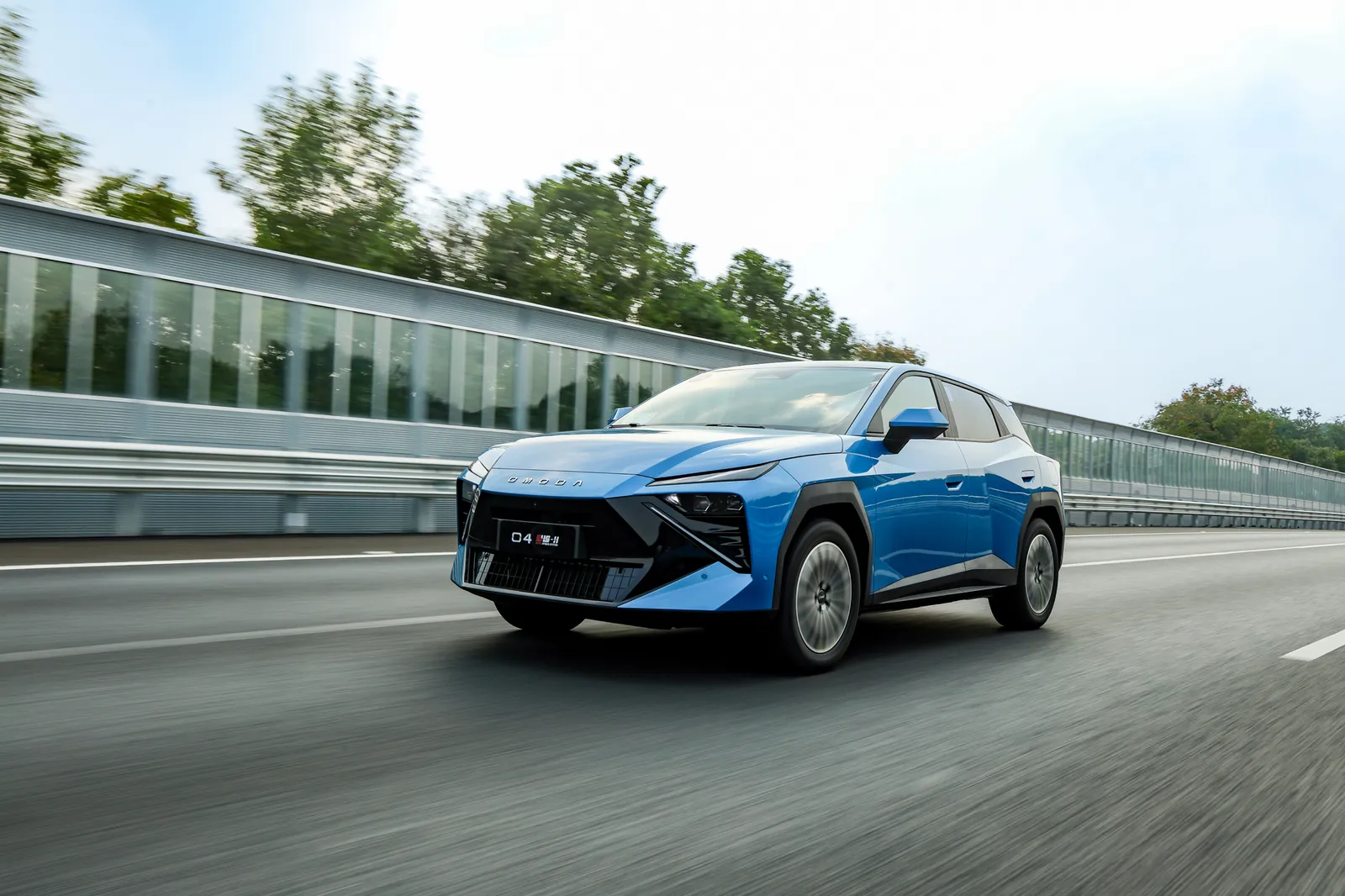
We got behind the wheel of the new Omoda 4 SHS-H ahead of its official release! This was during a nearly 700 km road trip in China. Invited by Chery as part of a very select group of French journalists, we tested this compact crossover on various routes, including urban traffic, long stretches of highway, and mountain roads. It provided an opportunity to evaluate its 224 hp hybrid engine, as well as to appreciate its efficiency and the optimization of its SHS system. It was our first encounter with a model expected to arrive in France in early 2027.
Following the Jaecoo 5 and 7, as well as the Omoda 7 and 9, the Chinese manufacturer is preparing the launch of a new SUV. Its name: Omoda 4 SHS-H. For this first test drive, we headed to Wuhu, the group’s historic base, before setting off for Hangzhou. It was a journey of about 700 kilometers, taken with a small group of French colleagues. This occasion is special, as Chery opens its domestic market to us even before the vehicle goes on sale in Europe. The group has been the world’s top automobile exporter for 23 consecutive years. Its newer brands, Omoda and Jaecoo, have already sold 1.4 million vehicles in just three and a half years. This particularly rapid growth reflects the manufacturer’s international ambitions. With the Omoda 4, the brand now aims to attract a broader customer base in a highly competitive segment. But what is this new hybrid SUV really like on the road?
The Omoda 4 in terms of style: a hybrid SUV inspired by “Mecha”
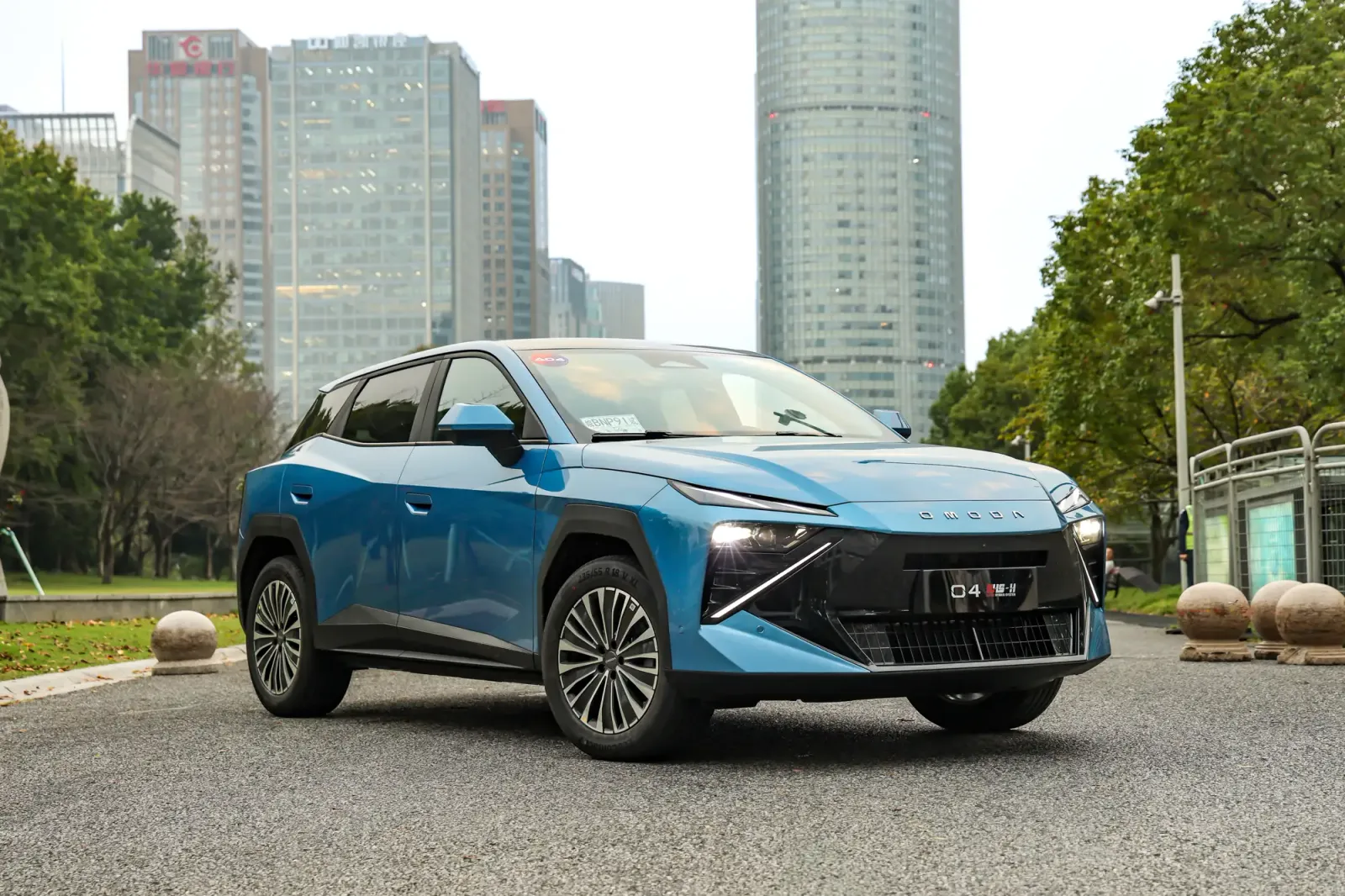
The Omoda 4 clearly doesn’t intend to go unnoticed. With its angular lines, sharp appearance, and notably prominent rear shoulders, this new Chinese crossover exudes a strong sense of personality. This stylistic direction was pursued by its designer, Mingzhi Li, who explained that he drew inspiration from the “Mecha” genre. This refers to those humanoid robots from science fiction, particularly popularized by manga and cinema. The goal is to reach a younger audience that is connected and interested in pop culture.
Also read
Omoda X: the Chinese SUV aiming to compete in the off-road segment
It indeed resembles a blend of science fiction and a sports car. The distinctive lighting design plays a key role in this identity, featuring two upper LED elements and a more subtle lower lighting setup. The brand intends to apply this design to its future models as a true signature element. The Vigorous Blue color of our unit further emphasizes its connection to water and natural elements.
+2
We have to admit it: this looks like a 2.0 version of the MG4. After all, its designer has worked at MG among other companies! Its dimensions are 4.42 meters in length, 1.87 meters in width, and 1.57 meters in height. The wheelbase measures 2.63 meters, with 18-inch wheels. These proportions place the Omoda 4 at the heart of the C-SUV segment, competing with models like the Toyota C-HR, Volkswagen T-Roc, and Renault Symbioz. Its particularly low profile and sloping roof line give it a crossover appearance rather than that of a traditional SUV.
The project required several upgrades to the technical platform to maintain roof coverage despite its compact design. The designer confirms that engineers had to adjust certain structural elements and the mechanical setup. This collaboration is worth highlighting, as technical constraints can sometimes limit the ambitions of design teams.
+2
On board: everything needed, with a touch of flair
While the exterior is particularly expressive, the interior adopts a much more conventional design. The dashboard features horizontal lines and a relatively clean layout. However, a few details add a touch of originality, starting with the red toggle switch that hides the start button—a small touch reminiscent of certain Italian supercars! The overall quality is very satisfactory, with several padded surfaces and solid construction.
The front seats also provide good support without compromising comfort on long trips. The contrasting upholstery in our test model is particularly pleasing, though its availability in French versions remains to be confirmed. In the back, the sloping shape doesn’t significantly affect passenger space. Two adults have adequate leg room and sufficient headroom. The trunk capacity is 402 liters, thanks to a seat that folds in two sections.
+2
A cohesive design for this segment, although some competitors offer more. It should be noted that the 12 V battery is currently located roughly under the floor (at least that’s the hope). The user interface relies mainly on two screens: an 8.9-inch digital instrument panel and a 13.2-inch central display. The interface is smooth and quite readable, with several shortcuts to easily access the main functions.
A special mention goes to the Chinese app Amap, which replaces Google Maps on our CarPlay! The large display allows users to access various practical features such as countdown timers for traffic lights, rest areas, and other detailed information. A few physical controls remain on the center console, but most adjustments are done through the touchscreen. This setup requires some time to get used to. We also wished for more controls on the steering wheel, which remains quite minimal here with just two buttons and two dials.
+2
Performance and driving: the 224 hp “Super Hybrid” system remains increasingly efficient
Under the hood, the Omoda 4 SHS-H uses the same hybrid powertrain found in the Jaecoo 5. This familiar setup combines a 1.5-liter turbocharged gasoline four-cylinder engine producing 143 hp with an electric motor delivering 204 hp. The total power output reaches 224 hp, with a combined torque of 295 Nm. A 1.83 kWh battery stores electrical energy without the need for external charging. The transmission features a fixed gear ratio, with electronic control of the various power sources.
On paper, the technical specifications are quite promising. But it is especially in real use that this engine system reveals its strengths. In urban areas, the “O4” naturally favors electric propulsion, offering smooth starts and particularly smooth driving. The involvement of the internal combustion engine remains subtle, whether it is charging the battery or directly contributing to propulsion. The switch between electric and internal combustion modes remains just as seamless, often imperceptible.
+2
On the highway, the Chinese crossover maintains good composure. Its acceleration is sufficiently brisk, and the sound insulation ensures comfortable driving conditions. We were also able to appreciate the chassis performance on some mountain roads. Far from being sporty, the Omoda 4 SHS-H still navigates turns with confidence, without excessive body movement.
The suspension offers a fairly firm setting that prioritizes stability over absorbing road irregularities. The steering and braking are gentle and easy to handle. Driving aids further contribute to its ease of use, with an adaptive cruise control and lane-keeping system that are well-calibrated. However, a few details could use refinement, particularly the cruise control adjustment, which is done in 5 km/h increments—a less practical choice for making precise speed adjustments.
+2
Fuel consumption and range: efficiency meets expectations
It is likely in this area that the Omoda 4 SHS-H impressed us the most. After traveling nearly 700 km between Wuhu and Hangzhou, primarily on expressways and highways, the fuel consumption recorded was 5.4 liters per 100 km. This is an impressive result considering its size and available performance. The SHS powertrain particularly demonstrates highly efficient energy management.
The electric motor handles most of the driving in low-load conditions, especially in urban areas and during acceleration. The four-cylinder engine then steps in relatively quietly, depending on power requirements and battery charge level. Together, they give the impression of driving an electric vehicle without the constraints associated with charging. In fact, we were able to experience driving in EV mode at speeds of nearly 120 km/h!
+2
In urban driving conditions, the fuel consumption even reaches 4.4 liters per 100 kilometers. The energy recovery can be adjusted across three levels to tailor the car’s behavior to the driver’s preferences. It’s a shame, however, that these settings require navigating through the menus on the center screen; levers on the steering wheel would have been more convenient. Otherwise, the Omoda 4 SHS-H comes equipped with a 51-liter fuel tank, which provides ample range for long trips without frequent refueling.
Also read
Omoda 7 PHEV review: an over-equipped rechargeable hybrid SUV at an unbeatable price
The temporarily announced WLTP combined fuel consumption is 5.2 liters per 100 kilometers, a figure close to our result from this initial test. It’s an encouraging performance that naturally needs to be confirmed through extended testing on our French roads and highways as soon as possible. In any case, we can confirm now that it offers a total range of 1,000 kilometers under normal driving conditions, with at least 700 kilometers in Sport mode with the foot on the pedal.
+2
Omoda 4 SHS-H: under 28,000€?
With the Omoda 4 SHS-H, Chery continues its push into the European market with a quite attractive offering. This Chinese crossover combines a pleasant and efficient hybrid powertrain with generous standard equipment, a well-crafted design, and a style that is impossible to ignore. There are still some concerns, particularly regarding suspension comfort and the primarily tactile user interface. Overall, however, it appears cohesive, especially considering its expected price point. Our initial estimates suggest a price range of 28,000 to 29,000 euros in France. Why not start at 27,490€? That’s purely speculative!
A price point that would make the Omoda 4 significantly more attractive than some Japanese and European competitors... Along with a particularly comprehensive standard equipment list, as the group is known for. Its arrival in French dealerships is expected in the first quarter of 2027. This could pose a challenge to the current leaders in the C-SUV hybrid segment, provided Chery maintains its ambitions in terms of pricing and after-sales service. But with the group’s responsiveness, its efforts in Europe, and even logistics warehouses in France, there’s little concern regarding after-sales support. What are your thoughts?