
E-Camping-Report: German campsites lag behind in charging infrastructure
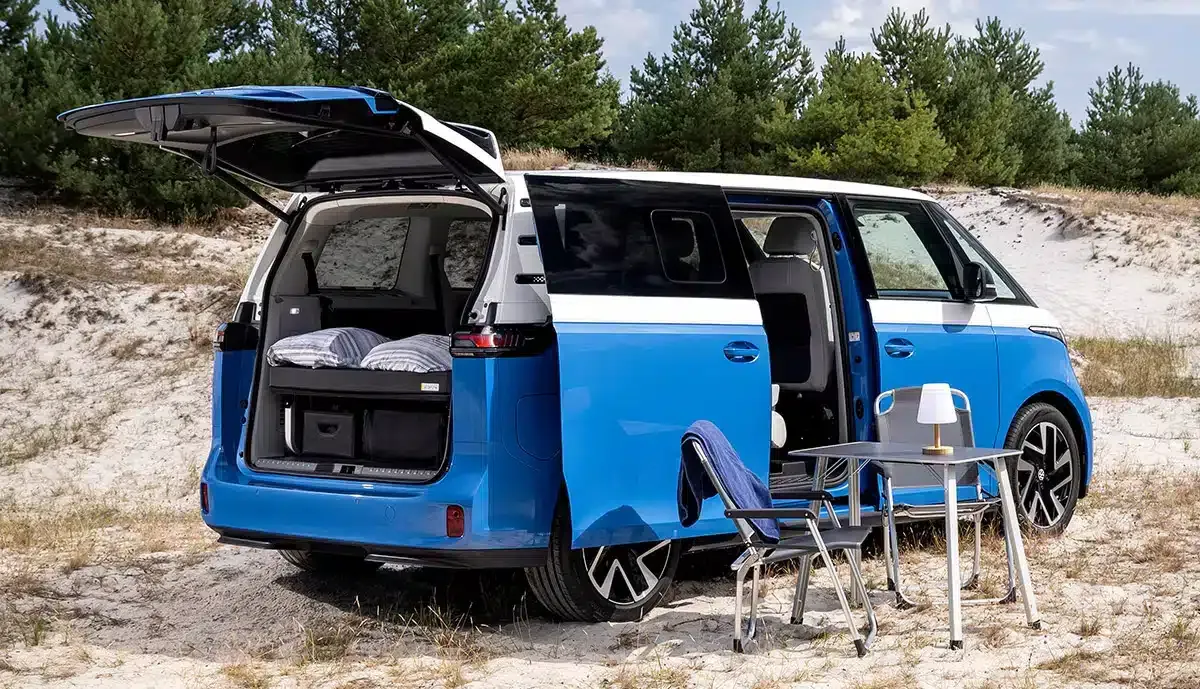
Image: VW (illustrative)
The first “E-Camping Report” by “E-Camping-Lotsen” from Bonn examines 4808 campsites and their websites in Germany, the Netherlands, Austria, and Switzerland. Official statistics, studies, and practical tests were compiled for this purpose. The results show significant differences between the development of electric mobility in cars and the equipment available at campsites.
While 44.7 million camping nights were recorded in Germany in 2025, by September 2026, 34.5 percent of newly registered cars were pure electric vehicles. Germany lags behind its neighboring countries when it comes to charging infrastructure: Only 15.4 percent of German campsites inspected by the camping guide ACSI have a charging point. In the Netherlands, that figure is 36.1 percent, and in Austria it is 24.8 percent.
At the same time, 84 percent of the 2,033 German camping site websites surveyed do not indicate whether guests can charge their electric vehicles. Among those that address the issue, one in four explicitly prohibits charging. Charging directly at the campsite is still rare: of the 435 camping sites offering charging facilities in Germany, Austria, Switzerland, and the Netherlands, only six specify a charging point for this purpose.
RVs are particularly affected by these restrictions: tests conducted by promobil and ADAC showed that real driving ranges with trailers ranged from 150 to 220 kilometers. In the ADAC test, the RV had to be detached at each charging stop.
Many operators cite the limited capacity of their power grids as an obstacle to expanding charging infrastructure. 45 percent of the surveyed campsites without charging points believe their grids are not adequately designed. Only 6 percent have load management systems, while 21 percent are unaware of their grid connection capacity.
“The electric wave isn’t arriving at campsites in RVs but in cars,” says Roman Klesper, founder of E-Camping-Lotsen. “Many campsites want to take action but don’t know where to start. The first step costs almost nothing: knowing one’s own grid connection and honestly telling guests where and how they can charge.”
The report outlines seven hypotheses for 2027 and seven action steps for campsite operators. The first three measures involve low costs: knowing one’s own power connection, publishing information on charging options on the website and booking platforms, and establishing clear, technically verified rules for site outlets.
Have you found any errors? Please let us know
by email
about them. Thank you!
Also interesting
About the author
Thomas Langenbucher is an expert in electromobility with professional experience in the automotive industry and finance sector. Since 2011, he has been covering electric vehicles, sustainable technologies, and mobility solutions on ecomento.de. Learn more.
Reader interactions