
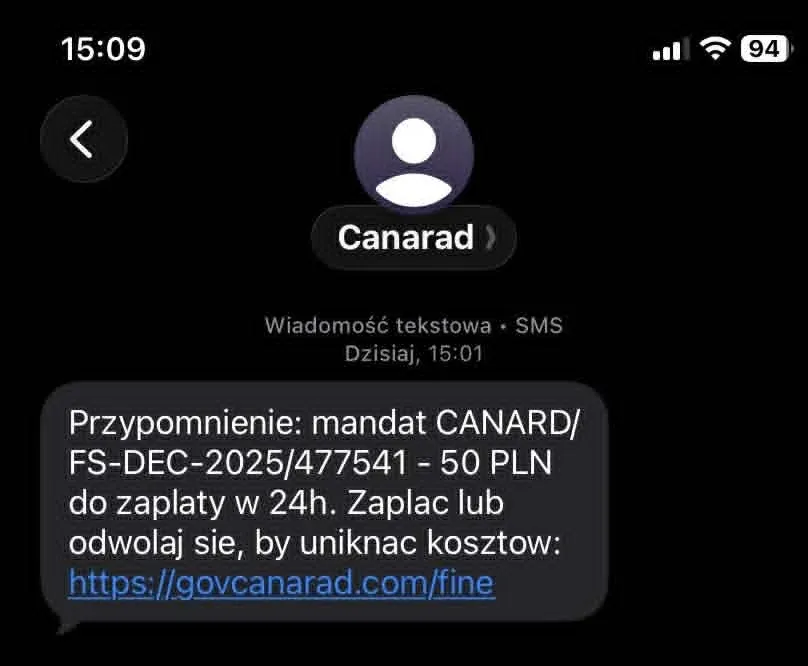
Did you receive an SMS about a fine? Don’t pay. Scammers impersonate not only GITD.
In the article:
- CANARD does not send SMS messages with links to pay fines.
- Similar scams target e-TOLL, mObywatel, courier services, and banks.
- Suspicious SMS messages can be sent free of charge to CERT Polska at number 8080.
SMS Scam
The scheme is simple. An SMS arrives informing you of a traffic violation and a small fine. There is also a warning that there are a few hours or 24 hours left to pay, after which additional costs will apply. All you need to do is click the link and pay.
The problem is that the message does not come from the Main Road Transport Inspection Authority.
The Automatic Road Traffic Monitoring Center (CANARD) warns that scammers impersonate the agency not only in SMS and emails but also in traditional mail. In October 2026, for example, a campaign was launched exploiting the planned implementation of partial speed monitoring on the sections of highway A2 under repair. Random individuals received messages about alleged violations along with a payment link.
CANARD and GITD do not send payment links via SMS!
The rule here is very simple: GITD does not send SMS links to pay a fine or check an ongoing case.
The first notice sent after a traffic violation is detected by a speed camera or fixed speed sensor is not yet a fine. CANARD first sends information about the violation along with the forms needed to determine who was driving the car. Only later can a credit-based fine be issued, which is linked to an individual bank account.
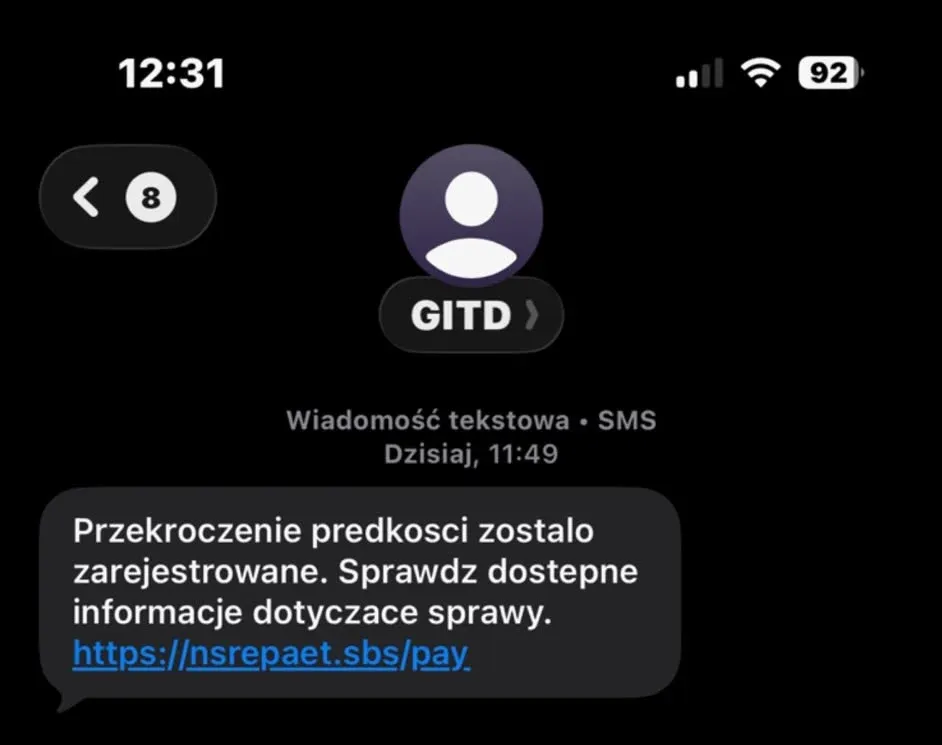
Official correspondence takes place by mail or through eBOK CANARD’s electronic customer service. Therefore, an SMS with a message like “fine of 50 PLN, pay within 24 hours” along with a linked page should immediately raise suspicions.
Highways and e-TOLL are another trap
False messages about unpaid road tolls work in a very similar way. The scammer informs the recipient of an outstanding balance for using the highway and threatens a penalty if a few zlotys are not paid immediately.
The National Tax Administration emphasizes that the e-TOLL system does not send SMS or emails containing payment links. However, fake websites can appear almost identical to the official site and use the e-TOLL or Ministry of Finance logos. The goal is to steal card or online banking details.
mObywatel can also appear as the sender
The name displayed in an SMS is not a guarantee of safety. Criminals also impersonate mObywatel by sending messages about supposed pending messages, fines, or the need to log in to the service.
The link then leads to a website that mimics the government site and is used to steal data. If the message is related to mObywatel, it is safest to simply open the official app directly rather than using the link sent via SMS.
A 2 zł surcharge on a package can actually cost much more
Scammers also take advantage of situations that almost everyone encounters. CERT Polska warned in early November 2026 about campaigns pretending to be from Pocztą Polską and InPost.
The message may mention a missing address, failed delivery, or a small customs fee. The amount is deliberately small so that the recipient doesn’t hesitate too long before paying. However, clicking leads to a fake form requesting personal details and full card information, including the CVV code. It’s best to check the package status directly in the carrier’s app or on the website you entered yourself.
The bank “will lock your account” if you don’t click immediately
Another common theme is the need to update information, verify identity, or activate new banking security measures. In October, CERT Polska warned, among other things, about messages pretending to be from PKO Bank Polski.
The mechanism is the same: time pressure, threats of restricting account access, and a link leading to a fake online banking site. The login and password entered there end up directly in the hands of criminals.
What to do with a suspicious SMS?
The most important rule is: do not use the link sent in an unexpected message. You need to verify the matter independently—through the official app, a manually entered website, or the customer service hotline of the institution.
Suspicious SMS messages can be reported free of charge to the number 8080, operated by CERT Polska 24/7. Fake websites and emails can also be reported through the incydent.cert.pl service or the “Safe Online” feature in the mObywatel app.
If bank details have already been provided or money has disappeared from the account, it is necessary to contact the bank as soon as possible and report the incident to the police and CERT Polska.
Piotr Sobczyk