
Charging prices in November 2026. Orlen Charge and GreenWay offer discounts, while Tesla raises rates for the third month in a row
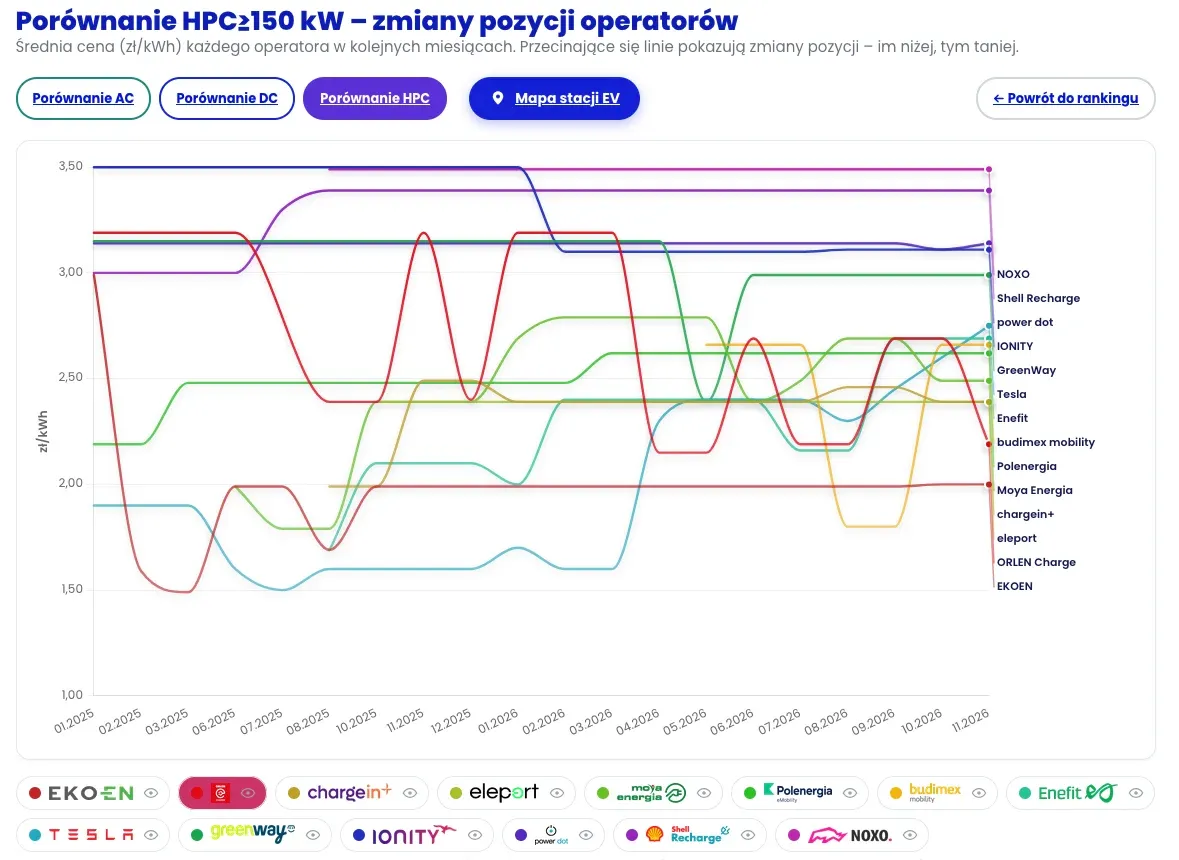
The November Charging Price Ranking, prepared monthly by the EV Klub Polska Foundation and the elektromobilni.pl portal, covers rates from 18 public station operators. Following October, when most networks returned to regular pricing, promotions once again became a tool to compete for customers. Orlen Charge reduced prices until November 16, while GreenWay Polska added bonus kilowatt-hours for subscribers until the end of the month. Meanwhile, price disparities are increasing. Depending on the operator, location, charger capacity, time of day, and subscription chosen, drivers pay between about 1 PLN and 5.49 PLN/kWh for charging. Tesla raised prices at its Superchargers for the third time in a row, and dynamic rates during peak hours can exceed those of networks considered the most expensive.
Article
How much does charging cost with Orlen Charge’s promotion and when does it end
Who benefits from the GreenWay subscription with bonus kWh
How prices at Tesla Superchargers have changed
Why the same charging session can cost several times more under dynamic rates
Which providers are cheapest for AC, DC, and HPC charging
What AFIR and 2027 pricing plans mean for charging costs
Orlen Charge – promotion until November 16
Until November 16, 2026, Orlen Charge charges 2.19 PLN/kWh for DC charging, which is 50 groszy less than the regular rate (2.69 PLN/kWh). AC charging costs 1.59 PLN/kWh instead of the standard 1.95 PLN/kWh. The promotional rate also applies to HPC stations with a capacity of 150 kW. When charging 50 kWh at a fast charger, the discount amounts to 25 PLN saved per session.
The promotion pushed the operator to the top of the rankings. Orlen Charge currently has the lowest standard AC rate in the list, shares first place with ChargeIn in DC charging at 150 kW, and in the HPC segment it is only surpassed by Ekoen, which is cheaper only at selected locations and times. After November 16, prices will return to regular levels.
GreenWay – bonus kilowatt-hours in subscriptions
GreenWay Polska has opted for a different form of promotion. From October 1 to November 30, 2026, customers with Energia PLUS and Energia MAX subscriptions receive an additional 10 or 25 kWh of energy for charging, without any change to their monthly fee. The pricing remains unchanged. Under the Energia STANDARD plan, which has no subscription fee, AC charging costs 1.89 PLN/kWh, while DC charging costs 2.99 PLN/kWh. With the Energia PLUS package (29.99 PLN per month), the rates are 1.75 and 2.40 PLN/kWh, respectively, and with Energia MAX (79.99 PLN per month), they are 1.60 and 2.10 PLN/kWh.
A simple calculation shows who would benefit from this subscription. Without considering the bonus, the PLUS package pays for itself after approximately 51 kWh of DC charging per month, while the MAX package pays for itself after around 90 kWh. The free kilowatt-hours lower this threshold, so November is a good time to try out the subscription.
Tesla Supercharger – third consecutive increase
In November, Tesla raised prices again at its Superchargers in Poland, for both its own vehicle owners and drivers of other brands. The median rate during peak hours increased from 2.60 to 2.75 zł/kWh. The average peak price for Tesla users rose by 5.3% to around 1.97 zł/kWh, while it increased by 5% for other drivers to around 2.77 zł/kWh.
For cars of other brands, price increases were seen in 16 out of 19 locations compared. The biggest rise occurred at the Supercharger at Chopin Airport in Warsaw, where the peak rate increased by 30 groszy to 3.60 PLN/kWh, the highest price across the entire network. Prices also rose by the same amount in Stryków, to 2.80 PLN/kWh. An exception was Czeladź, where rates for other brands dropped by 30 groszy during peak hours and by 40 groszy outside of them. Off-peak rates remained much more stable: their average prices increased by 3.8% for Teslas and by 1.6% for other cars. Drivers of other brands who purchase a Tesla subscription and charge outside peak hours can save nearly 50 PLN per 50 kWh, so the cost of the subscription may be recouped after just one charging session.
Dynamic rates – from 1.39 to 5.49 PLN/kWh
In dynamic tariffs, the charging time determines the price. Ekoen still offers the cheapest ultra-fast charging in Poland, at 1.39 PLN/kWh in selected locations, with an average of 2.00 PLN/kWh. However, during peak demand hours in the national electricity system, the rate at some of this provider’s stations rises to 5.49 PLN/kWh, up from 3.94 PLN/kWh in October. This is the highest price in the comparison.
Tauron’s dynamic tariff is also getting more expensive. The average price at DC stations has increased from 2.60 to 2.82 PLN/kWh, with rates ranging from 1.89 to 3.33 PLN/kWh depending on location and time of day. At this provider’s AC chargers, drivers pay between 1.69 and 3.67 PLN/kWh, with an average of 2.15 PLN/kWh.
The difference is most evident through an example. Recharging 50 kWh at a rate of 1.39 zł/kWh costs just under 70 zł, while at 5.49 zł/kWh it costs over 274 zł. For a car that uses 18 kWh per 100 km, this means travel costs ranging from about 25 zł to nearly 99 zł per 100 km. Those who charge during off-peak hours pay the least in the market. Those who charge during peak hours may end up paying more than at networks considered the most expensive.
November’s Top Picks – Cheapest Providers for AC, DC, and HPC
In AC slow charging, Orlen Charge has the lowest standard rate at 1.59 zł/kWh, followed by ChargeEuropa at 1.75 zł/kWh, GreenWay Polska at 1.89 zł/kWh without a subscription and 1.60 zł/kWh with the Energia MAX package, ChargeIn at 1.89 zł/kWh, Polenergia eMobility at 1.92 zł/kWh, and Lidlem at 1.93 zł/kWh. Moya energia offers the lowest minimum rate for AC charging at 1.29 zł/kWh in selected locations, with Powerdot close behind at 1.32 zł/kWh.
In DC fast charging up to 150 kW, ChargeIn and Orlen Charge lead tied at 2.19 zł/kWh each, ahead of ChargeEuropa (2.30 zł/kWh), Enefit (2.38 zł/kWh), and Moya energia and Eleport (both at 2.39 zł/kWh). For ultra-fast HPC charging, the cheapest rates are available at Ekoen stations (average 2.00 zł/kWh), followed by Orlen Charge (2.19 zł/kWh), ChargeIn and Eleport (both at 2.39 zł/kWh), and Moya energia (2.49 zł/kWh). Customers of Shell Recharge (3.39–3.59 zł/kWh) and Noxo (3.49 zł/kWh) pay the most in this segment.
AFIR and tariffs for 2027.
With such variable rates, it is crucial to have price information available before charging. This is required by the EU’s AFIR (2023/1804) regulation, which came into effect on April 13, 2024. Operators must clearly display the ad hoc charging price along with all its components, and new charging stations must allow payment without registration or entering into a contract. Starting from January 1, 2027, card payment will also be required for some older chargers with a capacity of 50 kW or more. In practice, the current rate should be visible in the app, while roaming, and at the charging station itself.
Energy costs will also affect charging prices in the coming months. The average energy price in tariffs for 2026 was 495.16 PLN/MWh net, with tariffs for 2027 usually approved by URE in December. The URE president has already announced the capacity charge rates for 2027: they remain unchanged for households, while businesses will pay up to 12% less. This is significant for operators because for businesses, this charge depends on energy consumption during peak hours.
The network where these pricing structures apply is growing rapidly. By the end of October 2026, there were 14,229 public charging points in Poland, of which 52% were fast DC chargers, and the fleet of fully electric vehicles numbered 171,616. Winter and the new energy rates in 2027 will show whether promotions and dynamic tariffs result in actual savings for drivers.
Interactive Charging Price Ranking: electromobilni.pl/ranking-cen-ladowania-w-polsce.
Maciej Gis