
BYD Flash Charging: First Station Opened in Austria
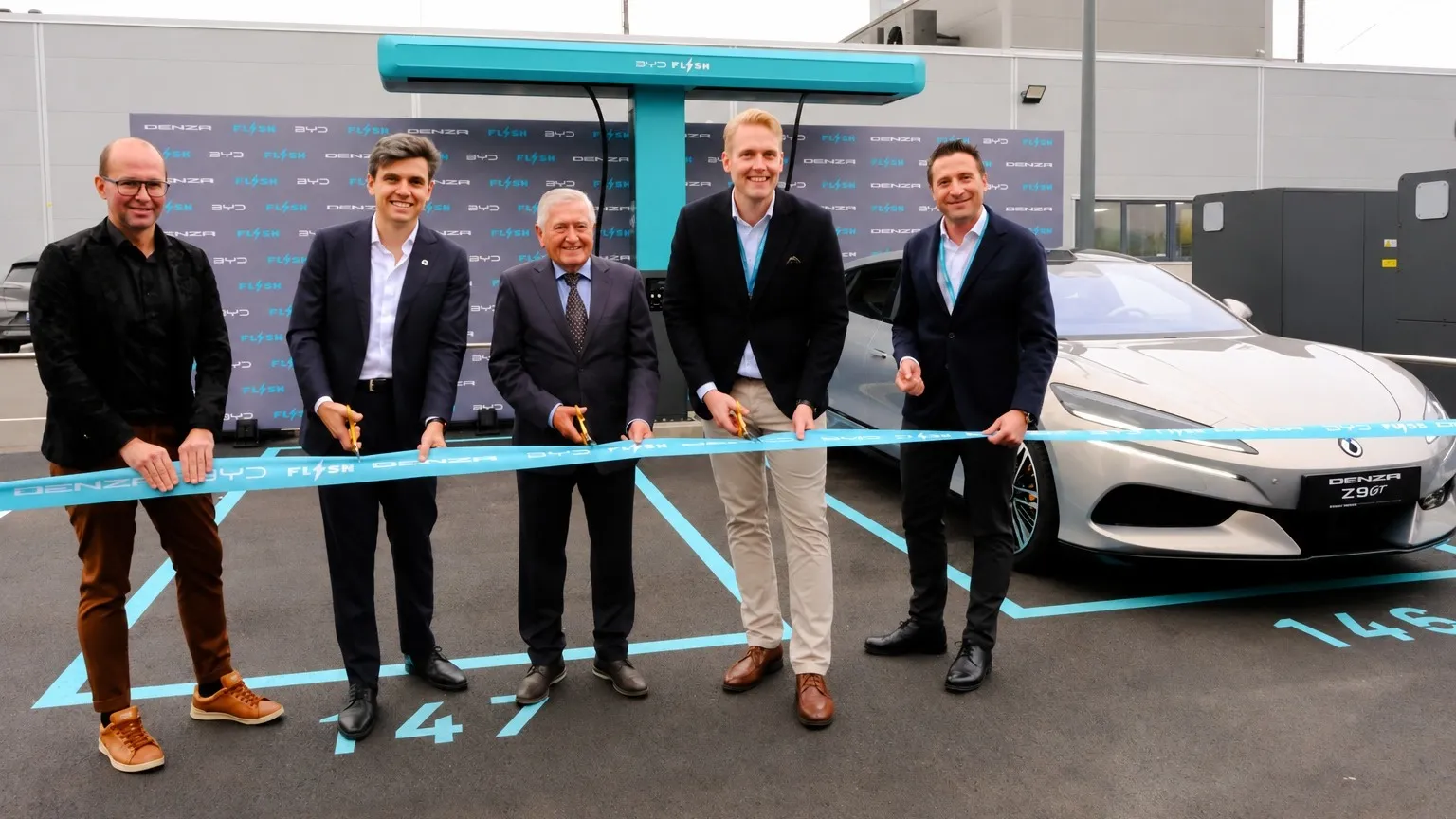

BYD has opened Austria’s first Flash Charging station at the Göndle Autohaus in St. Pölten, which combines megawatt-level charging technology with a 400-kWh battery storage system. The network in Austria is expected to expand to up to 100 locations by the end of 2027.
Advertisement
In March 2026, BYD introduced Flash Charging, a fast-charging technology with a capacity of up to 1,500 kW tailored to Chinese market standards, along with its second-generation Blade batteries. At that time, the manufacturer claimed charging times of five minutes to reach 10–70 percent charge and nine minutes to reach 10–97 percent charge. BYD did not provide specific figures or timelines for markets outside China at that stage. Now, the first station of this kind has been installed in Austria.
First location at Autohaus Göndle
BYD opened the station on November 11, 2026, at the Göndle Autohaus in St. Pölten. According to BYD’s dealer list, the autohaus is located at Engelbert-Laimer-Straße 5 and has been a partner of the brand for over a year, per their own statements. BYD now has 60 dealer partners in Austria. Managing director Michael Hickelsberger described the opening as a significant milestone for the autohaus.
BYD does not specify in the announcement how many charging stations the location has or what charging capacity the columns there offer, referring generally to megawatt-level charging power. The photo from the opening shows a T-shaped charging column with two hanging cables, along with a DENZA Z9GT. The shooting brake from the premium brand DENZA was introduced in spring as the first vehicle to feature Flash Charging for Europe. Patrick Lang, Country Manager Austria at BYD Automotive Austria, describes DENZA as a pioneer brand for this new technology. According to him, BYD is the first manufacturer in Europe to offer megawatt-level charging technology. The goal is to make charging an electric vehicle as simple and fast as refueling a gasoline vehicle.
Advertisement
Battery storage with 400 kWh
The station is equipped with an integrated battery storage system with a capacity of 400 kWh. It is designed to enable high charging speeds without the need for a correspondingly strong power connection or an upgrade to existing transformers. According to BYD, this makes locations with limited connection capacities of 100 kW or higher suitable for fast charging. With a 100 kW connection, it would take approximately four hours to fully charge an empty battery, assuming no losses.

Up to 100 locations by the end of 2027
Following a pilot phase in 2026, BYD plans to gradually expand the network in Austria, aiming to reach up to 100 locations by the end of 2027. In addition to selected dealers, collaborations with gas station operators, charge point operators (CPOs), and energy suppliers are set to contribute to this expansion. According to BYD, discussions are currently underway for 40 to 50 potential locations across Austria. The network is intended to be established along major traffic routes and at strategically important mobility locations. Wolfgang Eisl, who is in charge of network strategy and development at BYD Automotive Austria, says the company is already working on additional locations and partnerships.
For all of Europe, BYD set a goal of 3,000 fast-charging stations by the end of 2027 when it unveiled the Atto 8 in Paris in October. The seven-seater vehicle was said at the time to be BYD’s first model in Europe equipped with the second-generation Blade battery, with it expected to reach dealers in the first quarter of 2027.
Open to other brands
The stations use the CCS2 charging standard. This allows electric vehicles from other manufacturers to charge there as well, provided they meet the technical requirements. Collaborations with charging card providers and billing based on kilowatt-hours charged are also planned. The announcement does not include any information on prices.
According to BYD, the offering is aimed at frequent drivers, field workers, and business vehicle users, among others. Flash Charging and the Blade Battery 2.0 are key components of the growth strategy for 2027, according to Danijel Dzihic, CEO of the Austrian BYD importer CCI Car Austria. For frequent drivers and business vehicle users, charging speed, everyday usability, and a reliable service network are crucial.
Would you deliberately head to a Flash Charging station even if your car cannot charge there at megawatt levels?
Advertisement