
Batteries: a sensor detects fire risks in advance

What if a lithium battery could warn of danger even before it catches fire? That’s exactly what a new sensor promises to do, capable of detecting the vapors of electrolyte escaping from the cell when something goes wrong. It does this before flames appear, by identifying extremely low concentrations—just 10.42 micrograms per cubic centimeter in enclosed environment tests.
The technology relies on continuously measuring electrical capacity right above the cell. Published in the Journal of Energy Storage, the study documents tests on a single cell, a simulated battery pack, and even inside a car cabin. However, note that we are still in the experimental demonstration phase. It’s not a device ready to be installed in commercial electric vehicles yet.
What the capacitance sensor detects
When a lithium-ion battery becomes overcharged, the liquid electrolyte begins to vaporize before the cell reaches the critical point of thermal runaway, the chain reaction that can lead to fire or explosion. The capacitive sensor detects these vapors by changing its electrical signal in their presence.
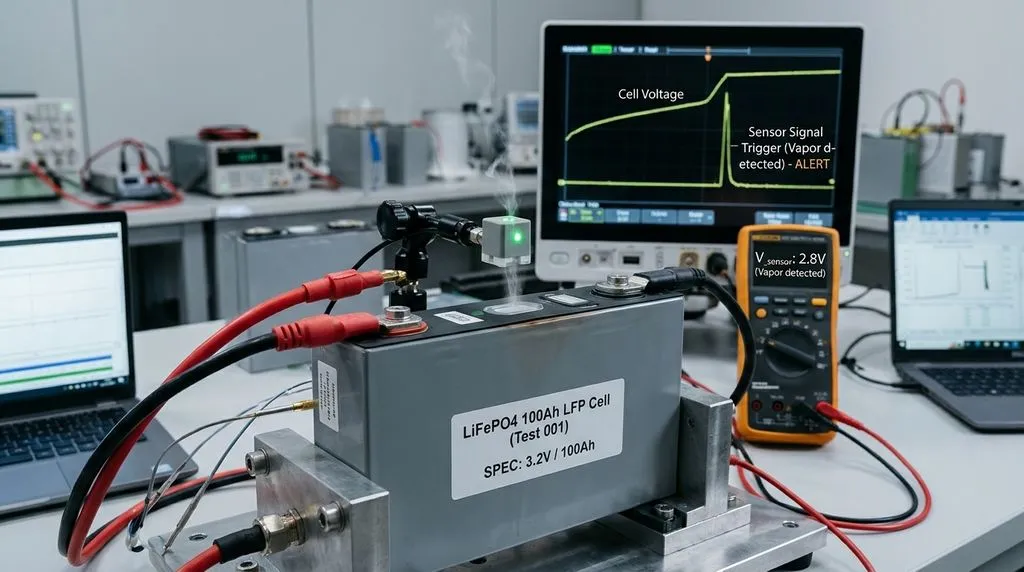
A sensor can detect electrolyte vapors before thermal runaway occurs, but the tests are still in the preliminary stage.
Photo by: Motor1 Italia visual (AI-assisted)
In laboratory tests, the researchers used a 100 Ah LiFePO4 cell, one of the most common chemistries for stationary storage and various electric vehicle models. The sensor’s response came well before the cell’s safety valve opened, the mechanism that activates when internal pressure rises too high.
The authors, however, temper expectations: as stated in the abstract, “the observations are individual events rather than average response times or universal warning times.”
Response times in cell, pack, and battery box tests
In tests on individual cells, the sensor preceded the safety valve opening by significantly varying amounts: 1, 6, 4, and 13 seconds respectively. This variability confirms that the phenomenon depends heavily on the specific conditions of each test rather than following a fixed rule.
In the test conducted on a simulated battery pack, the time interval between the sensor response and the surface temperature peak was 229 to 312 seconds in the two trials. These intervals are much larger than those observed in a single cell, indicating that internal heat propagation takes longer when multiple components are involved.
However, the most relevant test for real-world applications is the one conducted in a chamber: here, the sensor response preceded the visible ignition by 202 seconds, and the surface temperature peak by 218 seconds. For comparison, a 2026 review indicates that internal heat propagation in high-capacity LFP cells can complete in about 78 seconds, a figure that makes these intervals particularly significant.
Read also