
BAIC Foton launches fast-charging ecosystem for electric trucks
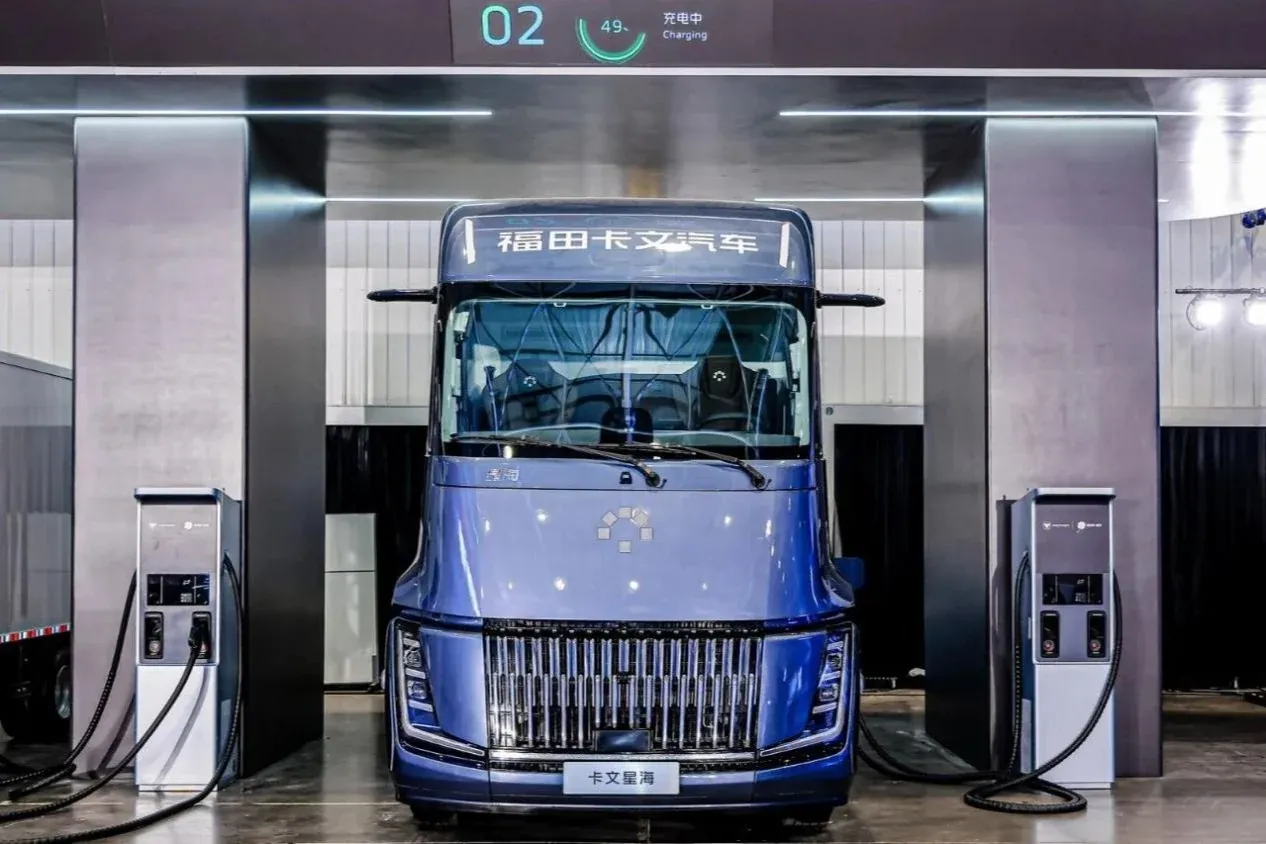
The Chinese commercial vehicle manufacturer BAIC Foton aims to take electric truck fast charging to the next level by introducing lightweight trucks as well as heavy trucks equipped with megawatt-level charging capabilities. The charging network is not intended to be limited to China alone; Europe is also mentioned as a target market.
Image: Foton
BAIC Foton, also known as Beiqi Foton Motor, is making a major push into the electric truck charging business. Together with CATL, Sunwoda, TELD, and Hunan Jingneng, this Chinese commercial vehicle OEM is forming an alliance to build thousands of standardized fast charging stations. As part of this effort, the company aims to install more than 3,000 charging stations overseas by 2027, specifically in the Asia-Pacific region, Latin America, Africa, and Europe. BAIC Foton unveiled this initiative recently at a major corporate event in Beijing.
The foundation of BAIC Foton’s “Supercharging” strategy is a strong ecosystem approach. By coordinating vehicles, charging stations, the power grid, and the cloud, the truck charger is intended to evolve “from a single charging process into a network-integrated, comprehensive energy service,” as the manufacturer puts it. Four core platforms serve as the backbone: ones for connected vehicle data, charging processes, energy interactions between vehicles and the grid, and battery management. This creates a data-driven overall system. BAIC Foton states, “With over 3.5 million connected vehicles, a daily data processing capacity of 3 petabytes, and more than 770,000 connected charging points, the system will provide the necessary data for planning and operating charging networks.”
Light trucks with megawatt-level charging capacity
BAIC Foton also introduced suitable vehicles on this occasion: the manufacturer highlighted the Aumark Zins, a light truck with megawatt-level charging capacity. According to the company, this model is built on a dedicated electric platform and boasts a maximum charging power of 1.05 MW. “Thanks to an 8C charging rate and this top-tier performance, the battery can be charged from 20% to 80% in just eight minutes,” BAIC Foton stated in the presentation.
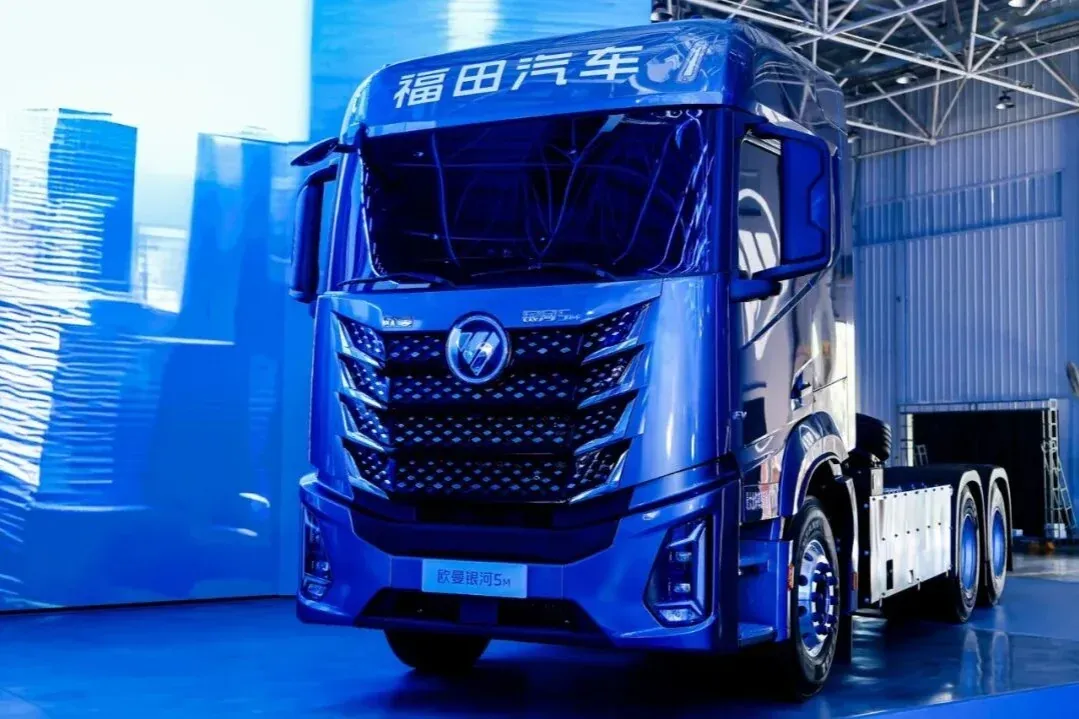
Image: Foton
- 1/4
- 2/4
- 3/4
- 4/4
Among the company’s heavy electric trucks, two models are set to be equipped with megawatt-level charging ports first: the Auman Galaxus and the Cavan Beacon. However, the company does not specify the maximum charging power or charging time for this high-speed charging capability. It only mentions that approximately 100 kilometers of range can be restored within six minutes, and that these vehicles are suitable for the express logistics sector, refrigerated transport, port operations, and bulk cargo logistics.
The Cavan Beacon platform is not new. Foton already introduced a variant of this platform at the IAA Transportation. It is a platform for heavy trucks with low-emission or zero-emission powertrains. Foton plans to develop a 40-ton truck powered by batteries and hydrogen based on this platform, but this is just a brief aside.
Charging station to integrate local energy generation
Regarding the charging solution for the upcoming truck fast-charging ecosystem, BAIC Foton presented in Beijing a charging station with a 10-kV AC input and a 1,000-V DC output that can be connected to PV systems and stationary batteries. This infrastructure can maximize its benefits if the vehicles being charged support dual-gun charging, allowing them to be charged simultaneously via two charging cables.
At the ecosystem level, BAIC Foton also announces the launch of a “Supercharger” industry alliance, to which renowned partners such as battery manufacturers CATL and Sunwoda, as well as charging network operator TELD and charging hardware maker Hunan Jingneng New Energy Technology, have already joined. The goal is to “establish 5,000 standardized, integrated charging stations.” BAIC Foton does not provide a timeline for this. In contrast, regarding overseas operations, the manufacturer mentions 3,000 units that are set to be installed by the end of next year, as mentioned earlier.
Qin Zhidong, vice president of BAIC Foton, emphasized during the presentation of the plans that the new fast-charging ecosystem is intended to “improve logistics efficiency, reduce operating costs, and contribute globally to a more environmentally friendly commercial transportation sector.” Zhidong also highlighted additional potential areas, such as virtual power plants, battery leasing, and second-life battery concepts.