
Audi A2 e-tron: How V2L and V2H work with the new OCDC 2.0
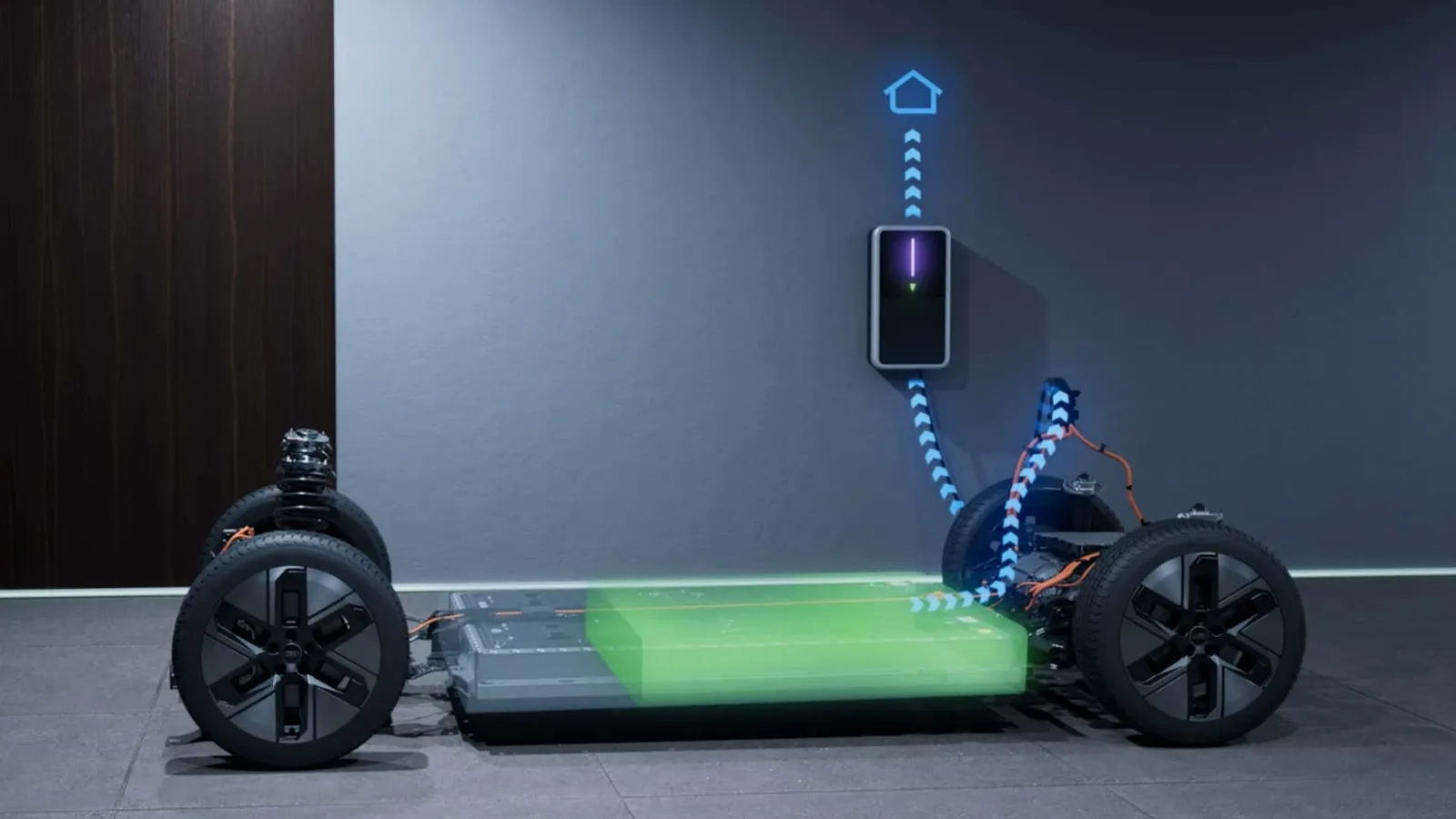
The fact that the Audi A2 e-tron supports two-way charging was already known since its introduction in September. Now the manufacturer is detailing the technical aspects, including the changes to the onboard charger and the two technologies: Vehicle-to-Load (V2L, powering external devices) and Vehicle-to-Home (V2H, using battery power in the home).
The Audi A2 e-tron comes equipped with either an LFP battery offering 50 or 58 kWh of capacity, depending on the version, or an NMC battery with 79 kWh. When developing the batteries, Audi focused not only on short-term performance peaks but also on a reproducible and efficient charging curve. To achieve this, the OCDC was upgraded to OCDC 2.0. OCDC refers to an onboard charger (OBC) with an integrated DC/DC converter. While the onboard charger converts alternating current from the power grid into direct current for the battery, the DC/DC converter transforms the battery’s 400 volts into 12 volts for lighting, control systems, infotainment, and the starter battery.
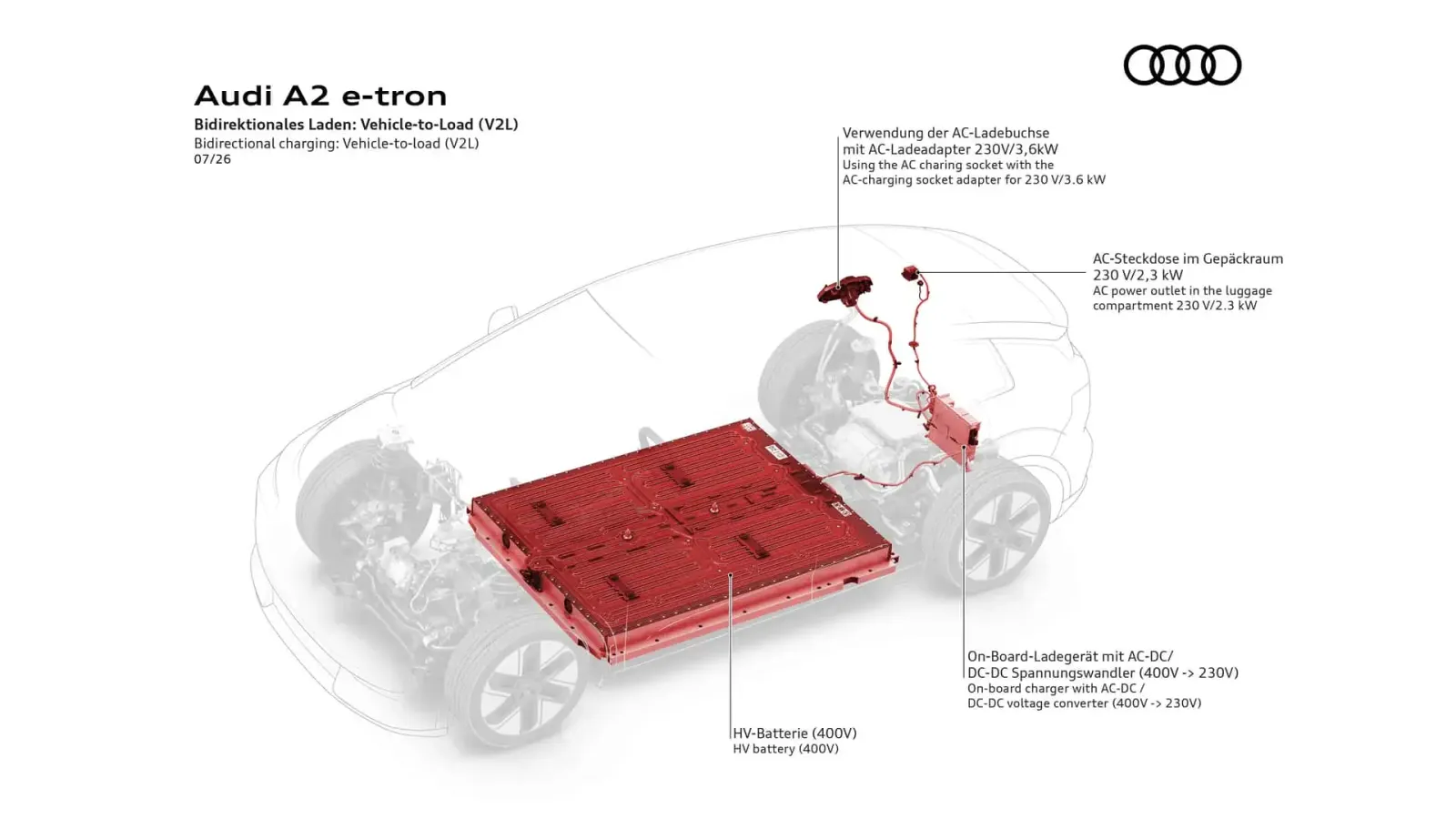
V2L: Direct current from the traction battery is converted to alternating current in OCDC 2.0
Image source: Audi
The most significant change in OCDC is that the onboard charger now supports bidirectional charging. With V2L, the direct current from the battery must be converted to alternating current for use with devices like toasters or electric bikes. This means the charger can function not only as a rectifier but also as an inverter. This requires more MOSFETs (metal-oxide-semiconductor field-effect transistors) and an adjusted AC output management system.
The power management system first checks whether the connected device can be powered and whether the connection is stable mechanically and electrically. It then ensures that clean alternating voltage with stable 230 volts and 50 hertz is generated—even when the load changes, such as when a connected refrigerator suddenly starts up. Additionally, it monitors and limits the maximum power output.
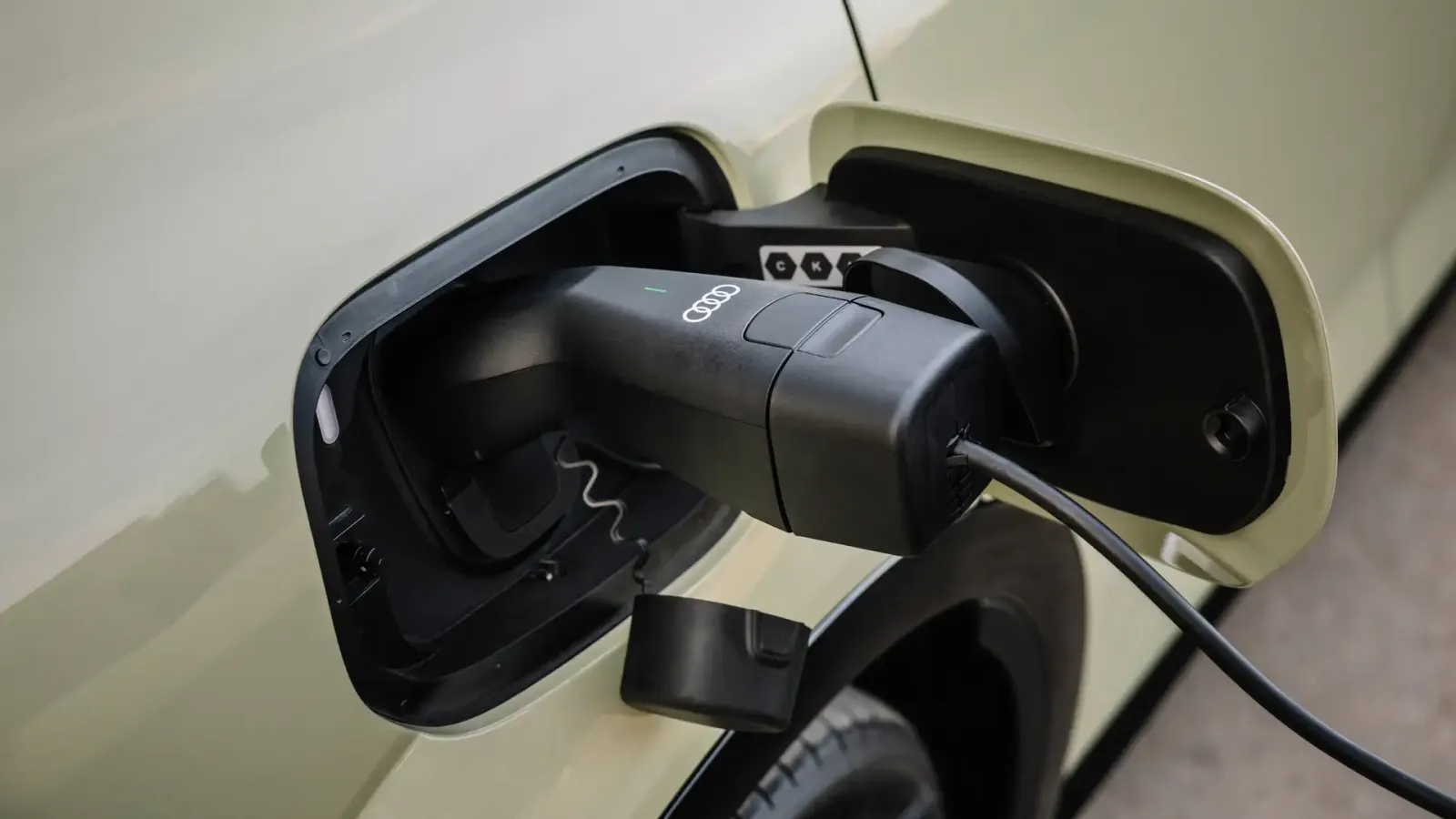
The V2L adapter on the A2 e-tron’s charging port
Image by: Audi
The Audi A2 e-tron offers 3.6 kW at the external connector (via adapter) and 2.3 kW through the optional socket in the trunk. The 3.6 kW corresponds to a standard household socket protected at 16 amperes (16 A × 230 V = 3,680 W), allowing most common 230-volt devices to be powered. When multiple devices are connected, the total power must not exceed 3.6 kW. The 2.3 kW in the trunk is sufficient for laptops or coolers, but it may be insufficient for hair dryers and space heaters.
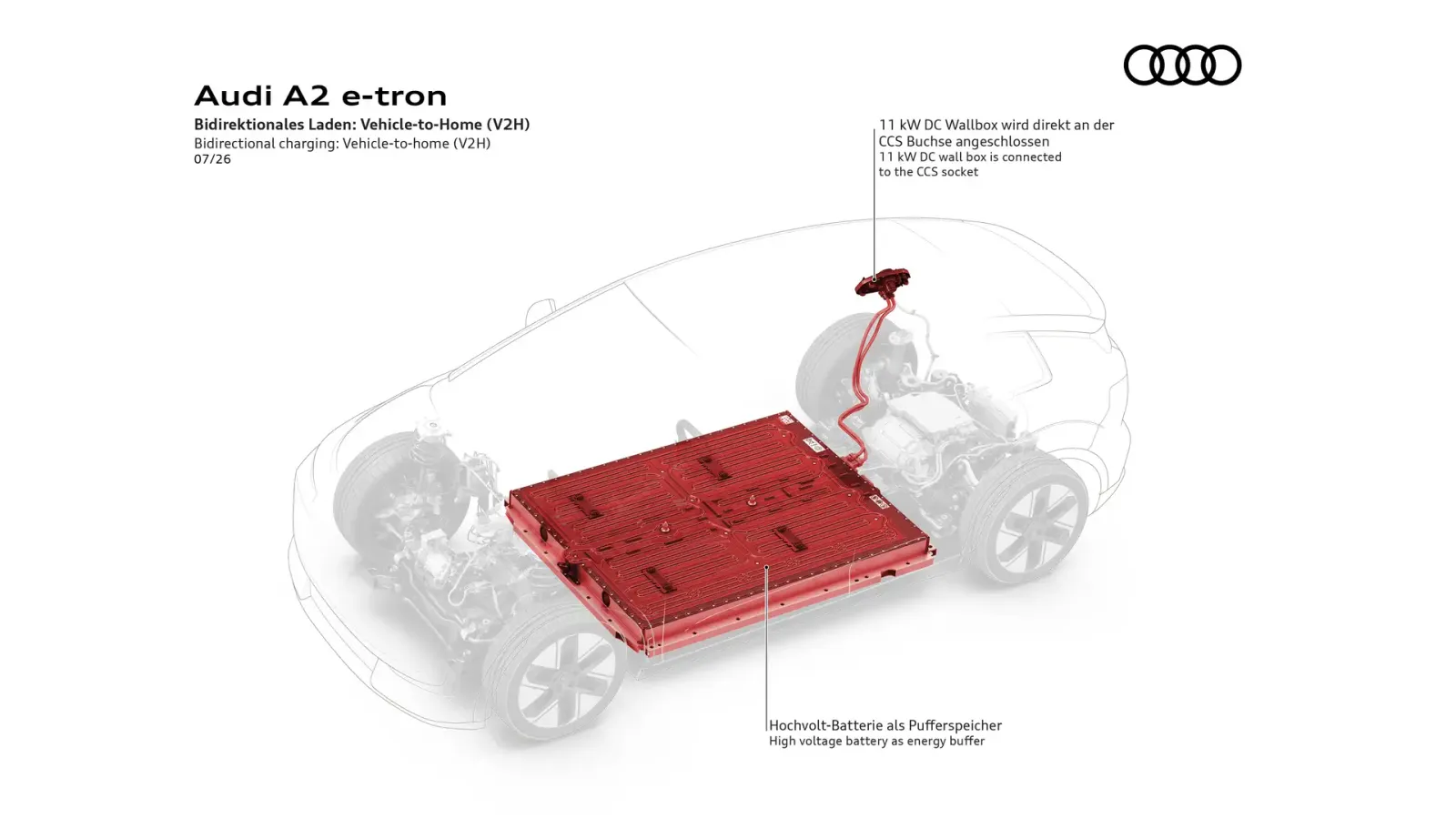
V2H: Direct current from the battery is used without conversion and then converted to alternating current externally
Image by: Audi
In V2H, there are systems where the direct current from the battery is converted into alternating current for the household grid using the built-in onboard charger, and those that use an external inverter. The A2 e-tron employs an external inverter in a bidirectional DC wallbox, known as a BiDi charger. The advantage is that it allows for higher power output than the 3.6 kW provided by the onboard charger.
Audi recommends a 11 kW bidirectional DC wall box from Moon Power on its website. This allows self-generated solar power to be used more efficiently to charge electric vehicles. The direct current from the PV system is sent directly to the car through the DC wall box without any conversion. However, bidirectional DC wall boxes are significantly more expensive. The manufacturer only reveals the price of Moon’s BiDi wall box upon request, but hardware costs are likely around 4,500 euros.
Energy exchange between the vehicle and the house is only possible when the battery level is between 20 and 80 percent. Below 20 percent, the vehicle is charged exclusively, while above 80 percent, it is discharged exclusively.
The battery management has also been improved, with the new LFP batteries particularly benefiting from this. LFP cells are known for having a flatter open-circuit voltage curve. This means the voltage of these cells does not decrease linearly with the charge level. This complicates the calculation of the charge level (State of Charge) as well as the degradation level (State of Health).
Audi now uses an adjusted algorithm for these calculations. The information obtained is used to determine range, charging behavior, and operating strategy. This means, among other things, that the displayed remaining range is more realistic.
More on the Audi A2 e-tron:
In summary
Audi is introducing two-way charging. The Q4 e-tron has supported it since summer, while the A2 e-tron will offer it from launch. A two-way onboard charger is used for this, capable of delivering up to 3.6 kW of AC power to external devices. Alternatively, the car can supply up to 11 kW of DC power to the household grid. However, to utilize V2H, a relatively expensive two-way DC wallbox is required. This V2H solution offers advantages especially when one has solar panels on the roof.