
6,000 km traveled with 2 hours and 46 minutes of charging time in a BMW i3 50 xDrive
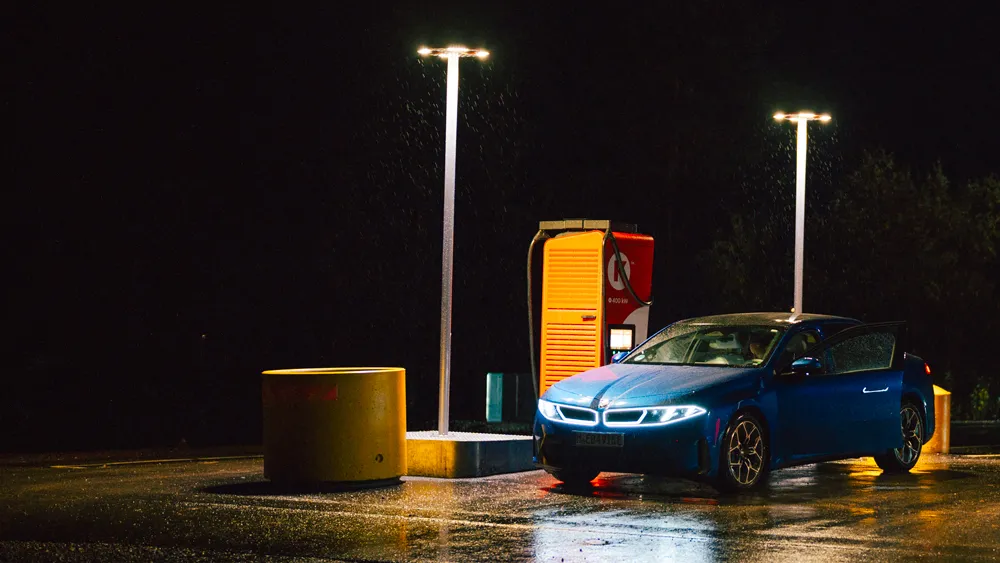
To demonstrate the fast charging speed of Neue Klasse electric vehicles operating at 800 V, BMW embarked on the Paneuropeana of Records route created by Rafael de Mestre.
800 V
Electric vehicles using 800 V systems feature a charging curve with much higher power levels, which reduces the time spent at charging stations. In France, models such as the Kia EV6 and Hyundai Ioniq 5 were among the first to adopt this technology. During long road trips over holidays, many electric vehicle owners observed that these models stayed connected to ultra-fast chargers for significantly shorter periods compared to other vehicles.
For its i3 50 xDrive equipped with a battery having a useful capacity of 108.7 kWh, BMW wanted to communicate in a different way. By tackling the Pan-European route between Cape North and Tarifa in Spain, the manufacturer was able to demonstrate the progress such an architecture brings.
In 2017, using a Tesla Model S, the team led by German entrepreneur Michael Willberg needed 9 hours and 51 minutes of charging to complete the journey. Nine years later, this time was reduced to exactly 2 hours, 45 minutes, and 54 seconds to cover the 5,886.7 km of the route designed by Rafael de Mestre.
The difference is simply enormous. Equipped with sixth-generation drive technology, the BMW i3 is capable of reaching 400 kW of power on compatible chargers that use the standard European CCS2 standard. On the test route, the average power output was 275 kW. Who will beat these figures by 2027?
Average speed of 79.7 km/h
Starting with a fully charged battery and in 1°C temperatures in Sweden, the all-wheel-drive BMW i3 was able to travel 744 km before needing to be recharged. While the official WLTP figures for this vehicle range from 13.4 to 16.2 kWh/100 km, the average consumption was only 12.5 kWh.
Since the goal was to set a record for the shortest possible charging time, BMW’s team took their time on the road, setting off at 10:00 a.m. on Saturday, September 26, 2026, and arriving seven days later, on Saturday, October 3, around 5:00 p.m. “The various stages and checkpoints were deliberately chosen so that road speed would not be a decisive factor,” BMW confirmed in a statement dated November 11, 2026.
The route through public roads included both rural paths and highways as well as urban areas. This resulted in an average speed of 79.7 km/h and a driving time of 3 days, 2 hours, and 41 minutes. The charging stops, though not pre-planned, were made at stations belonging to networks typically open to all electric vehicle users.
For reference, the two electric motors in the BMW i3 50 xDrive can deliver a combined power of 345 kW (469 hp) with a torque of 645 Nm.