
Ford Explorer Collection 4×4. A family electric vehicle that pleasantly surprised me
The Ford Explorer is the first electric SUV from this manufacturer that I’ve had the chance to drive. It’s a mid-size vehicle — neither overly large nor too small. I would say it’s just the right size for someone looking for a car for both daily city driving and longer trips.
Table of Contents
Show
Hide
The Explorer turned out to be a very pleasant car and a practical family SUV that can accommodate two children and luggage for longer trips. There shouldn’t be much trouble fitting everything needed inside. The car is comfortable, well-equipped, and has several really interesting features. However, not everything was designed perfectly.
Ford, but with clear influences from the VAG group
One of the first things that caught my attention was the similarity of many elements to Volkswagen Group vehicles. In fact, Ford employees confirmed with me that collaboration with VAG played a role in designing the Explorer.
This is evident even in the key. It’s practically identical to those in new Skodas and other Volkswagen Group cars. Similarities can also be found in the driver information display system, interior elements, and even the loading flap. The vehicle is based on the VAG Group platform, and common solutions are clearly visible in many areas.
This isn’t a criticism. On the contrary, some of these elements are well-known from other cars and work quite efficiently.
Thoughtful interior, but a few things need improvement
The interior is comfortable. In front of the driver, there is a small display showing the most important information, such as speed or light status. It can be divided into several sections to display things like energy consumption and navigation cues. However, the navigation information comes exclusively from the factory system. We won’t show Android Auto or Apple CarPlay prompts here.
Both systems are available wirelessly, which greatly simplifies daily use of the car.
Controlling the lights is done using buttons located on the left side of the steering wheel, under the ventilation grille. The left lever is also responsible for the turn signals and the front and rear wipers. On the right side, there is a selector for driving modes.
I have the most concerns about the buttons on the steering wheel. Some of them may respond to different levels of pressure. A good example is the cruise control. A gentle press on the plus button increases the set speed by 1 km/h, while a stronger press causes it to increase by 10 km/h. The problem is that the difference between these two levels of pressure is very hard to detect.
Throughout the week of testing, I made mistakes. Worse still, several functions are located on the same control panel, and sometimes instead of increasing the volume of the music, I reduced the cruise control speed. Other times, instead of turning on the steering wheel heating, I switched tracks. In my opinion, this design needs further refinement.
There is, however, one thing I really liked. Ford placed a button on the steering column to turn the car on and off. For an electric vehicle, I consider such a feature completely unnecessary. Fortunately, it doesn’t have to be used. We get in, press the brake, and the car is ready to go. We get out, lock the car, and can leave, with the car turning off automatically. This is exactly how it should work in every electric vehicle.
There was, though, one rather strange situation. During a week-long test, the entire system failed once. Everything turned off, and after restarting, the car greeted me in German. For several minutes, I couldn’t switch back to the Polish version. Eventually, the language switched back automatically, and everything started working normally. I don’t know exactly what happened, but it was a quite surprising incident.
Seats and Cabin Space
The driver’s seat is electrically adjustable, and we can save its settings for two occupants. There is also an adjustable lumbar support available. The passenger seat already has manual adjustment via a traditional lever.
In my Collection version, there are additional color accents on the upholstery. The red stitching and strips look great, giving the interior a slightly more sporty vibe. My children really liked this setup and immediately noticed the appearance of the seats.
There’s plenty of space in the center for small items. We have quite spacious holders for drinks, a small compartment with an inductive charger, and an additional shelf for a second phone. The idea itself is very good, though the construction surprised me a bit. The phone charges on the passenger side, while the driver’s side has a spot for a second phone that doesn’t offer charging.
An interesting feature is also the sliding central screen. We can adjust its position and tilt angle, and there’s an extra hidden shelf behind the display. This allows us to customize the screen to our preferences and gain a bit more space for storing small items.
The armrest provides another storage area. It can be further divided using partitions. Here, we see inspiration from Simply Clever solutions known from Skoda. They may not be groundbreaking ideas, but they can be useful in everyday use.
The Bang & Olufsen audio system, if I remember the markings on the speakers correctly, also impressed me greatly. Both music and audiobooks sound pleasant. I didn’t experience any discomfort during longer drives.
Backseat Space and Child Transport
The rear seat comes with standard ISOFIX anchors. A big plus is the way they’re designed, as they’re protected by covers that can be opened if needed. There’s no need to push anything between the backrest and seat or struggle to find the anchors. The car seats install quickly and easily.
The Explorer is a good choice as a 2+2 family car. With two child seats, however, the space in the middle of the sofa is quite limited. Only someone very slim might fit there, but comfortable travel in this arrangement is unlikely.
A useful feature is the opening in the middle of the rear seat backrest. This allows us to transport longer items, such as skis, without having to fold down the entire seat.
Trunk and practical solutions
The trunk is quite spacious and well-designed. It has two levels. We can leave it in the higher position, creating an additional compartment underneath for cables and other items that are useful in the car but don’t need to be within easy reach at all times. When the floor is removed, we gain about 20 cm of extra depth.
We will also find a 230 V outlet in the trunk. The Ford Explorer features Vehicle to Load, which allows powering external devices using energy stored in the car’s battery. An appropriate adapter is included in the set and connects to the charging outlet. This enables us to power devices outside the car, for example using an extension cord.
We also have a 12 V outlet and small hooks for groceries. Everything is simple and functional. There are no excessive numbers of additional mechanisms that could potentially break down over time.
There is no traditional glove compartment in the front. Instead, Ford has used a cover over the drivetrain components, which can serve as an extra space for smaller items, such as wires.
I do have serious concerns about its design. To add fluid to the sprayers, one must first remove this cover. I don’t know who thought this was a good idea, but it could definitely have been designed better. Refilling the fluid shouldn’t require removing additional components.
Appearance and Supporting Systems
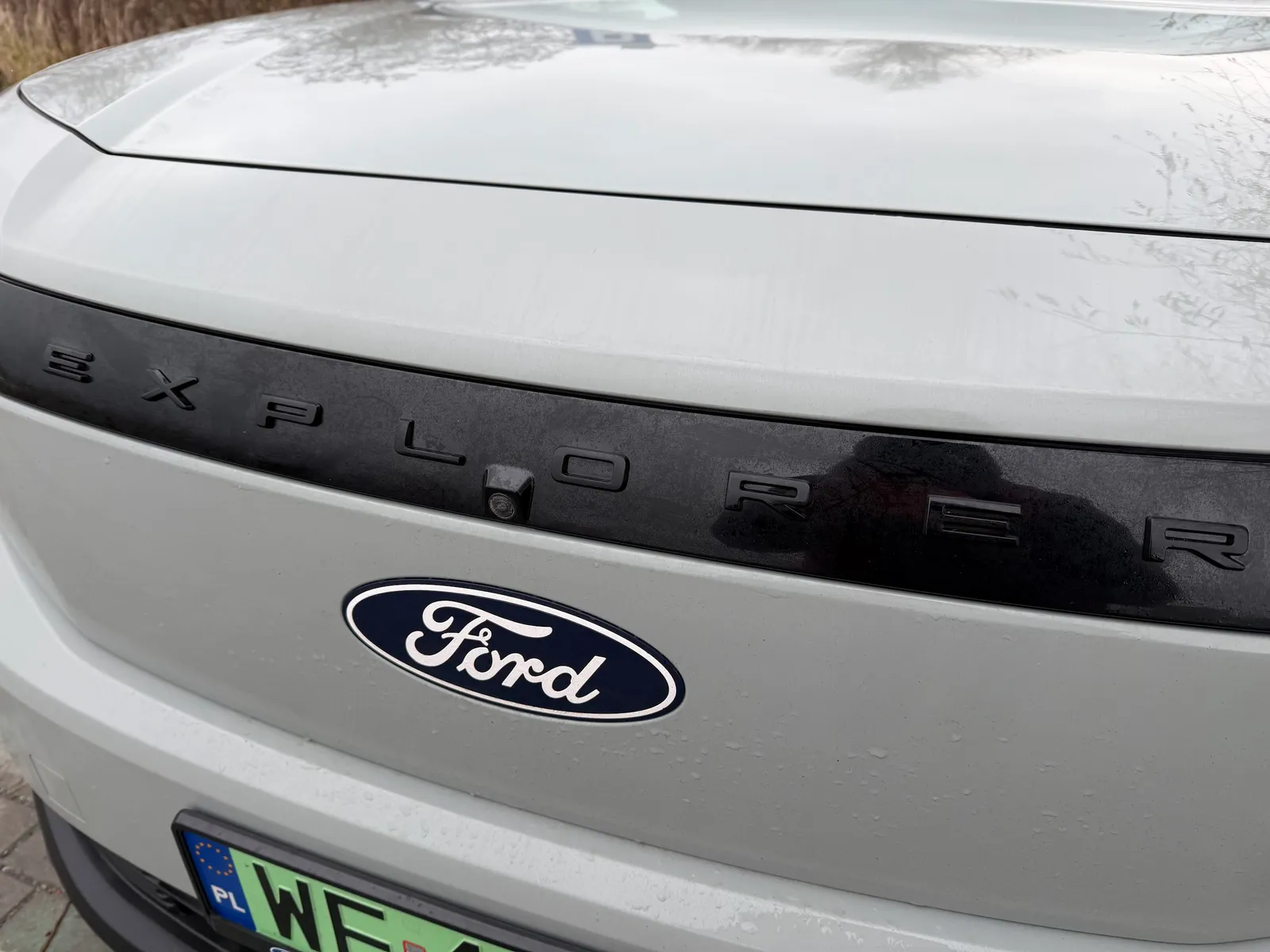
I really like the shape of the Explorer. The car has a somewhat American style. It’s quite angular, with well-defined headlights and the distinctive “Explorer” logo placed at the front, right above the Ford logo. The overall design looks cohesive, and the car appears larger than its dimensions would suggest.
The back is also well-designed. The trunk lid has a simple shape, and the lights fit nicely into the car’s overall silhouette.
When it comes to assistance systems, the equipment is really decent. We have cameras in the front, back, and sides, along with a 360-degree view. My test unit also came equipped with an automatic parking assistant, which is available as an additional feature package. This allows the car to assist not only with maneuvering but also with parking itself. The combination of cameras and assistance systems makes one feel more confident even in tight spaces.
Energy Consumption and Charging
I tested the version with all-wheel drive and a battery with a capacity of 77 kWh. The rear-wheel drive version comes with a battery having a capacity of 79 kWh.
The energy consumption while driving on the highway was around 25-26 kWh/100 km. However, it should be noted that the test was conducted during the autumn-winter period, with speeds on the road reaching 120, 130, and sometimes even 140 km/h. In urban areas, the consumption was lower, at about 21-22 kWh/100 km.
These aren’t results that particularly surprised me. We’re dealing with a fairly large SUV with 4×4 drive and high-speed driving. Under such conditions, it’s hard to expect low energy consumption.
The maximum DC charging power is 185 kW. I wasn’t able to achieve this value during the test because I didn’t come across a charger with sufficiently high power along the way. However, I managed to get around 150 kW without much trouble. This is a very decent result, and I have no major complaints about it.
A major advantage is also the ability to independently initiate battery conditioning, that is, heating it before fast DC charging. We don’t have to rely solely on the car’s automatic battery preparation. We can decide ourselves when we want to prepare it for charging. This is a particularly useful feature in autumn and winter, when the battery temperature has a significant impact on the charging power achieved.
Ford Explorer Collection 4×4. Technical specifications
Length: 4468 mm
Width: 2063 mm
Height: 1641 mm
Weight: 2204 kg
Battery capacity: 77 kWh
Drive type: four-wheel drive (4×4)
Maximum DC charging power: 185 kW
Top speed: 180 km/h
Winch: yes, on the tested unit
Vehicle to Load: yes
The heat pump and head-up display are not part of the standard equipment in the Collection version. The automatic parking assistant is available in an additional package. The test unit was equipped with it.
Is it worth buying a Ford Explorer?
I must admit that the Ford Explorer surprised me positively. Before the test, I wondered why Ford promotes its special programs so heavily, including the Ambassador program, which offers very attractive rental terms. I assumed the car might have some shortcomings that the manufacturer is trying to compensate for in this way.
After a week of driving, I didn’t find anything that undermined this car. Of course, there are areas for improvement. The steering feel can be unintuitive, access to the windshield washer fluid is unnecessarily complicated, and several interior elements could be designed better. However, this doesn’t change the overall impression.
Driving this car was truly enjoyable. It’s comfortable, spacious, well-equipped, and practical enough for a family with two children. It also has a decent charging power, the ability to manage the battery independently, a V2L function, and several features that I appreciated during daily use.
The listed price for the tested version with equipment is 244,150 PLN. That’s a significant amount, but one should keep in mind the available discounts and financing options. In my case, the Ambassador program seems particularly interesting, as it offers very favorable leasing terms.
Could I have a Ford Explorer as my next car? Definitely. I didn’t expect to have such positive feelings after this test. If you’re looking for a family-friendly electric SUV that performs well both in the city and on longer trips, it’s definitely worth considering this model.