
Worldwide, one in six new Mercedes cars are fully electric.
The Mercedes-Benz Group sold 78,100 electric vehicles in the third quarter. This represented 16 percent of all cars and vans sold by Mercedes worldwide — an increase of nearly six percentage points from the previous year. However, China remains an extremely challenging market for the Stuttgart-based company.
Image: Mercedes-Benz
The Mercedes-Benz Group recorded 78,100 BEVs sold between July and September. This represents a 24 percent increase from the second quarter and a 52 percent rise compared to the same period last year. Of all BEVs, 68,400 units (+61% YoY) were in the passenger car segment, while 9,700 units (+12%) were in the van segment. Across all powertrains, the group sold 491,700 cars and vans in the quarter under review, a 6% decrease year over year. The significance of electric models is evident in the E-Quote: it rose from 9.6 percent in Q2/2025 to 16.8 percent in the passenger car segment. In other words, one in six new Mercedes cars had an electric drive system over the past three months. Including plug-in hybrids, 25 percent of global Mercedes-Benz Cars sales in the third quarter came from electrified vehicles, which Mercedes itself refers to as “xEV”.
Let’s take a closer look at Mercedes-Benz Cars’ financial results: The automaker’s passenger vehicle division sold 407,200 cars worldwide in the third quarter, which is 8% lower than the same period last year — consistent with the results from Q2 this year. The weak performance in China continues to be a factor: With only 86,800 sales in Q3, sales there dropped by 31%. This is also a trend that has been observed for some time.
In other markets, things are going better for Mercedes: “Outside of China, sales of passenger cars and vans increased by 2% compared to the previous year’s quarter.” Europe (+5%) and North America (+4%) were key drivers of this growth — Germany also performed very well, with sales up by +13%.
Europe Remains the Core Market for BEVs
Looking at battery electric vehicle sales, Mercedes-Benz Cars delivered 68,400 such vehicles globally between July and September, representing a 61 percent increase compared to the same period last year. Europe remains the core market, with growth of 78 percent year-on-year and 24 percent compared to Q2. According to the manufacturer, “almost one in three Mercedes cars here are fully electric.”
| | Q3 2025 | Delta (in %) | Q1-Q3 2025 | Delta (in %) |
| --- | --- | --- | --- | --- |
| Mercedes-Benz Group | 491,700 | -6 | 1,503,200 | -6 |
| – of which BEVs | 78,100 | +52 | 191,400 | +38 |
| Mercedes-Benz Cars | 407,200 | -8 | 1,244,400 | -7 |
| – of which BEVs | 68,400 | +61 | 165,500 | +40 |
| Mercedes-Benz Vans | 84,400 | +1 | 258,800 | -1 |
| – of which eVans | 9,700 | +12 | 25,800 | +28 |
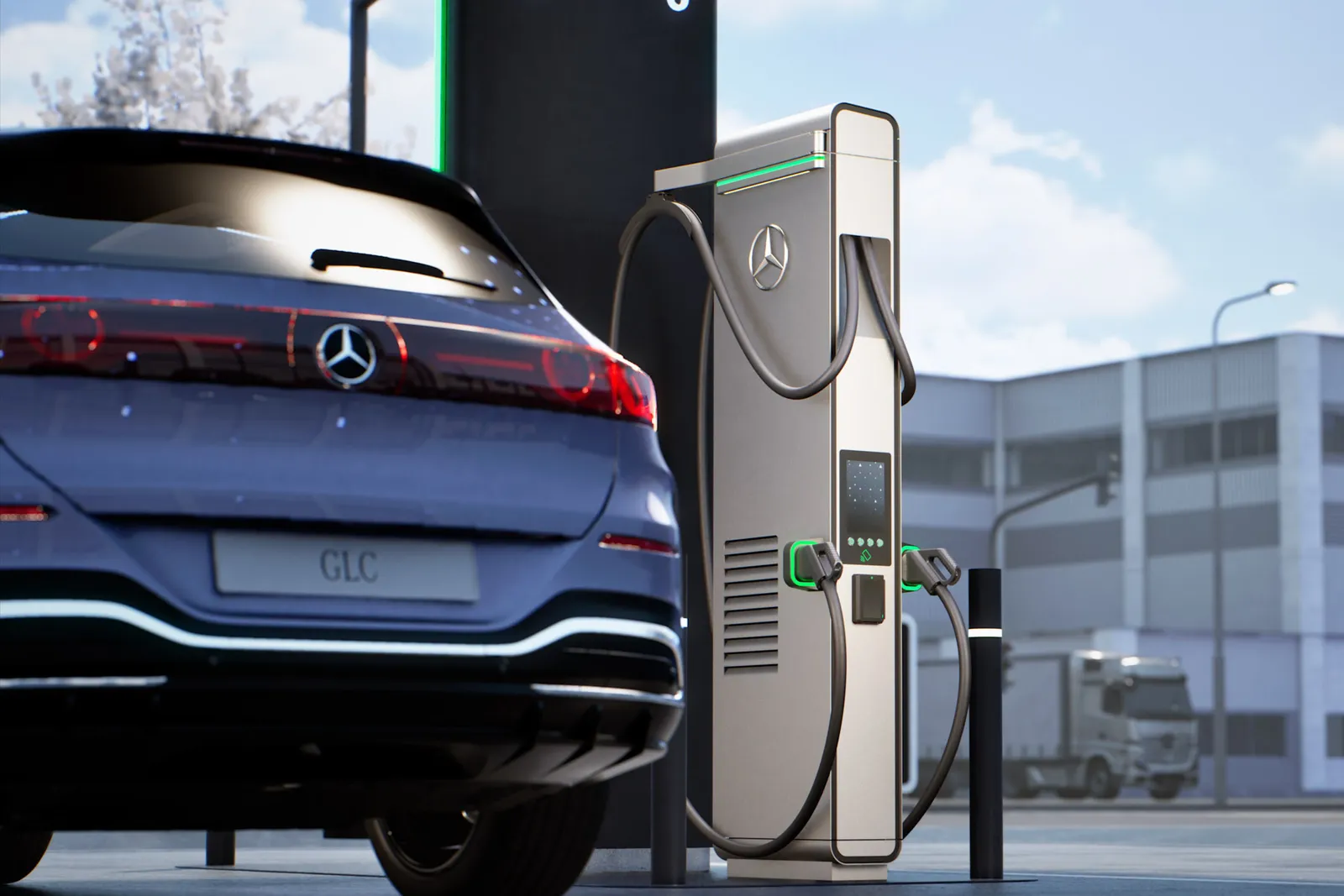
According to Mercedes, key contributors to this strong performance were the electric CLA, electric GLC, and electric GLB: Sales of the GLC are said to have more than tripled compared to the second quarter. Mercedes reports that sales of electric CLA models increased by 24% versus the second quarter, driven by the introduction of these models in additional markets including the U.S. and Japan. The new electric GLB also had a successful launch, building on the success of its predecessor. Additionally, “the battery-electric versions of GLC, CLA, GLB, and GLA are sold out in Europe for the rest of the year. Order books are filled well into 2027. To meet the high demand, factories in Bremen, Rastatt, and Kecskemét are operating on three shifts,” emphasizes Mercedes.
For the regions of Asia (including China), North America, and other markets grouped by Mercedes under “Rest of the World,” the manufacturer does not provide specific BEV sales figures but only cites the overall sales trend across all powertrains as outlined earlier. However, Mercedes emphasizes that with the introduction of new electric models, its ambition to “significantly increase electric vehicle sales by 2026” will be advanced. The new electric C-Class, known as a potential volume driver, has been available for ordering in Europe since May and is expected to improve sales statistics soon with substantial deliveries.
25% of all new Mercedes cars come with a charging port
Mercedes-Benz Cars does not release separate information regarding the sales of its plug-in hybrids (PHEVs). However, calculations show that approximately eight percent of all global sales were part-time electric vehicles. Combined with the known proportion of BEVs, this results in the aforementioned 25 percent of plug-in vehicles (xEVs).
The manufacturer dedicates a longer paragraph to the topic of China in its sales report. “In China, Mercedes-Benz car sales declined by 31% amid a continued challenging automotive market environment and fierce competition. The GLC and E-Class together accounted for almost two-thirds of Mercedes-Benz car sales in China and performed more robustly than the overall market.” It also states, “The newly introduced electric GLC L, launched in July, is gaining traction well and receiving positive feedback from customers in China. In mid-September, Mercedes-Benz also introduced the newly locally produced GLE L SUV.” Additionally, AI-powered cockpits and advanced driver assistance systems are set to be rolled out across nearly the entire product lineup in the coming months.
Mathias Geisen, member of the board of management at Mercedes-Benz Group AG for Sales & Customer Affairs, commented: “Mercedes‑Benz Cars achieved the highest quarterly sales volume of fully electric vehicles in the company’s history, led by the electric GLC, whose sales more than tripled compared to the second quarter. Outside of China, passenger car sales rose for the third consecutive quarter in 2026 compared to the previous year. Our new electric models GLC, CLA, GLB, and GLA are sold out in Europe for the rest of the year; order books extend through 2027.”
This shows: Our model offensive is in full swing.
New vans are 11 percent electric
Let’s take a final look at Mercedes-Benz Vans’ Q3 sales: The division recorded 84,400 units sold in the previous quarter, including 9,700 BEVs. While total sales remained almost unchanged compared to the previous year (+1%), the 9,700 BEVs represented a 12% increase from Q2 2025 and a -4% decrease from Q2 2026. The global electric vehicle share rose accordingly to 11.5% (Q3 2025: 10%). In Europe, the electric vehicle ratio was even higher at 15% (Q3/2025: 14%).
