
Landmark ruling: EWE Go must charge DCS only the prices for contract customers
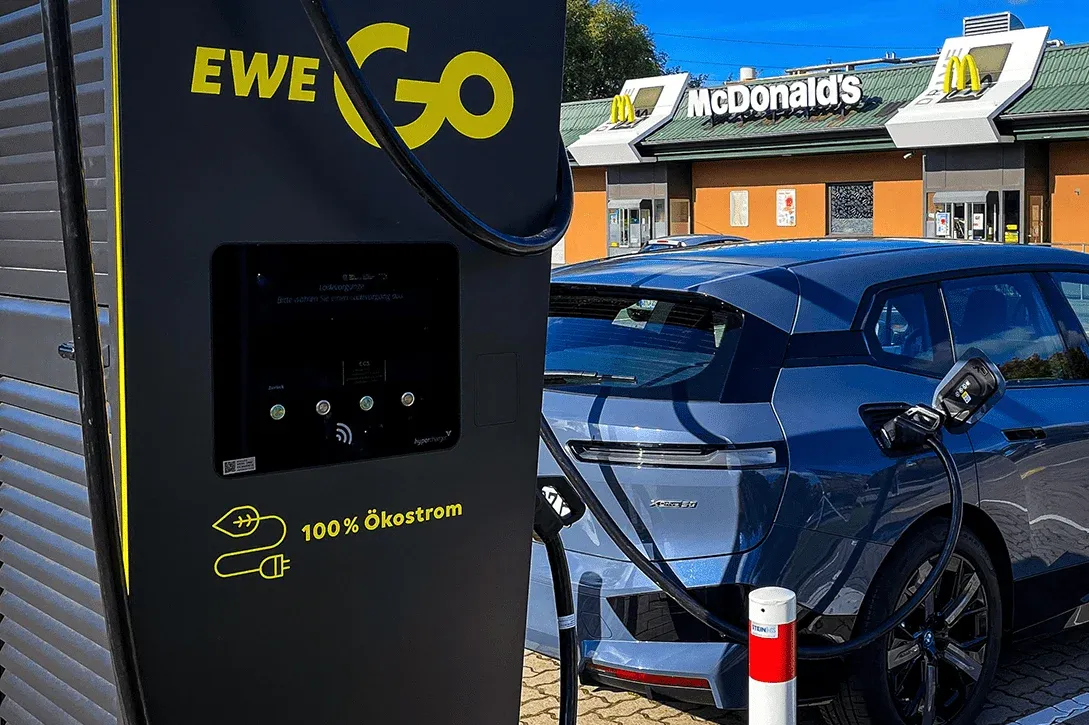
The Landgericht München I ruled that charging station operator EWE Go must not charge roaming provider DCS higher prices than it charges its own end customers. This judgment explicitly defines for the first time the prohibition on discrimination under the EU’s AFIR Regulation — and is likely to have a significant impact on the industry.
Image: Daniel Bönnighausen
What prices may CPOs charge from providers of charging cards and apps for using their charging stations? And what regulatory rules apply to pricing? Digital Charging Solutions (DCS), the company behind charging solutions for brands such as BMW and Mercedes-Benz, has been in dispute over this with EWE Go, a charging station operator, for some time. As early as February, there was a hearing at the Landgericht München I that the industry watched with great interest, focusing primarily on the B2B prices for roaming providers like DCS and their compliance with AFIR, the EU regulation regarding the development of infrastructure for alternative fuels along with charging stations.
On October 6, 2026, the judgment was delivered. It is likely to be a turning point for the charging industry – and could drive roaming prices down significantly. The Regional Court of Munich I, in its decision (case number: 33 O 2062/25), which is not yet final, put an end to a practice that has for years caused dissatisfaction not only among industry experts but also among electric vehicle owners: the arbitrary pricing of charging services. At charging stations, there are usually one or more contract customer rates set by the station operator (e.g., with or without a subscription model), ad-hoc prices, as well as various roaming rates from different charging card providers.
In the Munich proceedings, the focus was indirectly on roaming prices, or more precisely, on their underlying factor: mobility service providers (MSPs) such as Digital Charging Solutions must pay special wholesale prices to the CPOs. Based on these prices, they in turn set roaming rates for their customers.
“Discriminatory pricing” by EWE Go
Digital Charging Solutions filed a lawsuit in the Munich court specifically over what it claimed was “discriminatory pricing” by the charging station operator EWE Go. In doing so, DCS cited Article 5, Paragraph 3 of the AFIR, which states: “Operators of publicly accessible charging points must not discriminate among end-users and mobility service providers or among different mobility service providers through the prices they charge. However, a differentiation in price levels is allowed, but only if such differentiation is proportional and objectively justified.”
The lawsuit concerned an “Offer2All price,”即 the bulk or B2B rate of 0.837 euros/kWh, which EWE Go demanded from mobility providers like DCS on January 1, 2025. However, at the same charging station, EWE Go charged ad-hoc payers only 0.79 euros/kWh and even its own contracted customers (i.e., registered users in the EWE Go app) only 0.52 euros/kWh for the same electricity (all prices are gross).
DCS also sued over a blocking fee of 0.10 euros per minute (net), which was applicable only to MSPs on the specified date but not to ad-hoc payers or EWE Go app customers.
EWE Go allegedly should have charged DCS only 0.52 euros/kWh
The ruling is significant: The LG Munich I court ordered EWE Go to stop charging the mobility service provider DCS these higher prices. The court explicitly included in this prohibition the price difference compared to EWE Go’s direct private customers, who pay only 0.52 euros/kWh. In other words, EWE Go is essentially allowed to charge DCS only 0.52 euros/kWh, not the much higher Offer2All price of 0.837 euros/kWh. Previous interpretations by the AFIR generally only prohibited discrimination between the often significantly higher ad-hoc price and the B2B price.
"The price differences when charging at the same charger are sometimes drastic and incomprehensible to consumers," says Jörg Reimann, Chief Executive Officer of Digital Charging Solutions. "Those who pay significantly more at a charging station than the operator charges its own customers cannot offer a competitive service there. Therefore, effective application and enforcement of AFIR’s ban on discrimination is essential for healthy competition in the charging market."
Roaming prices could drop significantly
This means DCS assumes that roaming providers could offer better prices to their customers in the future, should the judgment become final and set a precedent for interpreting AFIR. As a result, price levels might approach those of roaming providers much closer to the original prices charged by charging station operators — and the usual surcharge for ad-hoc payments could also be called into question.
Timo Knapheide, General Counsel at Digital Charging Solutions, says: “The judgment answers a question that was open to the entire market: whether
the AFIR’s ban on discrimination also applies when an operator simultaneously offers its own charging rates. To our knowledge, there has been no judicial resolution on this issue across the EU to date.”
The rationale for the price surcharge is not plausible
As mentioned, a difference in price levels must be objectively justified according to AFIR. However, the court deemed EWE Go’s substantial increase of 0.317 euros/kWh, or about 60 percent, between EWE Go’s end customers and roaming providers like DCS, to be unreasonably justified: the defendant’s attempts to explain the price gap through higher administrative costs, customer service expenses, business risks, or contractual customer retention models failed.
In an initial response to electrive, EWE Go said about the verdict: “At this time, we need to evaluate and examine the reasons for the judgment and decide based on that how to proceed. This will take some time. Since it is still an ongoing process and the judgment has not yet become final, we cannot comment on further aspects of the case at present.”
The court not only ruled in this case that EWE Go’s practices do not comply with AFIR but also ordered EWE Go to pay damages to DCS for all losses incurred since the implementation of AFIR on April 13, 2024. The amount is likely to be several million euros, though the precise figure has not yet been determined. However, like the entire verdict, the issue of damages is also not final yet.
_Sources: via email, personal research_
