
Why BMW is bringing a hydrogen X5 to market in 2028
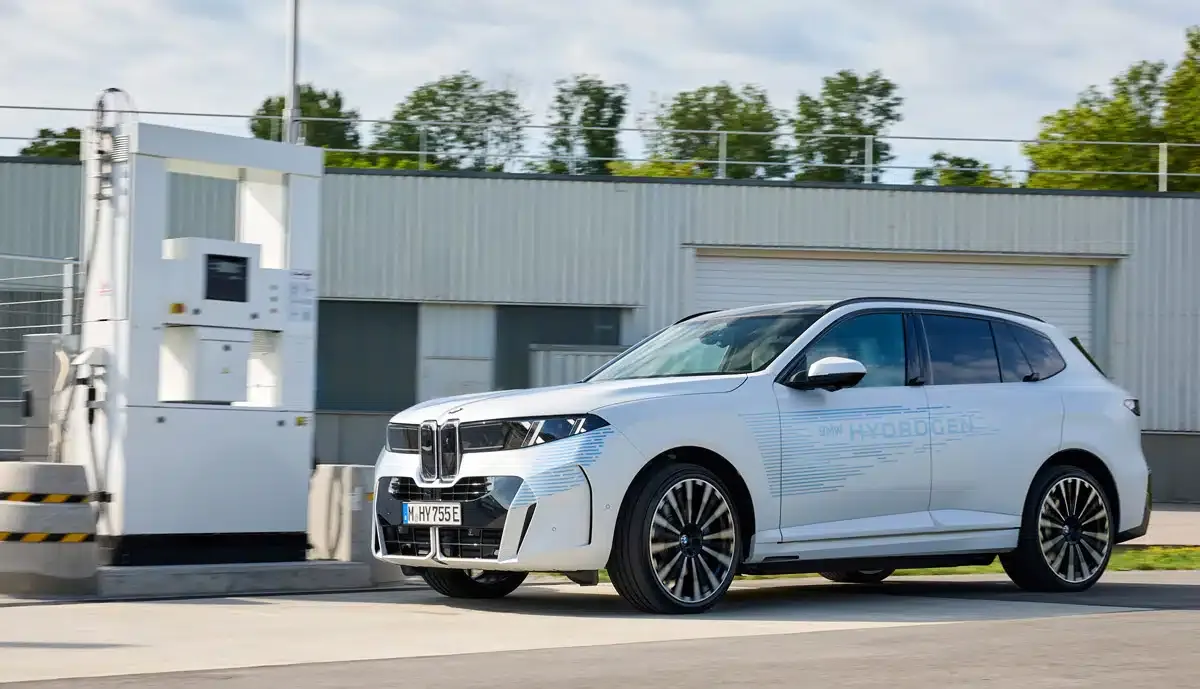

Image: BMW
BMW is advancing the development of hydrogen fuel cell electric vehicles and plans to bring the iX5 Hydrogen into production. Project leader Josef Hochreiter described fuel cell technology in an interview with Automobilwoche as a complement to purely battery electric drives, not a replacement for them. BMW utilizes existing electric vehicle platforms and adopts as many components from its electric car lineup as possible. This approach aims to reduce development and investment costs while avoiding the need for additional vehicle architectures.
According to Hochreiter, the third generation of the fuel cell system has been designed to be about a quarter more compact. This creates space for an electric all-wheel drive system, while the hydrogen storage unit is located where the high-voltage battery would be in an electric car. Using identical components and assemblies aims to bring advantages in development, procurement, risk management, and production.
Hochreiter’s principle is “one model, multiple drive types.” As a result, the X5 will be offered in the future as a conventional internal combustion engine vehicle, plug-in hybrid, pure electric car, and hydrogen fuel cell electric vehicle. For the latter category, the Bavarians are collaborating with Japanese hydrogen pioneer Toyota.
BMW sees opportunities for hydrogen where high range, fast refueling, and a lack of charging infrastructure converge. Hydrogen can also store and transport renewable energy, helping to reduce dependence on specific infrastructures, raw materials, and supply chains, says Hochreiter. For fuel cell technology, he mentions aluminum, steel, and relatively small amounts of platinum as necessary materials. BMW views battery electric vehicles and fuel cells as technologies suited for different applications.
Infrastructure remains the challenge
Regarding the available hydrogen, the manager admits that not all hydrogen at fueling stations is green today. With further expansion of renewable energy, he says, there will be more periods of excess electricity that can be used to convert it into hydrogen. To develop the value chain, he believes dialogue among energy and power suppliers, the automotive industry, suppliers, and policymakers is necessary. Policymakers should create reliable frameworks for investing in production, transportation, and fueling station infrastructure.
Technically, a fuel cell system, a high-voltage battery as a buffer storage unit, and hydrogen flat storage must be integrated into the vehicle. Seven individual hydrogen tanks are to be placed under the vehicle floor so as not to compromise interior space, comfort, or functionality. The design aims to balance range, regenerative braking performance, and driving dynamics. Hochreiter reports from his own tests with the vehicles that they offer silent operation, smooth acceleration without steps, sufficient system power, and excellent driving dynamics.
Hochreiter cites the high demand, scalability potential, and available space as reasons for choosing the X5 as the base vehicle. Before the planned launch of the hydrogen version in 2028, BMW must prove its reliability over its lifetime and under various weather conditions through ongoing and long-term testing. At the same time, processes related to production speed, quality, and costs need to be secured both among suppliers and within its own manufacturing operations. According to Hochreiter, BMW considers this concept to be industrializable.
The manager has not yet provided specific details on the vehicle’s price. The goal is to reach a level that is attractive to private customers once sufficient scale is achieved. Increased production volumes are intended to reduce manufacturing costs. Regarding the network of gas stations, Hochreiter mentions a new generation of stations designed to serve both trucks and cars, with the aim of handling higher transaction volumes. He considers success to be the vehicle’s mass production, visible improvements in infrastructure, and customers viewing the vehicle as an additional, emission-free option for their daily use.
Also interesting
About the author
Thomas Langenbucher is an expert in electromobility with professional experience in the automotive industry and finance sector. Since 2011, he has been covering electric vehicles, sustainable technologies, and mobility solutions for ecomento.de. Learn more.
Reader interactions